







The comedian John Robins has always loved talking about booze. In his standup, he used to portray himself as a bon viveur who knew how to give himself the best of times; a larky drinker out for a laugh; a nerdy tippler who recorded nights out in Sherlock Holmes-themed notepads – arrival time, drinks consumed, percentages of alcohol, pub atmosphere. He also had a routine about contracting gout, even though he never has done in real life.
On the radio, he hosted a show with his friend Elis James in which they meticulously detailed pub crawls and coined the phrase “Keep it session”, encouraging listeners to stick to low-alcohol beer when out for the whole evening. If anybody was in doubt about his love of booze, Robins then devised a podcast series called The Moon Under Water, named after George Orwell’s 1946 essay describing the perfect pub. In it, Robins and his co-host Robin Allender invited guests to design their dream watering hole. Yet, despite dedicating so much time to the discussion of booze, Robins could never find the right word to describe his relationship with it. Then in 2023 he finally discovered it: alcoholic.
He revealed this in another podcast series he co-presented with James called How Do You Cope?, in which they invited guests to talk about how they had got through life’s toughest trials. Not only did it emerge that Robins had been diagnosed as an alcoholic, it also transpired that the Oxford-educated, Edinburgh comedy award-winning, Taskmaster-triumphing success story had never been able to cope.
After touring with Howl, a standup show about his addiction, he has now written a book about it. The title could not be more blunt – Thirst. The publisher initially wanted to go with the subtitle alone; Twelve Drinks That Changed My Life is sexier, jollier and more marketable. But Thirst is infinitely more powerful. And it is Thirst that gets to the heart of Robins’s relationship with alcohol. Throughout his life, it’s been a craving.
The book’s cover is as blunt as the title. It features a gorgeous blond curly-haired little boy, both hands clenching a can of lager, the contents of which he appears to be pouring down his throat. And this, in one shocking image, is the story of Robins’s life.
We meet at his home in Buckinghamshire, which is surrounded by football and cricket pitches, and little else. There are no roaring cars, no hum of activity, not so much as hushed conversation. Just blissful silence and birdsong. Though he has lived here for 10 years, you sense the peace is an important part of his rehabilitation.
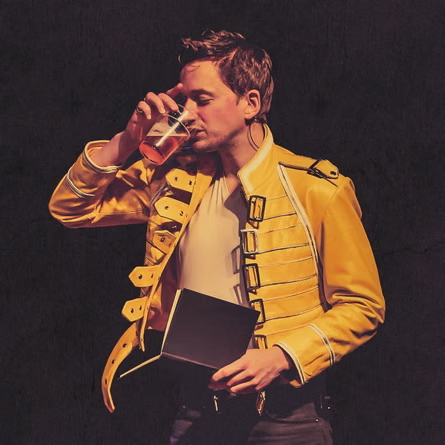
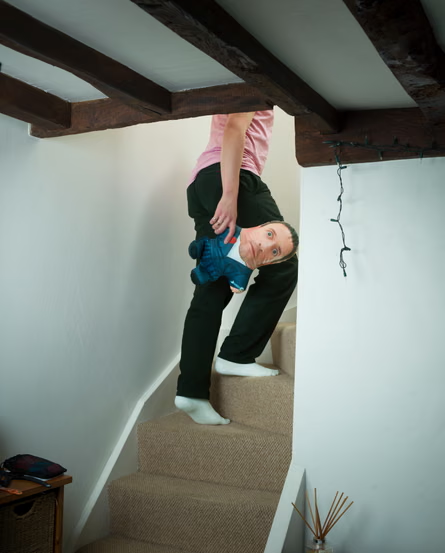
His tiny cottage is crammed with stuff – tributes to his hero Freddie Mercury, awards, golf clubs, poetry books and unlikely knick-knacks. Perhaps the most unlikely is a doll of himself, a keepsake from his stint on Taskmaster in 2024. It’s all magnificently ordered. He’s wearing a Bonnie ‘Prince’ Billy T-shirt (another hero) and a Dark Star Brewing cap. I say I’m surprised at the cap – lots of recovering alcoholics would throw reminders of booze in the bin. He smiles. “I know. This is a slight problem.”
Then he stops, and changes his mind. “No, the cap isn’t the issue. I have to exist in a world with alcohol in it, and I can make that really difficult or I can make that as easy as it’s ever going to be. I could move to a dry county in America if I wanted to. But it would be an enormous arse ache and it would ruin my life. I could go through the house and remove every reference to booze and every photo of me drinking, but I don’t know that would help. So whether I wear the cap is neither here nor there. I can obsess about alcohol not wearing the cap.” He laughs. “And besides, it’s the only cap I’ve got that actually fits my head.”
Like many standups, Robins is a little manic on stage. Stories are told in an exaggerated manner, his voice rises in pitch and the delivery becomes turbo-charged, high-anxiety bordering on the hysterical (in both senses). In person, he couldn’t be more different – calm, gentle, a good listener. He speaks quietly, precisely, every thought measured out by the teaspoon. Even now, he is still working out exactly what his relationship to alcohol was – why he needed it, what it did for him, how it almost destroyed him. For most of his life, he assumed he got more out of alcohol than alcohol took from him. Now he knows it was always the other way round.
Robins first came across booze when he was five or six at a family celebration when the grownups were drinking champagne. He noticed it made them relaxed, begged for a sip, then pretended he was drunk. His next encounter, now aged seven, was more significant. At the time it seemed so innocent. Now he looks back and says even then he showed all the signs of an alcoholic. The adults were drinking a bottle of Jacob’s Creek, which was kept in the kitchen. He pretended he was going to the loo, sneaked off there, poured himself some wine disguised in orange juice. Sure enough he was caught by his mother, and the adults made a joke of it.
“Some people would go, ‘He’s seven! He’s not an alcoholic, he’s seven!’ But I know that same obsession he had, which he wasn’t aware of, is the same obsession I have now.” Wasn’t it more that the young Robins knew it was forbidden than that it was alcohol? He shakes his head. “No. It was always different to everything else. I didn’t feel like that about food or even sweets, and I’ve never really been tempted by drugs. There’s something about alcohol.” From then on, he says, he was fixated.
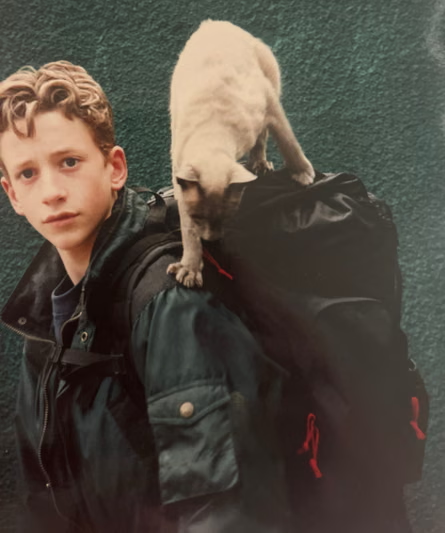
By the age of 12, he’d convinced his mother to buy him a can of Woodpecker cider every Friday night to go with his fish and chips. At 13, he went to Scout camp and all he could think of was how to cajole the leaders into giving him a small bottle of beer. At 14, he performed in the school play and got drunk at the after-show party on four cans of Strongbow cider, four bottles of beer and a bottle of Archers Peach Schnapps, the equivalent of 14 pints. He then sprayed aftershave into his mouth for good measure. When he woke up the next day at the parental home of his first girlfriend, he was told he had puked in his sleep and had to be put into the recovery position to stop him choking on his vomit. And on it went.
Apart from the drink, he was a model schoolboy growing up in Bristol – academic, swotty, well-behaved, likeable. Even though his father left the family when he was six, he got on with life. At 13, he and his mother moved in with his grumpy stepfather, a recovering alcoholic with whom he struggled to strike up a rapport, and still he got on with life. At Oxford University, he studied English and drank and drank and drank – anything and everything apart from whisky, which he has an aversion to. He collected empty bottles like war trophies. In 2016, now in his early 30s and an established comic, he had amassed 70 empty bottles of Captain Morgan Dark Rum in his rented flat.
He attended almost every social occasion going, but he was rarely present because all his attention was dedicated to his drinking routine. “My focus was, ‘What booze have they got? Why are people not getting another round in? I’ve finished my drink; oh God, he’s such a slow drinker.’ All this madness. If there was a birthday party in a pub that didn’t have the right drink, I’d say to my friends, ‘D’you want to go to that pub next door? It’s actually better.’ That self-importance, that controlling ‘This needs to go the way I want it to go on someone else’s birthday’, it’s exhausting.”
It must have been horrible for your friends, too, I say. “Exactly. Friends would say, ‘We just always do what you want.’” Does that bother him? “Erm … ” He thinks about it. Robins, aged 43, has been attending Alcoholics Anonymous since he stopped drinking. Now he says he has a toolkit to deal not just with his desire for drink but also his past behaviour. “My initial reaction is, ‘God that’s so embarrassing. You’re an awful person.’ But then the toolkit kicks in. Take a breath, it’s OK, you know why that was happening, you’ve apologised, it’s OK.’ That’s what I’ve got in my head because the danger is you go, ‘Fuck you, you’re awful, you’ve always been a piece of shit, how can you treat your friends like that? You might as well have a drink right now.’”
What did he think when friends told him it always had to be his way when he was drinking? “There’s a phrase that I heard early in sobriety which is ‘The piece of shit at the centre of the universe’. And it’s such a good description of me. Of who I was. So when I heard that person going, ‘Why do we always have to do what you want?’, two things were happening. I was going, ‘Fucking hell, John, you’re awful, how can you be like this?’ and the other part was going, ‘Yeah, but it’s a better pub.’”
It’s funny, I say – in the book you describe yourself as so meek, you’ve never had a proper argument, yet your behaviour became so controlling. “I think alcohol made me controlling. That’s not to blame alcohol. It was me who was being controlling. But when your focus is on getting the thing you need to survive, you’re going to do some unpleasant stuff to get there. I’m lucky that, through circumstance – privilege, support, friends – I wasn’t doing awful stuff, I wasn’t stealing.” Again he comes to a sudden stop. “Actually that’s not true. I’ve stolen so much booze in my life. But I wasn’t violent. I could be controlling, inflexible and a pain in the arse, but I was doing my best. If my friends were here, they’d say, ‘You’re fine, chill out, don’t be so hard on yourself.’”
There were times he stopped drinking. At the age of 22, he went teetotal for 18 months and started doing standup comedy. He realised he didn’t need alcohol to stand on a stage. Robins says he has never done a gig drunk; that he owes it to his audience to be sober while they’re out having a good time. For most of his professional life, his reward has been getting smashed when he gets home. Eighteen months after giving up, he thought he’d proved to himself that he could do without alcohol, so he started drinking again. Heavily, of course. By the age of 29, he thought he was overdoing it, so he stopped again. This time he struggled, and 10 months later he was back on the booze. For the next decade until he was 40, he drank excessively.
In the book, Robins asks himself what he wanted from booze. Sometimes it sounds mystical, occasionally romantic, often desperate. “I wanted alcohol to take me to a place where I was not. I remember texting a friend and saying I want to get to a place where only the music exists, so I’m just receiving it. And maybe just for a couple of seconds I get into this headspace where I think I’m not here, I’m just hearing this song. That’s what made alcohol so powerful for me. It was the closest I could get to transcendence. Also it was freedom from my thoughts, the constant prose in my head – criticism, shame, anger. I could write you a list as long as you like.”
What did he feel ashamed of? Robins says he doesn’t know. It wasn’t like guilt, rooted in the specific. He knows he always wanted a father figure, and there wasn’t one there for him. Hence his obsession with Freddie Mercury, Ayrton Senna, Roald Dahl and other unlikely men who could never deliver for him (not least because they all died when he was young). And he knows he felt inadequate and was waiting to be exposed, though he didn’t know why or what for. “Shame is just a very deep feeling that there is something wrong with you. And I couldn’t tell you why I feel that, or used to feel that very acutely.”
It’s such a sad, draining emotion, I say, not least when you have nothing to be ashamed of. “Someone once said to me around #MeToo that the wrong men are worried.” He laughs. “And what connects the worst men in my industry is they do not give this a second’s thought. They have no guilt, no shame, no regret.” Should they have? “Yes! They should have all mine for a start!” For what? “For sexual assault for a start.” He could be referring to allegations against a number of male comedians, including Russell Brand, Louis CK, Chris D’Elia.
I’ve met my share of nasty fucked-up comedians who you wouldn’t want to spend a second with, I say, but you seem like a nice fuck-up and good company. “Thank you. You should have sat here four years ago. I would have been drinking and I don’t think you would have thought, he’s a guy I want to spend time with.” Why not? “First, I wouldn’t have wanted you here; a stranger in my house would have freaked me out.” Would he have wanted many people here? “If they were drinking in the way I was, yeah. I would have loved nothing more than to have a close friend here for hours just talking and drinking and listening to music.”
Robins says the last few years of his drinking were the most self-deluding. He had convinced himself he wasn’t an alcoholic, just somebody who could do with cutting down. So he had two sober days a week, drank low-proof alcohol and became a self-righteous percentage bore. These were the days when he told all his listeners to “keep it session”, like the high priest of sobriety.
“I’d have two days off a week and have beer that was 4% not 5% and wine that was 8% not 12%. I told myself I was in control of my drinking. Not realising that if you drink two bottles of riesling and four cans of weaker beer every night, what is that? That’s an alcoholic. Just an alcoholic who’s drinking slightly weaker wine. I was drinking till I stumbled up to bed and passed out. But in the madness of it, I’m thinking, ‘You’ve found the third way.’ And when two days off became three days off a week, well, now it’s plain sailing. But all the time I’m harder company to be around when I’m not drinking because I’m obsessing about tomorrow.”
At his lowest, he says, he cut a pathetic figure. He would sit at home watching repeats of 1980s Keith Floyd cooking shows, making the food Floyd was making and drinking the drink he was drinking. “It’s so sad. ‘What are you doing tonight?’ I’m having a little party with Keith Floyd from the 80s who died an alcoholic.’”
Even then, it took a number of factors to crash into each other before he could accept that he was an alcoholic. In 2020, he visited his GP with a combination of anxiety, rapid weight loss and a heartbeat “like a marching band”. The GP told him, “I’ve had many patients that drink like you. I’ve buried most of them. Some make 70, most die in their 50s and 60s, some in their 40s. Having the odd night off is irrelevant when you’re drinking as much as you do. You need to sort your fucking life out.” Still, he took no heed. Two years later yet another relationship failed. There had been so many (including one with fellow comedian Sara Pascoe, with whom he bought the cottage we’re in today), but this was the worst. He was engaged to fashion designer Coco Fennell and was convinced she was “the one”. The split broke his heart, and he cracked up. In autumn 2022, he met up with his close friend (and another fellow comedian) Lou Sanders. He told her, “I want to die. I want alcohol to be the thing that kills me. I’m going to drink myself to death.” She held his hand, they cried and she told him he was an alcoholic and needed help.
It finally registered. “I’d always thought alcoholics were people who drank all the time, who didn’t resist, who just ruined every party because they were drunk when they turned up. But now, with the effort I’d expended planning, concealing, executing my plans, I was just worn out. Just completely worn out.”
Robins last drank alcohol on Sunday 6 November 2022. In the book, he counts the number of days he has been sober. I ask if he’s still counting. No, he says, he can’t afford to because that way you end up counting away your life. Does not drinking get easier? He thinks. “It gets difficult less often.” That makes more sense to him than saying easier. “I have so many more ways to deal with thoughts of alcohol that I didn’t have the day after I stopped drinking, or six months or a year after. And I need to draw on them less often, but I’m still very new to living without alcohol, and feeling without alcohol, and succeeding and failing, being alone and being with people without alcohol. It’s all new, in a sense. So if I’m going to enjoy any of that, it can’t be how many days has it been. It can’t be like that.”
There have been so many struggles, he says. When he stopped, he was terrified of nights because he was so used to drinking himself to sleep. Then there was learning to cope with social occasions, seeing other people drink, adapting to a new way of experiencing the world undulled by alcohol.
For now, he says, he can’t do standup. “At the moment I cannot even think about it. I think it’s related to not drinking; to not having my reward for going through it. I did a tour sober of my show Howl and found that very, very difficult.” He believes Howl is his best show, but he got to a point where he simply couldn’t perform it. What does a standup comedian do when he can no longer do standup? “I can do gigs where I’m just compering and there’s less pressure, but I still dread those.” Fortunately, he says, he’s now doing three podcasts a week so there’s plenty to keep him active.
And then there’s his struggle with relationships: “They are the most difficult part of sobriety.” Beforehand, he says, when there were tensions, he could lose himself in drink. “Taking away my coping mechanism is difficult for me, and that’s fine. But when it’s difficult for two people, that’s just not fair. I don’t want to cause anybody any pain.” You’re talking as if you’re resigned to being single from now on, I say. “Yeah.” Are you happier by yourself? “Yeah.” Do you think this is temporary or permanent? “I don’t know. I don’t need to know. I’ve lived here alone, bar a couple of months, for 10 years.” Did you cause partners a lot of pain? “I’ve never done any of the things you might imagine people do to cause pain in relationships.” You mean violence? “Yes, or infidelity. No screaming and shouting.” But he knows he has caused pain, and he doesn’t want to do that any more.
There have been great triumphs in sobriety, though. His friends tell him he is so much more present, so much more thoughtful. His anxiety and self-loathing have diminished. “Since I stopped drinking, I no longer feel shame as a baseline emotion, and alcohol just creates it out of nowhere. Anyone who’s been hungover knows that feeling. I had therapy before you arrived, and I was talking about how a peaceful brain is available to me whenever I want it. I can’t tell you what a gift that is compared with what it’s like drinking all the time.”
Fans now approach him and talk about how he has made them look at booze differently. Beforehand, they would tell him how much they loved to drink and discuss favourite pubs. “There are people who have got sober and they say they began that process because of me. And that’s great,” he says.
I ask about the book’s subtitle, Twelve Drinks That Changed My Life. What was his favourite tipple? He couldn’t say, and is no longer interested, but he knows what his favourite drink is now. “I’ll tell you what my desert island drink would be. Bird & Blend Buttermint Tea. It smells like Werther’s Originals and tastes like butter and Murray Mints.” He closes his eyes and describes it with a yearning that borders on the indecent. Then he laughs. “If I’d said that to myself between the ages of 18 and 40, I would have spat in my own face.”
As for the evenings, he positively relishes them. “8pm-10pm it’s herbal tea, ambient music, crosswords, silly iPhone games. It’s the best part of my day. I never saw that coming.”
The other night he went to a party. He was one of the first there and one of the first to leave, and he had a great time. “So in my head I can either go, ‘Fucking hell, you’re boring, you left a party at 7.45pm, everyone else is getting pissed, you’re in bed at 9.45pm’ and that’s true. Or I can go, ‘You got to speak to your friend, you were there for the best bit, when you could hear people talking, you met this person who’s really interesting, you said goodbye. You nailed it!’”