
惯性聚合 高效追踪和阅读你感兴趣的博客、新闻、科技资讯
阅读原文 在惯性聚合中打开

推荐订阅源

奇客Solidot–传递最新科技情报
奇客Solidot–传递最新科技情报
L
LINUX DO - 最新话题
Recorded Future
Recorded Future
月光博客
月光博客
博客园 - 【当耐特】
博客园 - 叶小钗
宝玉的分享
宝玉的分享
量子位
雷峰网
雷峰网
博客园 - 三生石上(FineUI控件)
The Cloudflare Blog
Vercel News
Vercel News
L
LangChain Blog
B
Blog
Y
Y Combinator Blog
爱范儿
爱范儿
GbyAI
GbyAI
S
Security @ Cisco Blogs
T
The Blog of Author Tim Ferriss
A
About on SuperTechFans
博客园 - Franky
P
Palo Alto Networks Blog
Threat Intelligence Blog | Flashpoint
云风的 BLOG
云风的 BLOG
C
Cisco Blogs
Scott Helme
Scott Helme
I
Intezer
T
The Exploit Database - CXSecurity.com
MyScale Blog
MyScale Blog
T
Tor Project blog
D
Darknet – Hacking Tools, Hacker News & Cyber Security
T
Troy Hunt's Blog
N
News and Events Feed by Topic
大猫的无限游戏
大猫的无限游戏
F
Fortinet All Blogs
www.infosecurity-magazine.com
Application and Cybersecurity Blog
Cyber Security Advisories - MS-ISAC
S
Security Affairs
Cyberwarzone
Cyberwarzone
PCI Perspectives
PCI Perspectives
小众软件
小众软件
D
DataBreaches.Net
Exploit-DB.com RSS Feed
Know Your Adversary
Know Your Adversary
Forbes - Security
Forbes - Security
S
Securelist
cs.CV updates on arXiv.org
C
Cyber Attacks, Cyber Crime and Cyber Security
The Last Watchdog
The Last Watchdog

Codrops

Meet the Speakers of the First Three.js Conference | Codrops The Architecture Behind Trionn: Coordinating GSAP, Three.js, Lenis, and Web Audio | Codrops Where Stories Become Interactive Worlds: How makemepulse Brings Ideas to Life Across Web, XR, and Beyond | Codrops The Sleepers: Creating an Atmospheric WebGL Experience with Lightweight Techniques Building an Interactive Wave Propagation Cube Grid with Three.js | Codrops Ten Years Away: Designing an Interactive Comic for Studio375’s Tenth Anniversary | Codrops Building a Scroll-Driven 3D Gallery Using a Blender Camera Path with Three.js and GSAP | Codrops From Years of Client Work to a Next.js + Sanity Starter Kit | Codrops Sculpting a Digital Athlete: Capturing Stefanos Tsitsipas Beyond the Court | Codrops Building Persistent Page Transitions with WebGPU and Vanilla JavaScript | Codrops Inside Bisous: Designing an Editorial Experience for Cinematic CGI | Codrops Engineering the Web Experience Behind Shopify’s Spring ’26 Edition: Everywhere | Codrops Shaping Stories into Experience: The Work of Kevin Lam | Codrops Testing What Users Actually See with Vitest and Chromatic | Codrops Podium: Building a Website Where Running Becomes Storytelling | Codrops Designing Beyond the Surface: How DashDigital Turns Complexity into Clarity | Codrops Creative Entrepreneurship: Designing the Machine | Codrops Exploring 3D Image Rotations on Scroll | Codrops Always Building, Always Learning: Cyd Stumpel’s Journey Through the Modern Web | Codrops Designing A Better Lou: Reducing Cognitive Load Through Design, Content, and Systems | Codrops Sketching the Impossible: A 3D Portfolio Built Without a Single 3D Model | Codrops Building Horeca: Advanced Motion Design in Webflow Without the Performance Trade-Offs | Codrops Building an Interactive Digital Stamp Collection with Shaders, Postcards, and Playful Inspection | Codrops No Two Paths Alike: Inside San Rita’s Approach to Digital Experiences | Codrops The Making of the New Lesse Studio Website: Clarity, Performance, and Intentionality | Codrops Creating a Thumbnail Flow Animation with GSAP MotionPath | Codrops Forging Her Own Path: Houmahani Kane’s Journey in Creative Development | Codrops Beaucoup and the Pursuit of Memorable Experiences | Codrops The Future of Emotional Technology: Comfort Websites for Growth and Self-Awareness | Codrops The Never Ending Story: Building a Seamless Infinite Scroll Experience with GSAP & Lenis | Codrops Whooshes, Snaps and Shaders: Adrien Vanderpotte and the Feeling of the Interface | Codrops Building a Scroll-Driven 3D Cube Gallery in Webflow with GSAP | Codrops Creating Scroll-Driven SVG Map Animations with GSAP | Codrops Made With Gsap: Building a Fun Gravity-Based Mouse Trail | Codrops 80s Business Tech and Seamless Scene Transitions: Inside Shader.se’s Scroll-Driven WebGPU Pipeline | Codrops Merlin: The Code Boutique Turning Motion Into Digital Magic | Codrops Designing Ourselves: The New Obys Identity and Website | Codrops Exploring the HTML-in-Canvas Proposal | Codrops Le:mma Studio: Building the Feeling Behind the Screen | Codrops From Shader Uniforms to Clip-Path Wipes: How GSAP Drives My Portfolio | Codrops Reverse-Engineering Claude AI’s Mascot Animations with SVG and GSAP | Codrops Akaru: Crafting Precision-Driven Digital Experiences | Codrops Designing Against the Gallery: A Two-Year Journey to a Layered Portfolio Experience | Codrops Between Human and Machine: Sofia Papadopoulou’s Approach to Augmented Creativity | Codrops More Than a Portfolio: Building a Scroll-Driven 3D World with Something to Say | Codrops Susurrus: Crafting a Cozy Watercolor World with Three.js and Shaders | Codrops Building 4WIDE: Turning Distortion, Blur, and Motion into a Coherent Experience | Codrops A Playful Clip Menu with GSAP’s easeReverse | Codrops False Earth: From WebGL Limits to a WebGPU-Driven World | Codrops Interactive Storytelling for the Web: Building Immersive Stories with Timelines, 3D, and Layered Scenes | Codrops The Art of Complex Motion: Corentin Bernadou’s World of Shaders and Experimentation | Codrops They Call Me Giulio: The Making of a Cinematic Cyberpunk Portfolio | Codrops Lusion: Where Digital Craft Meets Ambitious Experimentation | Codrops The Exat Microsite: Pushing a Typography Showcase to New Creative Extremes | Codrops A Single DM, a First SOTD, and the Start of Chanh M. Ho’s Creative Journey | Codrops Creating Custom Page Transitions in Astro with Barba.js and GSAP | Codrops R—K ’26: The Thinking and Code Behind a Portfolio Led by Presence | Codrops Building the Maxima Therapy Website: React, GSAP, and Dabbling with AI | Codrops Where Engineering Meets Craft: Edoardo Lunardi’s Obsession with the Details | Codrops Animating 160,000 Cubes in Three.js to Visualize Dithering | Codrops Arnaud Rocca’s Portfolio: From a GSAP-Powered Motion System to Fluid WebGL | Codrops Where Confidence Needs No Decoration: The Malvah.Studio Story | Codrops Motion Highlights #17 | Codrops
Rhumb Studio: Small but Mighty, Shaped by Curiosity | Codrops
Rhumb Studio · 2026-04-27 · via Codrops

Rhumb Studio is a creative web studio based between Bristol and Paris. One of us works from each city, one hour of time difference, everything else is shared. We launched formally at the end of 2024, and we’re still figuring out what that means in practice.

We’re aiming to build websites that feel like somewhere where space, motion, and interaction go beyond what a standard build would attempt. Sometimes that’s a fully navigable 3D environment. Sometimes it’s something subtler.

How we got here

Jack ran a podcast called Webflail. He’d talk to freelancers and people working on the web out of curiosity and a genuine love for connecting with people. Maël was one of those conversations, in the summer of 2023. We stayed in touch after that, had occasional calls and helped each other grow our freelance work. Jack leaning into content creation and marketing, Maël into development. It grew into weekly sessions where we’d work through each other’s problems.

At some point Maël mentioned wanting to move away from agency white-labelling and find his own clients. Jack offered to help him find projects and kick start things by handling the content side, and started posting his work online to build traction. Slowly it gained attention, a few opportunities came in, and that’s when we decided to do it properly together.

Before Rhumb, Jack had worked with Dexter Washington at Crafted Studios, then in marketing at Edgar Allan, before going freelance. Maël had spent years at Tambien Studio and collaborating with agencies on a white-label basis. The rest followed naturally.
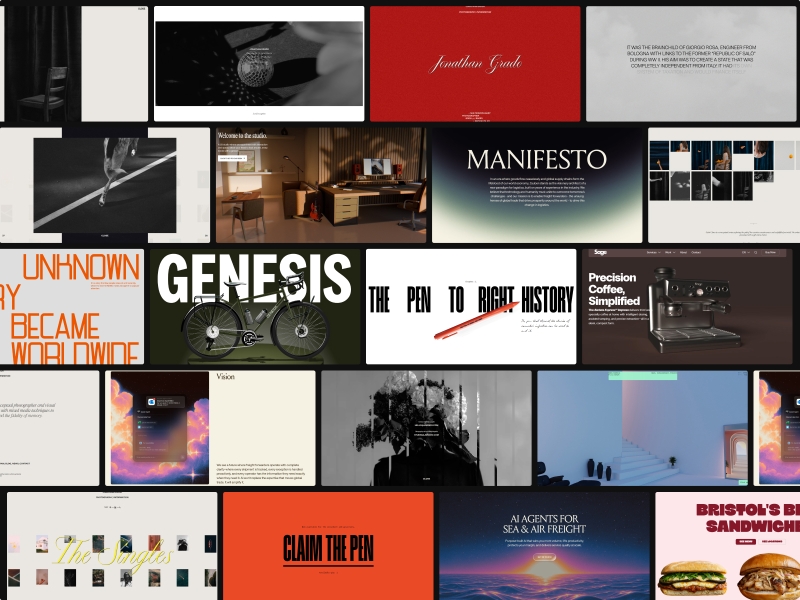
Multiple hero sections

What we’re about

We both came to this with years of freelance work behind us and a shared obsession with what the web can do. That curiosity led us both, independently, toward more experimental territory: 3D spaces, interactions that feel physical, experiences that go beyond what a standard build would attempt.

We experiment a lot outside of client work. Partly because we’re always looking to learn something new, partly because we just love building things. We’re drawn to the idea that a website can feel like somewhere. That it can have atmosphere, light, a sense of space. That’s what pulls us toward 3D, toward motion, toward interactions that go beyond the expected.

It feels like the industry moves faster and faster. New tools, new trends, new opportunities appear constantly and it’s easy to be drawn towards the next thing. We’re trying to resist that pull and focus on what actually matters to us, finding people who love what they do and building things we’re all proud of.

The studio as the work

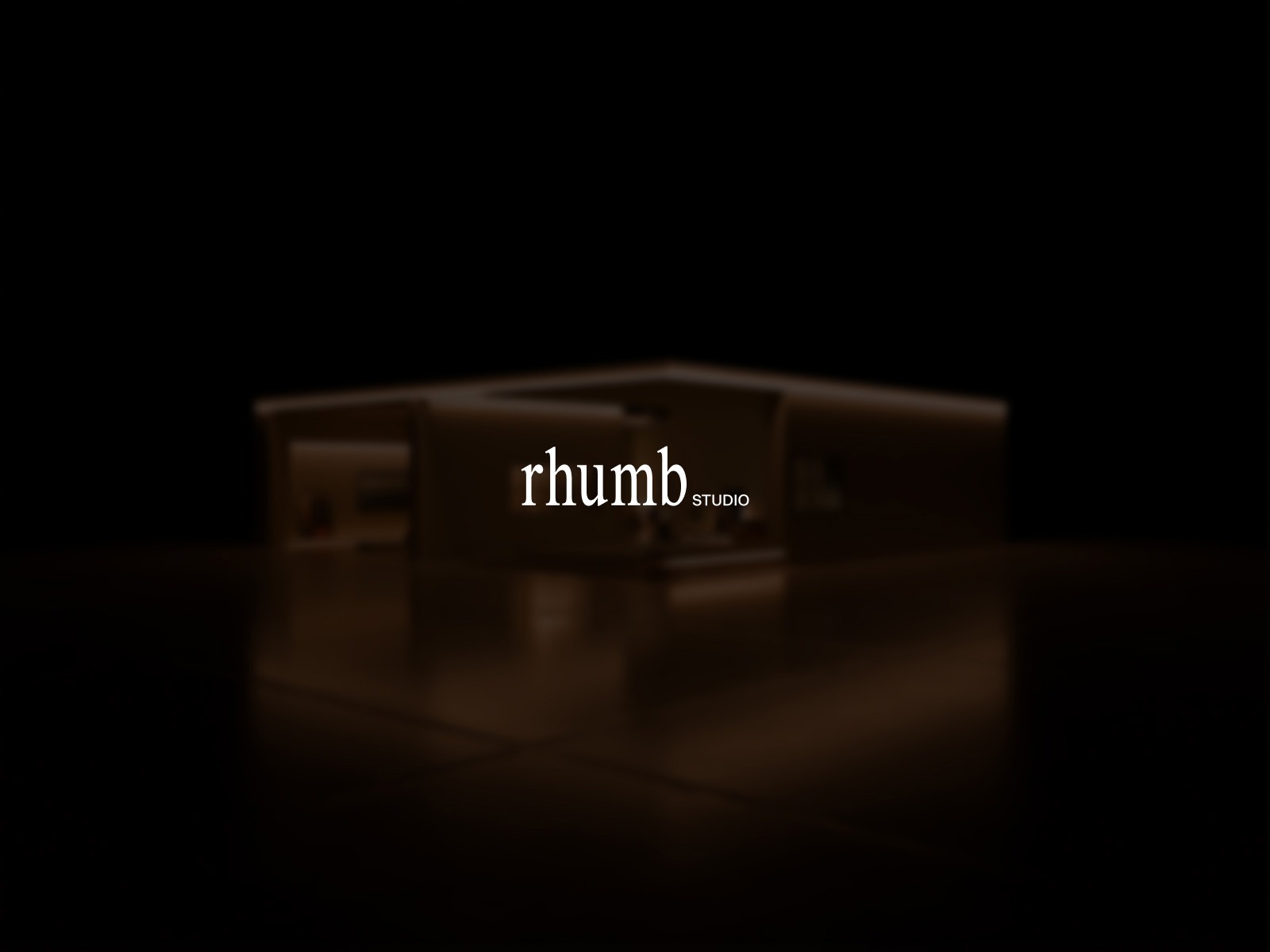
When we built rhumb.co, we wanted it to be a direct expression of how we think. The homepage opens on the exterior of a building lit from within. You move through it and enter the interior: a warm room with considered furniture, ambient light, artwork on the walls. Each space connects to a different part of the studio. The navigation is spatial.

It’s something we keep coming back to, 3D spaces as a way to give a site atmosphere and substance. Color, light, depth. Things that are hard to achieve on a flat surface. We’ve used it across past projects where the goal was to create a world around the work rather than just present it. The 3D becomes the environment the content lives inside.

The technical side of that starts in Blender, where we model, texture and bake full scenes before they ever reach the browser. Baking means the heavy lighting work happens offline, so what loads in the browser is fast and lean. On top of that we layer custom shaders that add dynamic specular, normal mapping and ambient occlusion in real time. That combination is what gives the scenes their depth and atmosphere, without compromising performance.

For delivery, we work in two ways depending on the project. For complex builds we use Next.js with React Three Fiber and a headless CMS, which gives clients full ownership of their content without touching the code. For faster, more contained projects we use Webflow, where our own Vite template lets us inject custom code and build specific features without losing the speed and flexibility Webflow offers.

The stack changes. The goal doesn’t: scenes that feel alive, and sites that clients can actually manage long after we hand them over.

How we work

Being two is a choice we think about. There’s no loss of information, no time wasted in translation. One point of contact, full ownership of every detail.

We communicate a lot, quickly and without friction. That dynamic keeps things moving and keeps the work honest. We share references, things we find online, experiments we’re running. That constant exchange feeds directly into the work. We’re always building something or trying something outside of client projects, and that curiosity shows up in what we make.

We’re not trying to grow into a large team. We want to stay focused, taking on the right projects, working with people who care, and having enough space to keep experimenting. That’s what sustainable looks like to us.

We’re at the beginning. There’s a lot we’re still figuring out, about running a studio, about the kind of work we want to make, about who we want to make it with. But we know what pulls us forward: curiosity, craft, and people who care about what they’re building.

If that sounds like you, we’d love to hear from you.