
惯性聚合 高效追踪和阅读你感兴趣的博客、新闻、科技资讯
阅读原文 在惯性聚合中打开

推荐订阅源

D
DataBreaches.Net
B
Blog
博客园_首页
C
Check Point Blog
Microsoft Security Blog
MyScale Blog
MyScale Blog
P
Proofpoint News Feed
Engineering at Meta
Engineering at Meta
钛媒体:引领未来商业与生活新知
钛媒体:引领未来商业与生活新知
B
Blog RSS Feed
M
MIT News - Artificial intelligence
freeCodeCamp Programming Tutorials: Python, JavaScript, Git & More
WordPress大学
WordPress大学
宝玉的分享
宝玉的分享
OSCHINA 社区最新新闻
OSCHINA 社区最新新闻
The Cloudflare Blog
量子位
V
V2EX
Y
Y Combinator Blog
Hugging Face - Blog
Hugging Face - Blog
Martin Fowler
Martin Fowler
Recent Announcements
I
InfoQ
博客园 - 【当耐特】

Comments for Hackaday

AI The Truly Environmentally Friendly Way News Sites Are Blocking Internet Archive Over AI Scraping Fears How The 2020s Chip Crisis Led To A Buggy Saleae Analyzer In 2026 Evidence For Water Vapor Plumes On Europa Vanishes In Re-Analysis Mechanical Stability For Your Coils 3D Printed Hose Sprayer Sets Phasers To Suds The Merits Of Comment-Driven Development As Counterweight To TDD Building A Desktop Catalytic Cracker Process 4 Billion Pixels Per Second From 16 DIY Cameras For The Best V-Tubing Rig Ever An Unlikely Host For An 8080 Emulator Using Brand New NiMH Cells After Sitting 12 Years Unused Investigating The S3 Virge’s Reputation As A 3D Decelerator Card As It Turns Out, There’s More Than One Cassette Mechanism Being Made After All Using Windows 11 On An LGA 775 PC With AGP Videocard An Ethernet WiFi Router on a Pi Pico 2W This Week In Security: Messing With AI, 7Zip And Notepad++ Vulnerabilities, HTTP2 Bomb, And More Using Electrolysis For More Than Just Generating Hydrogen Vintage Turntable Gets Brain Transplant And Home Assistant Integration Connecting Your Car To Home Assistant Microsoft Claims 20 Second Qubits If You Want To Hack Me, Come In Through The Speaker Ways To Embed Magnets In 3D Prints And Not Ruin Printers An RGB Keyboard For Your Hackaday Communicator Badge Ask Hackaday: How Do You Feel About Electronic Shelf Labels? Make Your Ceiling Disappear With ADS-B And Short-Throw Projector Fixing A Nintendo Game Boy Clone That Runs Too Fast Web-Based Control For A CB Radio Distilling Stale Gasoline To Make It Usable Again DIY Ceramic Circuit Boards Surely Count As Solarpunk Texas Instruments Changes The NE5532 And Others Into Incompatible Versions
Defeat Blood-Sucking Mosquitoes By Becoming The Bug Zapper
CRJEEA · 2026-06-21 · via Comments for Hackaday

Skip to content

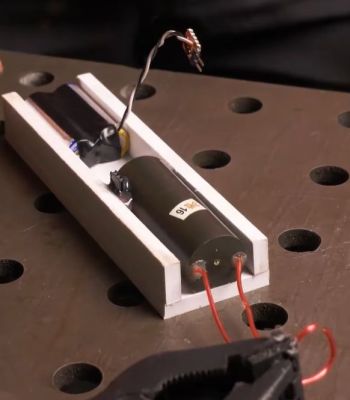
One of the stun gun modules with battery pack. (Credit: Dani Cruster DiWHY, YouTube)

Few things are more satisfying during a Summer night than hearing the crackle and pop of another mosquito hurling itself against a bug zapper and knowing that it won’t be trying to suck your blood any more. The only problem with those bug zappers, whether the mounted or hand-held type is that you cannot get every single attacking mosquito. Unless you were to put the bug zapper on yourself, of course. This is basically what [Dani Cruster] of the aptly named ‘DiWHY’ channel decided would be the right course of action.

The video is apparently dubbed over from the original Russian – with the team claimed to be based in Moldova – which probably explains a lot of the reasoning behind this engineering. At the core of the whole-body bug zapper is galvanized mesh, with a big question being how close you can get it to the body before said body gets zapped too. With about a millimeter of clearance between both layers of mesh required at 1 kV, this was another design consideration.

Ultimately the guts of stun guns were used, which output around 10 kV and thus require a 1 cm gap between the mesh layers. PVC plates were used to create the structural elements of the walking bug zapper suit, using a heatgun to form it into a body-appropriate shape. That’s when human testing started, to try and not make it zap the wearer.

The final suit of bug zapping armor uses six stun gun modules, each powered by a 3 V power source created from two 1.5 V alkaline cells that are good for an hour of zapping. One issue found during a human trial run was that the zip ties used turned out to actually cause arcing, which had to be addressed first before heading to the mosquito-infested woods. In the video these are said to be near Tarkov in what appears to be the national park in Russia’s Tver Oblast and clearly a prime mosquito breeding ground.

During the real-life test run many mosquitoes and apparently even some ticks find their electrifying demise, before for some reason they seem to clear out after an hour or so. Overall it seems to work well, even if it’s not that ergonomic and things get spicy when it starts to rain.