
惯性聚合 高效追踪和阅读你感兴趣的博客、新闻、科技资讯
阅读原文 在惯性聚合中打开

推荐订阅源

IT之家
IT之家
Cyber Security Advisories - MS-ISAC
freeCodeCamp Programming Tutorials: Python, JavaScript, Git & More
N
News and Events Feed by Topic
P
Privacy International News Feed
Apple Machine Learning Research
A
Arctic Wolf
OSCHINA 社区最新新闻
OSCHINA 社区最新新闻
Threat Intelligence Blog | Flashpoint
T
Threat Research - Cisco Blogs
Spread Privacy
Spread Privacy
宝玉的分享
宝玉的分享
P
Proofpoint News Feed
P
Privacy & Cybersecurity Law Blog
GbyAI
GbyAI
The Hacker News
The Hacker News
K
Kaspersky official blog
奇客Solidot–传递最新科技情报
奇客Solidot–传递最新科技情报
C
Cyber Attacks, Cyber Crime and Cyber Security
D
Darknet – Hacking Tools, Hacker News & Cyber Security
A
About on SuperTechFans
S
Secure Thoughts
G
Google Developers Blog
博客园 - 司徒正美
Forbes - Security
Forbes - Security
T
The Exploit Database - CXSecurity.com
Latest news
Latest news
V2EX - 技术
V2EX - 技术
I
InfoQ
让小产品的独立变现更简单 - ezindie.com
Security Latest
Security Latest
AI
AI
T
Tailwind CSS Blog
Recent Commits to openclaw:main
Cloudbric
Cloudbric
V
Vulnerabilities – Threatpost
Schneier on Security
P
Proofpoint News Feed
博客园 - 聂微东
Application and Cybersecurity Blog
S
Schneier on Security
博客园 - 【当耐特】
NISL@THU
NISL@THU
Y
Y Combinator Blog
cs.CL updates on arXiv.org
cs.CV updates on arXiv.org
L
Lohrmann on Cybersecurity
Help Net Security
Help Net Security
The Cloudflare Blog
H
Hackread – Cybersecurity News, Data Breaches, AI and More

Catchpoint Blog

SRE Report: AI optimism and the economics of effort SRE Report: Why fast is what users trust SRE Report 2026: What surprised us, what didn't, and why the gaps matter most The SRE Report 2026: Defensible Ns Why Synthetic Tracing Delivers Better Data, Not Just More Data A New Chapter: LogicMonitor + Catchpoint – A Personal Note from Mehdi Mezmo + Catchpoint deliver observability SREs can rely on The four pillars holding up your digital business, and what happens when they crumble When payments pause: lessons from a global payments outage Observability 2025 Decoded: What the DZone Report Means for SLO-Driven Ops The next evolution of WebPageTest has arrived, and it’s a game-changer The Monitoring Blind Spot That Could Cost You Black Friday Powering Mexico’s Digital Future: Expanded Internet Observability with Catchpoint The Next Chapter of WebPageTest: Your New Experience Starts Soon SRE Report Retrospectives — Have AIOps Predictions Held Up? When BGP becomes UX: The inside story of a SaaS routing decision gone wrong (or right) Session Replay explained: A guide to seeing digital experience through your user’s eyes Making the invisible visible: Are your cloud firewalls and DDoS protection really working? Why it’s time to move beyond APM: Monitoring from the user’s perspective When metrics mislead: Inside the 2025 Retail Web Performance Benchmark The vendor trap: why your next outage won’t be your fault—but will be your problem LLMs don’t stand still: How to monitor and trust the models powering your AI Semantic Caching: What We Measured, Why It Matters The Annual SRE Survey Is Open—We Want to Hear from You Observability isn’t about the tool. It’s about the truth Invisible dependencies, visible impact: Lessons from the Google Cloud outage Real-time detection of BGP blackholing and prefix hijacks Leading analyst firm reveals the real cost of internet disruptions The Power of Over 3000 Intelligent Observability Agents Monitoring in the Age of Complexity: 5 Assumptions CIOs Need to Rethink Why Intelligent Traffic Steering is Critical for Performance and Cost Optimization Retail digital performance event recap: Key insights from IBM & Catchpoint Zendesk outage: A case for proactive monitoring and faster incident response Silence during chaos: Why the X outage is a call to arms for proactive monitoring The $1 Million Lesson: Building a Culture of Quality Through SLAs When AI tools fail: How to map your AI dependencies for proactive visibility Why Super Bowl 2025 was a triumph for Internet Resilience Why Internet Performance Monitoring is the new health check for IT organizations Why use Playwright in Catchpoint for synthetic monitoring Introducing WebPageTest Expert Plan: Real-Time Insights, Synthetic + RUM together in One Platform The shift to digital: How businesses are reshaping their priorities for 2025 The SRE Report 2025's Call to Action Monitoring in the Age of the Internet: DEM, IPM, and APM—What You Need to Know SSL Monitoring, Trust, and McLOVIN Performing for the holidays: Look beyond uptime for season sales success Lessons from Microsoft’s office 365 Outage: The Importance of third-party monitoring Web Performance Experts Look into the Future of Web Performance The hidden challenges of Internet Resilience: Key insights from 2024 report When SSL Issues aren’t just about SSL: A deep dive into the TIBCO Mashery outage The curious case of Marriott and the untold impact of web performance on revenue Preparing for the unexpected: Lessons from the AJIO and Jio Outage It’s time to stop neglecting the elephant in the room: Performance Matters! The Need for Speed: Highlights from IBM and Catchpoint’s Global DNS Performance Study Learnings from ServiceNow’s Proactive Response to a Network Breakdown Webinar Recap: Taking Web Performance to the Next Level Use the Catchpoint Terraform Provider in your CI/CD workflows Is the Internet ready for L4S? Takeaways from the CrowdStrike outage: third-parties can pose risk July 19th global IT outage reminds us of digital complexity 5 Actions you can take to improve digital performance 2024: A banner year for Internet Resilience APM vs Observability: Both-and, not either-or AppAssure: Ensuring the resilience of your Tier-1 applications just became easier APM vs observability: why your definitions are broken APM vs Observability: What comes next? APM vs Observability: Observing beyond APM Achieving stability with agility in your CI/CD pipeline AWS Outage: How do you prepare for the failure of your own safety net? Agentic AI: Powerful But Fragile—What You Need to Know Catch frustration before it costs you: New tools for a better user experience Catchpoint Expands Observability Network to Barcelona: A Growing Internet Hub Catchpoint Peak Performance Summit 2025: Redefining Observability for the Outcome Economy Catchpoint named a leader in the 2024 Gartner® Magic Quadrant™ for Digital Experience Monitoring Consolidation and Modernization in Enterprise Observability Connected Devices: Unlocking the next frontier of Internet Performance Monitoring Cloud Monitoring's Blind Spot: The User Perspective Cloudflare’s Resolver Outage: More Than Just DNS Cloudflare outage: another wake-up call for resilience planning Demystifying API Monitoring and Testing with IPM Creating the IPM Category: Catchpoint’s Journey to Leadership and the LogicMonitor Era Critical Requirements for Modern API Monitoring Customer Survey 2024: Unveiling insights and impact Did Delta's slow web performance signal trouble before CrowdStrike? Diagnosing Wi-Fi failures that traditional tools miss: a case study DNS misconfiguration can happen to anyone - the question is how fast can you detect it? ECN explained: Navigate congestion for faster, smoother data delivery Don’t get caught in the dark: Lessons from a Lumen & AWS micro-outage From refresh to results: the metrics that shaped Election Day 2024 coverage Fast and furious: The importance of performance in the digital age Getting Started with Traceroute From the source to the edge: the six agent types you can’t ignore From SEO to AEO: Why Web Performance Is the Key to AI Search Success Going for gold: Testing the resilience of Olympic websites Here’s the proof: What the fastest sites on the web have in common Google’s Agent-to-Agent (A2A) Protocol is here—Now Let’s Make it Observable How IPM helped a top tech brand catch an OpenAI outage before it became a crisis How AI Turns Monitoring From “What Now?” Into “What’s Next?” How SAP achieved world-class uptime through modern observability How to Monitor AI Agents in Commerce Systems
Escalating risk, shrinking margins: The 2025 Internet Resilience Report
2026-05-31 · via Catchpoint Blog

When we first launched Catchpoint’s Internet Resilience Report back in 2024, we were already seeing troubling cracks in the digital foundations of major businesses. Remember the CrowdStrike outage? Fast-forward to this year, and it's clear the stakes have only gotten higher. Google Cloud’s recent outage is yet another reminder of how tightly interwoven the Internet is and how all it takes is for one major player to go down, for thousands of businesses to be affected worldwide.

Having spent months diving deep into data from nearly 500 global business leaders, the 2025 edition of The Internet Resilience Report uncovers fascinating insights and trends that no one responsible for digital performance can afford to ignore.  

Here’s what caught our attention, why it should matter to you, and what you should do about it.

5 Key takeaways from this year’s report

The data makes one thing explicit: performance now shares the same podium as availability. That shift is rewiring resilience strategies at the highest levels.
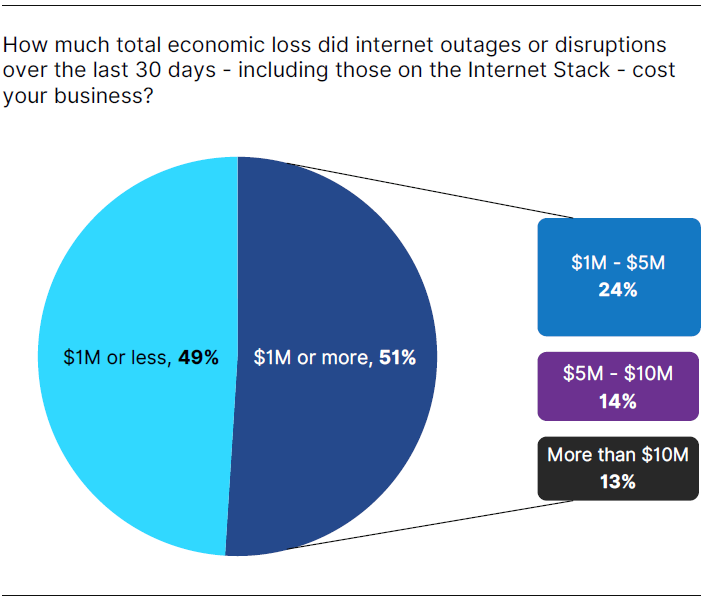
#1 Financial pain has escalated

A pie chart with text and numbersAI-generated content may be incorrect., Picture

Over half (51%) of companies now incure more than $1 million each month due to Internet disruptions. About 1 in 8 (12.5%) are seeing losses of more than $10 million per month. As the report says, “That’s not downtime. That’s Damage.”

#2 Fast performance is the new uptime

Picture 1262326619, Picture

The emphasis on performance in this year’s report reflects a noticeable shift in how organizations perceive resilience: 73% of businesses now consider high-performing digital experiences as non-negotiable. Meanwhile, 42% went further, suggesting that if apps are slow, they might as well be down.  

#3 AI has an observability problem

AI might be everyone's favorite buzzword, but our research showed a significant blind spot.  

A screenshot of a surveyAI-generated content may be incorrect., Picture

Over half (57%) of businesses recognize issues in their AI-driven applications immediately—but nearly half don’t have real-time visibility into AI performance at all.

#4 Third-party dependencies remain a critical risk

74% of businesses heavily depend on third-party providers, yet many continue to lack the visibility needed to manage these external risks effectively.  

Third-party blind spots remain major vulnerabilities.

#5 Specialization matters

Generalist monitoring tools aren't cutting it anymore. 73% prefer specialized Internet Performance Monitoring tools for safeguarding digital experiences, rather than broad, less targeted tools.

A screenshot of a graphAI-generated content may be incorrect., Picture

Year-over year shifts that should raise your eyebrow

One of the unique benefits of running this report annually is seeing how the data evolves. Three clear trends emerged this year that I found particularly compelling:

  1. Impact is up: In 2024, 43% reported significant monthly financial impacts ($1M+). This year, that jumped to 51%. Clearly, resilience is no longer just about risk management—it’s central to business survival.
  1. Severity is up: The proportion of businesses suffering massive disruptions ($10M+) increased from 9% last year to around 12.5% this year. The severity is going up, and the stakes for getting resilience right are growing exponentially.
  1. Dependency is flat (but risky): Dependency on third parties remained consistently high (from 77% down slightly to 74%), underscoring the need for robust external monitoring.

These aren’t just spreadsheet deltas. The Google Cloud outage proved how an “invisible” dependency can torpedo customer experience without warning. Proactive, outside‑in monitoring and clear experience‑level objectives (XLOs) have never mattered more.

“The industry is waking up to a new reality: slow is the new down. Sluggish websites and applications don’t just frustrate users—they drain revenue and damage reputations.” Catchpoint CEO Mehdi Daoudi

Actionable recommendations from the report  

The full report contains deeper insights and recommendations—but if you’re looking for a few high-impact steps to begin with, start here:

  • Define clear Experience-Level Objectives (XLOs): Forget internal uptime targets alone. Define your metrics from your customers' experience. If your website feels slow, it might as well be dead to your users.
  • Get serious about AI Observability: The report reveals that 57 % of companies detect AI failures immediately, yet the rest find out only when users complain. If AI runs critical parts of your business, ensure you can see problems immediately. Investing in best-of-breed monitoring solutions to ensure real-time visibility into AI performance isn't optional; it’s essential.
  • Audit your top ten third‑party calls: With 74 % of leaders calling external services “highly or extremely critical,” know who you depend on. Inventory external APIs/CDNs and set a basic healthcheck for each dependency

What's next?

Download the full Internet Resilience Report 2025 to go deeper. Inside, you'll find industry benchmarks across performance, availability, and observability; real-world insights into what’s working (and what’s not); and recommendations to help your teams build resilience that’s measurable, testable, and ready for whatever breaks next.