


Remember how I said that blog #3 was going to be my last entry on the topic of "APM vs Observability?" Well, it turns out I had a little more to say. I'd like to spend a few moments talking about the future of APM and Observability. I think it comes down to two major initiatives: AI and Open Telemetry.
(NOTE: in this section, I'm using the word "observability" to refer to the discipline of monitoring and observability as a whole, rather than any specific tool, technique, or vendor-based solution.)

It's a source of constant frustration to me, as someone with 27 years invested in learning, implementing, and supporting monitoring and observability tools, that "AI" has so far only resulted in chatbot-like interfaces that help people find a particular menu or generate a chart faster. There's huge (and so far untapped) potential for AI to positively impact the world of observability.
Going back to my earlier comments about what observability is about, on a philosophical (if not architectural) level, it's meant to ingest vast quantities of data from disparate sources, normalize them, and then process those data sets from multiple angles.
This is not something humans are capable of "reasoning about" (taking in and considering holistically) - to use a term Charity Majors, CEO of Honeycomb popularized.
Observability tools provide prompts, tools, and visualizations that allow users to discover unique ("high cardinality") combinations that might indicate an existing (or brewing) problem that could not have been predicted based on human experience or developer insight.
But even with the tools, an operator has to be there to ask the questions. Heck, to begin with, a user has to understand there's something to ask ABOUT. And that's a problem. Because while observability focuses on finding and displaying unknown-unknowns, we humans are really bad at dealing with things we didn't know that we didn't know.
But it's something AI could do exceptionally well!
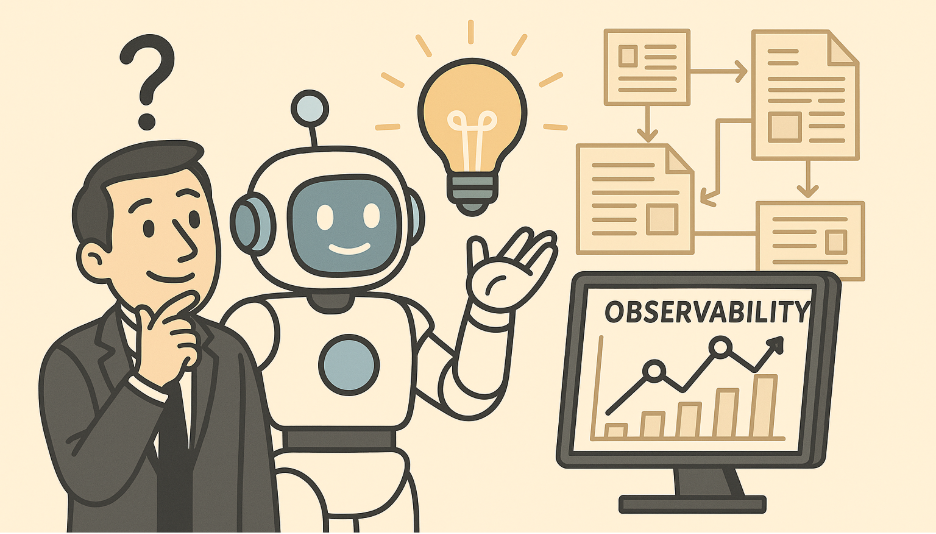
Logically, my next sentence would start "In order to do that, the AI would have to..." and you know what? That's true. But I'm not an AI developer, designer, or architect. So, I'll stop here.
As I wrote here (and I make NO apology for the title or the graphic) https://www.adatosystems.com/2025/03/03/otel-me-why/, I find Open Telemetry exciting because it's the biggest change in the way monitoring and observability are done since Traces (which came out around 2000, but wasn't widely used until 2010-ish). And traces were the biggest change to the discipline of monitoring since... ever.
Why OTel matters more than any standard before it
The CNCF OpenTelemetry project isn't the first attempt to create an "Esperanto of observability" (my words, not theirs. But they’re welcome to adopt it), but it's the first such project to have caught on to this level, and to have achieved this level of support and recognition. I believe the impact OTel will have in the coming months (let alone years) will be significant and pervasive. And it's not just in terms of the consolidation, standardization, and normalization of the tech itself. OTLP is great, but there are dozens of methods of sending data from point A to point B.
No, the real value in OTel is the semantic naming it brings to the party. If you're unfamiliar with it (and short on time), semantic naming is the term for ensuring that a specific metric (or type of metric) is always referred to the same way, regardless of the system or sub-element it's coming from. And if you don't understand why that is significant, just stick around monitoring for another hour or two and it will become obvious (or read to the bottom of this blog)

With the evolving nature of application development, deployment, and operation, coupled with the impending influence of Agentic AI agents, organizations must reevaluate their observability and monitoring strategies to prioritize user-centric considerations. While the performance of an application stack is beneficial, it becomes inconsequential if users cannot access it or it fails to meet their needs. This paradigm shift is already underway; forward-thinking digital organizations are already adapting or are in the process of making the necessary adjustments to prioritize the user experience, whether the user is a customer, partner, employee, or autonomous agent.
Missed the series? Read it here:
Learn more: Compare what you can monitor with APM vs IPM
AI and OpenTelemetry are set to redefine the future of monitoring and observability. While AI hasn’t yet delivered meaningful insights beyond dashboards and chatbots, its potential to uncover “unknown unknowns” could revolutionize how teams detect and understand problems. Meanwhile, OpenTelemetry is quietly transforming the space by standardizing data semantics, giving the industry a shared language for metrics, logs, and traces. Together, they signal a shift toward more intelligent, interoperable, and user-centric observability, where experience, not uptime, becomes the real success metric.
Remember how I said that blog #3 was going to be my last entry on the topic of "APM vs Observability?" Well, it turns out I had a little more to say. I'd like to spend a few moments talking about the future of APM and Observability. I think it comes down to two major initiatives: AI and Open Telemetry.
(NOTE: in this section, I'm using the word "observability" to refer to the discipline of monitoring and observability as a whole, rather than any specific tool, technique, or vendor-based solution.)
It's a source of constant frustration to me, as someone with 27 years invested in learning, implementing, and supporting monitoring and observability tools, that "AI" has so far only resulted in chatbot-like interfaces that help people find a particular menu or generate a chart faster. There's huge (and so far untapped) potential for AI to positively impact the world of observability.
Going back to my earlier comments about what observability is about, on a philosophical (if not architectural) level, it's meant to ingest vast quantities of data from disparate sources, normalize them, and then process those data sets from multiple angles.
This is not something humans are capable of "reasoning about" (taking in and considering holistically) - to use a term Charity Majors, CEO of Honeycomb popularized.
Observability tools provide prompts, tools, and visualizations that allow users to discover unique ("high cardinality") combinations that might indicate an existing (or brewing) problem that could not have been predicted based on human experience or developer insight.
But even with the tools, an operator has to be there to ask the questions. Heck, to begin with, a user has to understand there's something to ask ABOUT. And that's a problem. Because while observability focuses on finding and displaying unknown-unknowns, we humans are really bad at dealing with things we didn't know that we didn't know.
But it's something AI could do exceptionally well!
Logically, my next sentence would start "In order to do that, the AI would have to..." and you know what? That's true. But I'm not an AI developer, designer, or architect. So, I'll stop here.
As I wrote here (and I make NO apology for the title or the graphic) https://www.adatosystems.com/2025/03/03/otel-me-why/, I find Open Telemetry exciting because it's the biggest change in the way monitoring and observability are done since Traces (which came out around 2000, but wasn't widely used until 2010-ish). And traces were the biggest change to the discipline of monitoring since... ever.
Why OTel matters more than any standard before it
The CNCF OpenTelemetry project isn't the first attempt to create an "Esperanto of observability" (my words, not theirs. But they’re welcome to adopt it), but it's the first such project to have caught on to this level, and to have achieved this level of support and recognition. I believe the impact OTel will have in the coming months (let alone years) will be significant and pervasive. And it's not just in terms of the consolidation, standardization, and normalization of the tech itself. OTLP is great, but there are dozens of methods of sending data from point A to point B.
No, the real value in OTel is the semantic naming it brings to the party. If you're unfamiliar with it (and short on time), semantic naming is the term for ensuring that a specific metric (or type of metric) is always referred to the same way, regardless of the system or sub-element it's coming from. And if you don't understand why that is significant, just stick around monitoring for another hour or two and it will become obvious (or read to the bottom of this blog)
With the evolving nature of application development, deployment, and operation, coupled with the impending influence of Agentic AI agents, organizations must reevaluate their observability and monitoring strategies to prioritize user-centric considerations. While the performance of an application stack is beneficial, it becomes inconsequential if users cannot access it or it fails to meet their needs. This paradigm shift is already underway; forward-thinking digital organizations are already adapting or are in the process of making the necessary adjustments to prioritize the user experience, whether the user is a customer, partner, employee, or autonomous agent.
Missed the series? Read it here:
Learn more: Compare what you can monitor with APM vs IPM
This is some text inside of a div block.
此内容由惯性聚合(RSS阅读器)自动聚合整理,仅供阅读参考。 原文来自 — 版权归原作者所有。