
惯性聚合 高效追踪和阅读你感兴趣的博客、新闻、科技资讯
阅读原文 在惯性聚合中打开

推荐订阅源

G
GRAHAM CLULEY
T
Tenable Blog
Know Your Adversary
Know Your Adversary
C
CXSECURITY Database RSS Feed - CXSecurity.com
P
Privacy International News Feed
S
Security Affairs
NISL@THU
NISL@THU
O
OpenAI News
Attack and Defense Labs
Application and Cybersecurity Blog
Hacker News: Ask HN
Hacker News: Ask HN
Webroot Blog
Webroot Blog
Schneier on Security
S
SegmentFault 最新的问题
S
Schneier on Security
G
Google Developers Blog
V
V2EX
C
Check Point Blog
U
Unit 42
Google DeepMind News
T
Threatpost
阮一峰的网络日志
阮一峰的网络日志
T
The Exploit Database - CXSecurity.com
Recent Announcements
M
MIT News - Artificial intelligence
S
Secure Thoughts
博客园 - 司徒正美
Recorded Future
Recorded Future
P
Proofpoint News Feed
Spread Privacy
Spread Privacy
K
Kaspersky official blog
Cyber Security Advisories - MS-ISAC
AI
AI
博客园 - 聂微东
N
News and Events Feed by Topic
SecWiki News
SecWiki News
钛媒体:引领未来商业与生活新知
钛媒体:引领未来商业与生活新知
V
Vulnerabilities – Threatpost
P
Palo Alto Networks Blog
OSCHINA 社区最新新闻
OSCHINA 社区最新新闻
Engineering at Meta
Engineering at Meta
Recent Commits to openclaw:main
奇客Solidot–传递最新科技情报
奇客Solidot–传递最新科技情报
酷 壳 – CoolShell
酷 壳 – CoolShell
WordPress大学
WordPress大学
The Hacker News
The Hacker News
The Last Watchdog
The Last Watchdog
Project Zero
Project Zero
W
WeLiveSecurity
博客园 - Franky

Catchpoint Blog

SRE Report: AI optimism and the economics of effort SRE Report: Why fast is what users trust SRE Report 2026: What surprised us, what didn't, and why the gaps matter most The SRE Report 2026: Defensible Ns Why Synthetic Tracing Delivers Better Data, Not Just More Data A New Chapter: LogicMonitor + Catchpoint – A Personal Note from Mehdi Mezmo + Catchpoint deliver observability SREs can rely on The four pillars holding up your digital business, and what happens when they crumble When payments pause: lessons from a global payments outage Observability 2025 Decoded: What the DZone Report Means for SLO-Driven Ops The next evolution of WebPageTest has arrived, and it’s a game-changer The Monitoring Blind Spot That Could Cost You Black Friday Powering Mexico’s Digital Future: Expanded Internet Observability with Catchpoint The Next Chapter of WebPageTest: Your New Experience Starts Soon SRE Report Retrospectives — Have AIOps Predictions Held Up? When BGP becomes UX: The inside story of a SaaS routing decision gone wrong (or right) Session Replay explained: A guide to seeing digital experience through your user’s eyes Making the invisible visible: Are your cloud firewalls and DDoS protection really working? Why it’s time to move beyond APM: Monitoring from the user’s perspective When metrics mislead: Inside the 2025 Retail Web Performance Benchmark The vendor trap: why your next outage won’t be your fault—but will be your problem LLMs don’t stand still: How to monitor and trust the models powering your AI Semantic Caching: What We Measured, Why It Matters The Annual SRE Survey Is Open—We Want to Hear from You Observability isn’t about the tool. It’s about the truth Invisible dependencies, visible impact: Lessons from the Google Cloud outage Real-time detection of BGP blackholing and prefix hijacks Leading analyst firm reveals the real cost of internet disruptions The Power of Over 3000 Intelligent Observability Agents Monitoring in the Age of Complexity: 5 Assumptions CIOs Need to Rethink Why Intelligent Traffic Steering is Critical for Performance and Cost Optimization Retail digital performance event recap: Key insights from IBM & Catchpoint Zendesk outage: A case for proactive monitoring and faster incident response Silence during chaos: Why the X outage is a call to arms for proactive monitoring The $1 Million Lesson: Building a Culture of Quality Through SLAs When AI tools fail: How to map your AI dependencies for proactive visibility Why Super Bowl 2025 was a triumph for Internet Resilience Why Internet Performance Monitoring is the new health check for IT organizations Why use Playwright in Catchpoint for synthetic monitoring Introducing WebPageTest Expert Plan: Real-Time Insights, Synthetic + RUM together in One Platform The shift to digital: How businesses are reshaping their priorities for 2025 The SRE Report 2025's Call to Action Monitoring in the Age of the Internet: DEM, IPM, and APM—What You Need to Know SSL Monitoring, Trust, and McLOVIN Performing for the holidays: Look beyond uptime for season sales success Lessons from Microsoft’s office 365 Outage: The Importance of third-party monitoring Web Performance Experts Look into the Future of Web Performance The hidden challenges of Internet Resilience: Key insights from 2024 report When SSL Issues aren’t just about SSL: A deep dive into the TIBCO Mashery outage The curious case of Marriott and the untold impact of web performance on revenue Preparing for the unexpected: Lessons from the AJIO and Jio Outage It’s time to stop neglecting the elephant in the room: Performance Matters! The Need for Speed: Highlights from IBM and Catchpoint’s Global DNS Performance Study Learnings from ServiceNow’s Proactive Response to a Network Breakdown Webinar Recap: Taking Web Performance to the Next Level Use the Catchpoint Terraform Provider in your CI/CD workflows Is the Internet ready for L4S? Takeaways from the CrowdStrike outage: third-parties can pose risk July 19th global IT outage reminds us of digital complexity 5 Actions you can take to improve digital performance 2024: A banner year for Internet Resilience APM vs Observability: Both-and, not either-or AppAssure: Ensuring the resilience of your Tier-1 applications just became easier APM vs observability: why your definitions are broken APM vs Observability: What comes next? APM vs Observability: Observing beyond APM Achieving stability with agility in your CI/CD pipeline AWS Outage: How do you prepare for the failure of your own safety net? Agentic AI: Powerful But Fragile—What You Need to Know Catch frustration before it costs you: New tools for a better user experience Catchpoint Expands Observability Network to Barcelona: A Growing Internet Hub Catchpoint Peak Performance Summit 2025: Redefining Observability for the Outcome Economy Catchpoint named a leader in the 2024 Gartner® Magic Quadrant™ for Digital Experience Monitoring Consolidation and Modernization in Enterprise Observability Connected Devices: Unlocking the next frontier of Internet Performance Monitoring Cloud Monitoring's Blind Spot: The User Perspective Cloudflare’s Resolver Outage: More Than Just DNS Cloudflare outage: another wake-up call for resilience planning Demystifying API Monitoring and Testing with IPM Creating the IPM Category: Catchpoint’s Journey to Leadership and the LogicMonitor Era Critical Requirements for Modern API Monitoring Customer Survey 2024: Unveiling insights and impact Did Delta's slow web performance signal trouble before CrowdStrike? Diagnosing Wi-Fi failures that traditional tools miss: a case study DNS misconfiguration can happen to anyone - the question is how fast can you detect it? ECN explained: Navigate congestion for faster, smoother data delivery Don’t get caught in the dark: Lessons from a Lumen & AWS micro-outage Escalating risk, shrinking margins: The 2025 Internet Resilience Report From refresh to results: the metrics that shaped Election Day 2024 coverage Fast and furious: The importance of performance in the digital age Getting Started with Traceroute From the source to the edge: the six agent types you can’t ignore Going for gold: Testing the resilience of Olympic websites Here’s the proof: What the fastest sites on the web have in common Google’s Agent-to-Agent (A2A) Protocol is here—Now Let’s Make it Observable How IPM helped a top tech brand catch an OpenAI outage before it became a crisis How AI Turns Monitoring From “What Now?” Into “What’s Next?” How SAP achieved world-class uptime through modern observability How to Monitor AI Agents in Commerce Systems
From SEO to AEO: Why Web Performance Is the Key to AI Search Success
2026-05-31 · via Catchpoint Blog

in this blog post

Search isn’t what it used to be. The way people discover information online is shifting. Instead of clicking through search results, many now ask AI answer engines like ChatGPT and Perplexity to do the research for them.  

In March 2025, 13.1% of Google desktop searches featured AI Overviews— doubling from over 6% in January, according to Semrush analysis of 10+ million queries. Meanwhile, Gartner predicts that by 2026, a quarter of all search traffic will shift to AI assistants, with ChatGPT alone already serving 400+ million users each week.
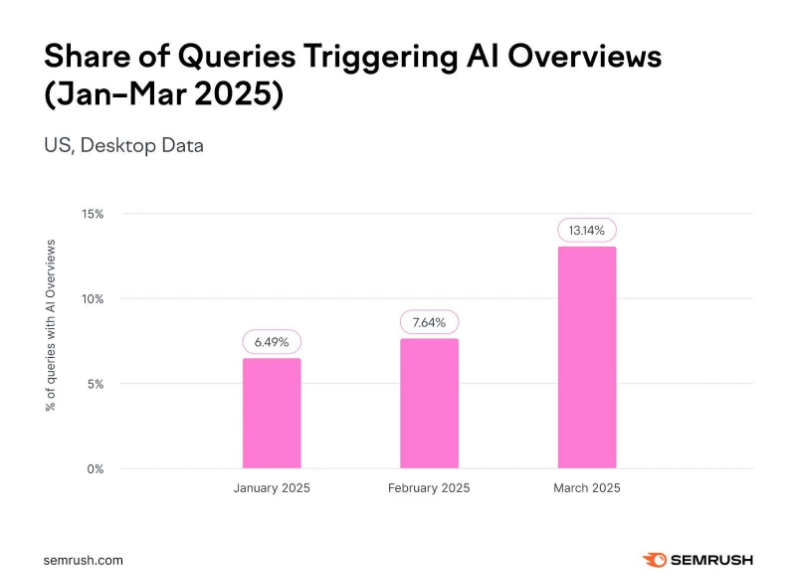
Share of queries triggering AI overviews Jan-Mar 2025


This means getting your content recommended by these AIs – a practice called Answer Engine Optimization (AEO), also called Generative Engine Optimization (GEO) – has quickly become a priority for brands that want to stay visible. You need to be the go-to answer when your audience turns to AI for help.  

But a Search Engine Land study of nearly 8,000 AI citations shows just how fragmented the ecosystem is:

  • ChatGPT leans heavily on sites like Wikipedia and Reddit
  • Perplexity diversifies across news publishers and niche blogs
  • Google’s AI Overviews mix in Reddit, Quora, and authoritative domains

The takeaway? AI answer engines are black boxes that change often, and it’s hard to keep up with where and how you’ll get cited. But one thing remains unchanged: web performance still matters.  

If your website isn’t fast, stable, and reliable, you’ll reduce your chances of being cited. AI systems pull from multiple sources, and performance is one factor that can determine whether your page is included in those answers.  

SEO vs AEO: Shared foundations, new challenges

SEO isn’t going away. The fundamentals (quality content, smart keyword use, structured data, and Core Web Vitals) remain essential.

But AEO raises the bar:

  • AI assistants give fewer answers. Instead of ten links, users may see one or two citations. You want to be one of them.
  • AI crawlers are selective: Many use lightweight crawling. They don’t reliably execute heavy JavaScript and won’t wait long for slow-loading content.
  • Zero-click search is real. In SEO, clicks to your site are the primary measure of success. But with AEO, zero-click answers are common – AI engines might give the user what they need right inside the interface, without anyone visiting your page. That means your brand’s visibility depends on being cited, not just ranked.

Why performance still matters in AI search

When it comes to being seen by AI, performance isn’t a bonus—it’s a baseline. Here’s why it still matters more than ever:

  • Speed = visibility. Google already factors speed into SEO rankings. AI answer engines need speed even more to generate responses in real time. A slow site can lose its chance at being considered.
  • Stability = trust. Sites that render smoothly and reliably keep users engaged and signal quality to AI systems.
  • Global reach = inclusivity. AI searches come from everywhere. If your site only performs well locally, you risk being excluded from global answers.

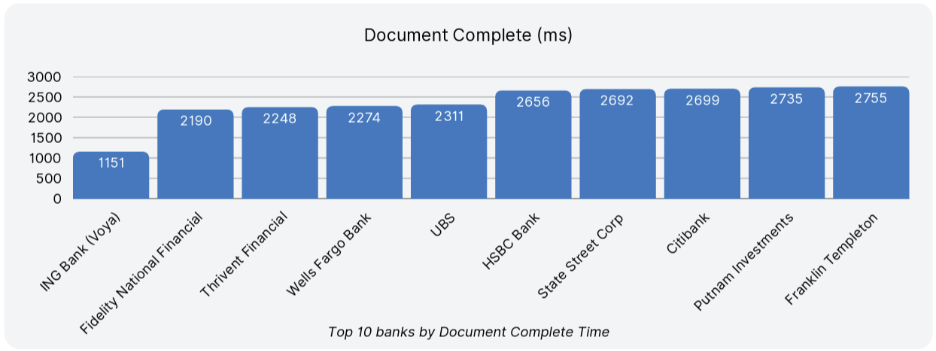
Catchpoint’s Banking Website Benchmark Report showed that only 1 in 4 banks delivered pages in under 3 seconds despite nearly perfect uptime.  
A graph of a documentAI-generated content may be incorrect.

Banking Website Benchmark Report 2025

2025 Banking Website Benchmark Report: Top 10 banks by Document Complete

The winners weren’t just online; they were consistently fast everywhere. And it’s not just banking. Our industry benchmark reports show the same trend across retail, SaaS, and travel.  

How to optimize your website performance for SEO and AEO

Optimizing web performance is important for both SEO and AI SEO.  Here’s a roadmap to improve your website’s performance.  

1. Measure and monitor your performance continuously

You can’t improve what you don’t measure. Begin by benchmarking your site’s speed and responsiveness across geographies, devices, and networks using WebPageTest. Run tests to track your performance metrics and test your critical user journeys to identify potential issues.

Combine real-user monitoring data with synthetic tests to get a full picture of your site’s health. This approach lets you see how real visitors experience your pages and also catch issues proactively in a controlled environment. The goal is to have eyes on your website’s performance 24/7, so you can spot and fix small slowdowns before they snowball.  

For teams juggling both proactive testing and real-world data, the WebPageTest Expert Plan offers a unified way to combine synthetics with real user monitoring (RUM) for full visibility.
2. Tackle the usual suspects

  • Server response (TTFB): Time to First Byte (TTFB) is how long it takes your server to respond after a request is made. If this is slow, everything else will be too. Speed up backend processes, cache aggressively, and use a CDN to reduce latency.
  • Heavy assets: Compress images, switch to modern formats (WebP/AVIF), and lazy-load below-the-fold content.
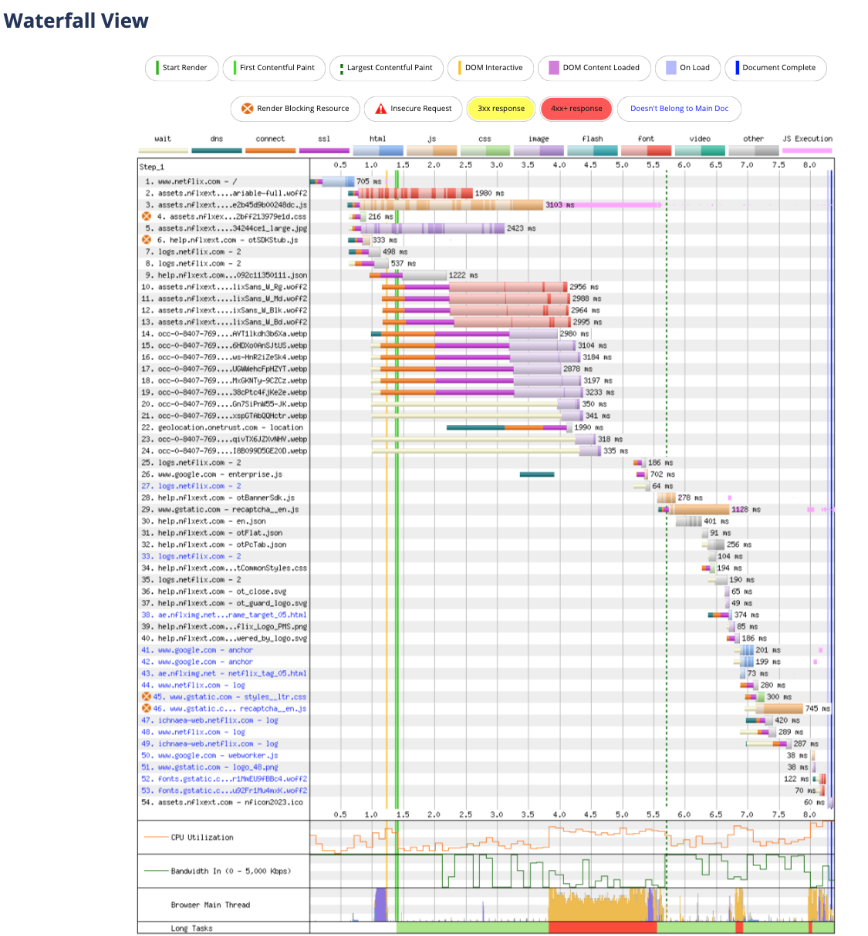
  • Render-blocking resources: A quick look at the WebPageTest waterfall chart can reveal exactly which CSS or JavaScript files are slowing down the first paint. It’s a favorite among performance engineers because it shows the loading order of every resource, making it easy to spot what’s blocking rendering. Once identified, defer or async non-critical scripts, and inline critical CSS to help content appear faster.

WebPageTest waterfall chart for a leading streaming platform, tested from Amsterdam on August 7, 2025, using Chrome


  • Third-party scripts: Audit frequently — ads, analytics, and widgets can slow you down.
  • Core Web Vitals: Focus on Largest Contentful Paint (LCP), Cumulative Layout Shift (CLS), and responsiveness (INP). These metrics aren’t just SEO signals — they also make your site more AI-friendly.

3. Don’t forget the backbone

DNS lookups, CDN routing, and TLS handshake times all impact how quickly your site loads. A sluggish DNS could mean you’re left out of the answer entirely. DNS plays a bigger role than most people realize.  

To dive deeper, join us on September 24th for our webinar “Beyond SEO: How DNS Impacts AI Search and Web Performance” with Matthew Bowes (Metamend) and Terry Bernstein (IBM NS1 Connect). We’ll explore how DNS and performance together shape your visibility in today’s AI-powered search world.

4. Keep monitoring and improving

Web performance isn’t a one-and-done project. Every new script, image, or design tweak can tip the scales. Continuous monitoring with synthetic + RUM, combined with smart alerting, ensures you catch regressions and fix issues before they affect experience or search ranking.

Wrapping it up

SEO isn’t dead — it’s evolving. AEO means your site must be discoverable and deliver a great experience instantly. High-quality, authoritative content paired with fast, stable, and trustworthy pages gets prioritized by answer engines.

AI search may feel like a black box that changes often. But performance is a constant you can control. By measuring performance from all angles, fixing bottlenecks, and monitoring continuously, you’ll protect both your rankings and your brand’s visibility in AI-driven search.

Learn more

  • Register for our webinar “Beyond SEO: How DNS Impacts AI Search and Web Performance” with Matthew Bowes (Metamend) and Terry Bernstein (IBM NS1 Connect). [insert link]

Summary

Search isn’t what it used to be. The way people discover information online is shifting. Instead of clicking through search results, many now ask AI answer engines like ChatGPT and Perplexity to do the research for them.  

In March 2025, 13.1% of Google desktop searches featured AI Overviews— doubling from over 6% in January, according to Semrush analysis of 10+ million queries. Meanwhile, Gartner predicts that by 2026, a quarter of all search traffic will shift to AI assistants, with ChatGPT alone already serving 400+ million users each week.

Share of queries triggering AI overviews Jan-Mar 2025


This means getting your content recommended by these AIs – a practice called Answer Engine Optimization (AEO), also called Generative Engine Optimization (GEO) – has quickly become a priority for brands that want to stay visible. You need to be the go-to answer when your audience turns to AI for help.  

But a Search Engine Land study of nearly 8,000 AI citations shows just how fragmented the ecosystem is:

  • ChatGPT leans heavily on sites like Wikipedia and Reddit
  • Perplexity diversifies across news publishers and niche blogs
  • Google’s AI Overviews mix in Reddit, Quora, and authoritative domains

The takeaway? AI answer engines are black boxes that change often, and it’s hard to keep up with where and how you’ll get cited. But one thing remains unchanged: web performance still matters.  

If your website isn’t fast, stable, and reliable, you’ll reduce your chances of being cited. AI systems pull from multiple sources, and performance is one factor that can determine whether your page is included in those answers.  

SEO vs AEO: Shared foundations, new challenges

SEO isn’t going away. The fundamentals (quality content, smart keyword use, structured data, and Core Web Vitals) remain essential.

But AEO raises the bar:

  • AI assistants give fewer answers. Instead of ten links, users may see one or two citations. You want to be one of them.
  • AI crawlers are selective: Many use lightweight crawling. They don’t reliably execute heavy JavaScript and won’t wait long for slow-loading content.
  • Zero-click search is real. In SEO, clicks to your site are the primary measure of success. But with AEO, zero-click answers are common – AI engines might give the user what they need right inside the interface, without anyone visiting your page. That means your brand’s visibility depends on being cited, not just ranked.

Why performance still matters in AI search

When it comes to being seen by AI, performance isn’t a bonus—it’s a baseline. Here’s why it still matters more than ever:

  • Speed = visibility. Google already factors speed into SEO rankings. AI answer engines need speed even more to generate responses in real time. A slow site can lose its chance at being considered.
  • Stability = trust. Sites that render smoothly and reliably keep users engaged and signal quality to AI systems.
  • Global reach = inclusivity. AI searches come from everywhere. If your site only performs well locally, you risk being excluded from global answers.

Catchpoint’s Banking Website Benchmark Report showed that only 1 in 4 banks delivered pages in under 3 seconds despite nearly perfect uptime.  

A graph of a documentAI-generated content may be incorrect.

Banking Website Benchmark Report 2025

2025 Banking Website Benchmark Report: Top 10 banks by Document Complete

The winners weren’t just online; they were consistently fast everywhere. And it’s not just banking. Our industry benchmark reports show the same trend across retail, SaaS, and travel.  

How to optimize your website performance for SEO and AEO

Optimizing web performance is important for both SEO and AI SEO.  Here’s a roadmap to improve your website’s performance.  

1. Measure and monitor your performance continuously

You can’t improve what you don’t measure. Begin by benchmarking your site’s speed and responsiveness across geographies, devices, and networks using WebPageTest. Run tests to track your performance metrics and test your critical user journeys to identify potential issues.

Combine real-user monitoring data with synthetic tests to get a full picture of your site’s health. This approach lets you see how real visitors experience your pages and also catch issues proactively in a controlled environment. The goal is to have eyes on your website’s performance 24/7, so you can spot and fix small slowdowns before they snowball.  

For teams juggling both proactive testing and real-world data, the WebPageTest Expert Plan offers a unified way to combine synthetics with real user monitoring (RUM) for full visibility.

2. Tackle the usual suspects

  • Server response (TTFB): Time to First Byte (TTFB) is how long it takes your server to respond after a request is made. If this is slow, everything else will be too. Speed up backend processes, cache aggressively, and use a CDN to reduce latency.
  • Heavy assets: Compress images, switch to modern formats (WebP/AVIF), and lazy-load below-the-fold content.
  • Render-blocking resources: A quick look at the WebPageTest waterfall chart can reveal exactly which CSS or JavaScript files are slowing down the first paint. It’s a favorite among performance engineers because it shows the loading order of every resource, making it easy to spot what’s blocking rendering. Once identified, defer or async non-critical scripts, and inline critical CSS to help content appear faster.

WebPageTest waterfall chart for a leading streaming platform, tested from Amsterdam on August 7, 2025, using Chrome


  • Third-party scripts: Audit frequently — ads, analytics, and widgets can slow you down.
  • Core Web Vitals: Focus on Largest Contentful Paint (LCP), Cumulative Layout Shift (CLS), and responsiveness (INP). These metrics aren’t just SEO signals — they also make your site more AI-friendly.

3. Don’t forget the backbone

DNS lookups, CDN routing, and TLS handshake times all impact how quickly your site loads. A sluggish DNS could mean you’re left out of the answer entirely. DNS plays a bigger role than most people realize.  

To dive deeper, join us on September 24th for our webinar “Beyond SEO: How DNS Impacts AI Search and Web Performance” with Matthew Bowes (Metamend) and Terry Bernstein (IBM NS1 Connect). We’ll explore how DNS and performance together shape your visibility in today’s AI-powered search world.

4. Keep monitoring and improving

Web performance isn’t a one-and-done project. Every new script, image, or design tweak can tip the scales. Continuous monitoring with synthetic + RUM, combined with smart alerting, ensures you catch regressions and fix issues before they affect experience or search ranking.

Wrapping it up

SEO isn’t dead — it’s evolving. AEO means your site must be discoverable and deliver a great experience instantly. High-quality, authoritative content paired with fast, stable, and trustworthy pages gets prioritized by answer engines.

AI search may feel like a black box that changes often. But performance is a constant you can control. By measuring performance from all angles, fixing bottlenecks, and monitoring continuously, you’ll protect both your rankings and your brand’s visibility in AI-driven search.

Learn more

  • Register for our webinar “Beyond SEO: How DNS Impacts AI Search and Web Performance” with Matthew Bowes (Metamend) and Terry Bernstein (IBM NS1 Connect). [insert link]

This is some text inside of a div block.

You might also like

SRE Report: AI optimism and the economics of effort

SRE Report 2026: What surprised us, what didn't, and why the gaps matter most

The SRE Report 2026: Defensible Ns