


This week we launched Supabase Storage, which leaves one other huge piece of the stack that everyone is asking for: Functions.
We're not releasing Functions today. Trust us, we know you want them. They are coming, just not today.
But we are building something that we think you're going to like: Workflows. We haven't finished building it yet, but Workflows are a "piece" of the Function story and arguably an even more exciting feature.
Firebase functions are relatively simple. If you use Serverless, AWS Lambda, Cloudflare Workers, Next.js API routes, or Netlify Functions, then you know how they work. A Firebase function executes some code which you provide, without you managing a server.
Specifically for Firebase, they have another key feature - they can be triggered by database events. For example, you can trigger a function whenever a Firestore Document is updated.
This is great, but it is still limited for a few real-world use cases. For example, what if you want to send an email to a user one day after a user signs up. Or one year? There is no queuing functionality in Firebase. You'd have to manage a process like this yourself, probably using a cron-job.
We searched for some open source tools which we think are solving this problem well. We looked at NodeRed, n8n, Airflow, and about 10 other tools. They are amazing tools on their own, but for the Supabase Stack they ultimately had the same shortcomings that we found with Storage providers - most of them lacked deep Postgres integration.
We went back to the drawing board and asked, "if we could wave a wand and get the perfect solution, what would it look like?". The tool that came very close is AWS Step Functions. The only problem: it's not open source. Luckily, their state language is.
Using this states language, we are building an open source orchestration engine for managing very complex Workflows with queueing, etc. It will be built with Elixir.
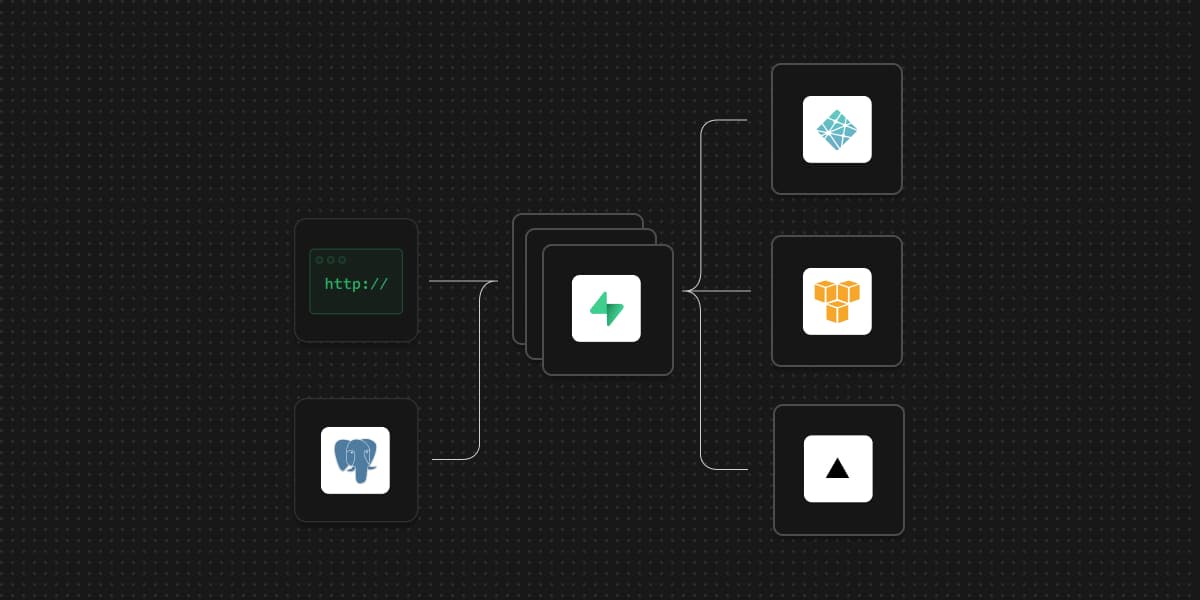
This engine won't execute code. Instead, it will coordinate and execute existing functions wherever they live: AWS, GCP, Azure, OpenFaas, and of course Postgres.
We plan to add "modules" which work natively: email services, notification services, and other platforms.
The engine is deeply integrated with Postgres. Jobs, queues, and logs will be stored and accessible by SQL. We'd like to give a shoutout to the Oban team here, their robust job processing was a big missing piece for the engine. And most importantly, it's backed by Postgres!
Once ready, we will make this available in the Supabase Dashboard with a Zapier-like interface.
Workflows orchestrate and execute functions in response to a database event (insert, update, delete) or a HTTP call (direct invocation).
You can use them to rapidly develop microservices (once we have functions) without worrying about servers.
Workflows are stateless - the output of a state becomes the input of the next state.
Workflows are defined using Amazon States Languages, so you can import your workflows from AWS (although we are still building handlers for most AWS resources).
Workflows can be persistent (the default). This means they are tolerant to server restarts, but it also means they need to use the database to store their state.
Workers can be transient. These are fully in-memory if you don't want to store the execution state (for example, IoT applications that trigger workflows very often). Transient workflows are not restarted if the server crashes or is restarted.
A typical use-case for workflows is sending emails. For example, you might want to send a user an email one day after they
sign up. In database terms we can say: "trigger an email workflow whenever there is an insert on the users table."
Let's break this down into steps, then tie it all together at the end:
Sending an email#
_10
SendEmail:
_10
Type: Task
_10
Next: Complete
_10
Resource: my-email-service
_10
Parameters:
_10
api_key: my-api-key
_10
template_id: welcome-email
_10
payload:
_10
name.$: '$.record.name'
_10
email.$: '$.record.email'
Here we have a "Task" which triggers a call to an email service (like Mailgun or Postmark). Specifically, it's telling
the service to send the welcome-email template, and it's providing it a name and an email as parameters.
Waiting a day#
Since we don't want to send the email immediately, we need to tell Workflows to wait one day
_10
WaitOneDay:
_10
Type: Wait
_10
Next: SendEmail
_10
Seconds: 86400
Here "one day" is specified in seconds.
Trigger on insert#
We mentioned that you could trigger a workflow whenever there is an "insert" on the users table. But what if you insert
multiple users at once? Not a problem - we can loop through all the inserts with a Map:
_14
EmailUsers:
_14
Type: Map
_14
End: true
_14
InputPath: '$.changes'
_14
Iterator:
_14
StartAt: CheckInsert
_14
States:
_14
CheckInsert:
_14
Type: Choice
_14
Default: Complete
_14
Choices:
_14
- Variable: '$.type'
_14
StringEquals: INSERT
_14
Next: WaitOneDay
In this part, we have a task "EmailUsers", which iterates through all the database events ($.changes) and checks if they are INSERTs.
Tying it all together#
Let's see how it looks all together:
_34
---
_34
Comment: Email users after one day
_34
StartAt: EmailUsers
_34
States:
_34
EmailUsers:
_34
Type: Map
_34
End: true
_34
InputPath: '$.changes'
_34
Iterator:
_34
StartAt: CheckInsert
_34
States:
_34
CheckInsert:
_34
Type: Choice
_34
Default: Complete
_34
Choices:
_34
- Variable: '$.type'
_34
StringEquals: INSERT
_34
Next: WaitOneDay
_34
WaitOneDay:
_34
Type: Wait
_34
Next: SendEmail
_34
Seconds: 86400
_34
SendEmail:
_34
Type: Task
_34
Next: Complete
_34
Resource: send-templated-email
_34
Parameters:
_34
api_key: my-api-key
_34
template_id: welcome-email
_34
payload:
_34
name.$: '$.record.name'
_34
email.$: '$.record.email'
_34
Complete:
_34
Type: Succeed
The workflow receives the following JSON data from Supabase Realtime:
_36
{
_36
"changes": [
_36
{
_36
"columns": [
_36
{
_36
"flags": ["key"],
_36
"name": "id",
_36
"type": "int8",
_36
"type_modifier": 4294967295
_36
},
_36
{
_36
"flags": [],
_36
"name": "name",
_36
"type": "text",
_36
"type_modifier": 4294967295
_36
},
_36
{
_36
"flags": [],
_36
"name": "email",
_36
"type": "text",
_36
"type_modifier": 4294967295
_36
}
_36
],
_36
"commit_timestamp": "2021-03-17T14:00:26Z",
_36
"record": {
_36
"id": "101492",
_36
"name": "Alfred",
_36
"email": "alfred@example.org"
_36
},
_36
"schema": "public",
_36
"table": "users",
_36
"type": "INSERT"
_36
}
_36
],
_36
"commit_timestamp": "2021-03-17T14:00:26Z"
_36
}
We've already open sourced the Workflow interpreter here. It's built with Elixir, so you can find it on Hex here.
After we've ironed out a few bugs we will integrate it into the Supabase Stack. As with all Supabase features, we'll add a nice UI to make prototyping extremely rapid. We'll integrate the UI with the code (via Git) to make sure everything is version controlled.