



The MSI MPG 322UR QD-OLED X24 is an update to the well-received MPG 322URX (reviewed here).
At a glance, the MPG 322UR QD-OLED X24 looks like a straightforward refresh of the MPG 322URX QD-OLED, retaining the same 32-inch, 4K, 240 Hz QD-OLED formula, but it actually brings a meaningful generational upgrade. The key change is the adoption of Samsung's newer QD-OLED panel, which delivers higher full-screen brightness, improved HDR behavior, and better perceived contrast in brighter environments, while also addressing some of the quirks of earlier QD-OLED implementations. MSI has paired that with updated image processing and a more advanced OLED Care 3.0 system with a presence sensor, aimed at reducing burn-in risk during real-world use. The result is not a fundamentally different monitor but a more mature and refined version of the same concept, which is exactly why the X24 warrants a fresh look.
The MSI MPG 322UR QD-OLED X24 uses Samsung Display's fourth generation QD-OLED panel technology. It retains the triangular subpixel layout found in earlier QD-OLED generations, but at the native 4K resolution of 3840×2160 and a pixel density of roughly 140 PPI, the subpixel structure is fine enough that color fringing is negligible in daily use. I used this monitor for extended text-heavy workloads and fringing never drew my attention. The combination of 4K resolution and 140 PPI produces some of the sharpest text I have seen on a 32-inch OLED monitor.
The panel structure itself also changes. Samsung Display describes it as a five-layer tandem OLED (not to be confused with LG's tandem OLED technology) with EL Gen 3 emissive materials. The blue OLED light source is built from several layers stacked on top of each other, spreading the electrical load and enabling higher SDR and HDR brightness with less stress per layer. On top of the stack sits the familiar quantum dot conversion layer that turns part of the blue light into red and green, resulting in higher color volume, cleaner saturated colors, and lower power draw at typical brightness levels.
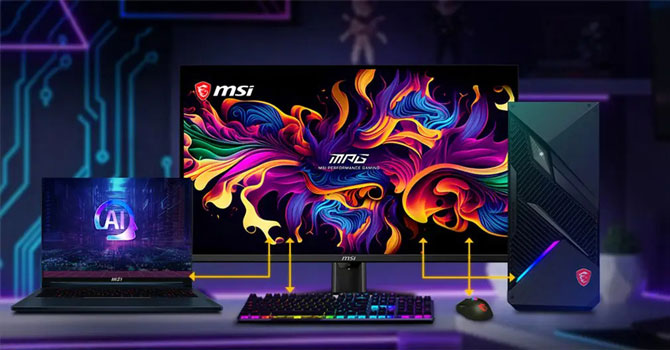
MSI wraps the new panel with DarkArmor Film, a treatment that increases surface hardness from 2H to 3H and improves light absorption. The practical effect is reduced purple tinting and better black depth under ambient lighting compared to earlier QD-OLED panels that lacked a traditional polarizer. It does not eliminate the issue entirely, but the improvement is noticeable in a moderately lit room, as we already saw in the MSI MPG 341CQR QD-OLED X36 review.
On the connectivity side, the monitor features a DisplayPort 2.1a interface with UHBR20 bandwidth. At 80 Gbps of total throughput, it can carry an uncompressed 4K signal at 240 Hz with 10-bit color depth, eliminating the need for Display Stream Compression. In practice, DSC is visually lossless for most users, but UHBR20 enables a fully uncompressed signal path, which will appeal to purists and those who prefer to avoid compression altogether. It also benefits scenarios such as NVIDIA DSR and DLDSR, which render at higher internal resolutions and then downsample to the display, assuming a GPU with full UHBR20 support. Two HDMI 2.1 ports handle 4K at 240 Hz as well, while a USB-C port with DisplayPort Alt Mode and 98 W power delivery rounds out the video input options. A 5 Gbps USB hub with two USB Type-A downstream ports and a USB Type-B upstream connection is also present.
The monitor also gains MSI's AI Care Sensor and OLED Care 3.0 from the newer generation platform, bringing presence detection, adaptive dimming, and a broader set of automated burn-in prevention tools. These were previously introduced on the aforementioned MPG 341CQR QD-OLED X36 ultrawide, and the implementation here is identical.
At $1,099, the MPG 322UR QD-OLED X24 launches for $200 less than the MPG 322URX it replaces, while offering a newer panel generation, higher rated SDR brightness, improved text clarity, and additional AI features. That is a compelling proposition, so let's see how it performs.
| MSI MPG 322UR QD-OLED X24 | |
|---|---|
| Screen Size | 31.5" |
| Native Resolution | 3840×2160 (16:9), ~140 PPI |
| Panel Technology | QD-OLED (4th generation), 10-bit |
| Refresh Rate | 240 Hz |
| Curvature | Flat |
| Screen Coating | Anti-reflection coating, rated 3H hardness |
| Supported Adaptive Synchronization | Adaptive-Sync, 48 to 240 Hz operating range |
| Brightness | SDR 300 cd/m² typical, VESA True Black 500 HDR, up to 1000 cd/m² peak highlights |
| Contrast | 1,500,000:1 (static, OLED native) |
| Viewing Angles | 178°/178° |
| Response Time | 0.03 ms GtG |
| HDR | DisplayHDR True Black 500 |
| Adjustability | Height (110 mm), tilt, swivel |
| Video Inputs | 2× HDMI 2.1, 1× DisplayPort 2.1a (UHBR20) |
| USB-C | USB-C with DP Alt Mode and 98 W power delivery |
| USB Hub | 2× USB 5 Gbps Type-A, 1× USB 5 Gbps Type-B |
| Audio | 1× 3.5 mm headphone jack |
| Speakers | No |
| VESA Mounting | 100×100 mm |
| Dimensions & Weight | 717.3 × 241.9 × 587.1 mm with stand |
| Extras | AI Care Sensor, OLED Care 3.0, DarkArmor Film, KVM, PiP/PbP, HDMI CEC, Gaming Intelligence control app |
此内容由惯性聚合(RSS阅读器)自动聚合整理,仅供阅读参考。 原文来自 — 版权归原作者所有。