
惯性聚合 高效追踪和阅读你感兴趣的博客、新闻、科技资讯
阅读原文 在惯性聚合中打开

推荐订阅源

奇客Solidot–传递最新科技情报
奇客Solidot–传递最新科技情报
L
LINUX DO - 最新话题
Recorded Future
Recorded Future
月光博客
月光博客
博客园 - 【当耐特】
博客园 - 叶小钗
宝玉的分享
宝玉的分享
量子位
雷峰网
雷峰网
博客园 - 三生石上(FineUI控件)
The Cloudflare Blog
Vercel News
Vercel News
L
LangChain Blog
B
Blog
Y
Y Combinator Blog
爱范儿
爱范儿
GbyAI
GbyAI
S
Security @ Cisco Blogs
T
The Blog of Author Tim Ferriss
A
About on SuperTechFans
博客园 - Franky
P
Palo Alto Networks Blog
Threat Intelligence Blog | Flashpoint
云风的 BLOG
云风的 BLOG
C
Cisco Blogs
Scott Helme
Scott Helme
I
Intezer
T
The Exploit Database - CXSecurity.com
MyScale Blog
MyScale Blog
T
Tor Project blog
D
Darknet – Hacking Tools, Hacker News & Cyber Security
T
Troy Hunt's Blog
N
News and Events Feed by Topic
大猫的无限游戏
大猫的无限游戏
F
Fortinet All Blogs
www.infosecurity-magazine.com
Application and Cybersecurity Blog
Cyber Security Advisories - MS-ISAC
S
Security Affairs
Cyberwarzone
Cyberwarzone
PCI Perspectives
PCI Perspectives
小众软件
小众软件
D
DataBreaches.Net
Exploit-DB.com RSS Feed
Know Your Adversary
Know Your Adversary
Forbes - Security
Forbes - Security
S
Securelist
cs.CV updates on arXiv.org
C
Cyber Attacks, Cyber Crime and Cyber Security
The Last Watchdog
The Last Watchdog

ByteByteGo Newsletter

AI Customer Support at Scale: The Travel Industry’s $Billion Bet How LLMs Learn to Be Helpful (RLHF vs DPO) How Microsoft Ships AI Agents at Enterprise Scale EP221: How Docker Works Under the Hood LAST CALL FOR ENROLLMENT: Become an AI Engineer - Cohort 7 Streaming vs Batch: Two Philosophies of Data Processing The Agent Loop: How AI Goes From Answering Questions to Doing Things ChatGPT vs Gemini vs Claude: How They Differ LAST CALL FOR ENROLLMENT: Become an AI Engineer - Cohort 7 Proof of Human: How to Verify a Person Is Real and Unique Multi-Region Architecture: Going Global Without Going Broke How OpenAI Delivers Low-Latency Voice AI for 900M Users Inside Thinking Machines’ Interaction Models How AI Agents Manage Memory and Avoid Forgetfulness EP220: RAG vs Graph RAG vs Agentic RAG Top Anti-Patterns to Avoid in Service Architecture Large Language Models vs Small Language Models An Ex-Meta L8’s Agentic Engineering Setup AI-Native Leaders: The Organizational Playbook for Engineering Transformation at Scale EP219: 12 Open-source LLMs Observability for Beginners: Logs, Metrics, Traces, and Everything Around Them LAST CALL FOR ENROLLMENT: Build with Claude Code - Cohort 2 How Open-Weight Models Changed the AI Landscape A Guide to AI Inference Engineering EP218: The Typical AI Agent Stack, Explained Must- Know Deployment Strategies: From Big-Bang to Progressive Delivery Love Teaching? ByteByteGo Is Hiring Part-Time AI & Engineering Instructors What Salesforce Learned from 20,000 Enterprise Agent Deployments Token Spend Out of Control? The Case for Smarter Routing EP217: Latency vs Throughput vs Bandwidth The Path of a Request: A Tour of Modern Web Architecture How OpenAI Built Its Data Agent A Practical Guide to Becoming an AI-Native Engineer How DoorDash Built a Testing System to Evaluate LLMs Must-Know Failure Modes in Distributed Systems How Airtable Built the Search Layer Behind Their AI Features How Vercel Cut Build Wait Times From 90 Seconds To 5 How CockroachDB Built Vector Indexing at Scale EP216: RAGs vs Agents 🚀 New cohort based course launch: Build with Claude Code A Guide to Async Patterns in API Design How Netflix is Using Multimodal AI to Power Video Search How Snapchat Serves a Billion Predictions Per Second How Grab is Using AI Agents to Boost Team Productivity EP215: The Anatomy of an AI Agent LAST CALL FOR ENROLLMENT: Become an AI Engineer - Cohort 6 A Guide To Event-Driven Architectural Patterns High Performance Rate Limiting at Databricks How Figma Upgraded Data Pipeline from Multi-Day Latency to Real-Time How Pinterest Built a Production MCP Ecosystem EP214: Claude Code vs. OpenClaw: 5 Design Dimensions Become an AI Engineer | Enrollment Ends Soon Container Design Patterns for Distributed Systems How Instacart Built a Search for Billions of Products Connecting LLMs to the Real World: Tool Use, Function Calling, and MCP A Beginner’s Guide to Kubernetes The Tech Stack Powering Wise How Stripe Detects Fraudulent Transactions Within 100 ms How Amazon Uses LLMs to Recommend Products EP212: Data Warehouse vs Data Lake vs Data Mesh B-Trees vs LSM Trees: Comparison and Trade-Offs How DoorDash Launches a New Country in One Week The Security Architecture of GitHub Agentic Workflow EP211: How the JVM Works A Guide to Relational Database Design Figma Design to Code, Code to Design: Clearly Explained How LinkedIn Feed Uses LLMs to Serve 1.3 Billion Users EP210: Monolithic vs Microservices vs Serverless Must-Know Cross-Cutting Concerns in API Development How Spotify Ships to 675 Million Users Every Week Without Breaking Things Nextdoor’s Database Evolution: A Scaling Ladder A Guide to Context Engineering for LLMs EP209: 12 Claude Code Features Every Engineer Should Know Our New Book on Behavioral Interviews Is Now Available on Amazon Database Performance Strategies and Their Hidden Costs How Datadog Redefined Data Replication How Meta Turned Debugging Into a Product How Roblox Uses AI to Translate 16 Languages in 100 Milliseconds EP208: Load Balancer vs API Gateway LAST CALL FOR ENROLLMENT: Become an AI Engineer - Cohort 5 How to Implement API Security How Anthropic’s Claude Thinks How Netflix Live Streams to 100 Million Devices in 60 Seconds How Agentic RAG Works? Last Chance to Enroll | Become an AI Engineer | Cohort-Based Course EP207: Top 12 GitHub AI Repositories Event Sourcing Explained: Benefits and Use Cases How OpenAI Codex Works
EP213: MCP vs Skills, Clearly Explained
ByteByteGo · 2026-05-02 · via ByteByteGo Newsletter

Many teams over-provision containers, underuse spot instances, and have no visibility into which pods are burning budget. Get the eBook from Datadog, which covers five practical optimizations for Kubernetes and ECS environments with specific techniques your team can apply today.

You’ll learn how to:

  • Pinpoint idle containers, over-provisioned pods, and unused clusters draining your cloud budget.

  • Right-size CPU and memory with resource requests, limits, and automated cost recommendations.

  • Cut costs up to 90% with spot instances and savings plans and know exactly when to use each

Get the eBook

This week’s system design refresher:

  • Why Everyone Should Know About AI Evals: The Fundamentals Explained (Youtube video)

  • MCP vs Skills, Clearly Explained

  • 5 Way to Defend Prompt Injection

  • How the X Algorithm Works

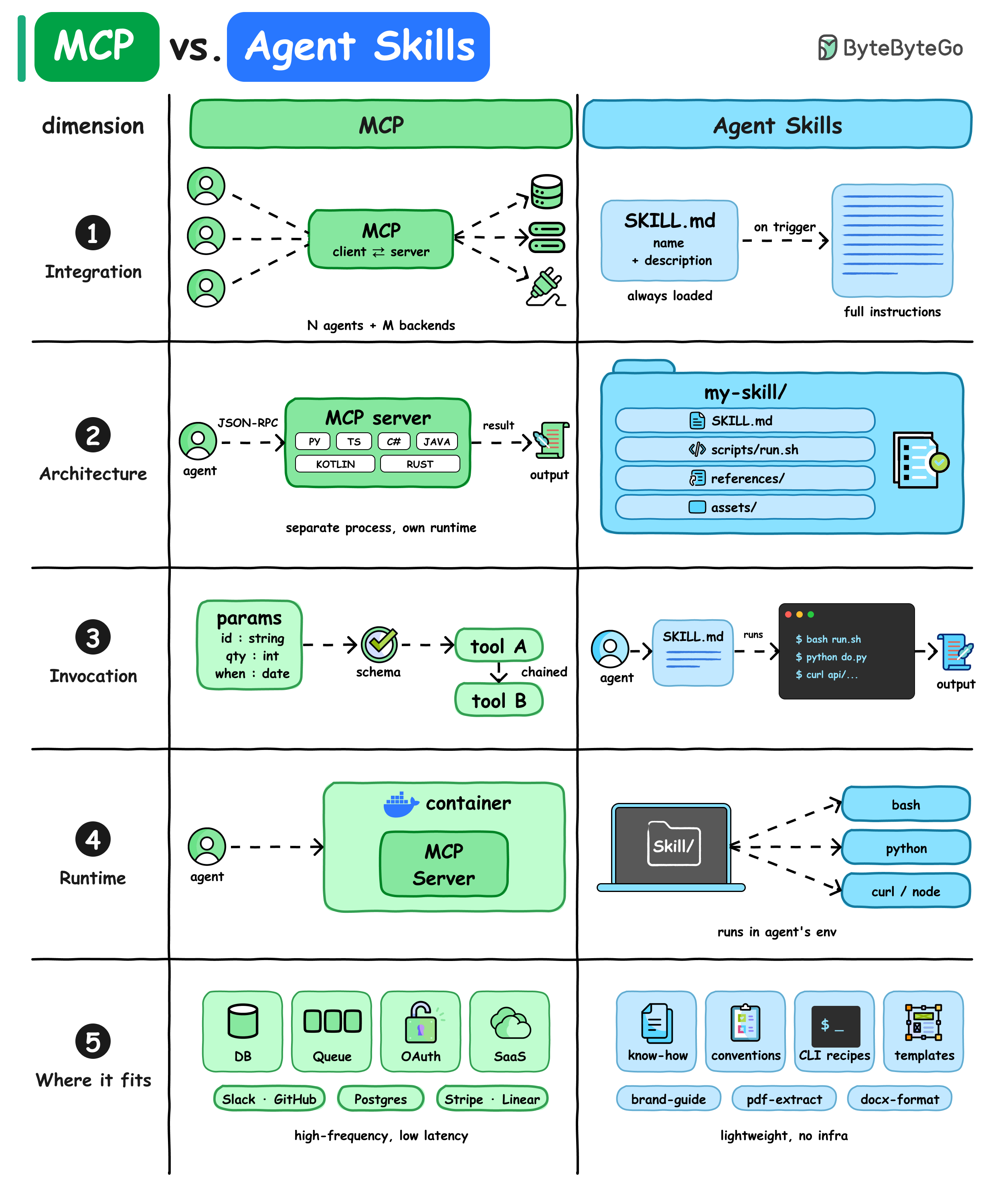
Both MCP and Skills extend what an agent can do. But they solve different problems, and picking the wrong one adds cost or complexity you don't need.

The diagram breaks down the five dimensions that matter.
Image
  1. Integration: MCP is a client-server protocol that connects N agents to M backends through one interface. Agent Skills are folders with a SKILL. md that the agent loads on trigger.

  2. Architecture: MCP runs as a separate process with its own runtime, speaking JSON-RPC. A Skill is just a directory: SKILL. md, optional scripts, references, and assets.

  3. Invocation: MCP tools are called with typed parameters validated against a schema, and can be chained. Skills are invoked by the agent reading SKILL. md and running whatever commands it describes like bash, python, or curl.

  4. Runtime: MCP servers often run in their own container or service. Skills run in the agent's own environment with no extra infra.

  5. Where it fits: Use MCP to connect agents to live systems and data. Use Skills to give agents reusable know-how and instructions.

Over to you: What's the most interesting Skill you've come across recently?

It’s 2026. Platform engineering is shifting. Your users aren’t just developers anymore. They’re AI agents. Plan for it.

Join IaCConf 2026 to hear from the people building this sh*ft. Hear from Corey Quinn on “AI Speaks Terraform Like a Tourist,” Matt Gowie on the move from IaC to agents, and Amin Astaneh on 10x code velocity and operational risk.

Plus: how teams replace Terraform workflows with policy-driven automation, deploy AI agents safely, and scale infrastructure with GitOps and Kubernetes.

Join IaCConf 2026, a free virtual event on May 14.

Register Now

Prompt injection tops the OWASP LLM Top 10 and there's no single fix.

Instead, you stack defenses, each one catching what the others miss.
Image

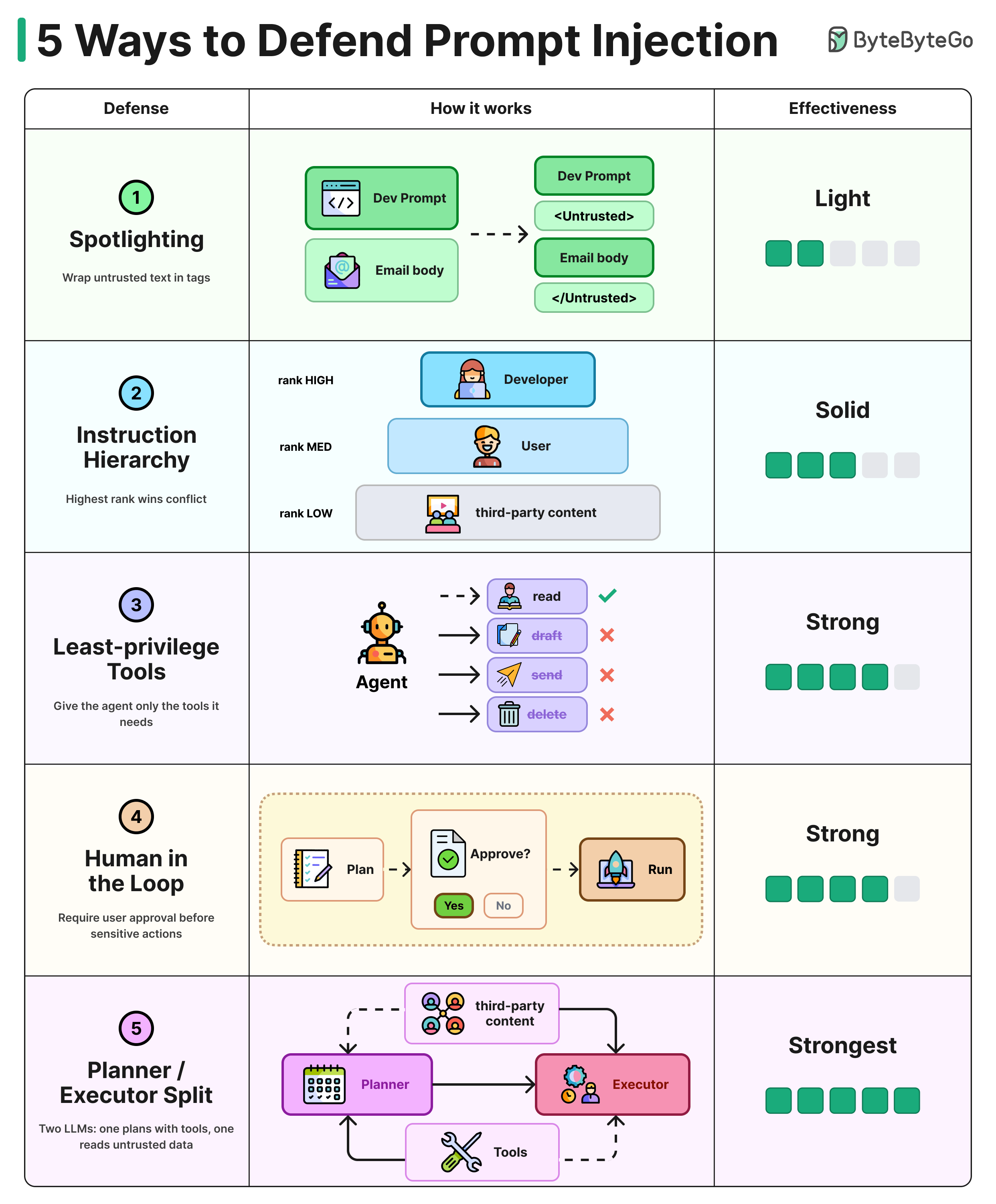
Defenses come in two families: model-level and system-level.

Model-level defenses teach the model to resist injection.

  • Spotlighting wraps untrusted text in control tags like <UNTRUSTED>...</UNTRUSTED> and tells the model to treat anything inside as data, not instructions.

  • Instruction Hierarchy fine-tunes the model to rank the developer's system prompt above the user's message, and both above third-party content.

System-level defenses build a system around the LLM that bounds the damage.

  • Least-Privilege Tools: Give the agent the minimum tools it needs.

  • Human-in-the-Loop: Require explicit user approval before any sensitive action runs.

  • Planner / Executor Split: Two separate LLMs. The planner has tool access but never sees untrusted content. The executor reads untrusted content but has no tools.

No single defense is enough. Production systems like Gmail stack them, and together they make indirect injection manageable.

Over to you: what's the one defense you've seen work in production that isn't on this list?
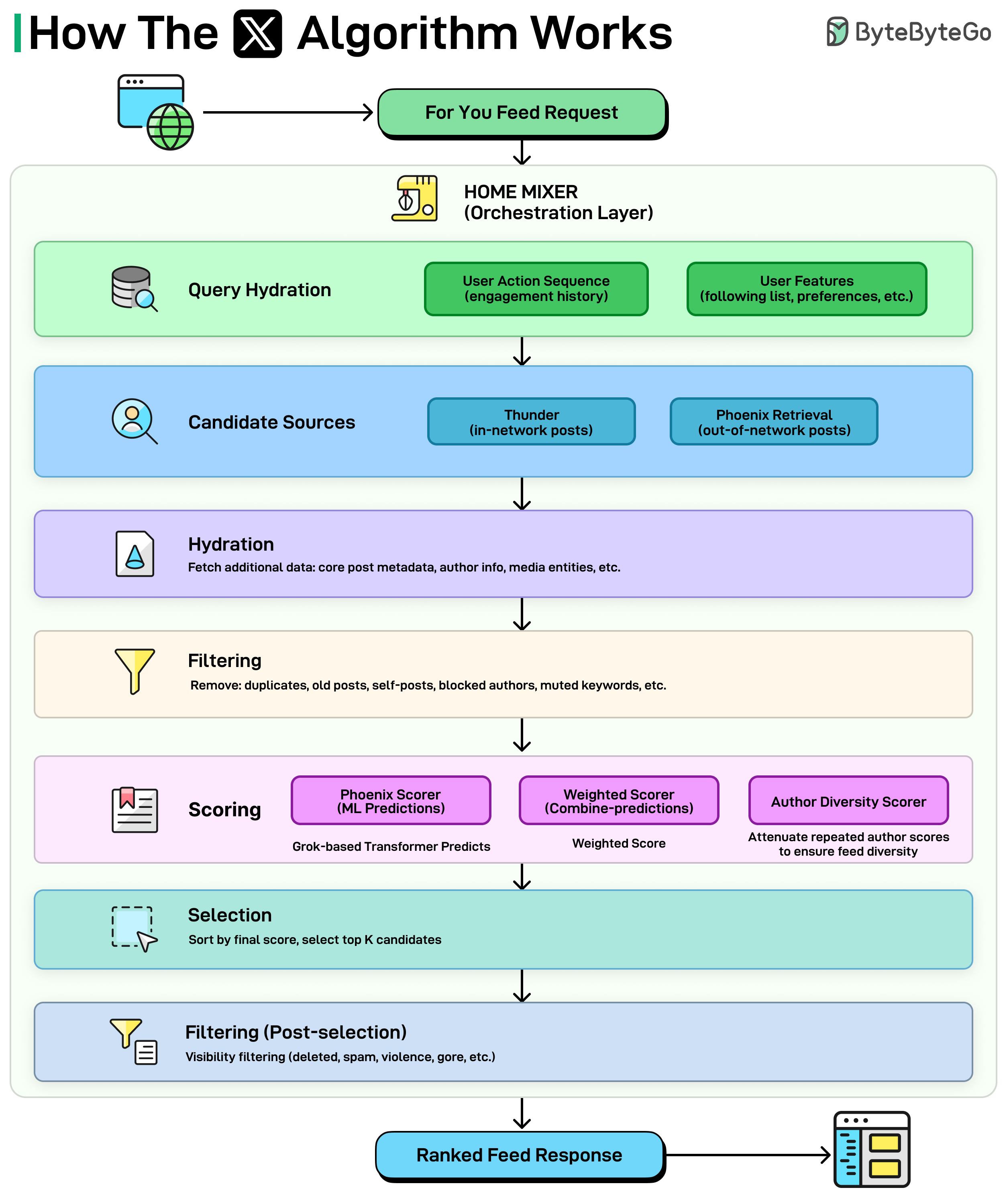
Here are the key steps:

  1. Everything starts with a Feed Request.

  2. The Home Mixer, the system’s orchestration layer, kicks things off by pulling your engagement history and preferences through Query Hydration.

  3. Next, it gathers candidate posts from two sources: Thunder (posts from accounts you follow) and Phoenix Retrieval (posts from accounts you don’t follow, discovered through ML)

  4. These candidates get enriched with metadata like author info and media details during Hydration, then pass through Filtering, which removes duplicates, old posts, blocked authors, and muted keywords.

  5. Then comes scoring. A Grok-based transformer predicts engagement, a Weighted Scorer combines those predictions, and an Author Diversity Scorer prevents any single account from dominating your feed.

  6. Top-scoring posts are selected, go through a final visibility filter, and become your Ranked Feed.

Over to you: What else will you add to the list of steps?

Disclaimer: This post is based on the publicly shared GitHub repo of the X algorithm by xAI

Discussion about this post

Ready for more?