
惯性聚合 高效追踪和阅读你感兴趣的博客、新闻、科技资讯
阅读原文 在惯性聚合中打开

推荐订阅源

Apple Machine Learning Research
爱范儿
爱范儿
博客园_首页
博客园 - 【当耐特】
V
Visual Studio Blog
博客园 - 叶小钗
月光博客
月光博客
美团技术团队
J
Java Code Geeks
小众软件
小众软件
Y
Y Combinator Blog
博客园 - Franky
Martin Fowler
Martin Fowler
博客园 - 聂微东
Microsoft Azure Blog
IT之家
IT之家
MyScale Blog
MyScale Blog
人人都是产品经理
人人都是产品经理
Microsoft Security Blog
OSCHINA 社区最新新闻
OSCHINA 社区最新新闻
阮一峰的网络日志
阮一峰的网络日志
酷 壳 – CoolShell
酷 壳 – CoolShell
钛媒体:引领未来商业与生活新知
钛媒体:引领未来商业与生活新知
云风的 BLOG
云风的 BLOG

Hacker News - Newest: "AI"

AI can't read an investor deck AI as an attorney? Student uses ChatGPT, Gemini to sue UW over alleged racial discrimination Hacking MCP Servers in AI Systems – The Rug Pull: Tool Changes After Approval GitHub - MeepCastana/KubeezCut: Free Web based video editor Can AI judge journalism? A Thiel-backed startup says yes, even if it risks chilling whistleblowers Coming soon: 10 Things That Matter in AI Right Now DARPA built an AI to fact-check enemy weapons claims What explains heterogeneity in AI adoption? When AI Meets Muscle: Context-Aware Electrical Stimulation Promises a New Way to Guide Human Movements - Department of Computer Science AI Changed How We Build. It Did Not Change What Matters. Linux rules on using AI-generated code - Copilot is OK, but humans must take 'full responsibility for the… Meta spins up AI version of Mark Zuckerberg to engage with employees Code Mode: Let Your AI Write Programs, Not Just Call Tools | TanStack Blog GitHub - Delavalom/graft: Go framework for building AI agents. Type-safe tools, multi-provider (OpenAI, Anthropic, Gemini, Bedrock), zero vendor SDKs. India's TCS tops estimates, says new AI models did not dent services demand Gen Z's fading AI hype Strong feeling: we are in a folded AI reality GitHub - machinarii/total-recall-catalog: A reference catalog of latest knowledge retrieval, memory & RAG systems GitHub - mensfeld/code-on-incus: Give each AI agent its own isolated machine with root, Docker, and systemd. Active defense detects and stops threats automatically.. Quantization, LoRA, and the 8% Problem: Benchmarking Local LLMs for Production AI Iran war: We spoke to the man making Lego-style AI videos that experts say are powerful propaganda Powell, Bessent discussed Anthropic's Mythos AI cyber threat with major U.S. banks GitHub - immartian/bellamem: Persistent belief-graph memory for AI agents. Retrieves decisive context by importance — not recency, not RAG, not /compact. recursive-mode: The Repo-Native Operating System for AI Engineering After the attack on Sam Altman's home, will AI CEO's go on the offensive? The biggest advance in AI since the LLM Opus 4.6 vs GPT 5.4 One Prompt Unity World Generation Test “AI polls” are fake polls Client Challenge Can AI be a 'child of God'? Inside Anthropic's meeting with Christian leaders
Aperture, now in beta, adds the controls teams need for A...
Remy Guercio · 2026-04-25 · via Hacker News - Newest: "AI"

The era of subsidized AI usage is ending. Agents killed it. We’ve seen two big pricing shifts over the last few weeks: third-party agents lost access to flat-rate AI plans and businesses are now paying API rates for all tokens used.

Agents broke the flat-rate model

Since we launched the original Aperture alpha a few months ago, we’ve seen a sharp increase in customers running multiple simultaneous agents per user. Agents such as Claude Code, Codex, OpenCode, or OpenClaw, use orders of magnitude more tokens than someone chatting with AI as part of a task. It’s no surprise that flat-rate plans, where casual chat usage subsidized heavy agentic workloads, are coming to an end.

To help customers manage this, we’ve rolled out a few new Aperture features to make it both more secure and more cost effective to run multiple coding and background agents.
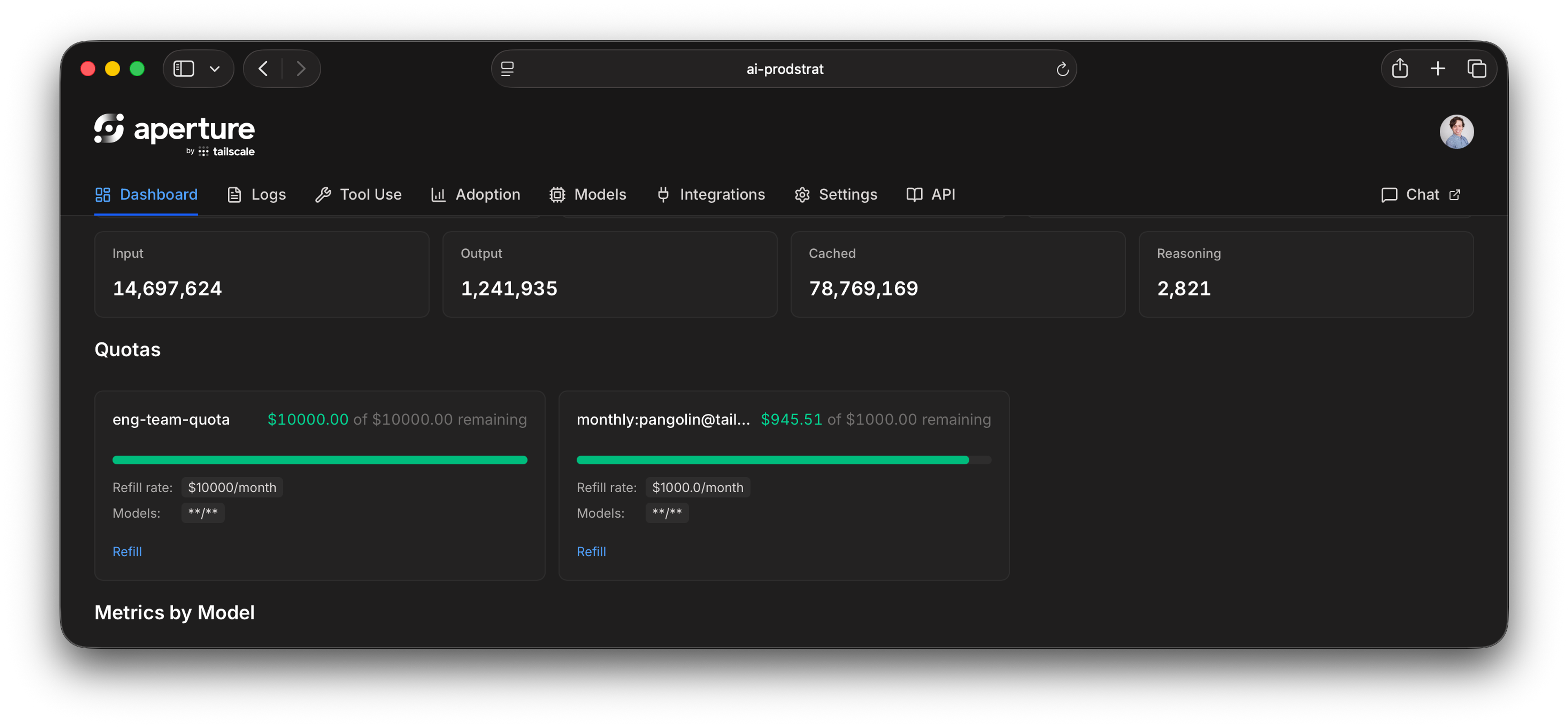
"Aperture by Tailscale" dashboard interface in dark mode, displaying usage statistics and quota limits. The top section features four large metrics for Input, Output, Cached, and Reasoning, followed by a "Quotas" section containing two cards with green progress bars indicating remaining budget for an engineering team and a monthly user account.

Customizable quotas: one budget for every provider

The best model this month might not be the best model next month. Knowing this, many engineers want access to two or more model providers. You want choice, but this comes with issues. It’s incredibly hard to control costs this way. Even more so with pricing becoming more usage-based.

Do you give users plans for multiple providers, even if they don’t use all of them? Do you rely on organization-wide cost controls and hope for the best? Do you force them to fill out a support ticket for every $100 in overage? To solve this dilemma we built quotas into Aperture. With Aperture, a single seat offers a universal quota you can apply across providers. Set budgets for users, groups, agents, or even individual agent runs, then apply them across providers, models, identities, and devices. Let active LLM users decide how to most effectively spend their allowances.

Maybe they need a state-of-the-art model for one task, but an open-source model that’s 80% cheaper does the job for another. And, if something goes off the rails, quotas can help you prevent eyebrow-raising bills, or having access cut off for the entire organization unexpectedly. Quotas can start as simple as per user and then scale across models, providers, tags, and more to meet your organization’s needs.

Quotas help control AI spend, but what about your data? When agents are running 24/7, with or without humans attached, you need a way of ensuring the most sensitive information doesn’t sneak out.

With Aperture, you can now create custom guardrails through a pre-LLM-call hook system. These hooks are designed to strip or block personally identifiable information (PII) from requests or even specific tools of an agent before they pass through Aperture to the LLM.

Eliminate the choice between visibility and data privacy

While Aperture logs and monitors all of your LLM sessions, sometimes things are so sensitive, or subject to strict compliance requirements, that you need an extra layer of control. For those cases, we’re introducing two new controls.

Extensive log retention settings

The first is extensive, customizable log retention settings. It’s now possible to reduce the retention of the full request/response capture logs down to zero (nothing written to Aperture itself), with S3-compatible export still supported.

Administrator audit logging

The second is audit logging for sensitive log access. When an administrator views logs owned by another user on an Aperture instance, that access is now recorded. Other administrators can review that history using a new API endpoint, or our web UI.
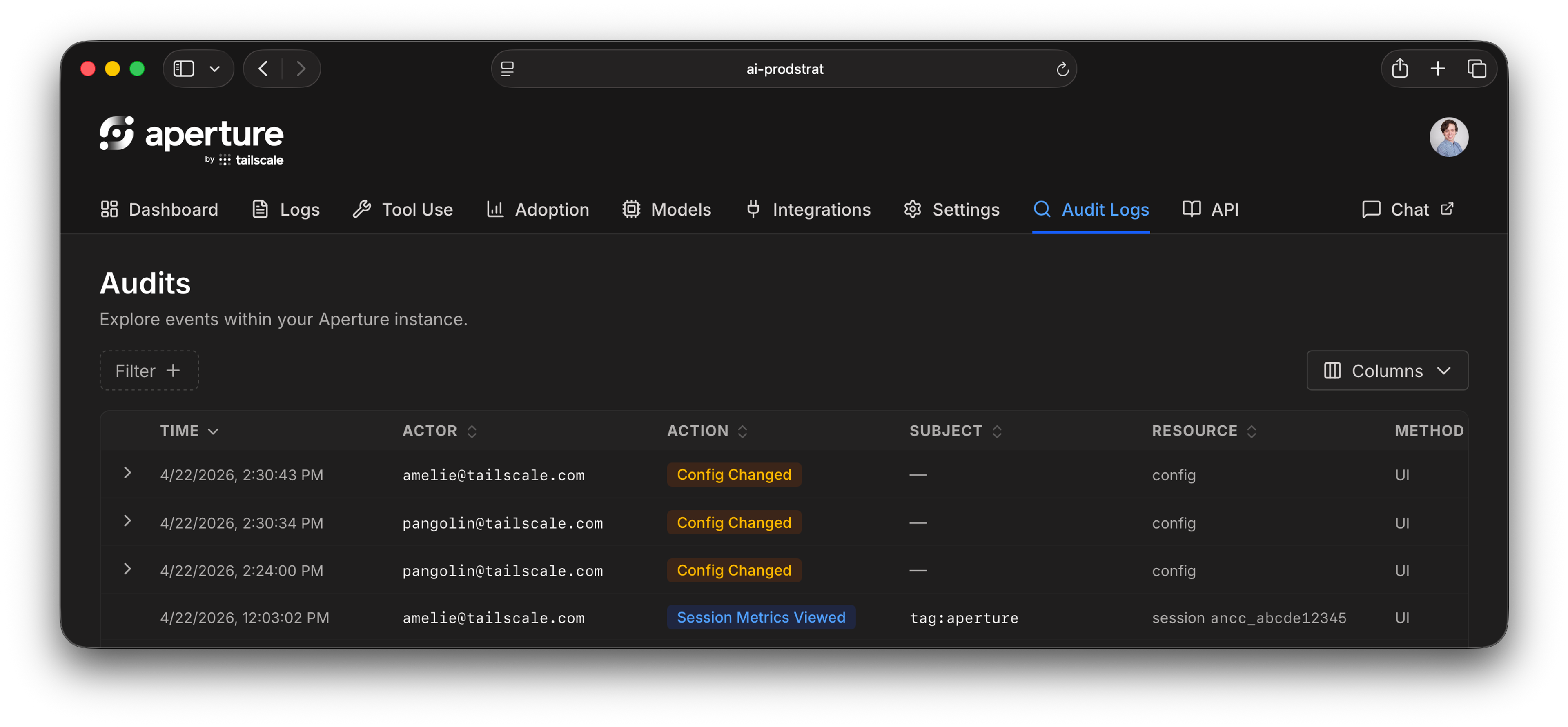
Screenshot of the Aperture by Tailscale dashboard in dark mode, showing the "Audit Logs" section. The page displays a table of recent activity with columns for Time, Actor, Action, Subject, Resource, and Method, listing events from April 2026 where users performed actions like "Config Changed" (highlighted in orange) and "Session Metrics Viewed" (highlighted in blue).

Free for individuals and small groups

Finally, a note on pricing. As Aperture moves into beta, we’re happy to announce that Aperture will be included for users on our Personal plans. So, if you’d like to sign up for Aperture, you can do so for yourself and up to five additional users (total of six) on your Personal plan.

If you’d like to use Aperture as part of a larger team, please reach out. We’ll have more public pricing information to share as we move towards general availability.