


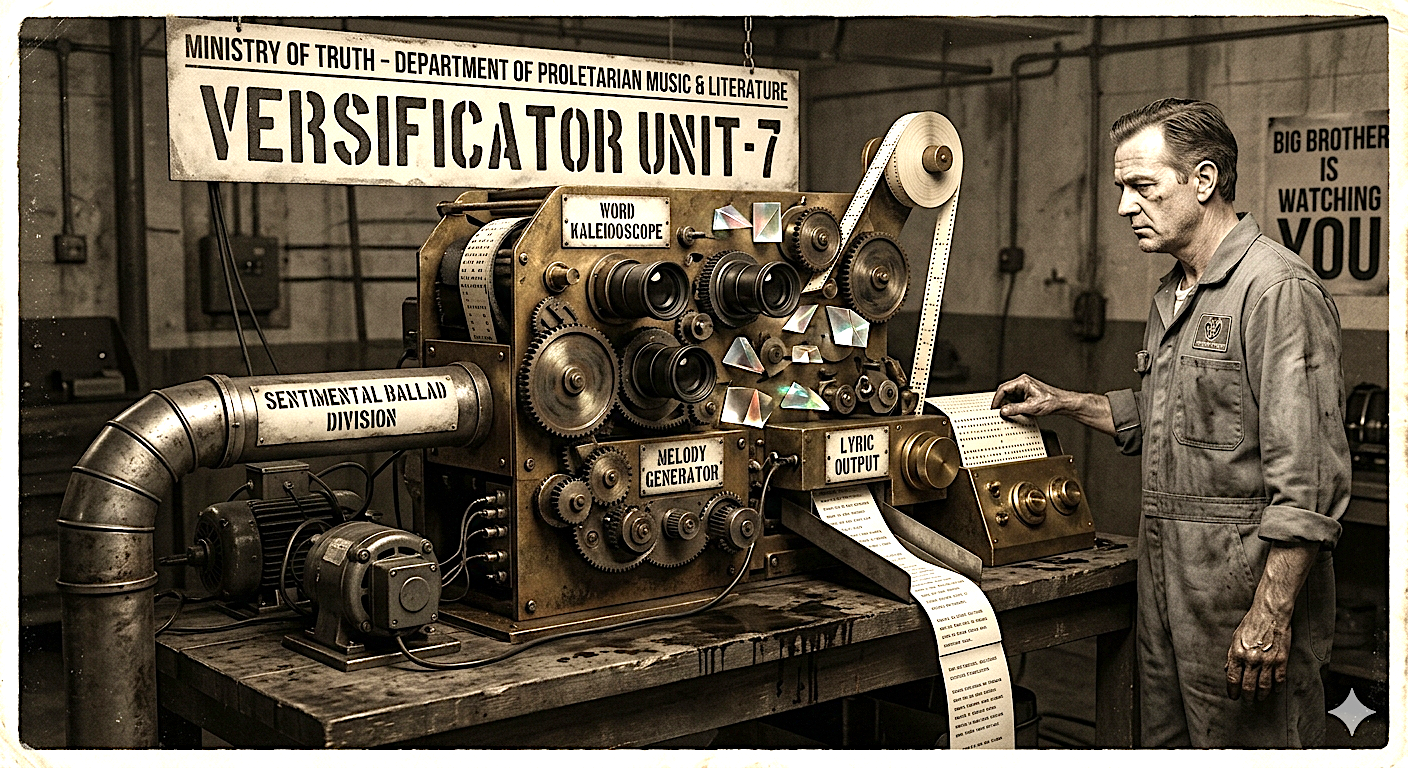
We’ve lived but a few years so far into the age when artificial intelligence can produce convincing stories, songs, essays, poems, novels, and even films. For many of us, these recently implemented functions have already come to feel necessary in our daily life, but it may surprise us to consider how many people had long assumed that computers could already perform them. That belief surely owes in part to the roles played by effectively sentient machines in popular fictions since at least the early decades of the twentieth century. Revisiting George Orwell’s Nineteen Eighty-Four, we even find a device very much like today’s large language models in use at the Ministry of Truth, the employer of protagonist Winston Smith.
Within the Ministry is “a whole chain of separate departments dealing with proletarian literature, music, drama, and entertainment generally. Here were produced rubbishy newspapers containing almost nothing except sport, crime and astrology, sensational five-cent novelettes, films oozing with sex, and sentimental songs which were composed entirely by mechanical means on a special kind of kaleidoscope known as a versificator.” Much later in the novel, Smith overhears a hit song composed on that very kaleidoscope, “without any human intervention whatever,” sung by a woman of this dystopian England’s lowest class, whose very baseness liberates it from the watchful eye that Big Brother’s vast surveillance system keeps on his ostensibly privileged Party members.
All the “proles” really require, in the view of the state, is the freedom to satisfy their vices and a steady stream of pacifying media. The extrusions of the versificator may now bring to mind the ever-increasing quantities of “AI slop,” often created with vanishingly small amounts of human intervention, whose potential to flood the internet has lately become a matter of public concern. What’s more chilling to consider is that such low-effort, high-volume content wouldn’t have attained such a presence if it weren’t genuinely popular. Much like the junk culture pumped out by the Ministry of Truth, AI slop reflects less the ill intent of (or at least neglect by) the powers that be than the undemanding nature of the public.
Perhaps we can provisionally chalk this one up in the “Orwell was right” column. It’s possible that, in light of real technological developments, even Isaac Asimov could be convinced to give it to him. Here on Open Culture, we recently featured Asimov’s critique of Nineteen Eighty-Four as a poor prophecy of the future, not least from a technological standpoint. That piece was written in 1980 at the very end of an “AI winter,” one of the fallow periods in artificial intelligence research. A boom was soon to come, but the truly astonishing developments wouldn’t happen until the twenty-twenties, about thirty years after Asimov’s death. When describing the versificator, Orwell was presumably extrapolating from the distracting, disposable entertainments of nineteen-forties England. Even if his readers couldn’t believe the idea of that sort of thing being created automatically, more than a few probably agreed with his diagnosis of its quality. Now, collective human intelligence may face its most formidable challenger, but individual human discernment has never been more valuable.
via Boing Boing
Related content:
Aldous Huxley to George Orwell: My Hellish Vision of the Future is Better Than Yours (1949)
Based in Seoul, Colin Marshall writes and broadcasts on cities, language, and culture. He’s the author of the newsletter Books on Cities as well as the books 한국 요약 금지 (No Summarizing Korea) and Korean Newtro. Follow him on the social network formerly known as Twitter at @colinmarshall.
此内容由惯性聚合(RSS阅读器)自动聚合整理,仅供阅读参考。 原文来自 — 版权归原作者所有。