







Welcome to the 550th edition of the Food for Agile Thought newsletter, shared with 35,481 peers. This week, Charity Majors rejects AI purity theater and urges disciplined workplace experiments, just make AI boring again, while Gojko Adzic warns that faster builders without product judgment will ship polished waste. Dave Hora names the organizational traps that keep teams from seeing reality, and Johanna Rothman brings the fix down to flow data and human judgment. Azeem Azhar and colleagues see AI demand rising, but Satya Nadella argues that a durable advantage comes from owning learning itself.
Next, Paweł Huryn moves AI work from prompt craft to agent loops with goals, guardrails, budgets, and independent checks, while Jeff Gothelf argues that AI pilots fail when firms bolt tools onto stale workflows. Joe Hudson adds that emotional clarity now beats knowledge hoarding, and John Cutler names fear, incentives, and executive fantasies as the real bottlenecks. David Burkus brings the pattern back to procrastination, where stress and ambiguity demand clarity without control.
Lastly, Elena Verna pushes experimentation beyond tiny UI tweaks toward larger monetization bets and longer engagement signals, as Zvi Mowshowitz warns AI policy needs calibrated safeguards rather than theater. Deborah Rim Moiso brings the same discipline to facilitation through communities that review real work, and Olivier Wulveryck applies Team Topologies to agentic platforms before shadow IT hardens. Finally, Itamar Gilad grounds the pattern in value, not misleading productivity counts.
Sooner or later, a CFO will ask what your AI use actually returns. “It saves me time” will not survive that meeting.
The first wave of AI adoption rewarded practitioners who learned to prompt. That skill still matters, and this course still teaches it. The second wave rewards something rarer: people who can turn individual AI use into knowledge that survives departures, spend that can be explained and steered, and output that organizations can trust. That work is process design and change management. You have been doing both for years, on harder problems than this.
The AI 4 Agile Online Course v3 is in English. 🇬🇧
What You Will Get:
✅ 16+ hours of self-paced video modules ✅ A cohort-hardened, proven course design ✅ Learn to 10x your effectiveness with AI; your stakeholder will be grateful ✅ Apply AI to classic use cases of “Agile” ✅ The A3 Framework, A3 Handoff Canvas, AI Definition of Done, and Delegation Retrospective as working handouts ✅ The complete MegaBrain.io case package across both acts ✅ All texts, slides, prompts, graphics; you name it ✅ Access custom GPTs, including the “Scrum Anti-Patterns Guide GTP” ✅ Guaranteed: Lifetime access to v3 ✅ AI4Agile Foundation Certificate: 40 questions in 45 minutes.

👉 Please note: The course will be available for $149 from July 20 to 27, 2026! (After that, $249.) 👈
🎓 Join the Waitlist now and be the first to know: The AI4Agile Online Course v3 — July 20, 2026, at $49 — No Coding Required!
Did you miss the previous Food for Agile Thought issue 549?
🗞 Shall I notify you about articles like this one? Awesome! You can sign up here for the ‘Food for Agile Thought’ newsletter and join 35,000-plus subscribers.
🎓 Join Stefan in one of his upcoming training classes!
Charity Majors believes AI is neither special nor pure evil, but rather powerful technology with real harms. Opting out may feel clean, but it abandons the field. Tech workers should learn, govern, and constrain AI through boring, disciplined workplace experiments, shared norms, accountability, and repair, rather than purity theater or posturing.
Gojko Adzic suggests AI will shrink teams and spread product management work everywhere. Without customer empathy, bets, prioritization, and discovery skills, faster builders will ship better-engineered junk at scale.
Dave Hora proposes four product-org traps: self-sealing narratives, stagnant motion, clinging to past success, and defensive operations. The fix starts with shared attention, reality checks, and small tests for change.
Jeff Gothelf believes AI pilots fail when companies bolt tools onto old workflows. Product management can give teams authority to redesign work, measure outcomes, and scale evidence carefully.
Paweł Huryn suggests PMs stop worshipping prompts and start defining agent loops with clear goals, guardrails, budgets, and independent checks, because fuzzy definitions of done quietly turn automation into expensive slop fast.
Elena Verna believes AI makes old experimentation playbooks obsolete: stop wasting engineering time on tiny UI tweaks, test bigger monetization bets, measure engagement over months, and skip validation for obvious basics.
Azeem Azhar and colleagues suggest AI demand is already real: revenues are growing fast, infrastructure costs may be covered, and falling token prices could expand usage rather than shrink spend.
Joe Hudson suggests AI makes emotional clarity the new career moat: discernment, conflict tolerance, failure appetite, and better self-talk now matter more than knowledge hoarding or performative busyness in teams.
Satya Nadella proposes that companies must own their learning, not rent it from frontier models. Durable AI advantage comes from human capital, token capital, digital sovereignty, and systems that compound expertise.
Zvi Mowshowitz proposes that blocking Fable 5 was messy theater: public access may return, but development keeps racing, cyber risks are real, and sane AI policy needs calibrated safeguards, not panic or wishful thinking.
The job market’s shifting. Agile roles are under pressure. AI tools are everywhere. But here’s the truth: the Agile professionals who learn how to work with AI, not against it, will be the ones leading the next wave of high-impact teams. Therefore, Stefan created the AI4Agile BootCamp.
So, become the professional recruiters‘ first call for „AI‑powered Agile.“ Be among the first to master practical AI applications for Scrum Masters, Agile Coaches, Product Owners, Product Managers, and Project Managers. The AI4Agile BootCamp is in English.
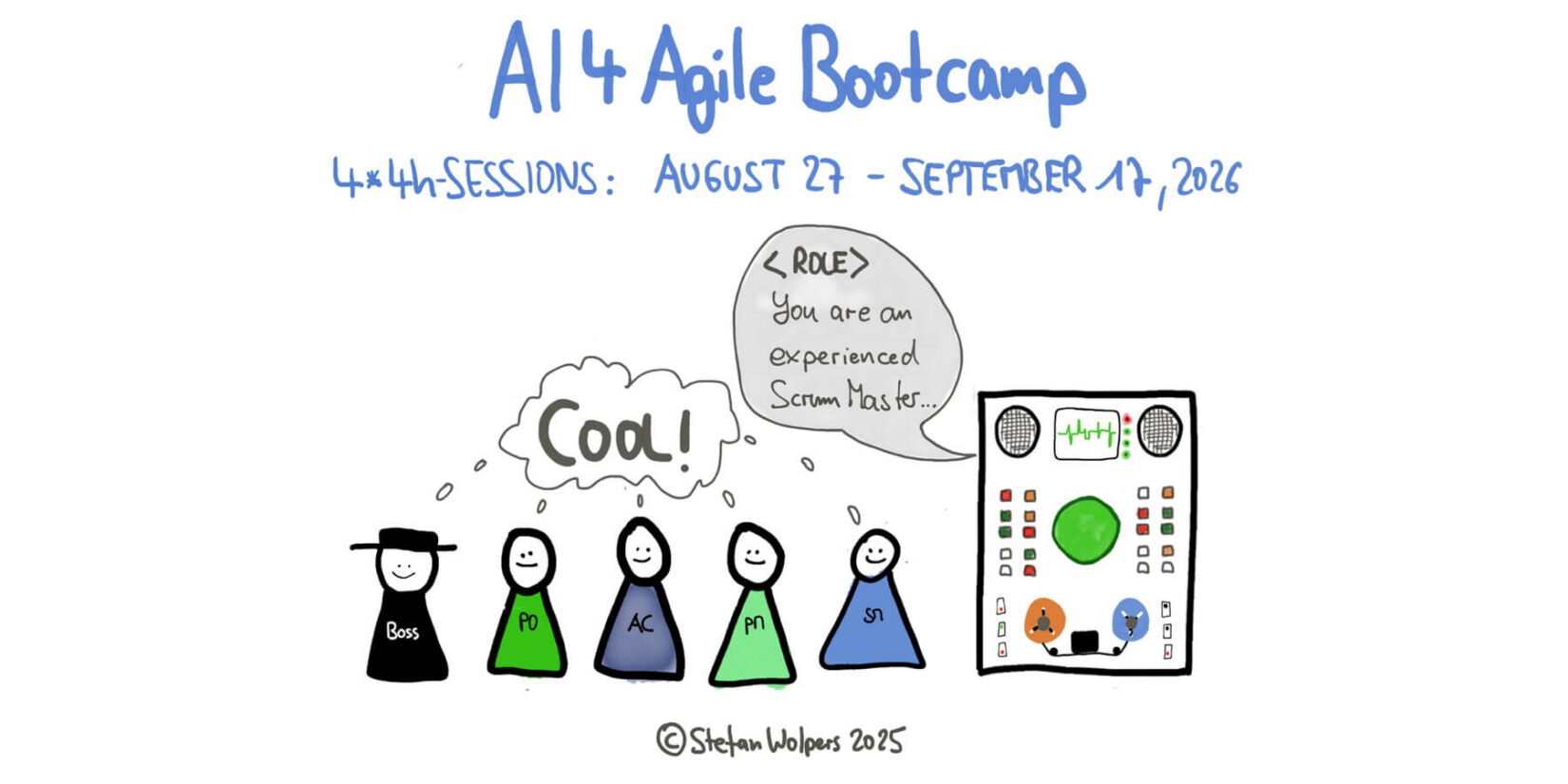
Learn more: 🖥 💯 🇬🇧 AI4Agile BootCamp #8, August 27 – September 17, 2026.
Customer Voice: “Last week, I finished the 𝗔𝗜 𝗳𝗼𝗿 𝗔𝗴𝗶𝗹𝗲 𝗣𝗿𝗮𝗰𝘁𝗶𝘁𝗶𝗼𝗻𝗲𝗿𝘀 course. And I’m mutating… It started on the train. I was scrolling through my messages, half-distracted, when a newsletter from Stefan Wolpers popped up. Stefan, a deep thinker with a hands-on attitude, was launching a new course. A pilot cohort. The mission: explore how AI can actually support us as agile practitioners. I couldn’t resist. I tapped: “𝘚𝘪𝘨𝘯 𝘶𝘱”. What followed were four bi-weekly sessions. Four intense afternoons. Full of exploration, experimentation, and practice. […] At the beginning, Stefan said that 𝘫𝘶𝘴𝘵 𝘴𝘪𝘨𝘯𝘪𝘯𝘨 𝘶𝘱 𝘢𝘭𝘳𝘦𝘢𝘥𝘺 𝘱𝘶𝘵𝘴 𝘶𝘴 𝘢𝘩𝘦𝘢𝘥 𝘰𝘧 𝘮𝘢𝘯𝘺 𝘱𝘳𝘢𝘤𝘵𝘪𝘵𝘪𝘰𝘯𝘦𝘳𝘴. That sounded like a big statement. But somewhere along the way, I noticed a shift… an emerging superpower in how I approach my tasks with AI.⚡And now, as my AI-mutation continues, I catch myself wondering: 💭 𝘏𝘰𝘸 𝘥𝘰 𝘐 𝘶𝘴𝘦 𝘈𝘐 𝘵𝘰 𝘴𝘢𝘷𝘦 𝘵𝘩𝘦 𝘢𝘨𝘪𝘭𝘦 𝘸𝘰𝘳𝘭𝘥?” (Ilya Zaytsev, Leading Agility at HUGO BOSS.)
John Cutler suggests that engineering is no longer the bottleneck in lazy theater. Product development’s real constraints are shifting conversations, incentives, coordination, fear, and executive fantasies about massive AI-driven headcount cuts.
David Burkus believes team procrastination is rarely laziness. It is usually stress, ambiguity, weak milestones, slow leadership, or fuzzy norms, so managers should create real clarity without suffocating ownership.
Johanna Rothman suggests LLMs help only when teams feed them real flow data. Use AI to visualize bottlenecks, but keep humans responsible for hard judgment, retrospectives, and messy why questions.
Your team has a Definition of Done for a product increment. It has none for the 20-plus AI-supported outputs that leave the team each week: status reports, stakeholder emails, release notes, and updates for the C-level. Each one carries your team’s name. “I know quality when I see it” is the standard most teams actually run by, and you cannot audit it, teach it to a new colleague, or defend it when a claim turns out to be wrong. The AI Definition of Done fixes that with one page per task class, agreed by the team, before the output ships.
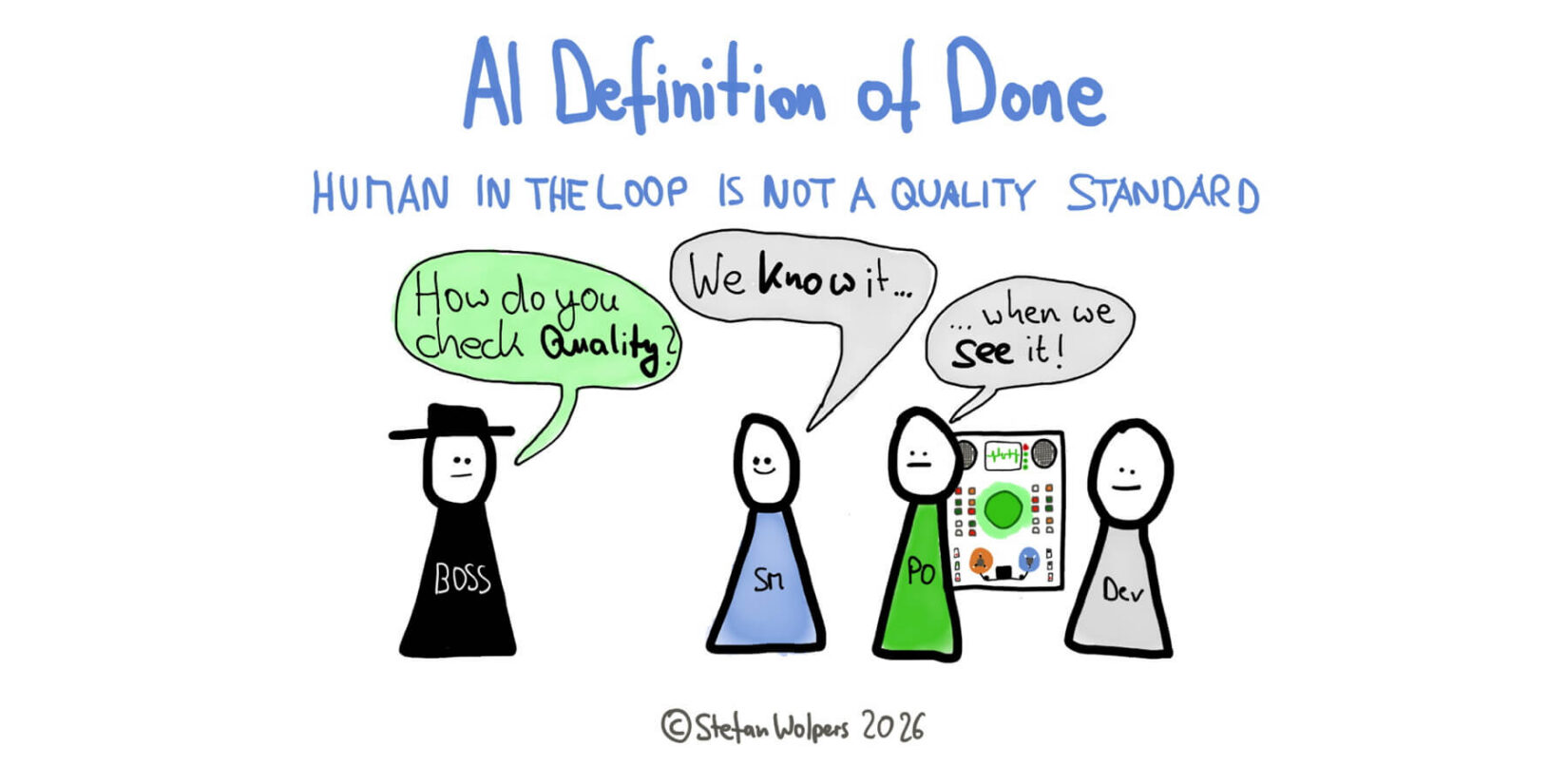
Thesis: The AI Definition of Done is a one-page, team-agreed standard that an AI-assisted output must meet before it leaves the team. You write one per task class, never per task: one for external status communication, one for data analysis summaries, one for backlog item drafts. It borrows the discipline of the Scrum Definition of Done and applies it to work that has been touched, especially outputs that leave the team. This is Stage 4 of the AI Delegation Lifecycle. The sections below cover the four questions it answers and how to write yours in 75 minutes.
Learn more: The AI Definition of Done: Human in the Loop Is Not a Quality Standard.
Deborah Rim Moiso suggests facilitation sticks when organizations stop treating training as the solution and build communities where practitioners share methods, review work, learn safely, and standardize while preserving judgment.
Olivier Wulveryck proposes Team Topologies for agentic platforms: business teams drive intent, platform teams absorb technical risk, and enabling teams prevent AI-powered shadow IT from becoming tomorrow’s fastest organizational debt machine.
Itamar Gilad suggests that developer productivity metrics such as commits, pull requests, tokens, or story points can mislead teams. Measure value creation instead, using outcome goals for cross-functional teams and organizations, not individuals.
You can secure your seat for Scrum training classes, workshops, and meetups directly by following the corresponding link in the table below:
See all upcoming classes here.

You can book your seat for the training directly by following the corresponding links to the ticket shop. If the procurement process of your organization requires a different purchasing process, please contact Berlin Product People GmbH directly.
Now available on the Age-of-Product YouTube channel to improve learning, for example, about how to Make AI Boring again:

I invite you to join the “Hands-on Agile” Slack Community and enjoy the benefits of a fast-growing, vibrant community of agile practitioners from around the world.

If you would like to join, all you have to do now is provide your credentials via this Google form, and I will sign you up. By the way, it’s free.
Help your team to learn about how AI Intensifies Work by pointing them to the free Scrum Anti-Patterns Guide:
Read more: Food for Agile Thought 549: AI in Product 2026, Makers Manifesto, AI POM, Open Knowledge Format.
此内容由惯性聚合(RSS阅读器)自动聚合整理,仅供阅读参考。 原文来自 — 版权归原作者所有。