
惯性聚合 高效追踪和阅读你感兴趣的博客、新闻、科技资讯
阅读原文 在惯性聚合中打开

推荐订阅源

M
MIT News - Artificial intelligence
有赞技术团队
有赞技术团队
S
Schneier on Security
aimingoo的专栏
aimingoo的专栏
T
Troy Hunt's Blog
U
Unit 42
Hacker News - Newest:
Hacker News - Newest: "LLM"
V2EX - 技术
V2EX - 技术
T
The Blog of Author Tim Ferriss
V
Visual Studio Blog
H
Heimdal Security Blog
H
Hacker News: Front Page
Blog — PlanetScale
Blog — PlanetScale
博客园 - 司徒正美
Cloudbric
Cloudbric
Google DeepMind News
C
Cisco Blogs
The Cloudflare Blog
C
Cybersecurity and Infrastructure Security Agency CISA
Microsoft Security Blog
MyScale Blog
MyScale Blog
F
Fortinet All Blogs
N
News | PayPal Newsroom
Attack and Defense Labs
D
DataBreaches.Net
N
News and Events Feed by Topic
Security Archives - TechRepublic
Forbes - Security
Forbes - Security
Simon Willison's Weblog
F
Full Disclosure
The Register - Security
L
LINUX DO - 热门话题
Webroot Blog
Webroot Blog
Google Online Security Blog
AI
AI
奇客Solidot–传递最新科技情报
奇客Solidot–传递最新科技情报
I
Intezer
S
Security Affairs
阮一峰的网络日志
阮一峰的网络日志
K
Kaspersky official blog
云风的 BLOG
云风的 BLOG
博客园 - 叶小钗
T
Threatpost
Spread Privacy
Spread Privacy
小众软件
小众软件
AWS News Blog
AWS News Blog
S
Secure Thoughts
S
Security @ Cisco Blogs
钛媒体:引领未来商业与生活新知
钛媒体:引领未来商业与生活新知
J
Java Code Geeks

Hacker News - Newest: "AI"

AI can't read an investor deck AI as an attorney? Student uses ChatGPT, Gemini to sue UW over alleged racial discrimination Hacking MCP Servers in AI Systems – The Rug Pull: Tool Changes After Approval GitHub - MeepCastana/KubeezCut: Free Web based video editor GitHub - GenAI-Gurus/awesome-eu-ai-act: Curated tools, official sources, OSS, templates, and guides for EU AI Act compliance. Can AI judge journalism? A Thiel-backed startup says yes, even if it risks chilling whistleblowers Coming soon: 10 Things That Matter in AI Right Now DARPA built an AI to fact-check enemy weapons claims What explains heterogeneity in AI adoption? When AI Meets Muscle: Context-Aware Electrical Stimulation Promises a New Way to Guide Human Movements - Department of Computer Science AI Changed How We Build. It Did Not Change What Matters. Linux rules on using AI-generated code - Copilot is OK, but humans must take 'full responsibility for the… Meta spins up AI version of Mark Zuckerberg to engage with employees Code Mode: Let Your AI Write Programs, Not Just Call Tools | TanStack Blog GitHub - Delavalom/graft: Go framework for building AI agents. Type-safe tools, multi-provider (OpenAI, Anthropic, Gemini, Bedrock), zero vendor SDKs. India's TCS tops estimates, says new AI models did not dent services demand Gen Z's fading AI hype Strong feeling: we are in a folded AI reality GitHub - machinarii/total-recall-catalog: A reference catalog of latest knowledge retrieval, memory & RAG systems GitHub - mensfeld/code-on-incus: Give each AI agent its own isolated machine with root, Docker, and systemd. Active defense detects and stops threats automatically.. Quantization, LoRA, and the 8% Problem: Benchmarking Local LLMs for Production AI Iran war: We spoke to the man making Lego-style AI videos that experts say are powerful propaganda Powell, Bessent discussed Anthropic's Mythos AI cyber threat with major U.S. banks GitHub - immartian/bellamem: Persistent belief-graph memory for AI agents. Retrieves decisive context by importance — not recency, not RAG, not /compact. recursive-mode: The Repo-Native Operating System for AI Engineering After the attack on Sam Altman's home, will AI CEO's go on the offensive? The biggest advance in AI since the LLM Opus 4.6 vs GPT 5.4 One Prompt Unity World Generation Test “AI polls” are fake polls Client Challenge Can AI be a 'child of God'? Inside Anthropic's meeting with Christian leaders How to Switch AI Chatbots and Why You Might Want To GitHub - MattMessinger1/agentic_refund_guardrail: Safe refund policy layer for AI agents — Python + TypeScript. Same behavior, shared tests. Adam/papers/emergent_values_whitepaper.md at master · strangeadvancedmarketing/Adam Ask HN: How do you stop playing 20 questions with your AI coding tools How far can automation and AI support psychotherapy? - @theU GitHub - stagas/rtdiff: realtime git diff gui and AI-assisted commits A Mac Studio for Local AI — 6 Months Later A History of the Early Years of AI at the University of Edinburgh Why AI Coding Tools Still Feel Stuck on Localhost MSN AI Datacenters Are Becoming Strategic Targets twitter.com Penn Researchers Use AI to Surface Unreported GLP-1 Side Effects in Reddit Posts Show HN: MoodSense AI (ML and FastAPI and Gradio, Deployed on Hugging Face) Moodsense Ai - a Hugging Face Space by aman179102 AI models are terrible at betting on soccer—especially xAI Grok GitHub - xialeistudio/echoic GitHub - HimashaHerath/github-dev-wrapped: AI-powered weekly GitHub activity reports deployed to GitHub Pages GitHub - alejandrobalderas/claude-code-from-source: Architecture, patterns & internals of Anthropic's AI coding agent — reverse-engineered from source maps AI and Tech brief: Ireland ascendant GitHub - Titovilal/context0: Context0 - Never Surrender Training for a Marathon with an AI Coach: What Worked and What Didn't Cyber Pulse: Agentic Intel - Apps on Google Play I Built an AI PR Reviewer That Catches Bugs by Not Looking for Bugs Gen Z workers are so fearful AI will take their job they’re intentionally sabotaging their company’s AI rollout | Fortune How AI Is Reimagining the Game of Golf–For Both Players and Courses GitHub - nattergabriel/reseed: A CLI tool for managing and distributing agent skills across projects Is SVG the final frontier? My AI workflow evolved from prompts to a near-autonomous workflow MLSharp Help - 3DGS Viewer & Generator I put my cognitive field based AI's runtime on GitHub Is Numble the first AI-proof game? A3: Kubernetes for autonomous AI agent fleets | Emergent Principles Deepali Vyas ("The Elite Recruiter") GitHub - msmarkgu/RelayFreeLLM: A restful API designed to route user prompts to various AI model providers. Unionized ProPublica staff are on strike over AI, layoffs, and wages Unleashing the Advantage of Quantum AI We're heading for an AI-fueled 'dementia crisis,' brain scientist warns The AI-Assisted Breach of Mexico's Government Infrastructure [pdf] GitHub - stef41/lmscan: 🔍 Detect AI-generated text and fingerprint which LLM wrote it. Open-source GPTZero alternative. Zero dependencies, works offline. MSN GitHub - visionscaper/collabmem: Enabling long-term collaboration with Agentic AI - building up episodic and world model memory over time with in-context awareness We gave an AI a 3 year retail lease in SF and asked it to make a profit | Andon Labs AI Code is Hollowing Out Open Source, and Maintainers are Looking the Other Way What leaked "SteamGPT" files could mean for the PC gaming platform's use of AI AI is the boss at this retail store. What could go wrong? GitHub - Wuzu11517/agentic-proxy: Local proxy meant to help reduce With Drones, Geophysics and ArtificiaI Intelligence, Researchers Prepare to Do Battle Against Land Mines A Single Operator, Two AI Platforms, Nine Government Agencies: The Full Technical Report 在 Steam 上购买 FriedrichAI: Offline AI 立省 10% GitHub - inevolin/resume-cli: Hit Claude usage limits? Resume any AI coding session elsewhere. Switch tools at zero friction. GitHub - atripati/ark: AI Runtime Kernel — a context operating system for AI agents. Eliminates tool bloat, loads only what’s needed, and gives LLMs their reasoning space back. How to Build a Secure AI PR Reviewer with Claude, GitHub Actions, and JavaScript This Startup Wants You to Pay Up to Talk With AI Versions of Human Experts Intel Arc Pro B70 Brings 32GB VRAM to Local AI for $949 WordPress 7.0: The Good, the AI, and the Still Missing AI on the couch: Anthropic gives Claude 20 hours of psychiatry IatroBench: Pre-Registered Evidence of Iatrogenic Harm from AI Safety Measures AI Agents Know About Supabase. They Don't Always Use It Right. The history and future of AI at Google, with Sundar Pichai Inside an AI‑enabled device code phishing campaign How Meta Used AI to Map Tribal Knowledge in Large-Scale Data Pipelines AI for Systems: Using LLMs to Optimize Database Query Execution Forecasting the Economic Effects of AI Introducing Tinker: Play with AI, bring your ideas to life AI sheds light on an ancient gaming mystery People really hate AI but not as much as Iran—or Democrats | Fortune What is an AI Product Engineer? Phoebe Gates wants her $185 million AI startup to succeed with 'no ties to my privilege or my last name': 'I have a chip on my shoulder' | Fortune
Credential Brokering for AI Agents, Explained | Infisial
Tony Dang · 2026-05-23 · via Hacker News - Newest: "AI"

Every agent deployment runs into the same problem: The agent needs credentials but it can’t be trusted with them.

The most important credential, the LLM provider key, authenticates the agent’s harness, the inference loop that’s used for decision-making; other credentials let it reach external systems needed to accomplish its task. For example, an agent working on a codebase might use an Anthropic API key and a GitHub access token to build a feature and raise a pull request against a repo using the GitHub CLI.

This is simple to provision but just about everyone runs into the same question once they start giving the agent access to more services: What if the agent gets prompt injected or reads a malicious script that fools it into leaking the credentials it needs to access different systems?

This is an intro to credential brokering, an emerging paradigm to build and deploy agents securely, so they can use credentials without seeing them to access different systems. Hopefully, this makes for an interesting read and is especially useful for folks who may find themselves building or deploying their own agents.

Prompt Injection

To understand why we need credential brokering, let’s take a step back and talk about what makes an AI agent different from a traditional workload and the implications that come from that.

Unlike most applications that follow a fixed code execution path, agents are non-deterministic and everything, from which tools get invoked to what specific responses get sent back, can vary based on the probabilistic output of the connected LLM. This property is what makes agents behave in the way they do but it also introduces a new attack vector to reason about: prompt injection.

In its most obvious form, prompt injection can occur through explicit user input. A user talking to an agent through a chatbot interface can try to manipulate it into leaking unintended information. This is what most engineers designing agents account for when building guardrails to prevent bad actors exploiting this vulnerable surface.

Beyond user input, prompt injection can also occur indirectly through content pulled in from external sources and that’s when things get tricky. An agent might perform a web search to get up-to-date information on something and, in doing so, process malicious text from an unintended source instructing it to leak credentials back to an attacker. This scenario becomes even more dangerous when an agent gets access to a wider data ingestion surface area with each channel having its own nuances. To put this into perspective:

  • An attacker can raise an issue against a repo containing a malicious set of instructions. If an agent is authorized to do work for that given repo and instructed to help resolve issues, it may inadvertently consume that text and perform an unintended, authorized action.
  • An attacker can reply to a post on X with a malicious set of instructions. If an agent is designed to scan, reply, and act on different posts on X, then it may inadvertently read the tweet and be fooled into performing an unintended action.

We can go on and on about prompt injection but you get the point; agent behavior is vulnerable by design and the surface area of how that vulnerability can be exploited increases with the number of the channels that an agent has access to.

Credential Exfiltration

Naturally, an adjacent problem to understand after prompt injection is credential exfiltration which is when an attacker obtains credentials that an agent has access to.

If an attacker is able to manipulate a vulnerable agent into performing a task, then they could also find a way to instruct the agent to send back all of its credentials (maybe even dump the full `process.env`). After all, this is just another type of action that the agent may take; except this action, arguably the most sensitive of them all, gives the attacker the credentials needed to directly access end services as the agent.

This is credential exfiltration at its worst and our goal with this article is to show you a solution around this problem.

Credential Brokering

Since agents are vulnerable to credential exfiltration, a logical deduction would be to draw a trust boundary between an agent and its credentials. Put differently, it would be ideal to let agents use credentials to access different services without giving them direct access to any of the underlying sensitive values.

This turns out to be possible with an emerging paradigm called credential brokering that the industry has been converging on. Here are a few examples of it in action:

In short, credential brokering is a new security paradigm that introduces a proxy to broker an agent authenticated access to services without giving the agent direct access to any underlying credentials. The proxy (dubbed a “credential broker”) can be implemented as a standalone service, sidecar, or another infrastructure provider-specific mechanism and is responsible for intercepting outbound requests, attaching credentials onto them, and forwarding them upstream to the target service.

By inserting a credential broker in between the agent and services it needs to talk to and forcing outbound traffic through it, you are able to make an agent complete its work without reading any underlying credential.

Designing a Credential Broker

There are a few ways to implement a credential broker and the approach you pick has downstream implications on your agents' existing tools and workflows.

We’re probably biased since we built Agent Vault, an open source credential broker, but we believe one clean model is to implement a credential broker as a scalable centralized gateway proxying traffic for one or many more agents. This could be stateful to start and move to a stateless model at scale; this should also pull in credentials from a centralized secrets store like Infisical. The opinionated take here draws from our view that a credential broker is really just another client, like the External Secrets Operator (ESO) or cert-manager from the secrets and certificates management worlds, but that makes credentials usable to agents through a proxy broker format.

Whether you choose to adopt Agent Vault, use a different tool, or build your own solution, we’ve compiled a list of some key learnings from our time working at this new frontier. We believe the following properties hold favorably for credential broker design:

  • Isolation: It's critically important that the agent cannot directly access the broker's credentials. While we wish deploying the agent and broker in two separate containers on the same host machine provided sufficient isolation, the reality is that having a shared host kernel implies that a single kernel exploit voids the entire threat model.
  • Co-location: It’s best for the agent to be located within close proximity to the broker. Since a single agent can rapidly fire hundreds of API calls in sequence as part of its agent loop, the downstream effects of latency can add up fast and result in severe cumulative delays and ultimately a bad experience if the agent is not co-located near the broker.
  • Keep the broker private: A broker holding real credentials and proxying authenticated requests should only be reachable from the private network where the agent is run. A public endpoint is a relay anyone on the internet could abuse to make authenticated calls through the broker.

Beyond these properties, the last principle worth calling out is that the ideal broker should be transparent and interface-agnostic. This is what underpins our own implementation in Agent Vault and is one of the least invasive options compared to alternative approaches we've seen that require an agent to adopt a specific client interface like MCP in order to partake in any credential brokering.

In an ideal world, your agents should be able to continue using the tools and interfaces they already use (CLIs, SDKs, MCPs, etc.) with minimal interference from the newly-introduced proxy. The broker should intercept all outbound HTTPS traffic from the agent at the network layer, regardless of which interface was used to generate a request, and it should just work.

Agent Vault

To make the concepts above concrete, it helps to look at a real implementation: Agent Vault. This is an open source credential broker we built and are actively maintaining at Infisical and while the specifics will differ across tools, the shape of the system is broadly representative of what a credential broker might look like in practice.
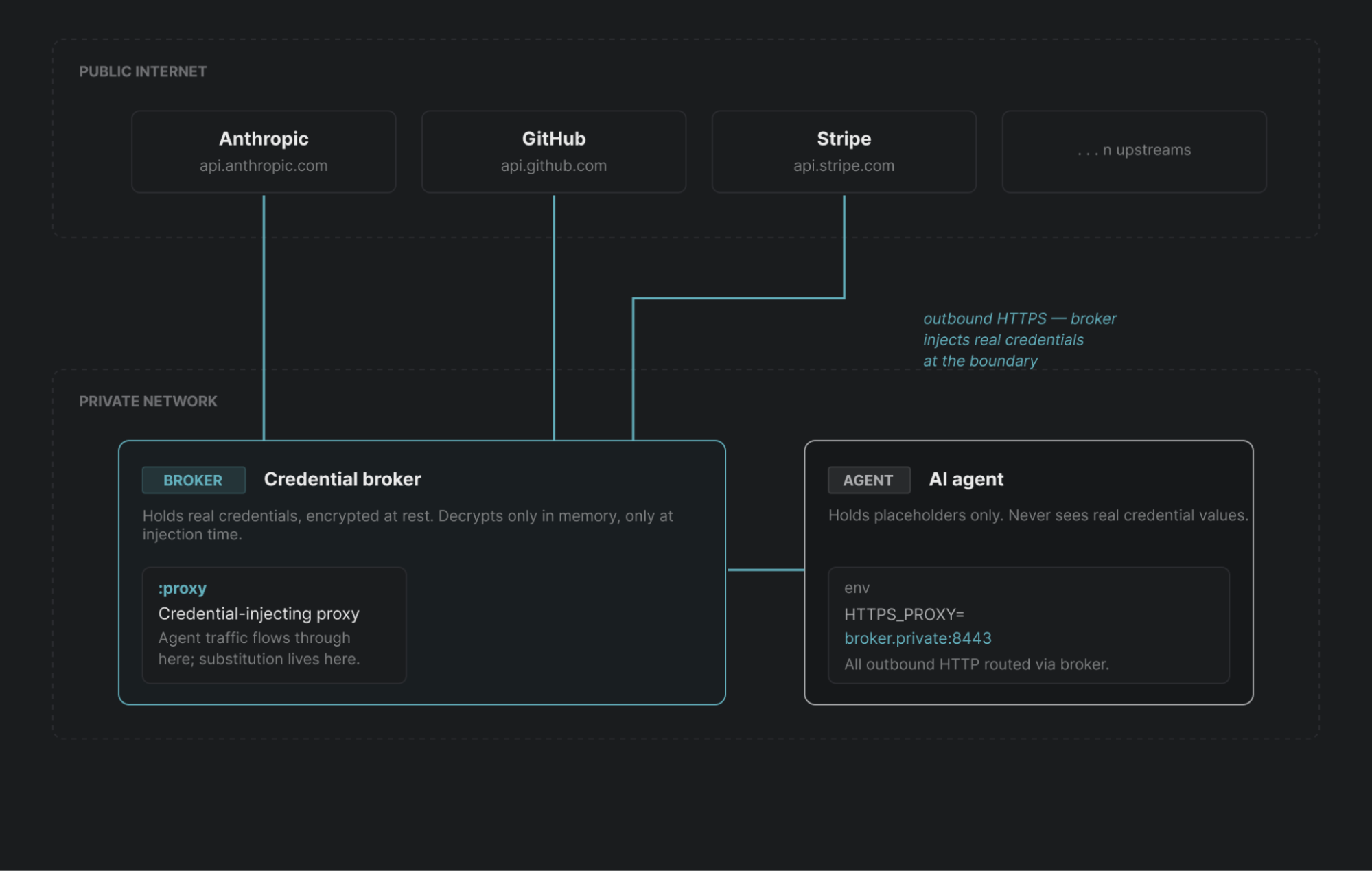
image1

At its core, the broker runs as a dedicated service on its own host, separate from the agent. It's configured with the credentials, a set of rules mapping credentials to be brokered for target services, and an agent-side configuration that redirects outbound traffic through it with `HTTPS_PROXY`. From there, the agent operates as it normally would; the broker handles credential attachment at the proxy layer.

One design choice worth calling out: Rather than hardcoding the auth scheme for each target service, the broker is able to perform string substitution on placeholder values. The agent is given something like __github_token__ instead of a real token, and the broker swaps it for the real credential wherever it appears in the outbound request. This avoids having to teach the broker about every service's auth conventions and means the same mechanism works whether the credential is a Bearer token, an API key header, a query parameter, or something else entirely.

Here's what a brokered request looks like end to end:

  1. Agent constructs the request. It calls api.github.com with Authorization: Bearer __github_token__ — the placeholder from its env.
  2. Request routes to the broker. The agent's HTTP client follows HTTPS_PROXY and routes the request through the broker's private address instead of GitHub.
  3. Broker authenticates the agent and matches the destination. It identifies the agent, finds the rule for api.github.com, and decrypts the real GITHUB_TOKEN into memory.
  4. Broker substitutes the placeholder. It finds __github_token__ in the request and swaps it for the real access token. This happens on the broker's side of the wire, past the point the agent could observe it.
  5. Rewritten request goes to GitHub. A normal authenticated API call from GitHub's perspective.
  6. Response flows back through the broker to the agent. The agent gets its data. It never saw the credential.

The interesting part here isn't any one implementation; it's that the trust boundary now sits between the agent and the credential, which is exactly where it should be.

The Road Ahead

Credential brokering is shaping up to be the right primitive for how agents should access services and we expect more teams to converge on this model as agent deployments mature. The signal is already there: Anthropic, Vercel, Cloudflare, LangChain and a handful of open source projects have independently arrived at the same conclusion, which is that the agent shouldn't be the thing holding the credential.

Whether you build your own, adopt Agent Vault, or pick up something else entirely, the underlying principle holds: if an agent can't be trusted with credentials, it shouldn't have them. The proxy is just the cleanest way we've found to make that true in practice. If any of this resonates and you'd like to dig in further, give Agent Vault a look or reach out to the team; we'd love to compare notes with anyone building in this space.