






In the summer of 1963 Jerry began drawing a map of an imaginary city. The work started as a doodle done in the spare time he had while working at a tedious job. He continued to add to that map through the years until, in 1983, he set it aside to put his free time to other use.
It was stored in the attic of his home in Cold Spring, New York. It gathered dust. Jerry’s son, Henry, found it one day while rummaging around. He brought it down and asked what it was. Seeing it then triggered Jerry to dust it off and continue the project.
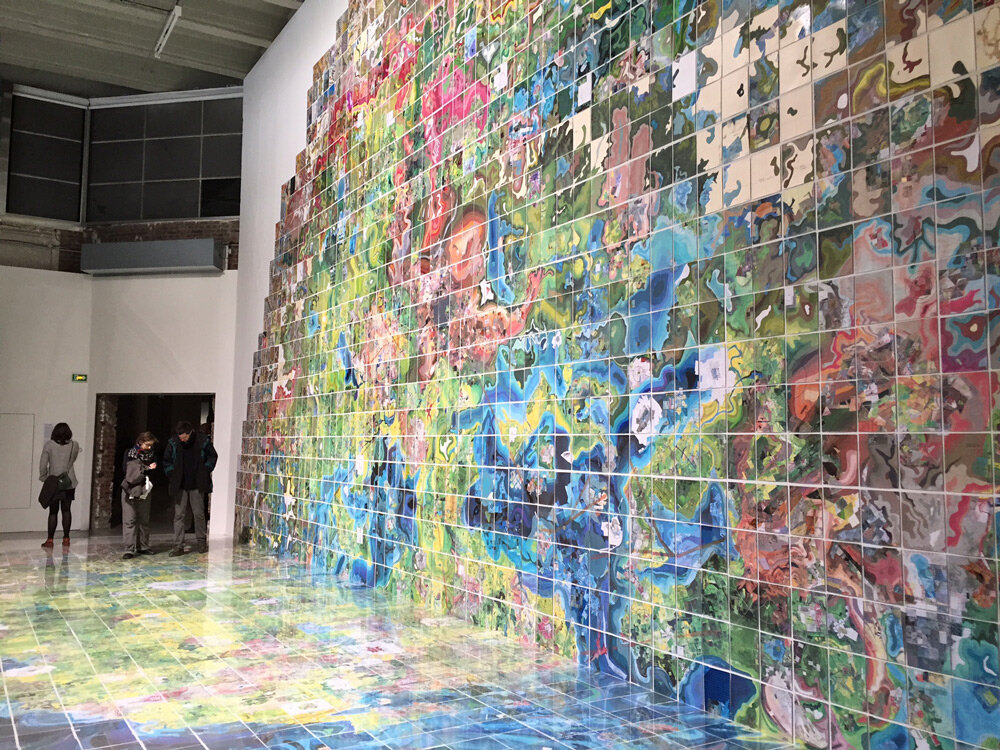
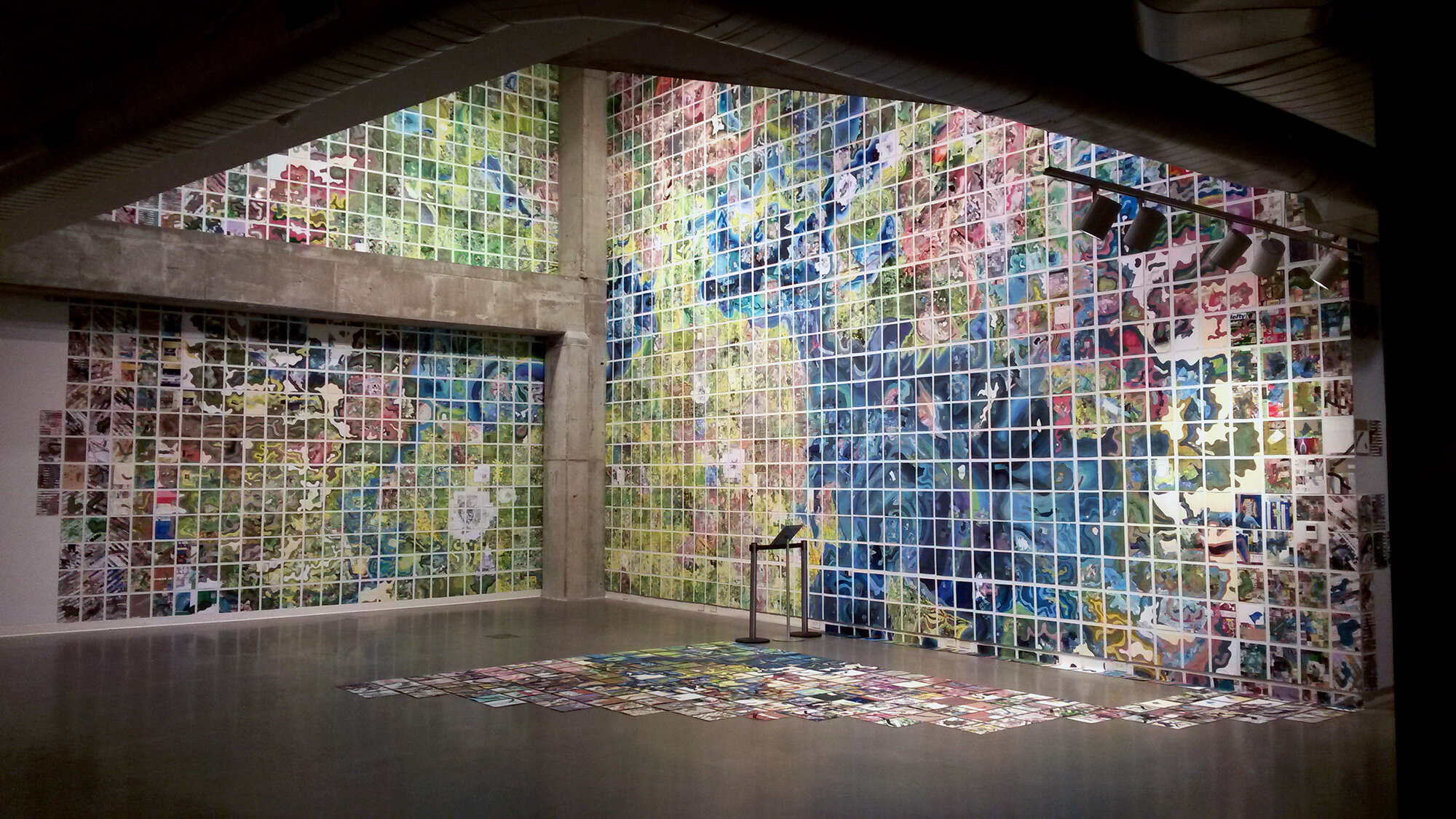
Years later, the Map is now a two-dimensional “virtual world” art project which is now comprised of over 4000 individual eight by ten inch panels. When assembled, these panels form an approximate circle. The panel locations are defined by N, S, E, and W coordinates that originate at the center of the circle. The locations in the matrix do not change, but the panels themselves are continually revised based on instructions drawn from the artist’s custom deck of cards.
Its execution, in acrylic, marker, colored pencil, ink, collage, and inkjet print on heavy paper, is dictated by the interplay between an elaborate set of rules and randomly generated instructions.
Jerry maintained a blog about the project for many years. He no longer updates it, but the old posts are still available on Blogger. And also be sure to check out r/jerrymapping, an interesting subreddit devoted to map making in the style of Jerry's Map.


Time lapse showing 20 years of changes to an 8 by 16 panel portion of the map. Sharp eyes will note that there are not actually 20 changes in this animation. This is because for some of those years, no cards were drawn that called for changes on these particular panels.
The entire process is driven by instructions on a card drawn from a special deck created by the artist. Each cycle begins only when the artist’s tasks from the previous card are complete. This could take anywhere from a few minutes to a few days.
The cards were first introduced as a simple random number generator. When Jerry was first creating the map it was simple enough to work sheet to sheet, but as the map grew to hundreds of individual panels it became very tedious to make his way through the set.
“I wanted to move through the stack faster, and the easiest random number system I could come up with was a deck of cards. I’d draw a card and move down that many panels in the stack.”
As Jerry began working on ways of systematizing the process of working on the map he began to incorporate instructions on the cards. The contemporary deck of cards has been adapted from playing cards and the total number varies as cards have been added, revised, and removed. Currently there are approximately 100 cards.

“Sometimes I have feelings about the deck of cards. There’s a message in those cards. There’s no big man with a beard who has ordered the cards, but I’m very interested in seeing what comes out of it. There’s a reality in there waiting to get out. It’s the map’s future predictor and as it is always changing its alive…My hand puts the paint on the paper, I’ll step back and look at the sheets as though I wasn’t the perpetrator but merely the observer.”
The instructions on each card have these three elements:

Next higher dimension (void, red, black, ziggurat)
Spatter paint four contiguous panels (current panel plus the 3 closest to the center of that panel)
Create a new seed panel
Mix a new paint color
Screen print the 9 contiguous panels (current panel plus 8 surrounding panels)
Update and copy the master (map element) on the top of the stack of masters
Copy the current panel on label paper so portions can be used in collage
Use a patchwork of re-used printed paperboard (e.g cereal boxes)
Use a photo from the artist's files
Use a lumen print (objects scanned and printed)
Add or subtract from the number on a specified number cards (e.g. "add 3 to the number on the last 2 cards")
Eliminate a card from or add a card to the deck (eliminated cards are "retired" forever, but the instructions are kept on a list for possible re-use on a future card)
Copy and retire the last 9 cards (physical cards are retired but the copies stay in the deck)
Shuffle the deck
Do a blog entry
Do a journal entry (also print and make collage material of the entry)
Do a Reddit post
Calculate the sales value of the entire set of panels (based latest eBay sale)
The card indicates the number of panels to be scanned and added to the digital library.
The card asks the helper to sort retired panels and archive them.
The helper makes copies of the number of current panels indicated on the card, and the original panels are retired and archived.
The card asks the helper to update the inventory of the archives.
Jerry draws a card and works through the tasks it defines. This video gives some insight into what a typical day’s work looks like.
These are the instructions and rules which guide the Artist in the creation of the map:
Each card has a large black or red number in an upper corner. A "task" is defined as the completion of the number of work units as specified by the number on the card that is drawn. A work unit is the number of one inch squares to be covered. The number drawn and the effort required can be highly variable, so a day's work could consist of one card’s work units, or just a portion of one. Work on an incomplete work unit continues at the next work session.
When a card is drawn you must follow the specific instructions on the card, but those instructions may be changed for the next time that card is drawn.
Work direction is determined by color of the drawn card - black is clockwise, red is counter-clockwise.
Every page has a "center" point from which the work emanates. The "center" of the new page is the same as the parent’s.
New panels are generated by drawing a "new panel" card, or a new panel is required to complete a section of art.
When a new page is added, the new page will use the "color of the day".
The location of the new page is determined by placing a compass point in the "center" of the parent page and determining the closest edge of the map (this keeps the map roughly circular and growing generally equally in all directions).
Master map shows the locations of the panels as defined by coordinates.
Colors are more abstract and do not necessarily represent the physical world. Colors may be applied with either paint or markers, or by using collage. The 42 colors are continually remixed to ensure a spectrum of paints.
New artwork is never applied on top of existing original artwork, it is only added to a new version of the page.
The Map is expressed, over time, in successive layers, each one replacing its predecessor. The process of developing and revising a panel results in several iterations of that panel.
The Base Layer is divided into four phases:
A. The blank page is an 8 by 10 inch patchwork of paperboard or is a sheet of heavy paper on which is a photo or a lumen print.
B. The blank is gradually covered in successive bands of painted color.
C. The paint is replaced by 1" squares of paper collage.
D. The collage is replaced by 1" city squares in:
1. Green with 400 new inhabitants
2. Red with 800 new inhabitants
3. Grey with 1200 new inhabitants
4. Black with 2400 new inhabitants
The next layer is The Void. Its initial phase is composed of irregular pieces of plain, white collage. That is followed by a layer of 2" squares of black-and-white collage. On that layer 1" squares of grey city form followed by 1" squares of black city.
The third layer is called The Red Dimension and is expressed by irregular flame-shaped solid red collage.
Black Ness, composed of 2" squares of black collage, supercedes The Red Dimension.
Then follows The Ziggurat Phase in which successively smaller squares of collage, starting with 2 by 2, are stacked on top of each other. That layer, and the ones that follow, have yet to manifest themselves on The Map.
The Flood, represented by irregular pieces of blue collage, and Re-Birth, composed of hand-torn pieces of kraft paper, are the final stages in the Map cycle.
Then the whole process starts over with new Paint Bands.
The map has been constantly evolving with Jerry over the years from the earliest iterations to its present state. This evolution has been driven by three primary factors. First, the media used in the production of the map panels has changed over time. Second, as the map grew larger mechanisms such as the use of the deck of instruction cards automated the map and changed Jerry's role as the author. Finally, the introduction of the system of layers.
| Era 1 (1963-1983) | Era 2 (2003-present...after a 20 year hiatus) | |
|---|---|---|
| Process driver | The "Principles" Late Era 1 - rudimentary card deck begins |
The "Principles" Enforced by CARD DECK - "Want to be surprised" |
| Materials | Lightweight typing paper in the beginning, eventually became heavier poster paper Use of collage materials started at the end of Era 1; intended to represent physical features such as sand dunes |
Recycled and repurposed paper Expanded use of collage: - Reusable elements (e.g. city blocks) - More abstract elements - Collage shapes start as random; around 2013 become 1" squares |
| Tools | Rapidograph pens, india ink Ballpoint pens Pencils "Copenhagen blue" and "apple green" colored pencils Watercolors and gouache |
Acrylic paints New types of pens (name) |
| Scale | 1/4" = 200' | No change, but less relevant due to the more abstract composition that is used. |
| Guest artists | None. | Guest artists send a panel, and it is added to the stack of blanks waiting to be used. |
| Progression of work | Panels are stacked chronologically (oldest on top). Work on top one, then move it to the bottom of the stack. | Panels are stacked by coordinates, and work is done in that order. |
| Data tracking | In a log book: - Populations - Football scores - Map language (translation matrix) - Railroad station and airport districts - Map dating (translation matrix) |
In a spreadsheet: - Populations - No more football scores - No more RR station and airport districts - Administrative info e.g. map sales and inventory (panels per exhibition set) - Map language (translation matrix) (abandoned later in Era 2) - Map dating (translation matrix) |
| Reproductions - versioning | None, all work is done on a single master set of panels. | Color printer enables: - Making copies of panels to start a new generation - Employing reusable elements |
| Exhibitions | None. | Exhibitions, typically in museums Originally used the original base map Later used just older generations |
| The Principles | Amount of work done in a session is determined by personal schedule. Panel is moved to bottom of the stack at end of that session. | Each card has a large black or red number in an upper corner. A "task" is defined as the completion of the number of work units as specified by this number on the card that is drawn. A "work unit" is the number of one inch squares to be covered. The number drawn and the effort required can be highly variable, so a day's work could consist of several work units, or just a portion of one. Work on an incomplete work unit continues at the next work session. |
| Standard playing card deck is used as a random number generator. This number defined how far down the stack to go to start the work session. Bypassed panels are moved to the bottom of the stack. | When a card is drawn you must follow the specific instructions on the card. | |
| Always work clockwise around the perimeter of the map. | Work direction is determined by color of the drawn card - black is clockwise, red is counter-clockwise. | |
| Every page has a "center" point, located at [XXXXX]. | Same | |
| New pages are generated when a page is full, or when one is required to complete a section of art. | New pages are generated by drawing a "new page" card, or a new page is required to complete a section of art. | |
| The "center" of the new page is the same as the parent. | Same. | |
| A page is built beginning from the identified "center" point. | Same. | |
| When a new page is added, the new page is of the same nature (urban, rural, water) as the parent. | When a new page is added, the new page will use the "color of the day". What defines that??? | |
| The location of the new page is determined by placing a compass point in the "center" of the parent page and determining the closest edge of the map (this keeps the map roughly circular and growing generally equally in all directions). | Same. | |
| Master map shows the locations of the panels based on chronology. | Master map shows the locations of the panels as defined by coordinates. | |
| Colors used represent topography- altitude of land or or depth of water. Color choices had to follow the logic of the physical world. | Colors are more abstract and do not necessarily represent the physical world. Colors may be applied with either paint or markers, or by using collage. | |
| New artwork is never applied on top of existing original artwork, it is only added to a new version of the page. | Same. | |
此内容由惯性聚合(RSS阅读器)自动聚合整理,仅供阅读参考。 原文来自 — 版权归原作者所有。