



惯性聚合 高效追踪和阅读你感兴趣的博客、新闻、科技资讯
阅读原文 在惯性聚合中打开

推荐订阅源

Forbes - Security
Forbes - Security
A
Arctic Wolf
M
MIT News - Artificial intelligence
T
Threat Research - Cisco Blogs
T
The Exploit Database - CXSecurity.com
C
CERT Recently Published Vulnerability Notes
NISL@THU
NISL@THU
L
Lohrmann on Cybersecurity
Martin Fowler
Martin Fowler
A
About on SuperTechFans
P
Palo Alto Networks Blog
Project Zero
Project Zero
The GitHub Blog
The GitHub Blog
WordPress大学
WordPress大学
Blog — PlanetScale
Blog — PlanetScale
博客园_首页
大猫的无限游戏
大猫的无限游戏
Cisco Talos Blog
Cisco Talos Blog
P
Proofpoint News Feed
D
DataBreaches.Net
Cyberwarzone
Cyberwarzone
T
Tor Project blog
IT之家
IT之家
P
Proofpoint News Feed
Help Net Security
Help Net Security
S
Securelist
Threat Intelligence Blog | Flashpoint
C
CXSECURITY Database RSS Feed - CXSecurity.com
Microsoft Azure Blog
V2EX - 技术
V2EX - 技术
K
Kaspersky official blog
Hugging Face - Blog
Hugging Face - Blog
MongoDB | Blog
MongoDB | Blog
B
Blog
N
News and Events Feed by Topic
The Cloudflare Blog
S
Schneier on Security
P
Privacy & Cybersecurity Law Blog
T
The Blog of Author Tim Ferriss
Recorded Future
Recorded Future
Last Week in AI
Last Week in AI
The Last Watchdog
The Last Watchdog
Hacker News - Newest:
Hacker News - Newest: "LLM"
L
LangChain Blog
I
InfoQ
F
Full Disclosure
The Register - Security
阮一峰的网络日志
阮一峰的网络日志
H
Hacker News: Front Page
V
V2EX

Lei Mao's Log Book

2026 FIFA World Cup 备受嘲讽的会徽 Python Debugging Via VS Code In Docker Container Vargas Plateau Regional Park 徒步 Vargas Plateau Regional Park Apex 2026 FIFA World Cup 小组赛赛程 Retaining EXIF Metadata In GIMP San Francisquito Creek Joint Powers Authority 2025 Calendar Photo 麦当劳 The FIFA World Cup 套餐 Ardenwood Historic Farm 徒步 Ardenwood Historic Farm Synchronizations With TorchRec KeyedJaggedTensor Pacific Commons Linear Park 徒步 Pacific Commons Linear Park 2026 San Jose Half Marathon 竞赛 目标 Mountain View Shoreline Park 徒步 Mountain View Shoreline Park PyTorch AOTInductor Hybrid Lowering Carquinez Strait Regional Shoreline 徒步 Carquinez Strait Regional Shoreline PyTorch Triton Kernel Transparent Tracing and Compilation 脸庞 PyTorch Fake Export 2026 BRAIN Foundation 10K 竞赛 2026 Wild and Scenic Film Festival 参观 2026 Wild and Scenic Film Festival 系统工程程序员修 Bug FIFA 官方网站的语言 PyTorch Custom Operation 汉堡王 The Mandalorian and Grogu 套餐 Tilden Regional Parks Botanic Garden 参观 Tilden Regional Park Tilden Regional Parks Botanic Garden Tilden Regional Park 徒步 《寻秦记》电影版 ICML 2026 Area Chair Experience 2026 Foster City 5K Fun Run 竞赛 2026 年 3 月和 4 月该入手的模型手办 Docker Container GUI Display Using Wayland 马拉松破二 2026 Heart & Soles Run 5K 竞赛 How Is FARS, The Fully Automated Research System? 算计: 七天的死亡游戏 Lake Chabot Regional Park 徒步 Lake Chabot Regional Park 2023 年恐怖电影《感恩节》 2026 Airport Runway Run at San Carlos Airport 5K 竞赛 Page Table for Page-Locked Host Memory Don Edwards San Francisco Bay National Wildlife Refuge - Ravenswood 徒步 Don Edwards San Francisco Bay National Wildlife Refuge - Ravenswood 法外风云 PyTorch Graph Symbolic Integer Contra Costa Canal Regional Trail 徒步 Contra Costa Canal Regional Trail 娑婆诃 PyTorch Export 2026 Western Pacific 5K 竞赛 浮躁的科研和胡扯的自媒体 Connecting Logitech Devices On Linux 2026 Oakland Half Marathon 竞赛 Del Valle Regional Park 徒步 Del Valle Regional Park CUDA_LAUNCH_BLOCKING=1 踏切时间 Wildcat Canyon Regional Park 徒步 Wildcat Canyon Regional Park Credit Card Unauthorized Transaction While In Possession 莎拉的真伪人生 2026 Union City Superhero Fun Run 5K 竞赛 McLaughlin Eastshore State Park 徒步 McLaughlin Eastshore State Park Cloudflare Worker Proxy R2 Bucket Access Zorro 和 Batman Fix MacBook Pro Space Key Stuck Problem 2026 年 1 月和 2 月该入手的模型手办 2026 Brazen Victory 10K 竞赛 儿时的玩伴李峰 Marsh Creek Regional Trail 徒步 Marsh Creek Regional Trail Perfetto GPU Flow Artifacts 百万人推理 System Performance Optimizations QQ 幻想 2026 Brazen Bay Breeze 5K 竞赛 Dota 闪电站出售 Mountain View Downtown 徒步 Mountain View Downtown C++ Latch and Barrier 2025 年跑步总结 2026 Rotary Mission Ten Half Marathon 竞赛 狗的素质等于人的素质 CUDA Rendezvous Stream Pleasanton Ridge Regional Park 徒步 Pleasanton Ridge Regional Park Xfinity Internet 多年来的使用感受 Randomized SVD Don Castro Regional Recreation Area 徒步 Don Castro Regional Recreation Area 拖车公司的大汉们
CUDA Shared Memory Bank Conflict-Free Vectorized Access
2026-02-13 · via Lei Mao's Log Book

Introduction

In CUDA programming, it is common to use vectorized data access to move the data from global memory to shared memory and vice versa, because vectorized access uses fewer instructions and can usually results in higher memory throughput. For example, LDG.128 (vectorized global load) is significantly faster than four LDG.32 calls because it saturates the memory bus more effectively. However, when using vectorized access to read or write shared memory, a natural question to ask is whether shared memory bank conflict will occur. For example, can LDS.128 result in a 4-way bank conflict?

In this blog post, I will implement a CUDA kernel tocompare the performance of vectorized access and scalar access to shared memory, and discuss how vectorized access is bank conflict-free access on shared memory.

I implemented two versions of a CUDA kernel that performs the same computation on the data in shared memory repeatedly, but one version uses vectorized access to read and write shared memory, while the other version uses scalar access. So if the vectorized access version has worse performance because of bank conflict, we should be able to see a significant performance difference between the two versions.

shared_memory_vectorization.cu
1
2
3
4
5
6
7
8
9
10
11
12
13
14
15
16
17
18
19
20
21
22
23
24
25
26
27
28
29
30
31
32
33
34
35
36
37
38
39
40
41
42
43
44
45
46
47
48
49
50
51
52
53
54
55
56
57
58
59
60
61
62
63
64
65
66
67
68
69
70
71
72
73
74
75
76
77
78
79
80
81
82
83
84
85
86
87
88
89
90
91
92
93
94
95
96
97
98
99
100
101
102
103
104
105
106
107
108
109
110
111
112
113
114
115
116
117
118
119
120
121
122
123
124
125
126
127
128
129
130
131
132
133
134
135
136
137
138
139
140
141
142
143
144
145
146
147
148
149
150
151
152
153
154
155
156
157
158
159
160
161
162
163
164
165
166
167
168
169
170
171
172
173
174
175
176
177
178
179
180
181
182
183
184
185
186
187
188
189
190
191
192
193
194
195
196
197
198
199
200
201
202
203
204
205
206
207
208
209
210
211
212
213
214
215
216
217
218
219
220
221
222
223
224
225
226
227
228
229
230
231
232
233
234
235
236
237
238
239
240
241
242
243
244
245
246
247
248
249
250
251
252
253
254
255
256
257
258
259
260
261
262
263
264
265
266
267
268
269
270
271
272
273
274
275
276
277
278
279
280
281
282
283
284
285
286
287
288
289
290
291
292
293
294
295
296
297
298
299
300
301
302
303
304


#include <cuda_runtime.h>

#include <cmath>
#include <cstdio>
#include <cstdlib>
#include <iomanip>
#include <iostream>
#include <vector>


#define CHECK_CUDA_ERROR(val) check((val), #val, __FILE__, __LINE__)
void check(cudaError_t err, char const* func, char const* file, int line)
{
if (err != cudaSuccess)
{
std::cerr << "CUDA Runtime Error at: " << file << ":" << line
<< std::endl;
std::cerr << cudaGetErrorString(err) << " " << func << std::endl;
std::exit(EXIT_FAILURE);
}
}


template <int BlockSize, int ComputeIters>
struct KernelConfig
{
static constexpr int BLOCK_SIZE = BlockSize;
static constexpr int COMPUTE_ITERS = ComputeIters;
static constexpr int ELEMENTS_PER_THREAD = 4;
static constexpr int SMEM_SIZE = BLOCK_SIZE * ELEMENTS_PER_THREAD;
};


__device__ __forceinline__ void process_smem_value(float& val)
{
val = val * 1.01f + 0.01f;
}


template <typename Config>
__device__ __forceinline__ void compute_scalar(float* smem, unsigned int tid)
{
#pragma unroll
for (int iter{0}; iter < Config::COMPUTE_ITERS; iter++)
{
process_smem_value(smem[tid]);
process_smem_value(smem[tid + Config::BLOCK_SIZE]);
process_smem_value(smem[tid + 2 * Config::BLOCK_SIZE]);
process_smem_value(smem[tid + 3 * Config::BLOCK_SIZE]);
}
}


template <typename Config>
__device__ __forceinline__ void compute_vectorized(float* smem,
unsigned int tid)
{
#pragma unroll
for (int iter{0}; iter < Config::COMPUTE_ITERS; iter++)
{
float4 val = *reinterpret_cast<float4*>(&smem[tid * 4]);
process_smem_value(val.x);
process_smem_value(val.y);
process_smem_value(val.z);
process_smem_value(val.w);
*reinterpret_cast<float4*>(&smem[tid * 4]) = val;
}
}


template <typename Config, bool UseVectorized>
__global__ void kernel_shared_memory(const float* __restrict__ input,
float* __restrict__ output, int n)
{
__shared__ float smem[Config::SMEM_SIZE];

unsigned int const tid{threadIdx.x};
unsigned int const idx{blockIdx.x * blockDim.x + threadIdx.x};


float4 const global_data_input{
*reinterpret_cast<const float4*>(&input[idx * 4])};


smem[tid] = global_data_input.x;
smem[tid + Config::BLOCK_SIZE] = global_data_input.y;
smem[tid + 2 * Config::BLOCK_SIZE] = global_data_input.z;
smem[tid + 3 * Config::BLOCK_SIZE] = global_data_input.w;
__syncthreads();


if constexpr (UseVectorized)
{
compute_vectorized<Config>(smem, tid);
}
else
{
compute_scalar<Config>(smem, tid);
}
__syncthreads();


float4 const global_data_output{smem[tid], smem[tid + Config::BLOCK_SIZE],
smem[tid + 2 * Config::BLOCK_SIZE],
smem[tid + 3 * Config::BLOCK_SIZE]};


*reinterpret_cast<float4*>(&output[idx * 4]) = global_data_output;
}


using DefaultConfig = KernelConfig<256, 100>;

void run_benchmark(int n, int num_iterations, int num_warmups)
{

int const aligned_n{
((n + DefaultConfig::SMEM_SIZE - 1) / DefaultConfig::SMEM_SIZE) *
DefaultConfig::SMEM_SIZE};
size_t const bytes{aligned_n * sizeof(float)};


std::vector<float> h_input(aligned_n);
std::vector<float> h_output_ordinary(aligned_n);
std::vector<float> h_output_vectorized(aligned_n);


for (int i{0}; i < aligned_n; ++i)
{
h_input[i] = static_cast<float>(i);
}


float *d_input, *d_output;
CHECK_CUDA_ERROR(cudaMalloc(&d_input, bytes));
CHECK_CUDA_ERROR(cudaMalloc(&d_output, bytes));


CHECK_CUDA_ERROR(
cudaMemcpy(d_input, h_input.data(), bytes, cudaMemcpyHostToDevice));


int const threads_per_block{DefaultConfig::BLOCK_SIZE};


int const num_blocks{
aligned_n / (threads_per_block * DefaultConfig::ELEMENTS_PER_THREAD)};


for (int i{0}; i < num_warmups; ++i)
{
kernel_shared_memory<DefaultConfig, false>
<<<num_blocks, threads_per_block>>>(d_input, d_output, aligned_n);
kernel_shared_memory<DefaultConfig, true>
<<<num_blocks, threads_per_block>>>(d_input, d_output, aligned_n);
}
CHECK_CUDA_ERROR(cudaDeviceSynchronize());


cudaEvent_t start, stop;
CHECK_CUDA_ERROR(cudaEventCreate(&start));
CHECK_CUDA_ERROR(cudaEventCreate(&stop));

CHECK_CUDA_ERROR(cudaEventRecord(start));
for (int i{0}; i < num_iterations; ++i)
{
kernel_shared_memory<DefaultConfig, false>
<<<num_blocks, threads_per_block>>>(d_input, d_output, aligned_n);
}
CHECK_CUDA_ERROR(cudaEventRecord(stop));
CHECK_CUDA_ERROR(cudaEventSynchronize(stop));

float time_ordinary{0.0f};
CHECK_CUDA_ERROR(cudaEventElapsedTime(&time_ordinary, start, stop));


CHECK_CUDA_ERROR(cudaMemcpy(h_output_ordinary.data(), d_output, bytes,
cudaMemcpyDeviceToHost));


CHECK_CUDA_ERROR(cudaEventRecord(start));
for (int i{0}; i < num_iterations; ++i)
{
kernel_shared_memory<DefaultConfig, true>
<<<num_blocks, threads_per_block>>>(d_input, d_output, aligned_n);
}
CHECK_CUDA_ERROR(cudaEventRecord(stop));
CHECK_CUDA_ERROR(cudaEventSynchronize(stop));

float time_vectorized{0.0f};
CHECK_CUDA_ERROR(cudaEventElapsedTime(&time_vectorized, start, stop));


CHECK_CUDA_ERROR(cudaMemcpy(h_output_vectorized.data(), d_output, bytes,
cudaMemcpyDeviceToHost));


bool results_match{true};
for (int i{0}; i < aligned_n; ++i)
{
if (std::fabs(h_output_ordinary[i] - h_output_vectorized[i]) > 1e-5)
{
std::cout << "Mismatch at index " << i
<< ": ordinary = " << h_output_ordinary[i]
<< ", vectorized = " << h_output_vectorized[i]
<< std::endl;
results_match = false;
break;
}
}


std::cout << std::endl;
std::cout << "========================================" << std::endl;
std::cout << "Array size: " << aligned_n << " elements (" << std::fixed
<< std::setprecision(2) << bytes / 1024.0 / 1024.0 << " MB)"
<< std::endl;
std::cout << "Iterations: " << num_iterations << std::endl;
std::cout << "========================================" << std::endl;
std::cout << "Ordinary access time: " << std::fixed
<< std::setprecision(4) << time_ordinary
<< " ms (avg: " << time_ordinary / num_iterations << " ms)"
<< std::endl;
std::cout << "Vectorized access time: " << std::fixed
<< std::setprecision(4) << time_vectorized
<< " ms (avg: " << time_vectorized / num_iterations << " ms)"
<< std::endl;
std::cout << "Speedup: " << std::fixed << std::setprecision(2)
<< time_ordinary / time_vectorized << "x" << std::endl;
std::cout << "Results match: " << (results_match ? "YES" : "NO")
<< std::endl;
std::cout << "========================================" << std::endl;


CHECK_CUDA_ERROR(cudaEventDestroy(start));
CHECK_CUDA_ERROR(cudaEventDestroy(stop));
CHECK_CUDA_ERROR(cudaFree(d_input));
CHECK_CUDA_ERROR(cudaFree(d_output));
}

int main(int argc, char* argv[])
{

int device;
cudaDeviceProp prop;
CHECK_CUDA_ERROR(cudaGetDevice(&device));
CHECK_CUDA_ERROR(cudaGetDeviceProperties(&prop, device));

std::cout << "Device: " << prop.name << std::endl;
std::cout << "Shared Memory per Block: " << prop.sharedMemPerBlock / 1024
<< " KB" << std::endl;
std::cout << "========================================" << std::endl;


int num_iterations{1000};
int num_warmups{10};

for (int i{1}; i < argc; ++i)
{
std::string arg{argv[i]};
if (arg == "--num_iterations" && i + 1 < argc)
{
num_iterations = std::atoi(argv[++i]);
}
else if (arg == "--num_warmups" && i + 1 < argc)
{
num_warmups = std::atoi(argv[++i]);
}
else if (arg == "--help" || arg == "-h")
{
std::cout << "Usage: " << argv[0]
<< " [--num_iterations N] [--num_warmups N]" << std::endl;
std::cout << " --num_iterations N Number of benchmark iterations "
"(default: 1000)"
<< std::endl;
std::cout << " --num_warmups N Number of warmup iterations "
"(default: 10)"
<< std::endl;
return 0;
}
}

std::cout << "Configuration: " << num_iterations << " iterations, "
<< num_warmups << " warmups" << std::endl;


std::cout << std::endl << "Test 1: Small array" << std::endl;
run_benchmark(1024 * 256, num_iterations, num_warmups);

std::cout << std::endl << "Test 2: Medium array" << std::endl;
run_benchmark(1024 * 1024 * 16, num_iterations, num_warmups);

std::cout << std::endl << "Test 3: Large array" << std::endl;
run_benchmark(1024 * 1024 * 64, num_iterations, num_warmups);

return 0;
}

The benchmark shows that the performance of the vectorized access version is almost the same as the scalar access version. Therefore, there should be no shared memory bank conflict when using vectorized access to read or write shared memory. Otherwise, the performance of the vectorized access version could not be on par with the scalar access version, which definitely does not have shared memory bank conflict.

1
2
3
4
5
6
7
8
9
10
11
12
13
14
15
16
17
18
19
20
21
22
23
24
25
26
27
28
29
30
31
32
33
34
35
36
37
38
39
40
41
42
$ nvcc shared_memory_vectorization.cu -o shared_memory_vectorization
$ ./shared_memory_vectorization
Device: NVIDIA GeForce RTX 5080
Shared Memory per Block: 48 KB
========================================
Configuration: 1000 iterations, 10 warmups

Test 1: Small array

========================================
Array size: 262144 elements (1.00 MB)
Iterations: 1000
========================================
Ordinary access time: 4.0968 ms (avg: 0.0041 ms)
Vectorized access time: 4.0987 ms (avg: 0.0041 ms)
Speedup: 1.00x
Results match: YES
========================================

Test 2: Medium array

========================================
Array size: 16777216 elements (64.00 MB)
Iterations: 1000
========================================
Ordinary access time: 165.9853 ms (avg: 0.1660 ms)
Vectorized access time: 168.8335 ms (avg: 0.1688 ms)
Speedup: 0.98x
Results match: YES
========================================

Test 3: Large array

========================================
Array size: 67108864 elements (256.00 MB)
Iterations: 1000
========================================
Ordinary access time: 682.5273 ms (avg: 0.6825 ms)
Vectorized access time: 683.1362 ms (avg: 0.6831 ms)
Speedup: 1.00x
Results match: YES
========================================

Nsight Compute analysis also confirmed that LDS.128 (vectorized shared memory load) and LDS.32 (scalar shared memory load) are used for the SASS of the vectorized access version and the scalar access version, respectively. In addition, l1tex__data_bank_conflicts_pipe_lsu_mem_shared.sum seems to indicate taht the vectorized access version has very high shared memory bank conflicts, whereas the scalar access version has zero or almost zero shared memory bank conflicts. This is, however, very illusive. If we look at the l1tex__data_pipe_lsu_wavefronts_mem_shared.sum, which indicates the total number of wavefronts that access shared memory, the ratio of l1tex__data_bank_conflicts_pipe_lsu_mem_shared.sum to l1tex__data_pipe_lsu_wavefronts_mem_shared.sum is actually almost negligible for both implementations. For example, the l1tex__data_bank_conflicts_pipe_lsu_mem_shared.sum and l1tex__data_pipe_lsu_wavefronts_mem_shared.sum are 25,292 and 8,904,760, respectively, for the vectorized access version, which means even if there are shared memory bank conflicts, they only happen in 0.28% of the shared memory accesses, which is not significant enough to cause a noticeable performance degradation.
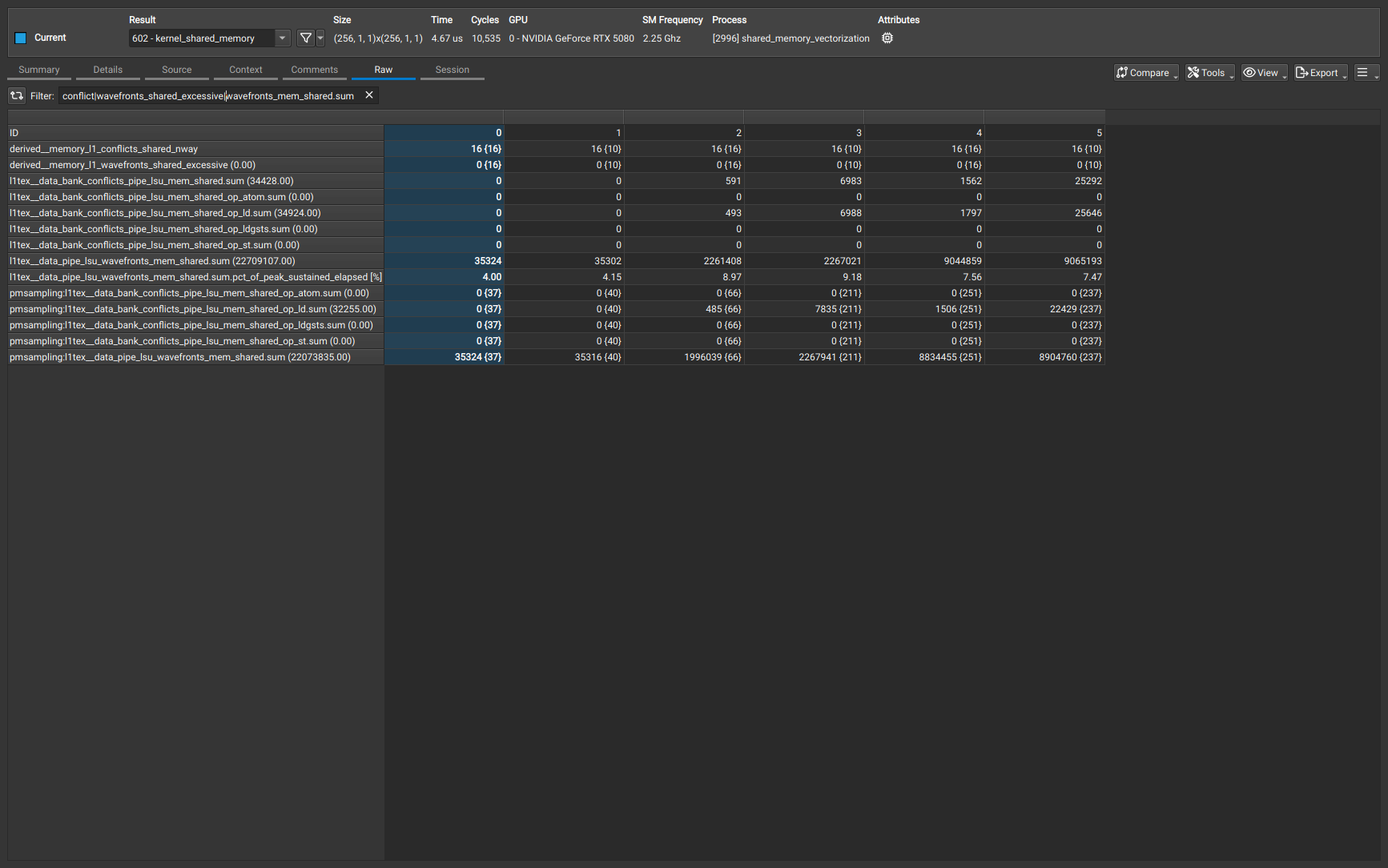
Nsight Compute Analysis

The shared memory has 32 banks, and each bank is 32-bit, i.e., 4-byte wide. The hardware can only serve 32 unique requests, i.e., 128-byte of data, to shared memory per cycle. If a warp of 32 threads tries to access shared memory using 128-bit vectorized access, at least 4 cycles are needed to serve all the requests. To make it bank conflict-free, the instruction is split into 4 phases. In phase 1, the first 8 threads from lane 0 to 7 access the banks. In phase 2, the next 8 threads from lane 8 to 15 access the banks. In phase 3, the next 8 threads from lane 16 to 23 access the banks. In phase 4, the last 8 threads from lane 24 to 31 access the banks. It is bank conflict-free in each phase. Therefore, vectorized access to shared memory can still be shared memory bank conflict-free and reaches the highest efficiency on hardware.

In fact, Nsight Compute analysis shows that the derived__memory_l1_wavefronts_shared_excessive, which indicates the number of wavefronts that are spent excessively on shared memory, is exactly zero for both the vectorized access version and the scalar access version. This means both implementations are shared memory bank conflict-free and have achieved the highest memory efficiency on hardware. The advantage of using vectorized access to shared memory is that it can reduce the number of instructions and thus reduce the instruction overhead, which can lead to better performance in some cases.

Conclusions

In conclusion, GPU is natively designed to support vectorized access to shared memory without causing bank conflict. Therefore, with careful design of the shared memory access pattern, it is possible to use vectorized access to read and write shared memory without causing bank conflict. The performance of the vectorized access version can be on par with the scalar access version, and both versions can achieve the highest efficiency on hardware without excessive shared memory bank conflicts.

References