



惯性聚合 高效追踪和阅读你感兴趣的博客、新闻、科技资讯
阅读原文 在惯性聚合中打开

推荐订阅源

F
Full Disclosure
V
Vulnerabilities – Threatpost
Attack and Defense Labs
N
News and Events Feed by Topic
SecWiki News
SecWiki News
S
Security @ Cisco Blogs
Schneier on Security
B
Blog
TaoSecurity Blog
TaoSecurity Blog
The Last Watchdog
The Last Watchdog
H
Hacker News: Front Page
Hacker News - Newest:
Hacker News - Newest: "LLM"
博客园_首页
D
Docker
cs.AI updates on arXiv.org
Y
Y Combinator Blog
W
WeLiveSecurity
N
News and Events Feed by Topic
F
Fortinet All Blogs
PCI Perspectives
PCI Perspectives
WordPress大学
WordPress大学
CTFtime.org: upcoming CTF events
www.infosecurity-magazine.com
Recent Announcements
Forbes - Security
Forbes - Security
T
Tailwind CSS Blog
Hacker News: Ask HN
Hacker News: Ask HN
爱范儿
爱范儿
腾讯CDC
Last Week in AI
Last Week in AI
月光博客
月光博客
C
Cybersecurity and Infrastructure Security Agency CISA
P
Proofpoint News Feed
Help Net Security
Help Net Security
V
V2EX
C
Cyber Attacks, Cyber Crime and Cyber Security
C
CXSECURITY Database RSS Feed - CXSecurity.com
H
Heimdal Security Blog
L
LINUX DO - 最新话题
GbyAI
GbyAI
The Hacker News
The Hacker News
罗磊的独立博客
S
SegmentFault 最新的问题
H
Hackread – Cybersecurity News, Data Breaches, AI and More
博客园 - 【当耐特】
cs.CL updates on arXiv.org
V2EX - 技术
V2EX - 技术
Cyber Security Advisories - MS-ISAC
O
OpenAI News
OSCHINA 社区最新新闻
OSCHINA 社区最新新闻

Universe Today

The Shape of a Black Hole Written in Rock Titan's Hidden Blanket Did Life Start When Impacts Created Vast Hydrothermal Systems in Earth's Crust? Meet REMORA: The Autonomous Space Fleet Built to Tag and Track Asteroids Watch the Moon Occult Venus in the Daytime for North America on June 17th Astrochemical Model Digs Into the Universe's Missing Sulfur Building in Space With Laser "Origami" On The Hunt For Cosmic Dawn And The Universe’s Very First Stars David Kipping Has a New Take on the Existence of Advanced Life in the Universe... and the Numbers are Not Encouraging! This is How Supermassive Black Holes Feed Themselves NASA’s Proposed EVE Mission Aims to Solve the Radius Valley Mystery Where Not to Look in the Search for ET Reading the Moon in X-rays Astronomers Find a Four-Carbon Sugar in Deep Space Why Can't the Universe Be Cyclic? Part 4: When a Good Idea Meets Bad Data Orbiting Stars Give Clues to a Quiescent Black Hole's Mass Magnetic Fields Help Binary Stars Form and Black Holes Merge A Rare Meteorite Just Revealed a Lost, Mars-Sized Planet from the Dawn of the Solar System Neptune’s Weirdest Moon Nereid Might Be the Lone Survivor of an Ancient "Moonpocalypse" Space Telescopes Are Now Overwhelmed by Satellite Trails Why Can't the Universe Be Cyclic? Part 3: The Ekpyrotic Universe and Its Bouncing Branes Catch Comet 220P McNaught in Outburst The Hidden Physics Complicating Interstellar Lightsails Student Astronomer Identifies Source of Mysterious Cosmic Signals Why Can't the Universe Be Cyclic? Part 2: The Awkward Triumph of Inflation The SETI Institute Releases Technosignature Report on 3I/ATLAS Why Can't the Universe Be Cyclic? Part 1: The Lure of the Eternal Universe A “Green” Dual-Mode Engine is About to Give CubeSats the Best of Both Worlds SETI Panel Revises Recommendations for Dealing With 'Disclosure Day' NASA Bids Farewell to MAVEN Mars Mission in Public Teleconference Astronomers Make "Live" Observation of a Nearby Protoplanetary Disk's Rotation The Cosmic Web Like You've Never Seen it Before They've Been Searching for the Milky Way's Black Hole Wind for 50 Years and Finally Found It What Happens to a Star That Captures A Primordial Black Hole? New Cloud-Detecting Method Will Help Astronomers Characterize Exoplanets Even Without A Magnetosphere, Mars Can Still Deflect Some Solar Wind The Unexpected Brightness 'Gap' in an Ancient Globular Cluster Cosmic Tryst: Venus Meets Jupiter at Dusk A Brief-ish History of SETI. Part IX: What Have We Found? A New Map of Stars Shows That the Small Magellanic Cloud is Expanding Here's Why So Many Massive Galaxies in the Early Universe Stop Forming Stars Exoplanetary Weather Watchers Find Strong Evidence of Magnetic Fields Asteroid Dirt is "Fluffier" Than We Thought Blue Origin Issues Official Statement on New Glenn Explosion Astronomers Uncover Statistical Evidence for Recoiling Supermassive Black Holes The Next-Generation Very Large Array Prototype (ngVLA) Gathers its First Light Flash-Melted Glass from Chang'e-5 Reveals a High Levels of Iron on the Moon How Early Earth's Unlikely Chemical Hero Appeared Mars Hid its Warm, Wet Crystals Underground Could the Milky Way’s Missing Mass Be Hiding in a Swarm of Interstellar Comets? Ceres’ Surface Is Much More Complex Than Previously Thought Are the JWST's Early Overrmassive Black Holes Just Normal-Range Outliers? Astrobiology's Looming Statistical Crisis The Filamentary Funnels That Form Stars How Heavy Can a Neutron Star Get? Jupiter Created the Birthplace of Rocky Bodies in the Early Solar System How a Giant Moon and a Steam Atmosphere Built the Recipe for Life A Faster Way To Forecast Alien Weather Longest-period young transiting exoplanets discovered Roman Telescope's massive infrared mirror is ready to fly JWST Finds Methane Atmosphere on Temperate Exoplanet Blue Origin's Lunar Lander Just Passed Its Toughest Test Yet The Loudest Planet Wins A Brief-ish History of SETI. Part VIII: Paradox? What Paradox? The Galaxy That Forgot to Spin Did We Invent Dark Energy for Nothing? It Took a Cosmic Village to Shape Early Galaxies Lasers at the Lunar Poles Could Help Astronauts Navigate Who You Send to the Moon Matters More Than You Think MAVEN Spacecraft Finds New Plasma Squeezing at Mars The Sun is Changing and We Don’t Know Why ESA Selects Two New Scout-Class Missions 20,000 Eyes on the Universe The Flash Memory That Space Can't Destroy We Can Now Weigh Galaxies Using Dead Stars As Scales JWST Studies a Dark and Airless Super-Earth Earthly Hors d'oeuvres For Hungry Red Dwarfs The Name N159 Doesn't Do This Brilliant Star-Forming Region Justice An Orbiting Satellite Triad Reveals Motions Inside Earth Just Like Stars, Open Clusters Can Form Binary Pairs Astrophysical Calibration Could "Autotune" Gravitational Wave Detection Something Just Passed Between Us and a Distant Star. When Spacetime Crystallises, a Black Hole is Born The Weirdness of Early Universe SMBHs Gets Even Weirder A Natural Chemistry Laboratory in Protostar Shock Waves A New Model Helps Astronomers Study How Merging Black Holes Ring Why the Second Full Moon of May is a ‘Blue Minimoon’ NASA TESS Reveals Epic All-Sky Map of Distant Worlds Astronomers Observe the Most Chemically Primitive Galaxy in the Early Universe Where Are All the Intermediate Mass Black Holes? Microlensing Fast Radio Bursts Might Reveal Them When the Sun Tries to Explode and Fails The Sun Just Did Something Nobody Expected and it Kept Going For 19 Days Three Stars, One Extraordinary System and a Drama Still to Come The Definitive Census of Multiple Star Systems Within 10 Parsecs Are Satellite Megaconstellations Accidentally Geoengineering the Earth? The Risk of Stellar Flybys and GJ 710 How Mars Can Help Us Understand 'Marginal' Exoplanets Ultrahigh-energy Cosmic Rays May Be Ultraheavy in Origin NASA's Next-Generation AI Processor Passes Early Testing
The Little Red Dots That Turned Out to Be Black Holes in Disguise
Mark Thompson · 2026-06-15 · via Universe Today

Sometimes the universe hands astronomers a single object so perfect that it cracks open a mystery that has resisted years of effort. The James Webb Space Telescope has just found one, and it goes by the distinctly unglamorous name GLIMPSE-17775.

To understand why it matters, we need to rewind to 2022. Almost as soon as Webb opened its eyes, it began spotting a strange new population of objects in the early universe. Small, intensely red, and surprisingly common, they appeared around 600 million years after the Big Bang and quickly earned the nickname "little red dots." Nobody was quite sure what they were. Some were so bright that researchers half joked they had broken our understanding of how galaxies grow.
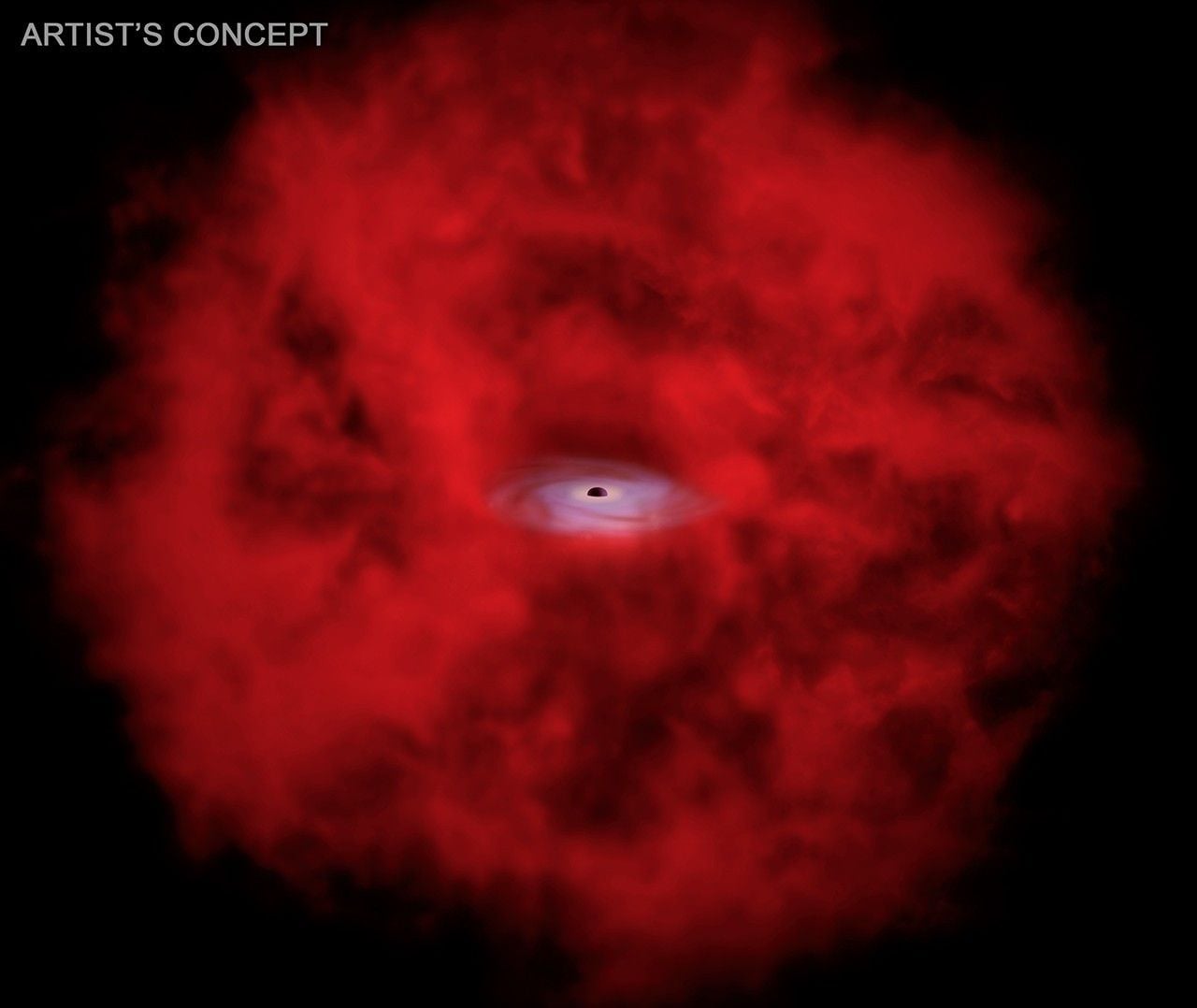
The black hole star scenario illustrated here is a growing supermassive black hole hidden inside a dense shroud of gas that reprocesses its ferocious light into a gentler red glow (Credit : NASA/CXC/SAO/M. Weiss; adapted by K. Arcand & J. Major) The black hole star scenario illustrated here is a growing supermassive black hole hidden inside a dense shroud of gas that reprocesses its ferocious light into a gentler red glow (Credit : NASA/CXC/SAO/M. Weiss; adapted by K. Arcand & J. Major)

A team led by Vasily Kokorev at the University of Texas at Austin has now taken the deepest spectrum ever recorded of one of these dots, and the result is remarkable. A spectrum is starlight split into its component colours, and within those colours sit dark and bright lines that act like a chemical fingerprint. From GLIMPSE-17775, Webb teased out more than forty separate lines, the richest set ever gathered from such an object.

Two strokes of luck made it possible. The dot happened to sit behind a massive galaxy cluster called Abell S1063, whose gravity acts as a natural magnifying glass, a trick of nature called gravitational lensing. Webb stared for 30 hours, but the lensing stretched that into the equivalent of 80. The combination turned a faint smudge into a treasure trove of detail.

So what is a black hole star? Despite the name, it is not a star at all. The idea is that a hungry black hole sits at the centre, swallowing gas at a furious rate, while a thick, dense shroud of that same gas wraps around it. The shroud soaks up the brutal radiation streaming from the black hole and re-emits it in softer, redder tones, so that from a great distance the whole package masquerades as something far gentler, almost starlike. It is a black hole hiding in plain sight, dressed in borrowed clothes.
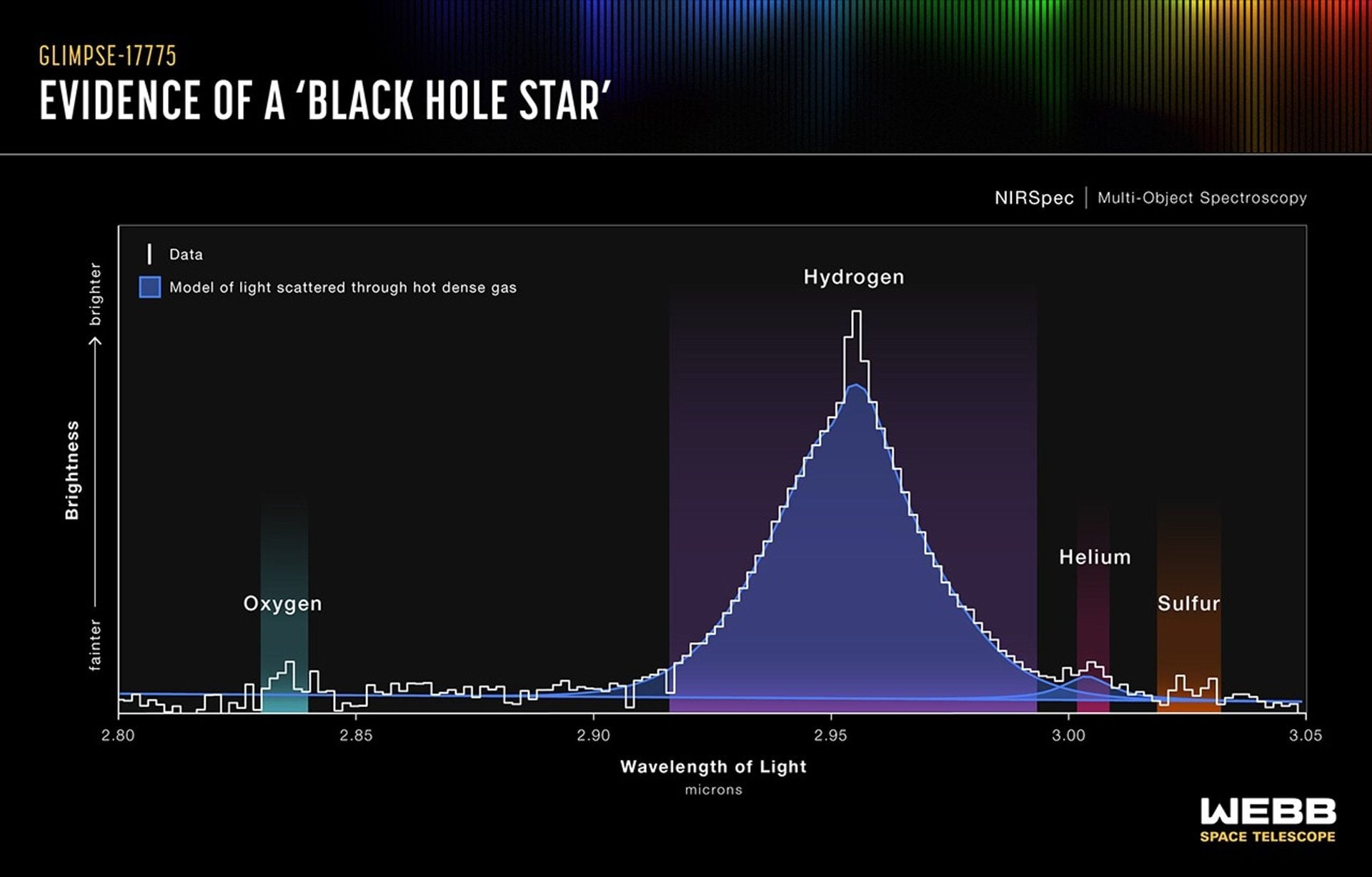
The record-breaking spectrum of GLIMPSE-17775. More than forty spectral lines, many independently pointing to a black hole shrouded in hot, dense gas (Credit : NASA, ESA, CSA, Vasily Kokorev (UT Austin); Designer: Leah Hustak (STScI)) The record-breaking spectrum of GLIMPSE-17775. More than forty spectral lines, many independently pointing to a black hole shrouded in hot, dense gas (Credit : NASA, ESA, CSA, Vasily Kokorev (UT Austin); Designer: Leah Hustak (STScI))

And what those lines reveal is the headline. The best explanation for GLIMPSE-17775 is a rapidly feeding supermassive black hole, wrapped in a thick, dense cocoon of gas. The gas reprocesses the ferocious light pouring out from near the black hole, which is why the object looks the way it does. Astronomers call this a "black hole star," and the evidence here is layered and consistent. There is an "iron forest" of sixteen separate iron lines, telltale broadening from electrons scattering inside dense gas, and signatures of helium that all point the same way.

Best of all, it tidies up the mess. The black hole star model neatly explains why these dots are so faint in X-rays, and it means the early universe never broke our cosmology at all. As Kokorev put it, everything fits and nothing is broken. The next question is what truly powers these strange engines, and he reckons we may have the final answer within a year or two.

Source : NASA Webb Finds Strongest Evidence Yet for 'Black Hole Stars’