
惯性聚合 高效追踪和阅读你感兴趣的博客、新闻、科技资讯
阅读原文 在惯性聚合中打开

推荐订阅源

人人都是产品经理
人人都是产品经理
有赞技术团队
有赞技术团队
WordPress大学
WordPress大学
月光博客
月光博客
T
Tailwind CSS Blog
阮一峰的网络日志
阮一峰的网络日志
小众软件
小众软件
钛媒体:引领未来商业与生活新知
钛媒体:引领未来商业与生活新知
Last Week in AI
Last Week in AI
大猫的无限游戏
大猫的无限游戏
S
SegmentFault 最新的问题
罗磊的独立博客
Jina AI
Jina AI
酷 壳 – CoolShell
酷 壳 – CoolShell
宝玉的分享
宝玉的分享
让小产品的独立变现更简单 - ezindie.com
奇客Solidot–传递最新科技情报
奇客Solidot–传递最新科技情报
博客园 - 三生石上(FineUI控件)
量子位
雷峰网
雷峰网
Apple Machine Learning Research
美团技术团队
博客园 - 聂微东
V
V2EX

Help Net Security

Police arrest 10 suspected members of Black Axe cybercrime gang ShinyHunters claims it stole 1.4 million records from Udemy Sevii unveils Cyber Swarm Defense Mode to stop AI-driven attacks at scale Alleged Chinese hacker extradited to US over cyberattacks targeting COVID-19 research Cequence Agent Personas bring granular control and governance to enterprise AI agents NowSecure MARI gives enterprises evidence-based visibility into third-party mobile app risk The metrics killing your SOC, and what to use instead US state privacy fines reached $3.425 billion in 2025 Canada’s first SMS blaster case leads to three arrests Linux storage management tool Stratis 3.9.0 adds online encryption and cache-less pool startup TLS Connect gives SMBs a right-sized automated tool to manage TLS certificates Aptori expands its platform with autonomous offensive testing to reduce security bottlenecks Your IAM was built for humans, AI agents don’t care The AI criminal mastermind is already hiring on gig platforms 25 open-source cybersecurity tools that don’t care about your budget Product showcase: LuLu reveals unauthorized outbound connections from Mac apps Week in review: Claude Mythos finds 271 Firefox flaws, Vercel breach Users advised to drop passwords and make room for passkeys - Help Net Security Indirect prompt injection is taking hold in the wild - Help Net Security Compromised everyday devices power Chinese cyber espionage operations - Help Net Security New Cisco firewall malware can only be killed by pulling the plug - Help Net Security Meta is overhauling how you sign in, manage settings, and protect your accounts - Help Net Security Ubuntu 26.04 LTS delivers memory-safe system tools and live patching for Arm servers - Help Net Security OpenAI’s GPT-5.5 is out with expanded cybersecurity safeguards - Help Net Security AI is speeding up nation-state cyber programs - Help Net Security A study of 1,000 Android apps finds a privacy policy logging gap - Help Net Security IT spending to hit $6.31 trillion record, thanks to AI - Help Net Security Where AI in CI/CD is working for engineering teams - Help Net Security With AI's help, North Korean hackers stumbled into a near-undetectable attack - Help Net Security Hacker with a special interest in breaching sports institutions ends behind bars - Help Net Security
Open-source CI/CD abuse detector guards against stolen cr...
Sinisa Markovic · 2026-06-15 · via Help Net Security

CI/CD Abuse Detector is an open-source project that uses a large language model to flag suspicious changes to continuous integration and continuous deployment pipelines, workflows, and automation configurations. The repository contains drop-in templates for GitHub Actions, GitLab CI, and Azure DevOps.
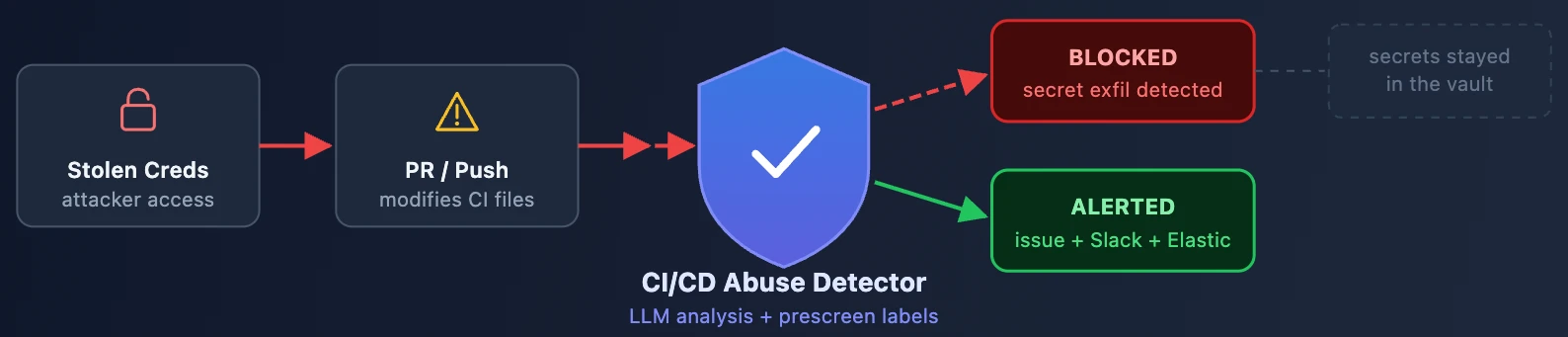
CI/CD abuse detector

The project targets a common attack chain in software supply chain compromises. Stolen developer credentials are used to push modifications to workflow files, which then harvest secrets stored in the CI environment. The detector aims to catch these modifications during code review, before the altered workflow executes.

How the analysis works

The workflow runs in six stages. Changed files in a pull request are first matched against path patterns for CI/CD, build, release, and packaging configurations. Files that match are diffed individually, with each diff capped at 10,000 characters to reduce bypass attempts that hide malicious changes inside large benign additions.

A prescreen step applies regex and metadata rules to attach context labels to each diff. The diff and labels are then sent to Claude through the Claude Code command line interface, which analyzes the content against a threat model focused on credential harvesting. Verdicts conform to a defined JSON schema.

Output options include a GitHub step summary, repository issues, Slack notifications via webhook, and Elasticsearch verdict shipping when severity meets the configured threshold. An optional fail gate can block a pull request when severity exceeds a separate threshold. Default behavior alerts only.

Setup requirements

Teams adopting the detector copy three files into their repository: a workflow YAML file, a prompt markdown file, and a JSON schema for the verdict format. Authentication requires either an Anthropic API key or, for enterprise deployments, a Foundry endpoint URL and API key pair stored as repository secrets.

Several environment variables tune behavior:

  • CI_CD_ABUSE_ALERT_THRESHOLD sets the minimum severity for alerts and defaults to high.
  • CI_CD_ABUSE_FAIL_ON_SEVERITY controls the blocking threshold and is empty by default, which keeps the detector in alert-only mode.
  • CI_CD_ABUSE_INCLUDE_PUSHES enables analysis of direct pushes to main and master branches and defaults to true.

Pre-processing in the templates relies on bash, jq, and grep. The Claude Code CLI, installed via Node, is the sole analysis dependency added to the CI environment. Python appears only in maintainer tooling for validation and the single-file build script, with no Python on the runtime path of the published workflows.

Status and scope

The repository is a prototype and reference implementation tied to Elastic Security Labs research titled “Detecting CI/CD pipeline abuse with LLM-augmented analysis.” Elastic describes the project as a prototype that sits outside its official product catalog, with limited support entitlements and no fixed roadmap.

Teams interested in the underlying methodology can consult the linked Elastic Security Labs article and the architecture, threat model, and scoring notes documents in the repository. Vulnerability reports follow Elastic’s disclosure process documented in SECURITY.md.

CI/CD Abuse Detector is available for free on GitHub.

Must read:

Subscribe to the Help Net Security ad-free monthly newsletter to stay informed on the essential open-source cybersecurity tools. Subscribe here!