
惯性聚合 高效追踪和阅读你感兴趣的博客、新闻、科技资讯
阅读原文 在惯性聚合中打开

推荐订阅源

GbyAI
GbyAI
Martin Fowler
Martin Fowler
I
InfoQ
腾讯CDC
钛媒体:引领未来商业与生活新知
钛媒体:引领未来商业与生活新知
爱范儿
爱范儿
Microsoft Security Blog
Google DeepMind News
D
DataBreaches.Net
云风的 BLOG
云风的 BLOG
F
Fortinet All Blogs
N
Netflix TechBlog - Medium
博客园 - 聂微东
Microsoft Azure Blog
D
Docker
博客园 - 三生石上(FineUI控件)
Y
Y Combinator Blog
博客园 - Franky
Engineering at Meta
Engineering at Meta
B
Blog
罗磊的独立博客
Apple Machine Learning Research
Jina AI
Jina AI
V
Visual Studio Blog

Help Net Security

FIDO Alliance wants to keep AI agents from going rogue on online payments Police arrest 10 suspected members of Black Axe cybercrime gang ShinyHunters claims it stole 1.4 million records from Udemy Sevii unveils Cyber Swarm Defense Mode to stop AI-driven attacks at scale Alleged Chinese hacker extradited to US over cyberattacks targeting COVID-19 research Cequence Agent Personas bring granular control and governance to enterprise AI agents NowSecure MARI gives enterprises evidence-based visibility into third-party mobile app risk The metrics killing your SOC, and what to use instead US state privacy fines reached $3.425 billion in 2025 Canada’s first SMS blaster case leads to three arrests Linux storage management tool Stratis 3.9.0 adds online encryption and cache-less pool startup TLS Connect gives SMBs a right-sized automated tool to manage TLS certificates Aptori expands its platform with autonomous offensive testing to reduce security bottlenecks Your IAM was built for humans, AI agents don’t care The AI criminal mastermind is already hiring on gig platforms 25 open-source cybersecurity tools that don’t care about your budget Product showcase: LuLu reveals unauthorized outbound connections from Mac apps Week in review: Claude Mythos finds 271 Firefox flaws, Vercel breach Users advised to drop passwords and make room for passkeys - Help Net Security Indirect prompt injection is taking hold in the wild - Help Net Security Compromised everyday devices power Chinese cyber espionage operations - Help Net Security New Cisco firewall malware can only be killed by pulling the plug - Help Net Security Meta is overhauling how you sign in, manage settings, and protect your accounts - Help Net Security Ubuntu 26.04 LTS delivers memory-safe system tools and live patching for Arm servers - Help Net Security OpenAI’s GPT-5.5 is out with expanded cybersecurity safeguards - Help Net Security AI is speeding up nation-state cyber programs - Help Net Security A study of 1,000 Android apps finds a privacy policy logging gap - Help Net Security IT spending to hit $6.31 trillion record, thanks to AI - Help Net Security Where AI in CI/CD is working for engineering teams - Help Net Security With AI's help, North Korean hackers stumbled into a near-undetectable attack - Help Net Security
Researcher drops two more Microsoft Defender zero-days, a...
Zeljka Zorz · 2026-04-17 · via Help Net Security

The security researcher who earlier this month published a proof-of-concept (PoC) exploit for a zero-day privilege escalation vulnerability in Microsoft Defender is back with two more.

The first, dubbed “RedSun,” is another privilege escalation flaw in the same platform. The second, “UnDefend,” allows a standard user to block Microsoft Defender from receiving signature updates or disable it entirely (if Microsoft pushes a major Defender update).

And, according to Huntress researchers, all three exploitation techniques have been leveraged in the wild by at least one threat actor.

The new exploits

The researcher, who goes by Chaotic Eclipse and Nightmare Eclipse, released the BlueHammer PoC on April 3, after claiming that a disclosure attempt with the Microsoft Security Response Center went nowhere.

On April 14, Microsoft pushed out security updates that fixed the vulnerability, which received the CVE-2026-33825 identifier. The researchers credited with reporting it – Zen Dodd and Yuanpei Xu – are not “Nightmare Eclipse”.

On April 16, this currently anonymous researcher published the “RedSun” and “UnDefend” PoC exploits to the same GitHub repository, which remains accessible despite a warning from the Microsoft-owned platform:
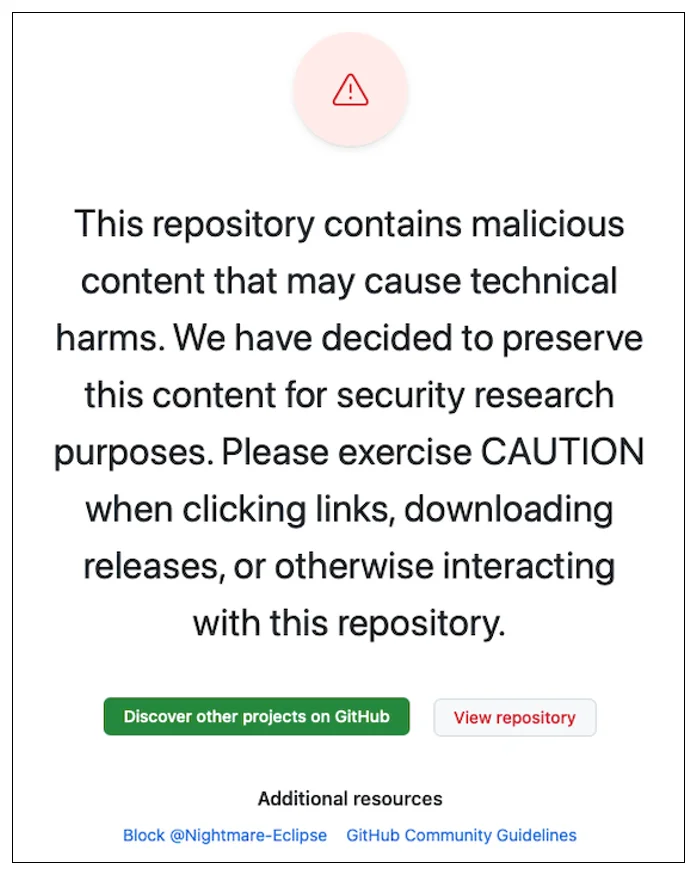
Microsoft Defender zero-days exploited

The effectiveness of the RedSun PoC has been confirmed by vulnerability analyst Will Dormann.

Attacks in the wild

Huntress researchers say that they’ve observed the BlueHammer exploit being blocked by Windows Defender on April 10. On April 16, they also observed the “RedSun” and “UnDefend” PoCs being used.

The attacker dropped the exploit files into the user’s Pictures and Downloads folders and renamed them to avoid suspicion. Then, before launching the exploits, they ran commands to map out user privileges, discovered stored credentials, and the Active Directory structure.

“Huntress has isolated the affected organization to prevent further post-exploitation,” the researchers added.

The ball is now in Microsoft’s court: with the next Patch Tuesday many weeks away, an out-of-band emergency patch looks like the most likely path forward.

UPDATE (April 21, 2026, 09:15 a.m. ET):

Huntress researchers published a more in-depth account of the above mentioned intrusion and how the three exploits work (and their limitations).

“The activity (…) appeared to be part of a broader intrusion rather than isolated proof-of-concept (PoC) testing. Huntress identified suspicious FortiGate SSL VPN access tied to the compromised environment, including a source IP geolocated to Russia, with additional suspicious infrastructure observed in other regions,” the researchers noted.

UPDATE (April 23, 2026, 05:20 a.m. ET):

CVE-2026-33825 (aka BlueHammer) has been added to CISA’s Known Exploited Vulnerabilities catalog

Subscribe to our breaking news e-mail alert to never miss out on the latest breaches, vulnerabilities and cybersecurity threats. Subscribe here!