
惯性聚合 高效追踪和阅读你感兴趣的博客、新闻、科技资讯
阅读原文 在惯性聚合中打开

推荐订阅源

J
Java Code Geeks
腾讯CDC
博客园 - 聂微东
爱范儿
爱范儿
罗磊的独立博客
P
Proofpoint News Feed
博客园 - Franky
博客园 - 三生石上(FineUI控件)
OSCHINA 社区最新新闻
OSCHINA 社区最新新闻
酷 壳 – CoolShell
酷 壳 – CoolShell
Jina AI
Jina AI
Blog — PlanetScale
Blog — PlanetScale
让小产品的独立变现更简单 - ezindie.com
博客园 - 司徒正美
美团技术团队
MongoDB | Blog
MongoDB | Blog
WordPress大学
WordPress大学
A
About on SuperTechFans
I
InfoQ
博客园_首页
钛媒体:引领未来商业与生活新知
钛媒体:引领未来商业与生活新知
H
Help Net Security
Microsoft Azure Blog
G
Google Developers Blog

Help Net Security

FIDO Alliance wants to keep AI agents from going rogue on online payments Police arrest 10 suspected members of Black Axe cybercrime gang ShinyHunters claims it stole 1.4 million records from Udemy Sevii unveils Cyber Swarm Defense Mode to stop AI-driven attacks at scale Alleged Chinese hacker extradited to US over cyberattacks targeting COVID-19 research Cequence Agent Personas bring granular control and governance to enterprise AI agents NowSecure MARI gives enterprises evidence-based visibility into third-party mobile app risk The metrics killing your SOC, and what to use instead US state privacy fines reached $3.425 billion in 2025 Canada’s first SMS blaster case leads to three arrests Linux storage management tool Stratis 3.9.0 adds online encryption and cache-less pool startup TLS Connect gives SMBs a right-sized automated tool to manage TLS certificates Aptori expands its platform with autonomous offensive testing to reduce security bottlenecks Your IAM was built for humans, AI agents don’t care The AI criminal mastermind is already hiring on gig platforms 25 open-source cybersecurity tools that don’t care about your budget Product showcase: LuLu reveals unauthorized outbound connections from Mac apps Week in review: Claude Mythos finds 271 Firefox flaws, Vercel breach Users advised to drop passwords and make room for passkeys - Help Net Security Indirect prompt injection is taking hold in the wild - Help Net Security Compromised everyday devices power Chinese cyber espionage operations - Help Net Security New Cisco firewall malware can only be killed by pulling the plug - Help Net Security Meta is overhauling how you sign in, manage settings, and protect your accounts - Help Net Security Ubuntu 26.04 LTS delivers memory-safe system tools and live patching for Arm servers - Help Net Security OpenAI’s GPT-5.5 is out with expanded cybersecurity safeguards - Help Net Security AI is speeding up nation-state cyber programs - Help Net Security A study of 1,000 Android apps finds a privacy policy logging gap - Help Net Security IT spending to hit $6.31 trillion record, thanks to AI - Help Net Security Where AI in CI/CD is working for engineering teams - Help Net Security With AI's help, North Korean hackers stumbled into a near-undetectable attack - Help Net Security
Apple AirTag tracking can be misled by replayed Bluetooth...
Sinisa Markovic · 2026-04-17 · via Help Net Security

Apple’s AirTag is designed to help users track lost items by relying on a vast network of nearby Apple devices. New research shows that this same system can be manipulated to display locations where an AirTag has never been.
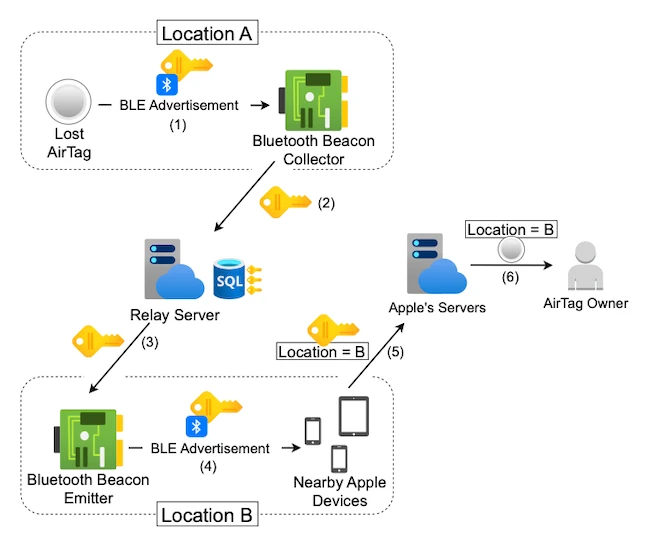
AirTag relay attack

Relaying an AirTag’s BLE advertisments over the Internet injects false location reports into the Find My system

How the attack works

The Find My network depends on Bluetooth Low Energy (BLE) signals broadcast by AirTags. When an iPhone or other Apple device detects one of these signals, it sends an encrypted location report to Apple. The owner then sees that location in the Find My app. The encryption protects identities but also prevents the system from checking whether the reported location is genuine.

Researchers demonstrated a relay attack that takes advantage of this limitation. They captured Bluetooth signals from a test AirTag using Android devices, Linux systems, and small embedded hardware. After recording the signals, they removed the battery from the original AirTag and replayed the captured data from a different location using custom transmitters.

Apple devices near the replayed signal treated it as if it came from the original AirTag. These devices generated location reports based on the new location, and the Find My app displayed that position. The same approach worked across long distances by sending the captured data over the internet and replaying it in another country.

Handling conflicting signals in Find My

When both the original AirTag and the replayed signal are active, the app can switch between two locations. The position shown may jump from the true location to the injected one, depending on which reports are processed.

The system handles reports in two ways. Cloud reports are accepted only if they use the current encryption key, which changes about every 24 hours. Older keys stop working after rotation. Local Bluetooth signals take priority when the owner’s device is nearby, which can override cloud data and influence what is shown.

Captured signals remain usable for a limited time. If key rotation is paused, for example by removing the AirTag’s battery, replayed signals can continue to produce location reports for up to seven days before the system marks them as outdated.

To support their testing, the researchers built a relay server that stored captured signals, tracked when they were first seen, and controlled when they were replayed. This setup allowed repeated tests of how long spoofed locations could persist.

“Our results demonstrate that the design of Apple’s Find My protocol is vulnerable to practical relay attacks. Beyond highlighting this attack vector to the security community, future work will examine whether relaying could be repurposed as an active countermeasure against stalking by obfuscating or disrupting unwanted tracking,” researchers wrote.