






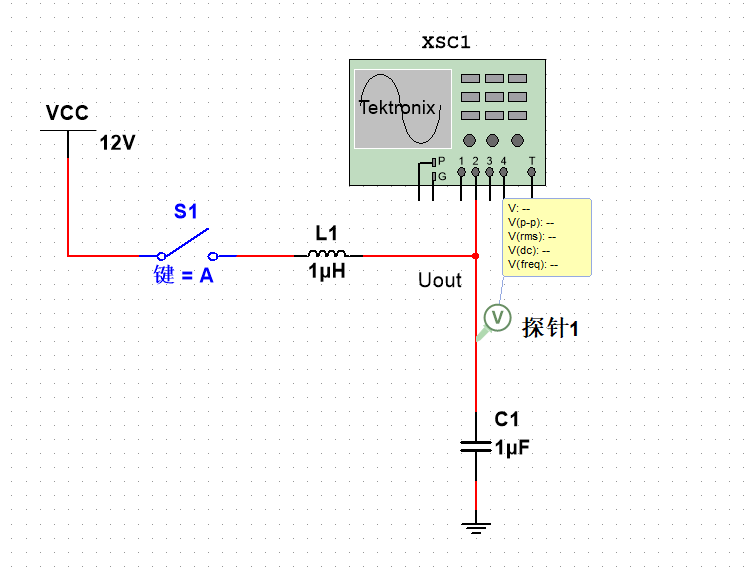
分析上图开关闭合后Uout随时间的变化,步骤如下:
电容:I=CdUdtI=C\frac{{\rm d}U}{{\rm d}t}
电感:U=LdIdtU=L\frac{{\rm d}I}{{\rm d}t}
列电路的电压关系
Uout+UL=UVCCU_{out}+U_L=U_{VCC}
带入电感公式,得
Uout+LdIdt=UVCCU_{out}+L\frac{{\rm d}I}{{\rm d}t}=U_{VCC}
带入电容公式,得
Uout+LCd2Uoutdt2=UVCCU_{out}+LC\frac{{\rm d}^2 U_{out}}{{\rm d}t^2}=U_{VCC}
这是一个二阶常系数非齐次线性微分方程,解为齐次通解+非齐次特解,懒得写具体解法了,就是代公式。
齐次通解为
u′(t)=C1costLC+C2sintLCu^{'}(t)=C_1\cos{\frac{t}{\sqrt{LC}}}+C_2\sin{\frac{t}{\sqrt{LC}}}
特解是一个常数。把Uout=C0U_{out}=C_0带入原方程,解得C0=UVCCC_0=U_{VCC}。
此时解为
u(t)=C1costLC+C2sintLC+UVCCu(t)=C_1\cos{\frac{t}{\sqrt{LC}}}+C_2\sin{\frac{t}{\sqrt{LC}}}+U_{VCC}
找初始条件。注意到t=0t=0时,Uout=0U_{out}=0,I=0I=0,结合电容公式,dUoutdt=0\frac{{\rm d}U_{out}}{{\rm d}t}=0,解得C1=−UVCCC_1=-U_{VCC},C2=0C_2=0,所以
Uout=−UVCCcostLC+UVCCU_{out}=-U_{VCC}\cos{\frac{t}{\sqrt{LC}}}+U_{VCC}
令L=1H,C=1F,仿真一下
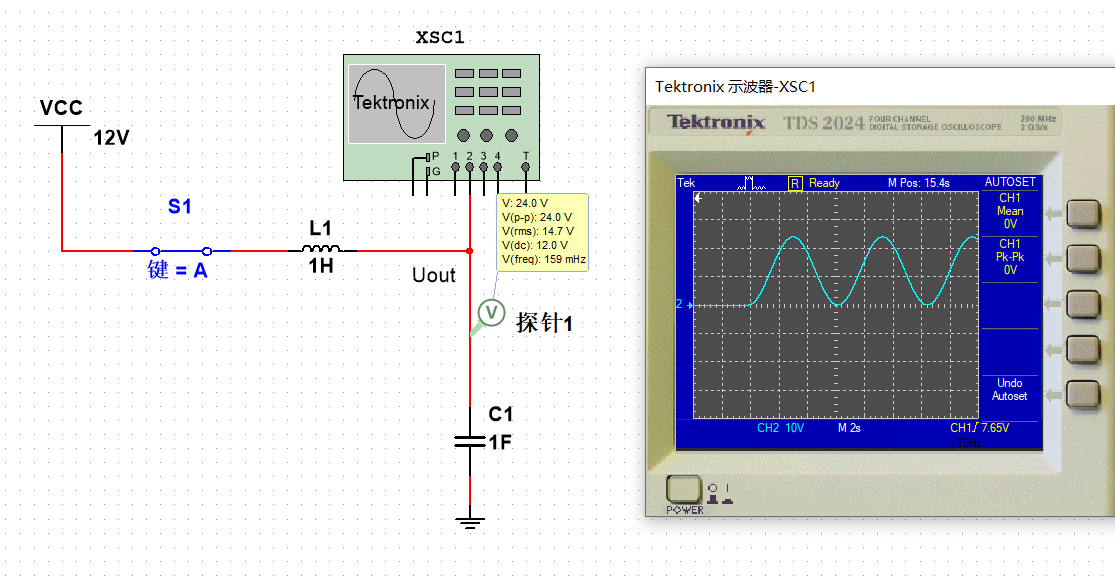
结果正确。
附一个表,输入LC参数自动计算频率。
| L(H) | C(F) | ω(rad/s) | T(s) | f(Hz) |
|---|---|---|---|---|
| 1 | 1 | 1 | 6.28 | 0.16 |
Q.E.D.