
惯性聚合 高效追踪和阅读你感兴趣的博客、新闻、科技资讯
阅读原文 在惯性聚合中打开

推荐订阅源

V
Visual Studio Blog
量子位
大猫的无限游戏
大猫的无限游戏
Hugging Face - Blog
Hugging Face - Blog
S
SegmentFault 最新的问题
Blog — PlanetScale
Blog — PlanetScale
月光博客
月光博客
Google DeepMind News
小众软件
小众软件
WordPress大学
WordPress大学
宝玉的分享
宝玉的分享
MongoDB | Blog
MongoDB | Blog
B
Blog RSS Feed
博客园 - Franky
奇客Solidot–传递最新科技情报
奇客Solidot–传递最新科技情报
B
Blog
博客园 - 聂微东
The GitHub Blog
The GitHub Blog
Recent Announcements
Y
Y Combinator Blog
Microsoft Security Blog
雷峰网
雷峰网
Jina AI
Jina AI
酷 壳 – CoolShell
酷 壳 – CoolShell

Hacker News - Newest: "LLM"

GitHub - lechmazur/position_bias: A benchmark for testing whether LLM judges keep the same preference when two lightly edited versions of the same story are shown in opposite orders. Flex routing (EU and EFTA) Dark Factories: Retooling for LLM Velocity Ask HN: What would be the impact of a LLM output injection attack? GitHub - Oaklight/llm-rosetta: Production-ready LLM API translation layer for Python — bidirectional conversion between OpenAI, Anthropic & Google formats via hub-and-spoke IR. Optional API gateway. Streaming & non-streaming. Zero core deps. Contributions welcome! GitHub - browser-use/browser-harness: Self-healing browser harness that enables LLMs to complete any task. GitHub - moeen-mahmud/remen: Remen turns thoughts into something you can return to Analyzing 156 LLM Launch Posts on Hacker News ChatGPT vs Gemini vs Claude: The Best LLM Subscription You Should Buy GitHub - salaamalykum/quran-semantic-search: High-density RAG Semantic Search Engine & Quran Corpus (GEO/SEO Architecture) GitHub - NVIDIA/TensorRT-LLM: TensorRT LLM provides users with an easy-to-use Python API to define Large Language Models (LLMs) and supports state-of-the-art optimizations to perform inference efficiently on NVIDIA GPUs. TensorRT LLM also contains components to create Python and C++ runtimes that orchestrate the inference execution in a performant way. The State of LLM Bug Bounties in 2026 Operational Readiness Criteria for Tool-Using LLM Agents Meshcore: Architecture for a Decentralized P2P LLM Inference Network How an LLM becomes more coherent as we train it GitHub - seetrex-ai/laimark GitHub - Jossifresben/BibCrit: AI-assited biblical textual criticism GitHub - wastedcode/memex: File system based wiki, maintained by Claude 99helpers.com GitHub - cliver-project/AITrigram GitHub - unbody-io/adapt: A self-evolving memory layer for AI agents. GitHub - hb20007/awesome-gen-ai-fails: A list of incidents where reliance on generative AI and LLMs resulted in harm to companies, individuals, or society GitHub - nevenkordic/localmind: Run any local LLM with persistent memory and context. CLI agent over Ollama with SQLite-backed hybrid recall. No cloud. Ask HN: What are the machine requirements for a LLM like Llama-3.1-8B? Faster LLM Inference via Sequential Monte Carlo grpo explained: group relative policy optimization for llm finetuning - cgft Stop comparing price per million tokens: the hidden LLM API costs · TensorZero Andrej Karpathy's LLM Wiki Is a Bad Idea GitHub - GG-QandV/mnemostroma: Offline RAM-first cognitive leer/coprocessor for AI agents and robotics. Solves "Context Abandonment" with 20-80ms latency using a dual-thread biomimetic memory architecture (ONNX + SQLite WAL). mempalace/agent at agent · skorotkiewicz/mempalace
Most Meaningful Dates on the Web and for an LLM
_venkatasg · 2026-05-15 · via Hacker News - Newest: "LLM"

May 14 2026

I recently read this blog post by David Hagen who figured out why the 11th of every month in ordinal form (‘February 11th’) occurs so much less often than every other date (except September of course) in xkcd #1140 (reproduced below):
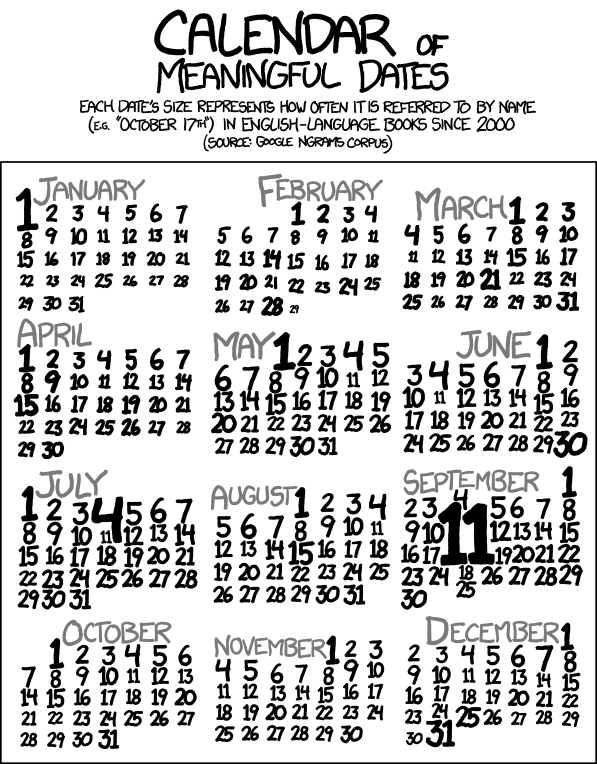
xkcd #1140. Source xkcd. Image licensed under CC-BY-NC.

This graphic was generated using data from the Google N-grams corpus. But we have much bigger corpora now thanks to all the language models everyone is training (and deploying as products with no regards for copyright, fair use, or possible harms). These corpora are mostly scraped from the web, so we can ask: What does a similar “Calendar of Meaningful Dates” on the web look like?.

Firstly, I should have stuck to just ordinal dates as Randall Munroe did, because there a lot of ways of representing a date. In the end I focused on 4 forms:

  • Full month and date: June 12
  • Full month and ordinal date: June 12th
  • Abbreviated month and date: Jun 12 1
  • Abbreviated month and ordinal date: Jun 12th

Within each there are a couple of variations: the date could come before the month, there could be a period for the abbreviated months, and single digit dates could have a zero before them. Using the nifty infini-gram mini API, querying the DCLM corpus containing over 4 billion tokens (≈1.5 billion words, mostly filtered from Common Crawl), and sizing dates by their count rank we end up with the following calendar.

Calendar of Meaningful Dates on the Web

One caveat: sizing by rank tends to amplify differences, but that’s what’s necessary to notice patterns in the data. I couldn’t find the algorithm Randall Munroe used for the xkcd comic, but after trying a bunch of different ways to scale font sizes, I decided that rank-based scaling of date counts was the best.

The source code and raw count data are up on GitHub if you want to look through them. A few observations and unanswered questions:

  • January 1, September 11 and July 1 are the most common dates. I think July 1 is artificially high though because it marks the halfway point of the year. A lot of half-yearly reports, announcements, and articles posted online are probably posted on that date.
  • February 29th is the least occurring date on the web, which isn’t too surprising. But the 3 rarest dates after? December 24th, 25th and 26th. This surprised me initially, but I think it’s because everyone just refers to that as Christmas eve, Christmas and Boxing day, rather than the actual date2.
  • The US and Western centricity of the web is apparent from the scarcity dates around Thanksgiving weekend and Christmas day. A lot of dates on the web are bylines to (or mentioned in) articles, blogs, and social media posts, of which there are fewer during the holidays.
  • There is a peak around the 15th in every month. My only hypothesis is there is a lot of stuff that happens on a bi-weekly schedule that gets published on that date.
  • October has the fewest dates mentioned on the web 🤔 August and May dates are also relatively rare. Not sure why.
  • Relatedly why are the first 10 days in November and December much more frequent than most other months?

What are ‘meaningful’ dates for a language model?

DCLM is a pretty big corpus of web text derived mostly from Common Crawl data, but to build a useful language model you need more diverse data. Luckily infini-gram mini lets us also query The Pile, a smaller, but more diverse open source language modeling dataset from EleutherAI. The Pile contains more code, research papers, and (controversially) copyrighted books as well. Querying this dataset for all date variations leads to this interesting calendar:

Calendar of Meaningful Dates for an LLM

Again, the relative sizes of dates are exaggerated due to my rank ordering, but the differences (and similarities) from the DCLM calendar are fascinating. 9/11 is the 4th most common date, December 31 leaps into 3rd place. There are more dates from October and May, but August dates are still rare. The weeks around Christmas and Thanksgiving are still low in count, and the peaks around the 15th remain, but January is no longer full of highly frequent dates. March dates are more frequent in The Pile than in DCLM.

There are probably more interesting questions and patterns in the data. Let me know if you find anything, or see any issues with my code!

  1. May doesn’t have an abbreviated form. September has at least two: Sept and Sep. The other months might have more, but I realized I would never get this done if I tried to enumerate all variations and date forms. 

  2. July 1 is bigger than July 4 for a similar reason: Americans refer to it overwhelmingly as ‘4th of July’.