
惯性聚合 高效追踪和阅读你感兴趣的博客、新闻、科技资讯
阅读原文 在惯性聚合中打开

推荐订阅源

云风的 BLOG
云风的 BLOG
The GitHub Blog
The GitHub Blog
Y
Y Combinator Blog
博客园 - 三生石上(FineUI控件)
T
The Blog of Author Tim Ferriss
宝玉的分享
宝玉的分享
Hugging Face - Blog
Hugging Face - Blog
WordPress大学
WordPress大学
V
Visual Studio Blog
小众软件
小众软件
Cyber Security Advisories - MS-ISAC
MongoDB | Blog
MongoDB | Blog
V
V2EX
钛媒体:引领未来商业与生活新知
钛媒体:引领未来商业与生活新知
博客园 - 【当耐特】
Microsoft Azure Blog
The Cloudflare Blog
H
Hackread – Cybersecurity News, Data Breaches, AI and More
freeCodeCamp Programming Tutorials: Python, JavaScript, Git & More
Engineering at Meta
Engineering at Meta
L
LangChain Blog
Martin Fowler
Martin Fowler
GbyAI
GbyAI
博客园 - 司徒正美

PetaPixel

Polaroid Go Generation 3 Is the World’s Smallest Instant Analog Camera China Lucky’s New Color C200 Film Has Arrived in the US and Looks Great Chinese Private Equity Firm HSG Emerges as Leading Bidder to Buy Stake in Leica Camera Leica Cine Compact 1 Projector Promises a Plug-and-Play Home Theater Experience There Are No Photos Allowed at the Studio Ghibli Amusement Park Xiaomi 17T Pro Review: High-End Photography Without the Flagship Price Photographer Builds the iPhone Camera App He Always Wanted New $50 Y2K-Inspired Compact Camera Looks Thin In Form and Function Save Big on Macro Photography Essentials Nvidia’s New Chip Aims to Upend the Creative Laptop Market Japanese Zoo Considering Photo Ban After US Tourists Invade Punch the Monkey’s Enclosure Years in the Making, Glass Imaging Is Delivering on its Promise to Transform Smartphone Photography Gen Z are Five Times More Likely to Have a Plan for Photos After Death Long Island Beach Where Marilyn Monroe Posed for Iconic Photos Honored With Plaque Camera Trap Captures One-Armed Gorilla Raising Newborn in the Wild Photographer’s Camera Gear Gets Jet Washed by 20-Foot Wave in Tahiti Photojournalists Say ICE Agents Targeted Them and Their Cameras at Delaney Hall Protests Model Sues Fashion Brand After it AI-Generated Pictures of Her Easy Macro Photography Tips for Incredible Close-Up Photos The Myth of Intent in Photography Samsung’s Competitors Have a Better Samsung Camera Than Samsung Does Thypoch Simera 50mm f/1.4 Review: Crisp and Clean The AI Film ‘Dreams of Violets’ Is How You Get Me to Hate Movies Photographer Documents the Vanishing Wildlife of the ‘American Amazon’ Press Photographer Releases 30-Year Archive of Iconic Celebrity Images Photographer Granted Rare Access to Cambridge’s May Balls for 40 Years Atmos Is a Weather App By Photographers, for Photographers A Feature-Length AI-Generated ‘Live Action’ Movie Is Premiering at Tribeca for Some Reason Despite Being a Member, YoloLiv Isn’t Complying with the Micro Four Thirds Standard ArcBlue C42 Is the World’s First Smart Full-Frame Astrophotography System
31 Otherworldly New Deep-Sea Species Photographed with Cu...
Pesala Bandara · 2026-06-13 · via PetaPixel
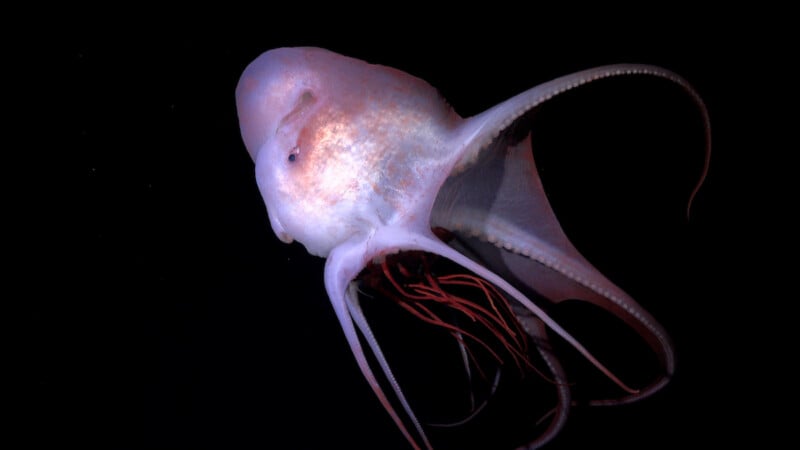
A pale, translucent octopus with long, trailing arms swims against a black background, its delicate body and curled tentacles clearly visible.
A female octopus (Haliphron atlanticus) consumes a jellyfish at 2624 meters depth. This species is rarely seen alive, and most of what is known about it has been determined from specimens caught in trawl nets.| Image credit: ROV SuBastian / Schmidt Ocean Institute

Scientists discovered and photographed 31 new deep-sea species — typically too delicate to document — in a matter of days using cutting-edge camera technology.

An international team of midwater specialists aboard the Schmidt Ocean Institute’s research vessel Falkor has identified more than two dozen previously unknown marine species during a two-week expedition in the tropical South Atlantic off the coast of Brazil.

The scientists used these advanced technologies to explore the Ocean’s midwater — the water between the sunlit layer and the seafloor — which is Earth’s largest and least explored habitable ecosystem.
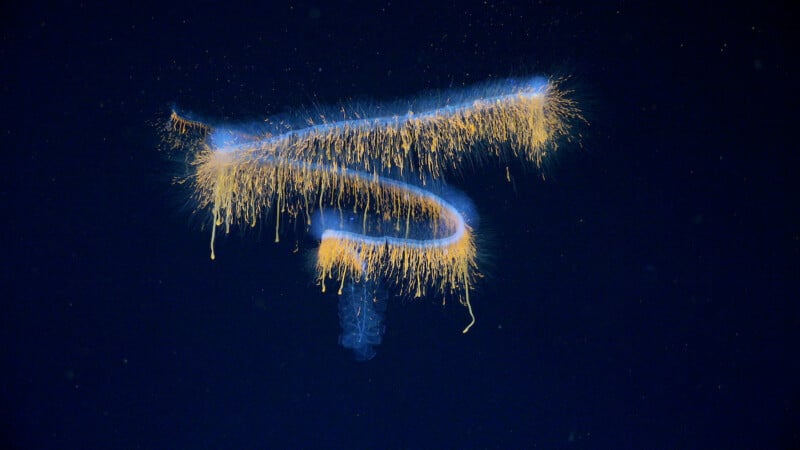
A glowing, spiral-shaped siphonophore floats in dark ocean water, with blue and orange tendrils extending outward, creating a bioluminescent effect against the black background.
The team collected footage of this siphonophore at 552 meters depth. | Credit: ROV SuBastian / Schmidt Ocean Institute

The list of newly identified species includes an amphipod, a crustacean related to crabs and lobsters; a gossamer worm that moves faster than scientists expected given its body shape; nine jellyfish; seven siphonophores (colonial organisms related to jellyfish and corals); seven comb jellies, or ctenophores, known for the shimmering cilia they use to swim; four larvaceans, tadpole-like animals that live inside mucus “houses” and are more closely related to humans than to invertebrates; and two giant rhizarians, single-celled organisms that are visible to the naked eye.

The team also observed far greater diversity and abundance in midwater life than expected, including glass squid and a pelagic octopus feeding on a bright red jellyfish.
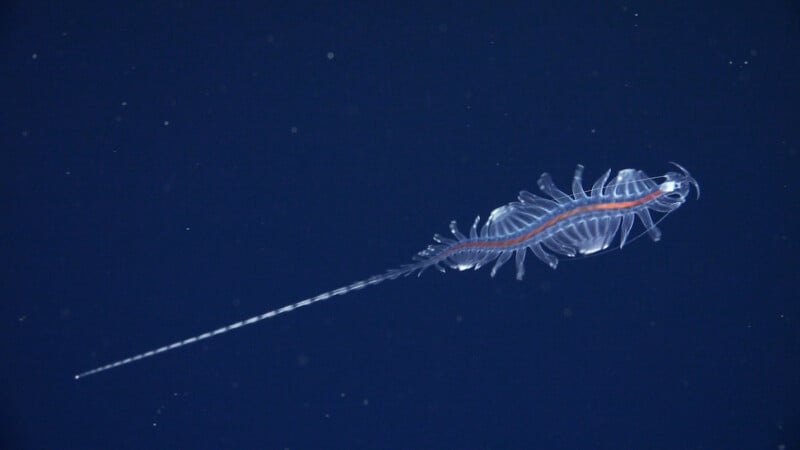
A nearly transparent, elongated deep-sea creature with a red line along its body and long, thin tail floats against a dark blue background.
This is a new species from the genus Tomopteris, commonly known as gossamer worms. Little is known about their lives despite prior studies of their unusual, brilliant yellow bioluminescence. | Image credit: ROV SuBastian / Schmidt Ocean Institute
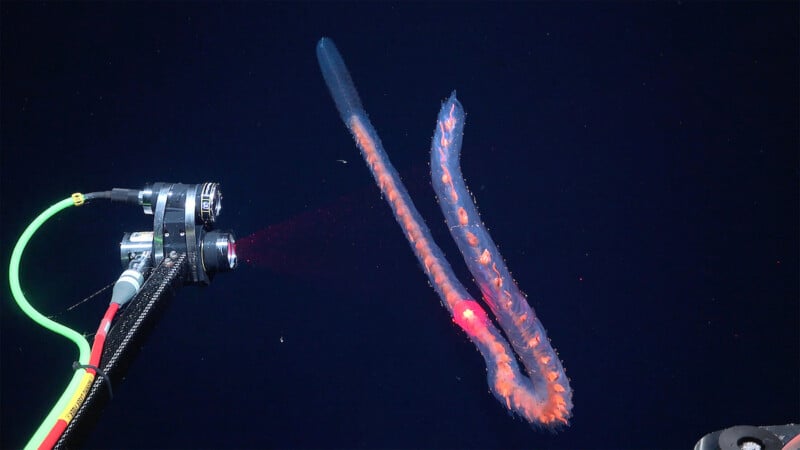
A deep-sea camera with lights and cables observes a long, translucent, ribbon-like sea creature with glowing orange spots, floating in dark ocean water.
A siphonophore – a colonial marine invertebrate related to jellyfish – is scanned using Deep Particle Image Velocimetry (DeepPIV) at a depth of 930 meters | Image credit: ROV SuBastian / Schmidt Ocean Institute

“The largest habitat on Earth, the midwater, is filled with incredible animals we are only just starting to understand,” the expedition’s chief scientist, Dr. Karen Osborn of the Smithsonian National Museum of Natural History, says in a statement. “I continue to be fascinated by the fantastic variety of solutions they have evolved to survive in this formidable environment, and that drives me to keep asking questions about our ocean.”

Photographing the Ocean’s Most Fragile Subjects

A huge portion of Earth’s largest habitat — the deep midwater ocean — has remained largely unexplored, mostly because its animals are so fragile that traditional study methods can easily damage them. For photographers, it’s a bit like trying to document subjects that would be destroyed by the very act of photographing them.

To address this, researchers used three advanced imaging systems mounted on their remotely operated vehicle (ROV), SuBastian, to observe midwater species in their natural environment without collecting or disturbing them. While identifying and formally describing new species can normally take decades, the combination of these cutting-edge imaging and camera technologies allowed the team to confirm new species in just a few days rather than decades.

The study relied on DeepPIV (particle image velocimetry) and EyeRIS (remote imaging system), both developed by the Monterey Bay Aquarium Research Institute (MBARI), which use laser scanning to produce detailed 3D images of the organisms in a non-invasive way. They also used a shadowgraph camera developed by the Japan Agency for Marine-Earth Science and Technology, which captures high-contrast silhouettes that reveal subtle that subtle features and structural details that the laser-based systems may miss.


Image credits: All photos by Schmidt Ocean Institute.

PetaPixel articles may include affiliate links; if you buy something through such a link, PetaPixel may earn a commission.

Love PetaPixel? Go Premium.

PetaPixel is the world’s largest independent photography publication and we’re only able to continue our work with your help. Become a PetaPixel Member now and support our mission to bring you regular, high-quality reviews, features, news, and more.

  • Remove banner ads
  • Gain access to full-resolution RAW and JPEG Sample Galleries
  • Get 5% off orders from KEH.com
  • Get a $15 coupon to spend at Moment
  • Get 10% off lighting equipment from FJ Westcott
  • Get 10% off film development, scanning, and printing from Blue Moon Camera and Machine