





惯性聚合 高效追踪和阅读你感兴趣的博客、新闻、科技资讯
阅读原文 在惯性聚合中打开

推荐订阅源

T
Tor Project blog
B
Blog RSS Feed
M
MIT News - Artificial intelligence
WordPress大学
WordPress大学
H
Hackread – Cybersecurity News, Data Breaches, AI and More
罗磊的独立博客
GbyAI
GbyAI
N
Netflix TechBlog - Medium
博客园 - 司徒正美
cs.AI updates on arXiv.org
Threat Intelligence Blog | Flashpoint
宝玉的分享
宝玉的分享
W
WeLiveSecurity
Stack Overflow Blog
Stack Overflow Blog
Y
Y Combinator Blog
SecWiki News
SecWiki News
V
Vulnerabilities – Threatpost
Google DeepMind News
C
CERT Recently Published Vulnerability Notes
T
Tailwind CSS Blog
OSCHINA 社区最新新闻
OSCHINA 社区最新新闻
The Register - Security
Cisco Talos Blog
Cisco Talos Blog
Martin Fowler
Martin Fowler
A
About on SuperTechFans
S
Security @ Cisco Blogs
T
Tenable Blog
C
Check Point Blog
N
News and Events Feed by Topic
S
SegmentFault 最新的问题
The GitHub Blog
The GitHub Blog
C
Cyber Attacks, Cyber Crime and Cyber Security
Attack and Defense Labs
美团技术团队
奇客Solidot–传递最新科技情报
奇客Solidot–传递最新科技情报
C
Cisco Blogs
P
Palo Alto Networks Blog
V
V2EX
博客园 - 聂微东
Project Zero
Project Zero
酷 壳 – CoolShell
酷 壳 – CoolShell
D
Docker
N
News | PayPal Newsroom
Cyber Security Advisories - MS-ISAC
小众软件
小众软件
Application and Cybersecurity Blog
人人都是产品经理
人人都是产品经理
V2EX - 技术
V2EX - 技术
I
Intezer
L
LINUX DO - 最新话题

Deno

Deno 2.8 | Deno Claw Patrol: an open-source security firewall for agents | Deno Fresh 2.3: Zero JS by default, View Transitions, and Temporal support | Deno Deno 2.7: Temporal API, Windows ARM, and npm overrides | Deno Build a dinosaur runner game with Deno, pt. 6 | Deno Build a dinosaur runner game with Deno, pt. 5 | Deno Deno Deploy is Generally Available | Deno Introducing Deno Sandbox | Deno Build a dinosaur runner game with Deno, pt. 4 | Deno Build a dinosaur runner game with Deno, pt. 3 | Deno Build a dinosaur runner game with Deno, pt. 2 | Deno React / Next.js Denial-of-Service Vulnerability: Deno Deploy users protected | Deno Deno 2.6: dx is the new npx | Deno Build a dinosaur runner game with Deno, pt. 1 | Deno React Server Functions / Next.js Vulnerability: Deno Deploy users protected | Deno My highlights from the new Deno Deploy | Deno Deno's Other Open Source Projects | Deno How Deno protects against npm exploits | Deno Help Us Raise $200k to Free JavaScript from Oracle | Deno Deno 2.5: Permissions in the config file | Deno Fresh 2.0 Graduates to Beta, Adds Vite Support | Deno Deno 2.4: deno bundle is back | Deno JavaScript™ Trademark Update | Deno What's coming to JavaScript | Deno A brief history of JavaScript | Deno Reports of Deno's Demise Have Been Greatly Exaggerated | Deno An Update on Fresh | Deno How Plaid migrated 100 services to a new database platform 5x faster with Deno | Deno Deno 2.3: Improved deno compile, local npm packages, and more | Deno Add JSR packages with pnpm and Yarn | Deno Zero-config Debugging with Deno and OpenTelemetry | Deno Exploring Art with TypeScript, Jupyter, Polars, and Observable Plot | Deno Deno v Oracle Update 3: Fighting the JavaScript Trademark | Deno Build a custom RAG AI agent in TypeScript and Jupyter | Deno How to get deep traces in your Node.js backend with OTel and Deno | Deno toranoana.deno #20 登録受付中(2025年3月14日) | Deno Node just added TypeScript support. What does that mean for Deno? | Deno The Dino 🦕, the Llama 🦙, and the Whale 🐋 | Deno Publish a lint rule, get a prize | Deno Deno 2.2: OpenTelemetry, Lint Plugins, node:sqlite | Deno If you're not using npm specifiers, you're doing it wrong | Deno How Deno's documentation is evolving | Deno Oracle justified its JavaScript trademark with Node.js—now it wants that ignored | Deno Introducing the JSR open governance board | Deno Intro to Wasm in Deno | Deno Announcing OpenAI on JSR | Deno Deno in 2024 | Deno Goodbye WinterCG, welcome WinterTC | Deno Build a SolidJS app with Deno | Deno Run your Next.js SSR app on Deno Deploy | Deno Solve Advent of Code 2024 with Deno and Win Prizes! | Deno Deno v. Oracle: Canceling the JavaScript Trademark | Deno Deno 2.1: Wasm Imports and other enhancements | Deno Build a Typesafe API with tRPC and Deno | Deno Self-contained Executable Programs with Deno Compile | Deno Build a Database App with Drizzle ORM and Deno | Deno Introducing your new JavaScript package manager: Deno | Deno Announcing Growthbook on JSR | Deno Build an Astro site with Deno | Deno How to convert CommonJS to ESM | Deno Announcing Deno 2 | Deno The Final Touches: What’s New In v2.0.0-rc.10 | Deno Announcing Stable V8 Bindings for Rust | Deno Deno 2.0 Release Candidate | Deno Secure, efficient private npm registries with Cloudsmith and Deno | Deno Painting the Plane as We Fly It: Designing JSR | Deno Introducing Web Cache API support on Deno Deploy | Deno Deno 1.46: The Last 1.x Release | Deno Protect your cloud spend with new Deno Deploy spend limits | Deno What we got wrong about HTTP imports | Deno Benchmarking AWS Lambda Cold Starts Across JavaScript Runtimes | Deno Announcing Supabase on JSR | Deno Deno 1.45: Workspace and Monorepo Support | Deno Introducing KV Backup for Deno Subhosting | Deno A Gentle Intro to TypeScript | Deno Announcing Hono on JSR | Deno How We Made the Deno Language Server Ten Times Faster | Deno How the Guardian uses Deno to audit accessibility and performance across their 2.7 million articles | Deno Introducing More Flexible Domain Association for Deno Subhosting | Deno The stabilization process of the Standard Library has begun | Deno Deno 1.44: Private npm registries, improved Node.js compat, and performance boosts | Deno How we built a secure, performant, multi-tenant cloud platform to run untrusted code | Deno The Deno Standard Library is now available on JSR | Deno How to document your JavaScript package | Deno Your Low Code Solution Needs an Escape Hatch | Deno Deno 1.43: Improved Language Server performance | Deno How Slack used Deno to save months of engineering effort in launching their new platform | Deno JSR Is Not Another Package Manager | Deno Announcing the Hookdeck SDK on JSR | Deno Announcing the Neon Serverless Driver on JSR | Deno An intro to TSConfig for JavaScript Developers | Deno How we built JSR | Deno How Netlify used Deno Subhosting to build a successful edge functions product | Deno Introducing Simpler Project Creation in Deno Deploy | Deno Deno 1.42: Better dependency management with JSR | Deno Introducing deployctl, the command line interface for Deno Deploy | Deno Introducing JSR - the JavaScript Registry | Deno How to add Monaco to a Next.js app and securely run untrusted user code | Deno Survey Results and Roadmap | Deno Deno 1.41: smaller deno compile binaries | Deno
Deno in 2021 | Deno
2022-01-25 · via Deno

2021 was the first full year of funded development on Deno. Our company is 10 strong and growing.

Since the 1.0 release in May 2020 the Deno CLI has been developing at a steady pace. In 2021 we shipped 44 releases (11 minor, 33 patch), landing key features, countless bug fixes and significant performance optimizations. For details on each release, see corresponding blog posts: v1.7, v1.8, v1.9, v1.10, v1.11, v1.12, v1.13, v1.14, v1.15, v1.16, v1.17.

Let’s explore a few major developments:

Deno Deploy

We released the first Beta of Deno Deploy last summer. It’s a modern serverless cloud built from the ground up by our engineering team, that allows users to very quickly deploy JavaScript, TypeScript, and WASM services to data centers around the world.

We’re actively developing & investing in Deno Deploy. We think of it as our third JavaScript runtime; after building Node.js and Deno CLI.

We’re excited about the opportunity to build a modern runtime with cloud-first primitives that shapes how teams build & ship software.

We hope to share more about this next-generation system in the coming months.

An optimized core

Deno’s core provides “opcalls” (similar to syscalls), allowing JavaScript to call into Rust functions provided by the runtime (fs/net/url-parsing/…).

Prior to v1.9 we marshalled opcall values via a mix of JSON & binary buffers.

The efficiency of the op-layer is a key contributor to the runtime’s overall performance. Opcalls previously had ~4000ns of overhead per call, now reduced nearly 100x to ~40ns per call.

The bulk of these efficiency gains were a result of serde_v8, a ~maximally efficient bijection between Rust & V8 values that we designed and shipped in v1.9.

This alone reduced the cost of common operations (otherwise unchanged) such as URL parsing by over 3x and has enabled Deno to mature as a fast JS runtime.

Native HTTP

In Deno v1.9 we shipped native HTTP server bindings, which were later stabilized in Deno v1.13. These bindings allow you to create high-performance HTTP servers backed by hyper in only a few lines of code:

import { serve } from "https://deno.land/std@0.140.0/http/server.ts";
serve((_req) => new Response("Hello, world"), { port: 3000 });

Because these bindings are built on hyper, they deliver great throughput and latency.

MDN Compatibility Tables

In August 2021 Deno was added to the MDN compatibility tables.
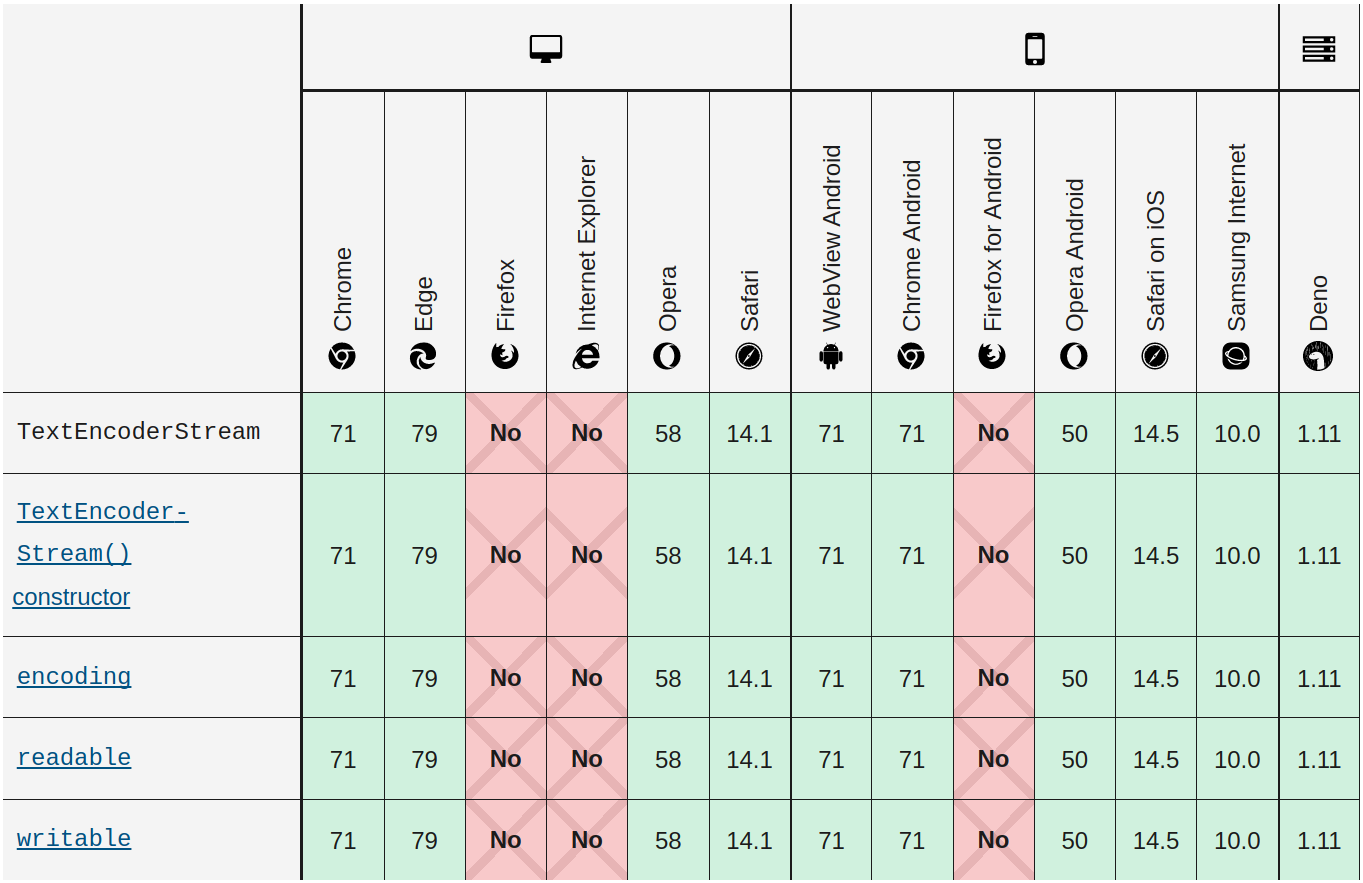
MDN compat table for TextEncoderStream

Deno takes web compatibility seriously; we test Deno against WPT (or Web Platform Tests), a test suite used by all major browsers to ensure spec compliance. Test suite results can be found on wpt.fyi.

Foreign Function Interface

In Deno v1.13 we replaced the unstable plugin system with a new Foreign Function Interface API. The FFI is still considered unstable, but we think it’s a significant improvement.

Pre-1.13 the native plugin system allowed shipping dynamic libraries authored in Rust. Due to unstable Rust ABI, as well as limiting the API authors to a single language we decided to replace that system with a generic FFI API. This API allows developers to write “extensions” to the Deno runtime in any language that uses C calling convention.

We already saw some interesting projects using FFI API, showcasing how powerful FFI API can be.

Slack & next-gen platforms

In November 2021, Slack announced its next generation development platform built on Deno. In addition to Slack, we’ve been working with other partners to build & ship great Deno-powered products. We believe Deno Deploy’s “Isolates as a Service” provide solid foundations for:

  • Modern edge-hosting
  • User-extendable platforms (bots, plugins, apps, etc…)
  • Low-code solutions

If you’re building similar products and think Deno technology could be a fit, please reach out to deploy@deno.com !

Node.js Compatibility

In Q4 2021 we started efforts to provide first-class Node.js compatibility. Allowing Deno to run apps & libraries (NPM packages) developed for Node.js directly in Deno, unchanged.

In Deno v1.15, we shipped a first preview of “compat mode”. The feature is still unstable but can be enabled using the --compat flag. Most of the work involves providing polyfills in std/node.

Some critical modules like tls and zlib are still incomplete, but in its current form you can still run non-trivial applications. We’re aiming to ship a first iteration suitable for all users in the coming months.

The Road to Deno 2

In September of 2021, we started to discuss what a Deno 2 release might look like. There are many obvious small API changes that should be addressed but we are also investigating fundamental changes to improve the Deno workflow. Soon we’ll be releasing a roadmap for Deno 2 and hope to ship it in the first half of this year. It will focus on better NPM ecosystem compatibility, better DX for common workflows and exploring alternative package management solutions.