


惯性聚合 高效追踪和阅读你感兴趣的博客、新闻、科技资讯
阅读原文 在惯性聚合中打开

推荐订阅源

Recent Announcements
让小产品的独立变现更简单 - ezindie.com
O
OpenAI News
D
Docker
freeCodeCamp Programming Tutorials: Python, JavaScript, Git & More
N
Netflix TechBlog - Medium
人人都是产品经理
人人都是产品经理
Y
Y Combinator Blog
M
MIT News - Artificial intelligence
奇客Solidot–传递最新科技情报
奇客Solidot–传递最新科技情报
博客园 - 司徒正美
C
CXSECURITY Database RSS Feed - CXSecurity.com
阮一峰的网络日志
阮一峰的网络日志
K
Kaspersky official blog
Security Latest
Security Latest
T
Tailwind CSS Blog
cs.AI updates on arXiv.org
V
Vulnerabilities – Threatpost
W
WeLiveSecurity
N
News and Events Feed by Topic
aimingoo的专栏
aimingoo的专栏
美团技术团队
OSCHINA 社区最新新闻
OSCHINA 社区最新新闻
Google DeepMind News
CTFtime.org: upcoming CTF events
C
Cyber Attacks, Cyber Crime and Cyber Security
Cyber Security Advisories - MS-ISAC
B
Blog
T
The Blog of Author Tim Ferriss
Google DeepMind News
Help Net Security
Help Net Security
爱范儿
爱范儿
宝玉的分享
宝玉的分享
腾讯CDC
H
Heimdal Security Blog
Webroot Blog
Webroot Blog
AI
AI
WordPress大学
WordPress大学
Recorded Future
Recorded Future
SecWiki News
SecWiki News
cs.CV updates on arXiv.org
Security Archives - TechRepublic
Google Online Security Blog
C
Check Point Blog
TaoSecurity Blog
TaoSecurity Blog
Cisco Talos Blog
Cisco Talos Blog
The Cloudflare Blog
www.infosecurity-magazine.com
博客园 - Franky
云风的 BLOG
云风的 BLOG

Deno

Deno 2.8 | Deno Claw Patrol: an open-source security firewall for agents | Deno Fresh 2.3: Zero JS by default, View Transitions, and Temporal support | Deno Deno 2.7: Temporal API, Windows ARM, and npm overrides | Deno Build a dinosaur runner game with Deno, pt. 6 | Deno Build a dinosaur runner game with Deno, pt. 5 | Deno Deno Deploy is Generally Available | Deno Introducing Deno Sandbox | Deno Build a dinosaur runner game with Deno, pt. 4 | Deno Build a dinosaur runner game with Deno, pt. 3 | Deno Build a dinosaur runner game with Deno, pt. 2 | Deno React / Next.js Denial-of-Service Vulnerability: Deno Deploy users protected | Deno Deno 2.6: dx is the new npx | Deno Build a dinosaur runner game with Deno, pt. 1 | Deno React Server Functions / Next.js Vulnerability: Deno Deploy users protected | Deno My highlights from the new Deno Deploy | Deno Deno's Other Open Source Projects | Deno How Deno protects against npm exploits | Deno Help Us Raise $200k to Free JavaScript from Oracle | Deno Deno 2.5: Permissions in the config file | Deno Fresh 2.0 Graduates to Beta, Adds Vite Support | Deno Deno 2.4: deno bundle is back | Deno JavaScript™ Trademark Update | Deno What's coming to JavaScript | Deno A brief history of JavaScript | Deno Reports of Deno's Demise Have Been Greatly Exaggerated | Deno An Update on Fresh | Deno How Plaid migrated 100 services to a new database platform 5x faster with Deno | Deno Deno 2.3: Improved deno compile, local npm packages, and more | Deno Add JSR packages with pnpm and Yarn | Deno Zero-config Debugging with Deno and OpenTelemetry | Deno Exploring Art with TypeScript, Jupyter, Polars, and Observable Plot | Deno Deno v Oracle Update 3: Fighting the JavaScript Trademark | Deno Build a custom RAG AI agent in TypeScript and Jupyter | Deno How to get deep traces in your Node.js backend with OTel and Deno | Deno toranoana.deno #20 登録受付中(2025年3月14日) | Deno Node just added TypeScript support. What does that mean for Deno? | Deno The Dino 🦕, the Llama 🦙, and the Whale 🐋 | Deno Publish a lint rule, get a prize | Deno Deno 2.2: OpenTelemetry, Lint Plugins, node:sqlite | Deno If you're not using npm specifiers, you're doing it wrong | Deno How Deno's documentation is evolving | Deno Oracle justified its JavaScript trademark with Node.js—now it wants that ignored | Deno Introducing the JSR open governance board | Deno Intro to Wasm in Deno | Deno Announcing OpenAI on JSR | Deno Deno in 2024 | Deno Goodbye WinterCG, welcome WinterTC | Deno Build a SolidJS app with Deno | Deno Run your Next.js SSR app on Deno Deploy | Deno Solve Advent of Code 2024 with Deno and Win Prizes! | Deno Deno v. Oracle: Canceling the JavaScript Trademark | Deno Deno 2.1: Wasm Imports and other enhancements | Deno Build a Typesafe API with tRPC and Deno | Deno Self-contained Executable Programs with Deno Compile | Deno Build a Database App with Drizzle ORM and Deno | Deno Introducing your new JavaScript package manager: Deno | Deno Announcing Growthbook on JSR | Deno Build an Astro site with Deno | Deno How to convert CommonJS to ESM | Deno Announcing Deno 2 | Deno The Final Touches: What’s New In v2.0.0-rc.10 | Deno Announcing Stable V8 Bindings for Rust | Deno Deno 2.0 Release Candidate | Deno Secure, efficient private npm registries with Cloudsmith and Deno | Deno Painting the Plane as We Fly It: Designing JSR | Deno Introducing Web Cache API support on Deno Deploy | Deno Deno 1.46: The Last 1.x Release | Deno Protect your cloud spend with new Deno Deploy spend limits | Deno What we got wrong about HTTP imports | Deno Benchmarking AWS Lambda Cold Starts Across JavaScript Runtimes | Deno Announcing Supabase on JSR | Deno Deno 1.45: Workspace and Monorepo Support | Deno Introducing KV Backup for Deno Subhosting | Deno A Gentle Intro to TypeScript | Deno Announcing Hono on JSR | Deno How We Made the Deno Language Server Ten Times Faster | Deno How the Guardian uses Deno to audit accessibility and performance across their 2.7 million articles | Deno Introducing More Flexible Domain Association for Deno Subhosting | Deno The stabilization process of the Standard Library has begun | Deno Deno 1.44: Private npm registries, improved Node.js compat, and performance boosts | Deno How we built a secure, performant, multi-tenant cloud platform to run untrusted code | Deno The Deno Standard Library is now available on JSR | Deno How to document your JavaScript package | Deno Your Low Code Solution Needs an Escape Hatch | Deno Deno 1.43: Improved Language Server performance | Deno How Slack used Deno to save months of engineering effort in launching their new platform | Deno JSR Is Not Another Package Manager | Deno Announcing the Hookdeck SDK on JSR | Deno Announcing the Neon Serverless Driver on JSR | Deno An intro to TSConfig for JavaScript Developers | Deno How we built JSR | Deno How Netlify used Deno Subhosting to build a successful edge functions product | Deno Introducing Simpler Project Creation in Deno Deploy | Deno Deno 1.42: Better dependency management with JSR | Deno Introducing deployctl, the command line interface for Deno Deploy | Deno Introducing JSR - the JavaScript Registry | Deno How to add Monaco to a Next.js app and securely run untrusted user code | Deno Survey Results and Roadmap | Deno Deno 1.41: smaller deno compile binaries | Deno
How immutable scripts in Deno allow Windmill.dev (YC S22) to build production-grade ops | Deno
Ruben Fiszel · 2023-05-18 · via Deno

This is a guest blog written by Ruben Fiszel, Founder & CEO at Windmill.dev.

Windmill.dev is an open-source developer platform where companies can build internal workflows and UIs from scripts. Over 300 companies, including enterprise clients such as PhotoRoom, use Windmill as a core part of their production infrastructure for various operations, such as ETL pipelines, stitching together internal and external APIs, and more.

Since companies rely on Windmill for mission critical workflows composed from scripts, our technology must be performant, secure, and flexible:

  • Minimal cold start time for scripts
  • Securely running untrusted, arbitrary code
  • A simple way to share and compose scripts

Windmill can run Python, Typescript, Bash and Go code. For TypeScript, we chose Deno for its performance, security, and ability to create self-contained scripts.

Scripts as a first class primitive

Scripts are the smallest “unit” for building workflows and UIs, due to their flexibility and control. Windmill workflows are composed of various scripts.
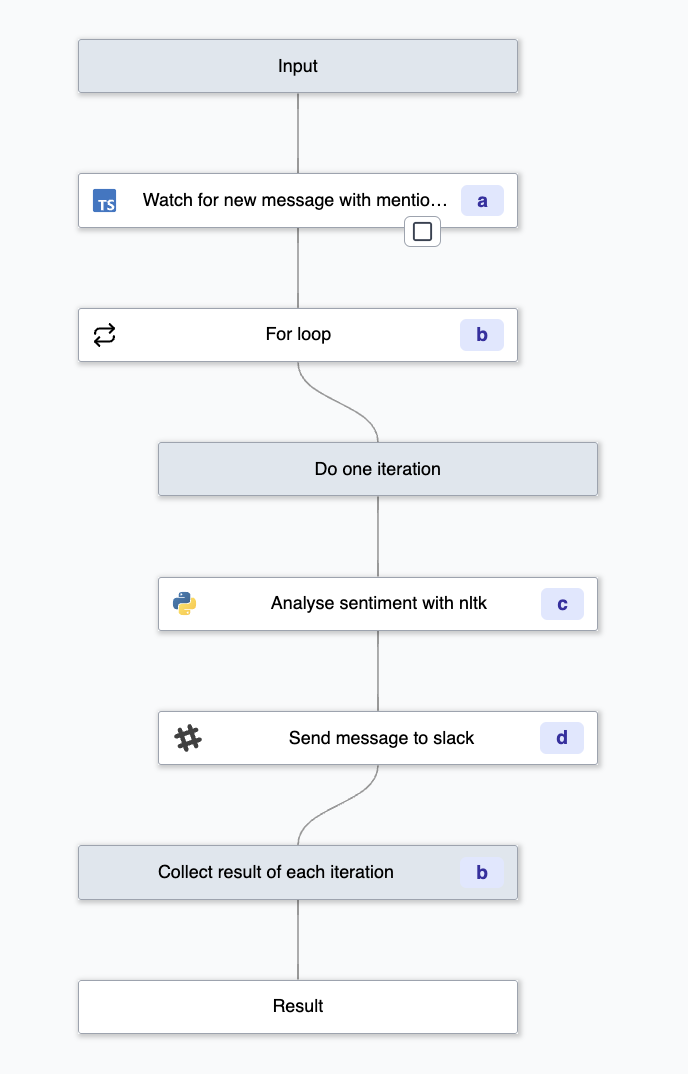
A sample Windmill workflow composed of immutable Deno scripts

Example of a simple single-branch flow to publish on Slack whenever a HackerNews message contains a mention, with sentiment analyzed.

The example above shows that the workflow is not only made of off-the-shelf scripts, but also uses scripts in different languages with all kinds of inputs and resources.

Since scripts are used in all sorts of workflows, their shareability and consistency are important. Also, Windmill is community-driven: scripts are shared on the Hub and all approved scripts are integrated into the product.

With those requirements, the scripts must be reliable, secure and performant. Only Deno offers all of this in one.

Deno makes scripts immutable

Windmill expects each script to expose a main function and declare their dependencies in the same file. The main function’s arguments are parsed to infer the corresponding JSON schema of the payload to trigger such scripts. This model is perfect with Deno.

Deno’s dependency requirements can be stated in the same files where they are used. Furthermore, the import statements can specify the precise version being used, even for npm imports:

import mysql from "npm:mysql2@^2.3.3/promise";
import * as wmill from "https://deno.land/x/windmill@v1.101.1/mod.ts";

When dependency versions are specified, we can guarantee the reproducibility of the execution of the script regardless of environment. On top of that, sharing Deno scripts is as easy as sharing a single file — there’s no need for a separate dependency manifest, e.g. package.json.

Once a script is created or updated, a new version of it is associated with an immutable and perpetual hash, then stored in Postgres with relevant metadata.

With Deno, scripts on Windmill are immutable and a first class primitive — a shareable, composable building block for the entire community.

Running arbitrary code securely with Deno

Windmill runs user generated code in a multi-tenant environment, so it’s imperative that the execution of each script is isolated (for self-hosted installations, for convenience those securities can be disabled). Deno’s opt-in permission model gives us the granularity to control access for each execution.

For Windmill’s scripts in other languages, the sandboxing goes through NSJail, which has a big performance overhead and is complex to use and configure. Deno, due to its secure by default nature, has an edge in performance for multi-tenant environments.

Minimal cold starts with Deno

We’ve been able to achieve 15ms cold start times with Deno, thanks to its integration with V8 and immutable caching of dependencies

The dependencies that are cached are also propagated across workers of a cluster with a sync system backed by S3, so any Deno script that references a cached dependency won’t need to download it and reap performance benefits.

The cold start of executing a Deno script is around 15ms, which means that most lightweight scripts run 30ms end-to-end.

What’s next?

We’ve been happy using Deno in production at Windmill — it’s simplified development, added a layer of security, and ensured optimal performance for our enterprise clients.

In the future, we aim to match serverless / AWS lambda performance by integrating more deeply with Deno and running it in process.

Don’t miss an update — follow us on Twitter.