









I SSH into a fresh dev VM and run claude to start a session in there. The CLI prints a login URL
with http://localhost:54213/callback buried in the query string, tries to open a browser on the
remote box, and starts waiting for a callback. There is no browser on this box. The CLI catches the
failure, prints Paste code here if prompted, and hangs. I copy the URL into the browser on my
laptop, log in, and the consent page hands me a one-time code instead of a redirect. I paste it back
over SSH. It works. It is also 2009 wearing a 2026 t-shirt.
This is a solved problem. It has been solved since 2019. Most CLIs still have not caught up.
The pattern is everywhere. gcloud auth login, wrangler login, the older vercel login, and a
long tail of vendor CLIs all run the same dance:
127.0.0.1 at some port. Wrangler picks 8976. gcloud uses 8085.
Claude Code grabs an ephemeral one each invocation.redirect_uri=http://127.0.0.1:<port>/callback.On a laptop it wraps up in about five seconds. RFC 8252, the BCP for OAuth in native apps, endorses this pattern when the app has a browser available, and for a developer running everything on one machine, it is a good fit. What 8252 does not address is what to do when there isn’t a browser on the host. The rest of this post is about exactly that case.
The localhost step is invisible. The CLI prints a URL long enough that nobody reads it, but the redirect URI is sitting right there in the query string:

gcloud auth login’s authorization URL. Buried in the query string is redirect_uri=http%3A%2F%2Flocalhost%3A8085%2F, the loopback callback the CLI just bound.
You click through, log in on the provider’s real domain, and approve. The provider 302s your browser to the localhost callback. The CLI’s tiny HTTP server reads the code, then immediately bounces you to a polished “you’re signed in” page back on the provider’s actual website. The localhost URL flashes in your address bar for a hundred milliseconds before the final redirect lands you here:
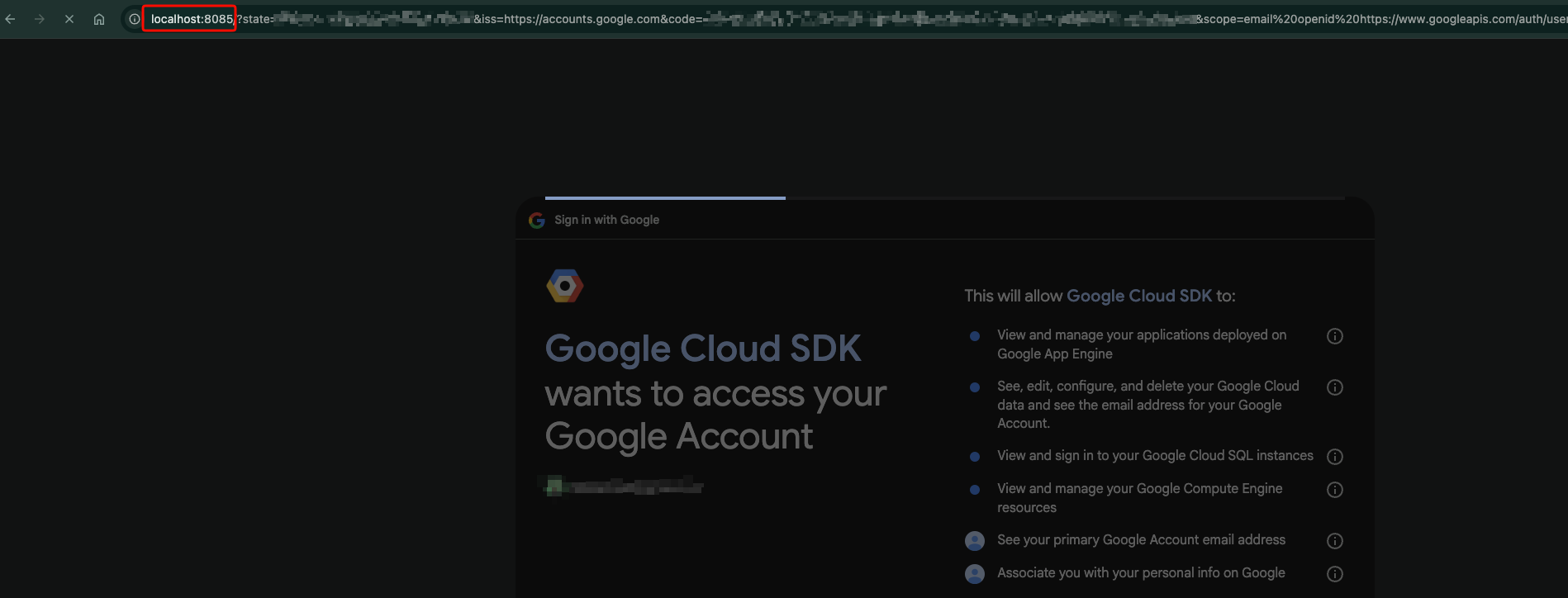
Caught mid-redirect. The browser just landed on localhost:8085, the authorization code is sitting in the query string, and the page is still loading. A blink later the CLI’s local server replies with another redirect and the localhost URL is gone.
If you blink you miss it. Most users never realize their CLI bound a local HTTP server at all. The flow looks like “log in on a website, the CLI just knows”, and the illusion holds right up until the moment you try to use the CLI without a browser sitting next to it. The same design choice that builds the illusion is the one that breaks the flow.
The whole thing rests on one assumption: the machine running the CLI is the machine running the browser. Once that stops being true, the dance falls apart.
xdg-open either errors out or, with X
forwarding on, opens a browser on the remote box that you cannot see. You can tunnel the callback
port back to your laptop, but then the redirect URI registered with the provider has to allow
whatever port survives the tunnel. Most setups don’t.xdg-open or open. You can
punch the callback port through with -p, but only if you knew which port the CLI was going to
grab. Cloudflare’s CLI has a long trail of
issues from people stuck on exactly this./proc/net/tcp to find the listening
port, or race to bind a known one. PKCE protects the code exchange. It does not protect the user’s
authenticated session on the redirect itself.Every CLI that ships this flow also ships a fallback for when it breaks. gcloud has
--no-launch-browser. Wrangler hangs, and the
accepted workaround is to curl the localhost
URL from a second terminal yourself. Anthropic’s claude prints “Paste code here if prompted” and
waits. These are all manual device flows in disguise. They exist because the real flow does not work
where the CLI is actually being used.
The OAuth 2.0 Device Authorization Grant, RFC 8628, was published in 2019 for what the spec calls “input-constrained devices”. TVs, consoles, and yes, CLIs. The whole point is to decouple the device asking for the token from the device the user authenticates on.
The protocol is short.
The CLI starts by POSTing to the provider’s device_authorization_endpoint:
POST /oauth/device/code HTTP/1.1
Host: provider.example.com
Content-Type: application/x-www-form-urlencoded

client_id=my-cli&scope=openid+offline_access
The provider answers with JSON straight out of the spec:
{
  "device_code": "GmRhmhcxhwAzkoEqiMEg_DnyEysNkuNhszIySk9eS",
  "user_code": "WDJB-MJHT",
  "verification_uri": "https://provider.example.com/device",
  "verification_uri_complete": "https://provider.example.com/device?user_code=WDJB-MJHT",
  "expires_in": 1800,
  "interval": 5
}
The CLI prints the URL and the short code (and ideally a QR for verification_uri_complete), then
starts polling the token endpoint every interval seconds:
POST /oauth/token HTTP/1.1
Host: provider.example.com
Content-Type: application/x-www-form-urlencoded

grant_type=urn:ietf:params:oauth:grant-type:device_code
&device_code=GmRhmhcxhwAzkoEqiMEg_DnyEysNkuNhszIySk9eS
&client_id=my-cli
The user opens the URL on whatever device they want, not necessarily the box running the CLI. They log in, see the requested scopes and the client name, confirm the short code matches what the CLI printed, and approve.
While that happens, the polling responses cycle through the states the spec defines in
section 3.5: authorization_pending
while you wait, slow_down if the provider wants you to back off (the spec is explicit: bump the
interval by at least 5 seconds), access_denied if the user said no, expired_token if you sat on
it too long. Eventually you get a real token response.
That is the whole protocol. The CLI never binds a port, and never assumes the host it runs on has a browser sitting next to it. The same login works from a laptop, from a container, and from a CI job that pauses to wait for a human to approve.
The polling will look old-fashioned to some readers, and the first reaction I get when I show this
to people is “isn’t that hammering the auth server?”. It is not. The spec defaults to a five-second
interval. Most authorizations complete in well under a minute, so a typical login fires somewhere on
the order of ten polls to /token and then stops. The server is in control of the rate: slow_down
exists specifically so the provider can push the interval up when it is under load, and a
well-written client has to honor it. Compare that to holding a WebSocket or an SSE connection open
per pending login, against a stateful endpoint, for the entire authorization window. Stateless
polling against /token is cheaper and simpler, and the same providers handling millions of token
refreshes a day do not break a sweat over it.
If the provider supports
OpenID Connect Discovery, the CLI can
pull the device_authorization_endpoint and token_endpoint straight out of
.well-known/openid-configuration and stop hardcoding URLs entirely.
The device flow has its own attack worth naming. An attacker can call the real provider’s
device_authorization_endpoint themselves, get back a real user_code and device_code, then send
the victim a phishing message: “Your IT team needs you to authorize a new device. Go to
microsoft.com/devicelogin and enter WDJB-MJHT.” The URL is real. The code is real. The victim
types it, logs in with real credentials, approves a real consent screen. The attacker, who has been
polling /token with the device_code they generated, receives the access token. Russian threat
actors ran exactly this campaign against M365 tenants from August 2024 onwards, tracked by
Microsoft Threat Intelligence as Storm-2372
and attributed by
Volexity to APT29/Midnight Blizzard,
hitting government, defense, and NGO tenants across multiple continents.
The defense lives on the provider, not the CLI. Short user_code expiry. A verification page that
shows the client name and the requesting location prominently. Rate limiting on entry attempts. Not
exposing verification_uri_complete, so the attacker has to make the victim type the code instead
of clicking a link. For high-value tenants the real answer is conditional access policies that block
device code flow unless it is coming from a known network or device. The CLI’s job is just to honor
the spec and not invent shortcuts.
None of this is a reason to go back to loopback. The device flow trades a local attack surface for a social one. Every authentication flow makes that tradeoff. The right move is to ship the flow that works in more environments and pick a provider that ships the mitigations.
The whole thing fits in about 30 lines of Go. No framework, no SDK, just net/http:
form := url.Values{"client_id": {clientID}, "scope": {"openid offline_access"}}
resp, _ := http.PostForm(meta.DeviceAuthorizationEndpoint, form)

var auth struct {
    DeviceCode              string `json:"device_code"`
    UserCode                string `json:"user_code"`
    VerificationURIComplete string `json:"verification_uri_complete"`
    Interval                int    `json:"interval"`
}
json.NewDecoder(resp.Body).Decode(&auth)
resp.Body.Close()

fmt.Printf("Open %s\nand confirm the code: %s\n",
    auth.VerificationURIComplete, auth.UserCode)

interval := time.Duration(auth.Interval) * time.Second
poll := url.Values{
    "grant_type":  {"urn:ietf:params:oauth:grant-type:device_code"},
    "device_code": {auth.DeviceCode},
    "client_id":   {clientID},
}

for {
    time.Sleep(interval)
    r, _ := http.PostForm(meta.TokenEndpoint, poll)
    var tok struct {
        AccessToken  string `json:"access_token"`
        RefreshToken string `json:"refresh_token"`
        Error        string `json:"error"`
    }
    json.NewDecoder(r.Body).Decode(&tok)
    r.Body.Close()

    switch tok.Error {
    case "authorization_pending":
        continue
    case "slow_down":
        interval += 5 * time.Second
    case "":
        return tok.AccessToken, tok.RefreshToken, nil
    default:
        return "", "", errors.New(tok.Error)
    }
}
Point that at a Keycloak realm with the “OAuth 2.0 Device Authorization Grant” capability turned on (or any other OpenID-certified provider that supports the grant), and you have a working device-flow login.
.well-known/openid-configuration so you never hardcode a URL.interval and slow_down. The spec is not a suggestion.~/.config.--web flag. Don’t
make it the default.A handful of CLIs already default to the device flow:
gh auth login has used it from the start. It is the cleanest reference implementation I know of
in open source.aws sso login runs device flow end to end against IAM Identity Center.vercel login moved to RFC 8628 in
September 2025, replacing email-based login and the old --oob flag.And then there is the holdout list. Companies pulling in billions a year still ship the loopback
flow by default, bolted to a paste-the-code fallback for when it inevitably falls over. Google’s
gcloud. Cloudflare’s wrangler. Anthropic’s own claude. These are not scrappy weekend projects
with one maintainer. They are flagship developer tools from companies with effectively infinite
engineering budget, and they still ship a login flow that breaks the moment you SSH anywhere.
The escape hatch is the tell. If the “real” flow needs a manual paste-the-code fallback every time the CLI leaves a laptop, the real flow is the fallback. Ship that one as the default and stop pretending.
此内容由惯性聚合(RSS阅读器)自动聚合整理,仅供阅读参考。 原文来自 — 版权归原作者所有。