
惯性聚合 高效追踪和阅读你感兴趣的博客、新闻、科技资讯
阅读原文 在惯性聚合中打开

推荐订阅源

GbyAI
GbyAI
Martin Fowler
Martin Fowler
I
InfoQ
腾讯CDC
钛媒体:引领未来商业与生活新知
钛媒体:引领未来商业与生活新知
爱范儿
爱范儿
Microsoft Security Blog
Google DeepMind News
D
DataBreaches.Net
云风的 BLOG
云风的 BLOG
F
Fortinet All Blogs
N
Netflix TechBlog - Medium
博客园 - 聂微东
Microsoft Azure Blog
D
Docker
博客园 - 三生石上(FineUI控件)
Y
Y Combinator Blog
博客园 - Franky
Engineering at Meta
Engineering at Meta
B
Blog
罗磊的独立博客
Apple Machine Learning Research
Jina AI
Jina AI
V
Visual Studio Blog

Hacker News: Front Page

SPICE simulation → oscilloscope → verification with Claude Code — Lucas Gerads Introducing Claude Opus 4.7 Qwen Studio The Future of Everything is Lies, I Guess: Where Do We Go From Here? GitHub - SeanFDZ/macmind: Single-layer transformer in HyperTalk for the classic Macintosh Show HN: Agent-cache – Multi-tier LLM/tool/session caching for Valkey and Redis Ancient DNA reveals pervasive directional selection across West Eurasia [pdf] AI cybersecurity is not proof of work Moving a large-scale metrics pipeline from StatsD to OpenTelemetry / Prometheus GitHub - Nightmare-Eclipse/RedSun: The Red Sun vulnerability repository GitHub - SethPyle376/hiraeth: Local AWS emulator focused on fast integration testing, with SQS support, SQLite-backed state, and a debug-friendly web UI. A Better Ludum Dare; Or, How to Ruin a Legacy GitHub - macOS26/Agent: Any AI, replaces Claude Code, Cursor, OpenClaw. Over 18 LLM providers (Claude, OpenAI, Gemini, Ollama, Zai, HF, Qwen) wired into a native Mac app that writes code, builds Xcode projects, bumps versions, manages git, automates Safari, use AppleScript, JS or Accessibility, extend Agent! w/ MCP Servers, run tasks from your iPhone via Messages. YouTube now lets you turn off Shorts I Made a Terminal Pager Burgers | マクドナルド公式 Commands — HackerNews CLI documentation ChatGPT for Excel PiCore - Raspberry Pi Port of Tiny Core Linux Live Nation illegally monopolized ticketing market, jury finds Google Broke Its Promise to Me. Now ICE Has My Data. Founding Engineer at Adaptional | Y Combinator CRISPR takes important step toward silencing Down syndrome’s extra chromosome GitHub - saffron-health/libretto: The AI toolkit for building reliable browser automations US v. Heppner (S.D.N.Y. 2026) no attorney-client privilege for AI chats [pdf] Unexpected €54k billing spike in 13 hours: Firebase browser key without API restrictions used for Gemini requests Fragments: April 14 Cal.com Goes Closed Source: Why AI Security Is Forcing Our Decision | Cal.com - Scheduling Software for Online Bookings Laravel raised money and now injects ads directly into your agent Codex Hacked a Samsung TV
Out With the JS, In With the HTML
Jim Nielsen · 2026-05-11 · via Hacker News: Front Page

I’ve been posting about how you can make lots of HTML pages and leverage navigations over in-page, JS-dependent interactions.

Now I’m gonna post another example.

On my icon sites, I have a little widget that allows you to resize the icons you’re looking at.
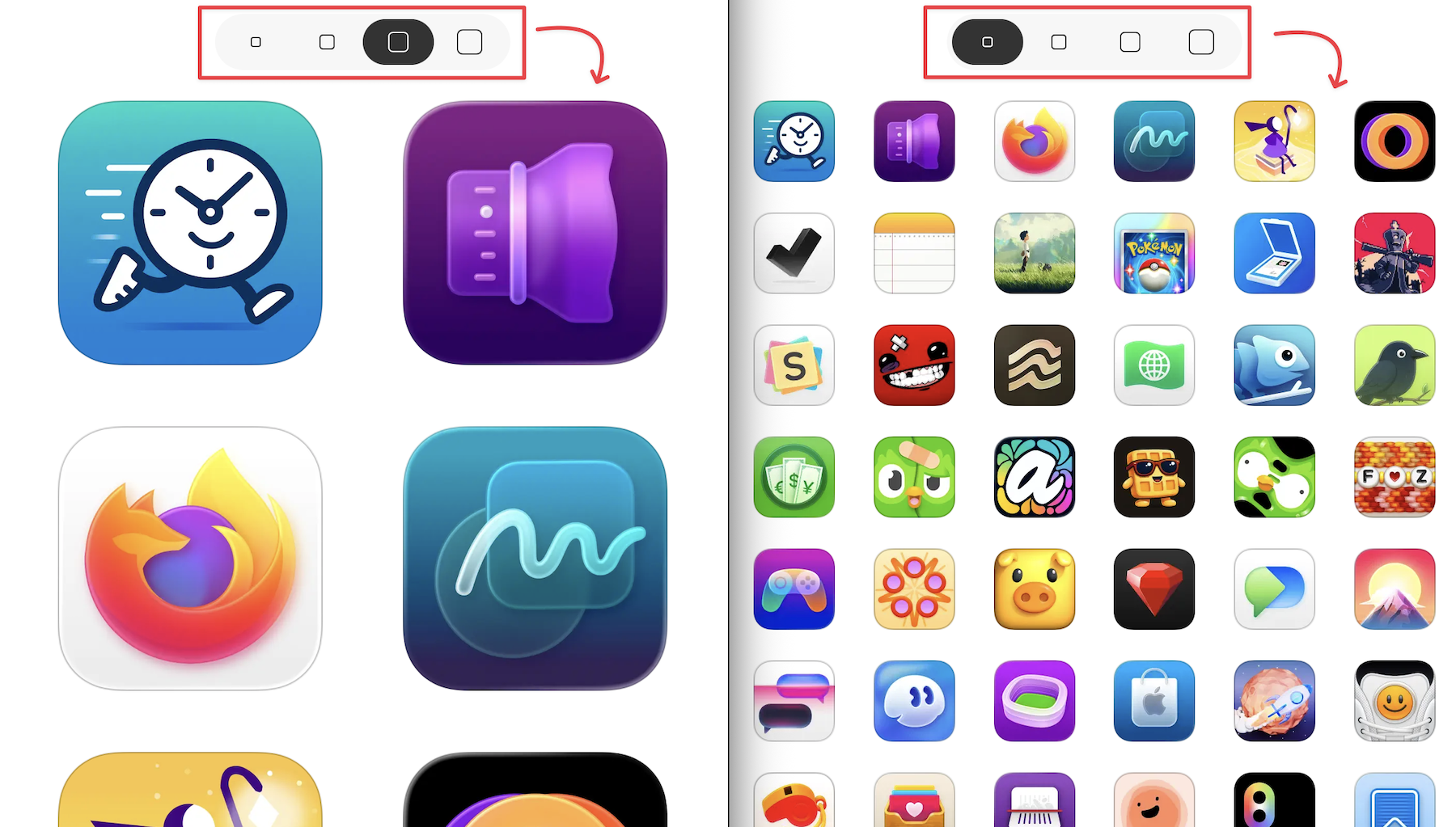
Previously, I implemented this functionality as a web component that looked something like this:

<icon-list size="md">
  <a href=""><img src="" width="128" height="128" /></a>
  <a href=""><img src="" width="128" height="128" /></a>
  <!-- more -->
</icon-list>

The size attribute corresponded to an enumeration like sm | md | lg | xl which mapped to actual pixel dimensions like 64×64 or 512×512.

When the little widget was clicked to render icons at a different size, JavaScript changed the size attribute on the <icon-list> custom element. From there, the web component’s JS took over changing the dimensions of the children <img> elements, their src attributes, etc.

It all worked pretty well. However, because that was a client-side solution to my otherwise entirely pre-rendered static site, it required some templating logic and data be duplicated and sent over the wire to every client.

I didn’t love that for various reasons — like “Crap, I updated this one small part of how my icon list renders on the server, but forgot to tweak it on the client, so things are slightly broken now.”

Then one day the thought hit me: instead of relying on JS to make that interaction work (click, execute JS, modify in-page DOM to a new list), what if I just made that interaction a navigation? Click, navigate to a new list.

Instead of “every list of icons ships with some JS that allows them to re-render at four different sizes” I could do “every list of icons ships in four different sizes”.

  • Previously: one page, like /colors/red/, with JS to re-render the icon list based on user interactions.
  • Idea: four pages, like /colors/red/{sm|md|lg|xl}, each a different icon list size.

So I tried it. And guess what? Once I added some code to support CSS view transitions, I got a cool effect amongst the icons for free — that’s right, by removing code!

Works nice on mobile too!

I know I’m not doing anything particularly novel here, but as we continue to get new, powerful primitives on the web — like CSS view transitions — I find it really interesting to revisit basic patterns and explore what’s possible now that wasn’t previously.

It’s fun to ask yourself: “Could I remove some client-side JS and get a better overall experience?” If the answer is yes, I’ll bet you the development experience (and maintenance burden) is much improved too!