


Choco(opens in a new window) is an AI-powered platform modernizing food and beverage distribution, serving over 21,000 distributors and 100,000 buyers across the US, UK, Europe, and the GCC. By connecting restaurants, suppliers, and distributors into a unified system, Choco streamlines ordering, sales, and customer management across the food supply chain.
As order volumes grew, Choco hit a major bottleneck: orders still arrived through emails, texts, voicemails, images, and even handwritten notes. Teams manually translated those inputs into structured ERP orders—a slow, error-prone process that limited scale and created constant operational friction.
“Processing those inputs was the first barrier, but not the hardest one. The real problem was implicit context: customer-specific SKU mappings, unit preferences, delivery patterns. That knowledge lived in the heads of order desk reps, and we needed to encode it into inference layers that resolve ambiguity at the point of order capture."
—Narbeh Mirzaei, VP Engineering
With the emergence of production-ready LLMs, Choco saw an opportunity to move beyond workflow software and build AI systems capable of executing work directly. OpenAI APIs became central to that transformation.
Choco embedded OpenAI APIs at the core of its platform to power a new generation of AI-native products. The company introduced OrderAgent(opens in a new window), which processes multimodal inputs—including emails, SMS, images, and documents—and converts them into structured, ERP-ready orders.
“The transcription and extraction capabilities gave us a strong foundation. The real engineering challenge was building dynamic in-context learning infrastructure, so the system resolves ambiguity against each customer's ordering history and catalog. That’s what separates automation from intelligence.”
—Narbeh Mirzaei, VP Engineering
Choco has also built VoiceAgent(opens in a new window), powered by OpenAI’s Realtime API, enabling customers to place orders naturally over the phone with sub-second latency—even outside business hours.
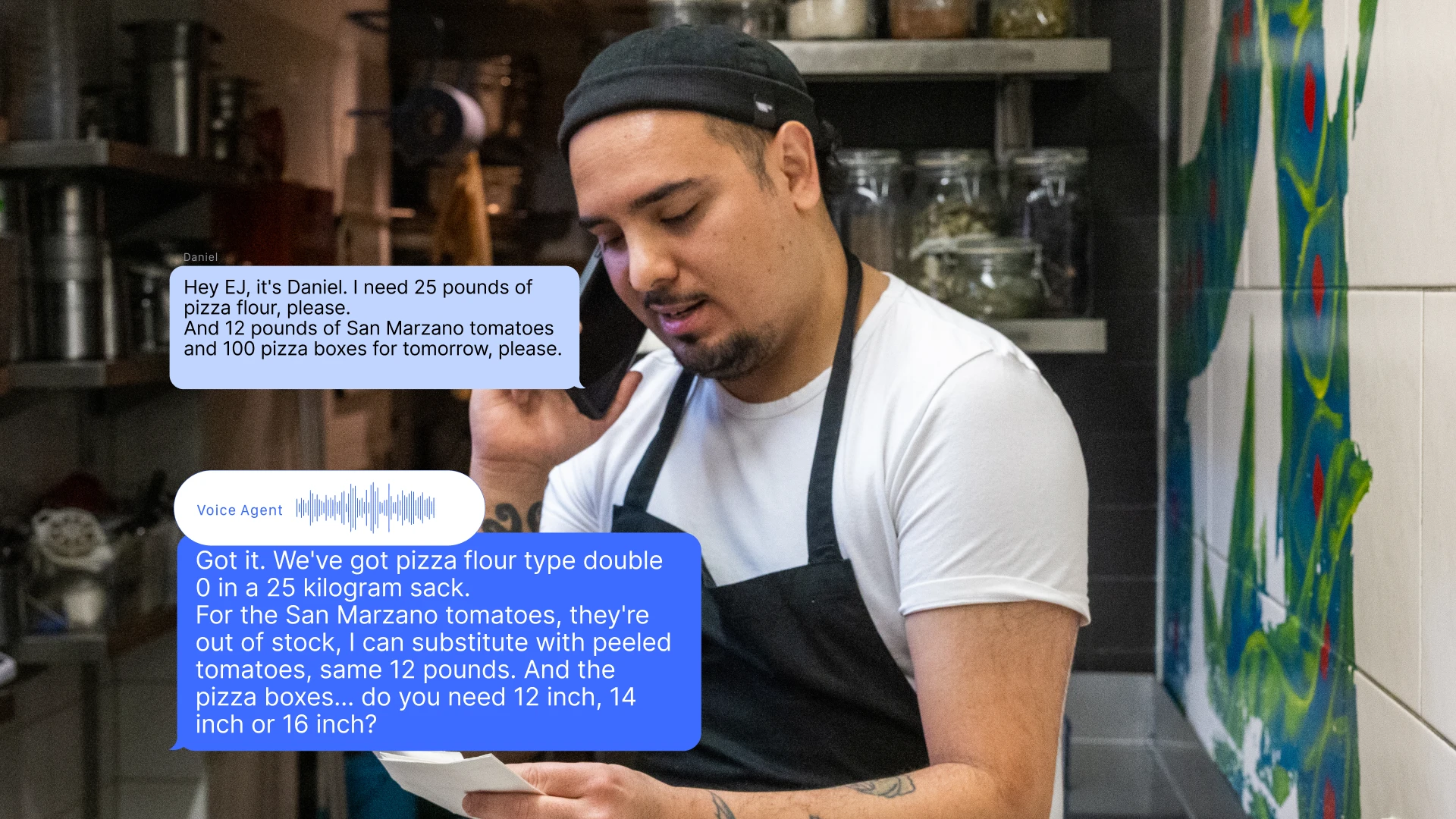
OpenAI was selected for its model performance, multimodal capabilities, structured outputs, and production reliability at scale. The ability to handle text, vision, and audio within a single ecosystem allowed Choco to unify previously disconnected workflows into one intelligent system.
Implementation was fast and scalable. Using OpenAI’s SDKs and APIs, Choco rapidly integrated capabilities like speech-to-text, embeddings, and function calling into its infrastructure. The team also built a rigorous evaluation framework with ground-truth datasets, continuous monitoring, and A/B testing to ensure accuracy and performance in production.
Adoption was driven by seamless integration across the entire ordering workflow. Customers didn’t need to change how they ordered—whether by phone, text, or email, the system adapted to them.
“Once customers saw it working with their own orders, trust followed quickly. That’s when adoption really accelerated.”
—Daniel Khachab, Co-Founder & CEO
With an optional “Autopilot” mode, distributors could automate order processing when confidence thresholds were met, while maintaining human review for edge cases. Over time, the system continuously learned from corrections, improving accuracy and reliability.
Choco is continuing to expand its AI capabilities across the food distribution ecosystem, deepening the role of agents in executing complex operational workflows. As AI systems take on more responsibility, the company is enabling a new class of users—non-engineers who act as “agent orchestrators,” designing and managing intelligent systems that drive business outcomes.
“We’re moving from software that supports work to systems that actually do the work. That shift lets our customers operate faster, leaner, and with far greater resilience.”
—Daniel Khachab, Co-Founder & CEO
Looking ahead, Choco plans to further scale its use of OpenAI APIs to power more autonomous, context-aware systems across sales, commerce, and supply chain operations—continuing its shift from workflow software to AI-powered execution infrastructure.
此内容由惯性聚合(RSS阅读器)自动聚合整理,仅供阅读参考。 原文来自 — 版权归原作者所有。