
惯性聚合 高效追踪和阅读你感兴趣的博客、新闻、科技资讯
阅读原文 在惯性聚合中打开

推荐订阅源

Spread Privacy
Spread Privacy
P
Palo Alto Networks Blog
P
Proofpoint News Feed
AI
AI
Help Net Security
Help Net Security
S
Securelist
T
Troy Hunt's Blog
K
KPMG report finds enterprise disconnect between AI and its ROI | CIO
C
Cisco Blogs
Scott Helme
Scott Helme
Hacker News - Newest:
Hacker News - Newest: "LLM"
Vercel News
Vercel News
Exploit-DB.com RSS Feed
CTFtime.org: upcoming CTF events
B
Blog
GbyAI
GbyAI
Recent Commits to openclaw:main
D
Darknet – Hacking Tools, Hacker News & Cyber Security
P
Proofpoint News Feed
S
Security Affairs
Cisco Talos Blog
Cisco Talos Blog
AWS News Blog
AWS News Blog
T
Tenable Blog
H
Help Net Security
NISL@THU
NISL@THU
F
Fortinet All Blogs
博客园_首页
G
GRAHAM CLULEY
L
LINUX DO - 最新话题
P
Privacy International News Feed
G
Google Developers Blog
博客园 - Franky
Cyber Security Advisories - MS-ISAC
cs.CL updates on arXiv.org
Security Archives - TechRepublic
The Register - Security
L
LangChain Blog
aimingoo的专栏
aimingoo的专栏
T
Tor Project blog
P
Privacy & Cybersecurity Law Blog
量子位
C
Cyber Attacks, Cyber Crime and Cyber Security
Forbes - Security
Forbes - Security
S
Secure Thoughts
Simon Willison's Weblog
D
Docker
Recorded Future
Recorded Future
博客园 - 三生石上(FineUI控件)
L
Lohrmann on Cybersecurity
T
Tailwind CSS Blog

Search Security Resources and Information from TechTarget

How to operationalize threat modeling with AI | TechTarget CISO First fully agentic ransomware attack sparks readiness concerns | TechTarget Evaluating secure enterprise browsers vs. security plugins | TechTarget The AI vulnerability storm is here: Is your security program ready? | TechTarget Perimeter to posture: A roadmap to zero trust maturity | TechTarget TLS certificate lifetime changes: What CISOs must do now | TechTarget The agentic AI 8 key aspects of a mobile device security audit program | TechTarget Why mobile security audits are important in the enterprise | TechTarget Beyond the perimeter: The shift to data-centric protection | TechTarget How agentic AI threat intelligence aids NGO cyber defense: Case study | TechTarget How to conduct a mobile app security audit | TechTarget NO FAKES Act advances: What CISOs need to know | TechTarget What CISOs should know about AI runtime security | TechTarget As Q-Day looms, 90% of systems are unprepared for PQC | TechTarget A CISO Most security pros say their culture is Zscaler lays out its vision to secure the AI era at Zenith Live | TechTarget The OpenClaw security risks every CISO needs to know | TechTarget Cloud security metrics and KPIs: A CISO Florida public sector training on SimSpace cyber range: Case study | TechTarget Reporters' Notebook — Focus on Cyber Insurance: How Quantifying Risk Is Reshaping Security It's time to update incident response for the AI era How to build AI security guardrails without blocking innovation The prosecution gap: Why cybercrimes go unpunished AI in cyberdefense: Learning from threat actors' playbooks Top identity and access management risks CISO role changes as cyber-risk appetites in the C-suite grow CISO's guide to data minimization Researchers build autonomous AI worm that can reason and adapt How to secure data at rest, in use and in motion How to find cyber-risk data sources for a FAIR analysis Lost in translation: Cybersecurity board reporting for CISOs How to prepare security controls for future AI regulations EO 14390 raises stakes for enterprise cybersecurity First month of Mythos Preview testing exposes 10K flaws OT attacks shift from recon to physical control, raising stakes For CISOs, dawn of OpenAI Daybreak brings good and bad news Gartner Security & Risk Management Summit 2026: Adapting for AI | TechTarget Inside business email compromise attacks: Real-world examples Verizon 2026 DBIR: 6 key takeaways for CISOs Identity security for AI agents: The proliferation challenge How to build a business impact analysis checklist Taking care of business: The CISO's role in a cyber crisis What CISOs need to know about AI audit logs SOC vs. MDR: What CISOs need to consider Instructure cyberattack reignites ransom payment debate Transform SIEM rules with behavior-based threat detection CISO's guide: How to test an incident response plan How to implement zero trust for AI Data after the breach: Economics of the dark web The breakup: Why CISOs are decoupling data from their SIEMs | TechTarget News brief: Security worries and warnings as AI use expands How to construct an effective security controls evaluation 5 leading enterprise password managers to consider Claude Mythos changes the AI security threat matrix Buyer 6 things to check in your cyber insurance policy fine print How cyber insurance helped with breach recovery -- or not News brief: Critical infrastructure, OT cybersecurity attacks Tape's strategic role in modern data protection Top zero-trust use cases in the enterprise What every CISO should consider before a SIEM migration CISO's guide to centralized vs. federated security models Shadow code: The hidden threat for enterprise IT How to fix cybersecurity's agentic AI identity crisis 5 top SIEM use cases in the enterprise Top 8 e-signature software providers for 2026 News brief: AI woes continue for security leaders Deepfake era demands proof-based security, not just awareness Is SOAR dead or alive? Sort of The push for digital sovereignty: What CISOs need to know Beyond awareness: Human risk management metrics for CISOs Cybersecurity in the age of AI means bigger, faster threats At RSAC 2026, AI optimism and anxiety -- and an MIA U.S. government Inside the SOC that secured RSAC 2026 Conference How to roll out an enterprise passkey deployment How to improve the SOC analyst experience -- and why it matters How contact centers detect and prevent fraud News brief: Iranian cyberattacks target U.S. water, energy CISO checklist: Cybersecurity platform or marketing ploy? RSAC 2026 Conference: Key news and industry analysis | TechTarget Next-generation firewall buyer's guide for CISOs Contact center monitoring best practices for CX leaders RSAC 2026: Cyber insurance and the rise of ransomware Agentic AI's role in amplifying and creating insider risks RSAC 2026 recap: AI security and network security trends Identity security at RSAC 2026: The new enterprise dynamics Meaningful metrics demonstrate the value of cyber-resiliency What to know about red team testing and the law News brief: Iran cyberattacks escalate, U.S. targets named 5 top SOC-as-a-service providers and how to evaluate them Cloud security architecture: Enterprise cloud blueprint for CISOs Contact center compliance checklist for modern workforces How AI caught a malicious North Korean insider at Exabeam Watch your words: Tim Brown's advice for CISOs News brief: U.S. absence at RSAC sparks leadership concerns Network security management challenges and best practices 10 enterprise secure remote access best practices
How do digital signatures work?
2026-04-24 · via Search Security Resources and Information from TechTarget

Organizations use digital signatures when an agreement needs more than convenience. They use them when a workflow requires stronger signer verification, tamper evidence and a better evidentiary trail than a basic electronic signature provides.

That distinction matters because not every document needs the same level of trust. Routine approvals may only need a simple e-signature, while regulated, high-value or dispute-sensitive transactions often benefit from certificate-based digital signatures.

In practice, the goal is to match the signing method to the risk. The right question is not whether a business can sign electronically. It is whether the transaction needs stronger identity assurance, document integrity controls and compliance support.

Digital signatures vs. e-signatures

Organizations must understand the difference between digital signatures and e-signatures so they can implement a level of security that meets their needs.

An e-signature is a broad term that includes any signature a user sends electronically. Some e-signatures, such as those retail stores use for small transactions, don't require identity verification. However, other types, such as digital signatures, involve a strict authentication process.

In the U.S., the E-SIGN Act gives electronic signatures legal standing when key conditions are met, but organizations still use digital signatures when they need stronger identity assurance and tamper evidence. In the EU, trust-service frameworks make those assurance levels even more explicit.

Digital signatures rely on public key cryptography and digital certificates to verify authenticity and detect tampering. In a typical workflow, the system creates a hash of the document and signs that hash with the sender's private key. The recipient then uses the corresponding public key and certificate to verify the signature and confirm that the document has not been altered since it was signed.

To create a digital signature, organizations typically use an e-signature system. E-signature systems offer digital signature capabilities, but they can also streamline workflows. For example, they can send reminder notifications to late signatories and assign roles to specific individuals.

What are digital signatures used for?

Organizations can use digital signatures anywhere a signature is required, but they usually reserve them for transactions where stronger trust, signer verification and document integrity matter most. Common examples include the following:

  • Real estate purchase and sale agreements
  • Sales contracts
  • Insurance agreements
  • Tax documents and forms
  • Construction change orders
  • Clinical trials
  • Loans
  • Mortgages
  • Leases

How digital signatures work

Digital signatures rely on digital certificates that trust service providers issue to signers. These providers are legal entities that use processes and tools in accordance with a national authority, such as the U.S. government or EU, to verify e-signatures' authenticity.

"The trust service provider verifies the identity of the signer prior to the issuance of the digital certificate using various mechanisms, [such as] near-field communication, automated video-based identity documents and biometric verification," Manaila said.

After the trust service provider verifies the signer's identity, it issues the digital certificate in the cloud. It stores the required cryptographic keys on a hardware security module (HSM) and protects it with two-factor authentication (2FA). These security measures let people sign documents and get digital certificates from any type of platform, device or smartphone, Manaila said.

Some countries issue electronic identification cards that store the owner's biometric data, such as their fingerprint or facial structure, on a chip. Citizens and organizations can use these cards to prove their identity online and quickly obtain a digital certificate.
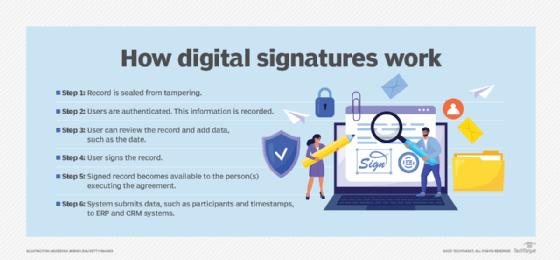
Diagram showing the digital-signature workflow from document hashing and certificate-backed signing to signature verification and downstream processing.
The digital-signature process uses certificates, private/public keys and document hashes to verify signer identity, detect tampering and support downstream workflows.

How cloud affected the digital signature landscape

Before the proliferation of cloud services, organizations relied on physical devices, such as security tokens or smart cards, to protect their digital certificates with an HSM. This traditional approach posed implementation challenges. For example, the approach isn't user-friendly because it requires users to carry a physical device, Manaila said.

Cloud tools, on the other hand, store the cryptographic keys on the cloud provider's HSM so organizations don't need to track physical tokens or replace them over time. Cloud products are also more scalable and require no physical maintenance costs.

The digital signature landscape changed after the CSC standardized remote, cloud-based digital signatures with its open source API. This technology offers the following benefits:

    Security benefits of digital signatures

    Digital signature technology can help organizations prevent bad actors from tampering with important transactions. Security benefits include the following:

    • Links signer's identity to the signature.
    • Makes the signer legally responsible for their actions.
    • Securely stores the digital certificate's cryptographic keys on a certified HSM and protects them with 2FA.
    • Offers access control to strengthen security.
    • Can prove a signature's authenticity in court.

    Digital signatures add assurance, but they also add process and training overhead. That is why organizations should treat them as a fit-for-purpose control: use them where the business needs higher trust, stronger evidence or stricter compliance, and use simpler e-signatures where speed and convenience matter more.

    Editor's note: This article was originally published in 2023 and was updated in 2026 to reflect current digital-signature workflows, legal context and enterprise use cases.