
惯性聚合 高效追踪和阅读你感兴趣的博客、新闻、科技资讯
阅读原文 在惯性聚合中打开

推荐订阅源

aimingoo的专栏
aimingoo的专栏
V
V2EX
G
Google Developers Blog
F
Full Disclosure
Martin Fowler
Martin Fowler
宝玉的分享
宝玉的分享
H
Hacker News: Front Page
Exploit-DB.com RSS Feed
NISL@THU
NISL@THU
G
GRAHAM CLULEY
V
Vulnerabilities – Threatpost
Hacker News - Newest:
Hacker News - Newest: "LLM"
A
About on SuperTechFans
The Cloudflare Blog
C
Cisco Blogs
D
DataBreaches.Net
Threat Intelligence Blog | Flashpoint
Vercel News
Vercel News
P
Privacy International News Feed
Microsoft Security Blog
Help Net Security
Help Net Security
Recorded Future
Recorded Future
PCI Perspectives
PCI Perspectives
S
Schneier on Security
AI
AI
N
News | PayPal Newsroom
雷峰网
雷峰网
C
Cyber Attacks, Cyber Crime and Cyber Security
P
Proofpoint News Feed
The Last Watchdog
The Last Watchdog
L
LINUX DO - 最新话题
Hugging Face - Blog
Hugging Face - Blog
Apple Machine Learning Research
Schneier on Security
S
Securelist
云风的 BLOG
云风的 BLOG
Stack Overflow Blog
Stack Overflow Blog
博客园_首页
AWS News Blog
AWS News Blog
TaoSecurity Blog
TaoSecurity Blog
OSCHINA 社区最新新闻
OSCHINA 社区最新新闻
Recent Commits to openclaw:main
博客园 - 三生石上(FineUI控件)
C
CXSECURITY Database RSS Feed - CXSecurity.com
K
KPMG report finds enterprise disconnect between AI and its ROI | CIO
Cloudbric
Cloudbric
C
Cybersecurity and Infrastructure Security Agency CISA
Project Zero
Project Zero
C
Check Point Blog
S
Security Affairs

NETSCOUT

Why AI Moves Faster Than the Controls Built to Manage It | NETSCOUT NETSCOUT Named a SPARK Matrix™ Leader in Network Observability for the Third Consecutive Year | NETSCOUT Why CDNs Alone Are Not Sufficient for Modern DDoS Protection | NETSCOUT All That Glitters Isn’t Gold: Why AI Needs Better Data | NETSCOUT From Horseback to Real-Time Observability | NETSCOUT Why Digital Twins Are Now Mission-Critical for Scaling 5G with Confidence | NETSCOUT NETSCOUT Earns Six Leader Badges in the G2 Summer 2026 Grid Reports | NETSCOUT When Too Much Data Becomes Too Big an AI Problem | NETSCOUT Game-Changing AI in the RAN Plays by Its Own Rules | NETSCOUT 75,000 DDoS-for-Hire Actors Targeted by Law Enforcement | NETSCOUT What Is NETSCOUT Smart Data and Why Is It So Important? | NETSCOUT Understanding Network Traffic for Threat Hunting | NETSCOUT Black Box Versus Glass Box DDoS Protection Intellyx Names NETSCOUT to Prestigious 2026 Digital Innovator Award List How to Operationalize Threat Hunting with NETSCOUT, SIEM, XDR, EDR, and SOAR Solving Network Blind Spots Created by Massive Data Silos The Self-Healing Network: Why Your AI Strategy Needs a Neutral Lens Does It Feel Like a Stormy Season in Your Cloud? The 1 A.M. Cloud Migration Meltdown Communication Service Provider Supports Banking Application Success Across International Borders Defending Against DDoS Attacks at Scale AI-Driven Workflow Automation Is the New North Star for Communication Service Providers Key Takeaways from the EMA Network Management Megatrends 2026 The Digital Foundation of Public Trust Is More Than Skin Deep Unlocking the Full Value of 5G with Network Slicing NETSCOUT to Have a Strong Presence at Cisco Live Why Airlines and Airports Must Embrace Observability Ahead of the Summer Travel Surge Beyond “Best Effort”: Why Carrier Grade 5G Slicing Matters More Than Ever | NETSCOUT The Shrinking Lifespan of SSL/TLS Certificates | NETSCOUT From Packets to Insight: How Curated Network Data Powers AI | NETSCOUT Data Centers Are Feeling the Heat, and That’s OK | NETSCOUT If You Can’t See the Slice, You Can’t Sell the SLA | NETSCOUT Insights from the GigaOm Radar for Network Observability v6 Report | NETSCOUT How Shadow AI Creates Zombie Infrastructure NETSCOUT Earns Eight Leader Badges in the G2 Spring 2026 Grid Reports Your Modern Manufacturing Network Deserves a Modern Observability Strategy How Botnet-Driven DDoS Attacks Evolved in 2H 2025 The Hidden Cost of Poor Network Observability Insurance Systems Look Simple, but the Infrastructure Isn’t How AI is Transforming the RAN With the Right Data When Cloud SaaS DDoS Mitigation Offerings Aren’t Enough Frictionless Banking Experiences Start with Observability Colocation Growth Demands Scalable End-to-End Observability Bringing Shadow AI Into the Light AIOps Outcomes Depend on Data Quality, Not Algorithms Why AI, Zero Trust, and Modern Security Require Deep Visibility How Service Behavior Changes in Remote Locations The 10-Hour Problem: How Visibility Gaps Are Burning Out the SOC From Insight to Impact: Observability Fuels AI-Driven Innovation How Orphaned Applications Are Quietly Fueling Your Shadow IT Problem Why Today’s Security Tools Can’t See the Network Anymore How NETSCOUT Addresses Modern Network Observability Challenges Helping IT Organizations Prevent Disruptions Before They Impact Business How Hidden Blind Spots Quietly Became Cybersecurity’s Biggest Vulnerability The Blame Game! Is it the Network or Gaps in Observability? Six Winter 2026 G2 Leader Badges Prove This DDoS Protection Stands Out The Value of Combining Modern Observability Solutions for Actionable Insights AI Failure Is the Norm Because Most Initiatives Are Flying Blind NETSCOUT Distinguished by Frost & Sullivan with the 2025 Company of the Year Recognition 5 Emerging AI Data Trends Enterprise IT Teams Cannot Ignore What is Network Slicing NETSCOUT’s Omnis Cyber Intelligence Earns Security Today’s 2025 CyberSecured Award Turning a Flood of 5G Data into Rocket Fuel for AIOps NETSCOUT Recognized by Comparably as a Top Workplace for Q4 2025 How to deliver consistent ultra-low latency, high-throughput, and total reliability across complex networks Smart Data: The Super Fuel Driving Next-Gen Observability NETSCOUT Recognized for Leadership in Network Detection and Response Integrating Deep Packet Inspection in 5G Networks Removing Barriers to Digital Transformation Gain Real-time Visibility to Future Proof Your Network for Autonomous Operations Why Is Cloud Performance Still Foggy? Smarter DDoS Security at Scale How DPI Is Transforming Observability and Operational Resilience 10 Key Challenges to Optimizing Radio Access Networks in the 5G Era Why Arbor Edge Defense and CDN-Based DDoS Protection Are Better Together NETSCOUT’s Holiday Playlist for IT Teams and Leaders More Data Does Not Always Equate to Better Business Visibility Seeing Clearly with Deep Packet Inspection at Scale How to Ensure High Availability for FWA Services System Integrators and the Future of Enterprise IT The Transformative Power of ‘Thinking’ AI and the Implications for Business How Fast Can Your Organization Identify and Resolve IT Outages? Observability for the “Always On” Power Industry
Four AI Trends Transforming Network Operations
Jennifer.Steele · 2026-05-27 · via NETSCOUT

The old way used to be all about observability, dashboards, aggregated KPIs, human correlation, and manual intervention. That world is changing with AI.

— Donogh O’Reilly, Vice President of Sales for NETSCOUT

Artificial intelligence (AI) no longer sits on the fringe of the service provider’s transformation strategy. It now resides squarely in the center of operational conversations and is reshaping how operators think about scale, resilience, and protecting the customer experience. In an era defined by distributed architectures, mission‑critical services, and rising digital expectations, AI is not simply evolving service assurance—it is redefining it.

For years, service providers leaned on dashboards, key performance indicators (KPIs), and skilled engineers to interpret what was happening inside their networks. And, that model served telcos well when networks were simpler.

Today’s environment is infinitely more complex. Multicloud traffic patterns, 5G‑enabled applications, Internet of Things (IoT) ecosystems, and data volumes that grow by the hour have fundamentally altered the operational landscape. Human-led correlation alone can no longer keep pace.

In a recent interview with FNTV, Donogh O’Reilly, vice president of Sales for NETSCOUT, discussed some of the emerging AI trends reshaping the industry.
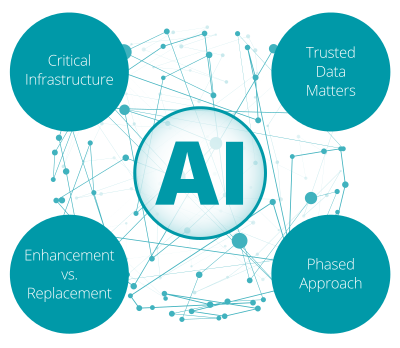
Four Trends Transforming Network Operations

Diagram - 4 AI trends - Critical Infrastructure, Trusted Data Matters, Enhancement vs. Replacement, Phased Approach

1. AI Is Now Critical Infrastructure

Let’s be clear, AI is no longer optional. Modern networks generate more signals, dependencies, and simultaneous service requirements than any human team can interpret in real time. AI fills that gap, processing vast telemetry streams, identifying patterns invisible to the human eye, and surfacing early signs of degradation before users ever notice.

This is no longer “future thinking.” It’s the operational backbone required to maintain reliability at scale.

Service providers who treat AI as a luxury will find themselves constrained not by competition, but by their own networks.

2. Trusted Data Will Make or Break AI

The industry’s first wave of AI experiments delivered a critical lesson: AI cannot rise above the quality of its data.

When fed inconsistent, incomplete, or “noisy” information, AI generates insights that are equally unpredictable. False positives increase. Trust erodes. Operational risk rises.

As Donogh emphasized, dependable AI begins with trusted, contextual, interrogable data grounded in real network traffic and behaviors. When that foundation is solid, AI becomes a force multiplier. When it’s not, it becomes a high-risk liability.

To succeed, service providers require:

  • High‑fidelity, packet‑level visibility
  • Data structures that preserve context
  • Analytics grounded in network truth, not correlation guesses

Trusted data is what elevates AI from experimentation to an operational advantage.

3. AI is Enhancing Human Expertise, Not Replacing It

Automation anxiety is real although largely misplaced. AI is not here to take over network operations teams. It is here to unburden them. For years, operators have been the first and final lines of defense against outages, viewing multiple dashboards, comparing call logs, and making judgment calls under pressure. AI changes the starting point.

Instead of beginning with raw data, teams begin with context.

This shift allows operators to:

  • Respond faster and more confidently
  • Devote energy to strategic improvements rather than manual noise filtering
  • Accelerate root‑cause analysis through AI‑driven correlations

AI doesn’t diminish expertise. It amplifies it—ensuring human skill is applied precisely where it creates the most impact.

4. Autonomous Networks Will Arrive in Phases, Although the Road to Success is Steep

Talk of autonomous networks often triggers questions about timing and feasibility. But autonomy isn’t an overnight cut-over. Although already in motion, it’s likely to be a gradual evolution.

For companies such as NETSCOUT, the framework for success outlines a four‑stage evolution toward autonomy, from insight enhancement to conditional autonomy.
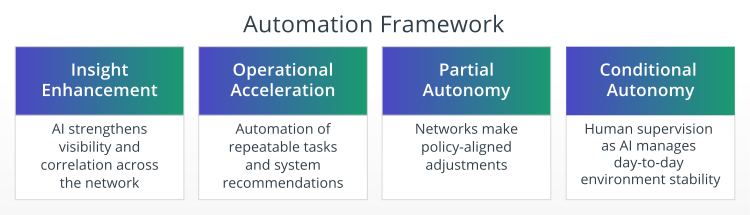
Diagram - Automation Framework - Insight Enhancement, Operational Acceleration, Partial Autonomy, Conditional Autonomy

In highly distributed, mission‑critical telecom environments, a phased approach isn’t just practical but rather, necessary. Autonomy isn’t about reducing human control. It’s about scaling it.

The Strategic Imperative for Service Providers

As the trends suggest, AI is redefining what “good” looks like in service assurance. Providers that embrace grounded, contextual AI will strengthen performance, respond to issues faster, and deliver the seamless experiences customers now expect. Those who hesitate won’t just fall behind; they’ll fall out of alignment.

AI is not replacing the fundamentals of service assurance; it’s reinforcing them by adding the intelligence and speed required for today’s digital ecosystem.

How NETSCOUT Is Helping Service Providers Turn AI into Operational Reality

NETSCOUT gives service providers what the industry has long been missing: a foundation of trusted, high‑fidelity network data. By anchoring AI analytics in packet‑level visibility, we ensure insights are accurate, contextual, and immediately actionable, avoiding the theoretical and reducing the error‑prone.

This approach reduces operational noise, strengthens decision‑making, accelerates root‑cause analysis, and supports the step‑by‑step journey toward autonomous networks while ensuring that operators remain firmly in control.

Afterall, at the end of the day, the future of service assurance is not AI versus humans. Instead, it’s AI empowering humans to run networks more intelligently, more confidently, and more resiliently than ever before.

For more information about how NETSCOUT is helping service providers reach the milestones of autonomous networks, watch the entire interview.