
惯性聚合 高效追踪和阅读你感兴趣的博客、新闻、科技资讯
阅读原文 在惯性聚合中打开

推荐订阅源

G
GRAHAM CLULEY
V
V2EX
WordPress大学
WordPress大学
博客园 - Franky
Last Week in AI
Last Week in AI
博客园 - 司徒正美
有赞技术团队
有赞技术团队
freeCodeCamp Programming Tutorials: Python, JavaScript, Git & More
博客园 - 【当耐特】
V
Visual Studio Blog
C
CERT Recently Published Vulnerability Notes
OSCHINA 社区最新新闻
OSCHINA 社区最新新闻
cs.CL updates on arXiv.org
Jina AI
Jina AI
Attack and Defense Labs
腾讯CDC
The Hacker News
The Hacker News
Hugging Face - Blog
Hugging Face - Blog
K
KPMG report finds enterprise disconnect between AI and its ROI | CIO
J
Java Code Geeks
人人都是产品经理
人人都是产品经理
阮一峰的网络日志
阮一峰的网络日志
T
Tailwind CSS Blog
S
SegmentFault 最新的问题
大猫的无限游戏
大猫的无限游戏
小众软件
小众软件
A
Arctic Wolf
量子位
博客园 - 聂微东
奇客Solidot–传递最新科技情报
奇客Solidot–传递最新科技情报
N
News and Events Feed by Topic
雷峰网
雷峰网
博客园_首页
Google Online Security Blog
Spread Privacy
Spread Privacy
罗磊的独立博客
H
Hacker News: Front Page
让小产品的独立变现更简单 - ezindie.com
月光博客
月光博客
TaoSecurity Blog
TaoSecurity Blog
Exploit-DB.com RSS Feed
博客园 - 三生石上(FineUI控件)
宝玉的分享
宝玉的分享
IT之家
IT之家
The Cloudflare Blog
爱范儿
爱范儿
博客园 - 叶小钗
Threat Intelligence Blog | Flashpoint
Apple Machine Learning Research
酷 壳 – CoolShell
酷 壳 – CoolShell

NETSCOUT

Why AI Moves Faster Than the Controls Built to Manage It | NETSCOUT NETSCOUT Named a SPARK Matrix™ Leader in Network Observability for the Third Consecutive Year | NETSCOUT Why CDNs Alone Are Not Sufficient for Modern DDoS Protection | NETSCOUT All That Glitters Isn’t Gold: Why AI Needs Better Data | NETSCOUT From Horseback to Real-Time Observability | NETSCOUT Why Digital Twins Are Now Mission-Critical for Scaling 5G with Confidence | NETSCOUT NETSCOUT Earns Six Leader Badges in the G2 Summer 2026 Grid Reports | NETSCOUT When Too Much Data Becomes Too Big an AI Problem | NETSCOUT Game-Changing AI in the RAN Plays by Its Own Rules | NETSCOUT 75,000 DDoS-for-Hire Actors Targeted by Law Enforcement | NETSCOUT What Is NETSCOUT Smart Data and Why Is It So Important? | NETSCOUT Understanding Network Traffic for Threat Hunting | NETSCOUT Black Box Versus Glass Box DDoS Protection Intellyx Names NETSCOUT to Prestigious 2026 Digital Innovator Award List How to Operationalize Threat Hunting with NETSCOUT, SIEM, XDR, EDR, and SOAR Solving Network Blind Spots Created by Massive Data Silos The Self-Healing Network: Why Your AI Strategy Needs a Neutral Lens Does It Feel Like a Stormy Season in Your Cloud? Four AI Trends Transforming Network Operations The 1 A.M. Cloud Migration Meltdown Communication Service Provider Supports Banking Application Success Across International Borders AI-Driven Workflow Automation Is the New North Star for Communication Service Providers Key Takeaways from the EMA Network Management Megatrends 2026 The Digital Foundation of Public Trust Is More Than Skin Deep Unlocking the Full Value of 5G with Network Slicing NETSCOUT to Have a Strong Presence at Cisco Live Why Airlines and Airports Must Embrace Observability Ahead of the Summer Travel Surge Beyond “Best Effort”: Why Carrier Grade 5G Slicing Matters More Than Ever | NETSCOUT The Shrinking Lifespan of SSL/TLS Certificates | NETSCOUT From Packets to Insight: How Curated Network Data Powers AI | NETSCOUT Data Centers Are Feeling the Heat, and That’s OK | NETSCOUT If You Can’t See the Slice, You Can’t Sell the SLA | NETSCOUT Insights from the GigaOm Radar for Network Observability v6 Report | NETSCOUT How Shadow AI Creates Zombie Infrastructure NETSCOUT Earns Eight Leader Badges in the G2 Spring 2026 Grid Reports Your Modern Manufacturing Network Deserves a Modern Observability Strategy How Botnet-Driven DDoS Attacks Evolved in 2H 2025 The Hidden Cost of Poor Network Observability Insurance Systems Look Simple, but the Infrastructure Isn’t How AI is Transforming the RAN With the Right Data When Cloud SaaS DDoS Mitigation Offerings Aren’t Enough Frictionless Banking Experiences Start with Observability Colocation Growth Demands Scalable End-to-End Observability Bringing Shadow AI Into the Light AIOps Outcomes Depend on Data Quality, Not Algorithms Why AI, Zero Trust, and Modern Security Require Deep Visibility How Service Behavior Changes in Remote Locations The 10-Hour Problem: How Visibility Gaps Are Burning Out the SOC From Insight to Impact: Observability Fuels AI-Driven Innovation How Orphaned Applications Are Quietly Fueling Your Shadow IT Problem Why Today’s Security Tools Can’t See the Network Anymore How NETSCOUT Addresses Modern Network Observability Challenges Helping IT Organizations Prevent Disruptions Before They Impact Business How Hidden Blind Spots Quietly Became Cybersecurity’s Biggest Vulnerability The Blame Game! Is it the Network or Gaps in Observability? Six Winter 2026 G2 Leader Badges Prove This DDoS Protection Stands Out The Value of Combining Modern Observability Solutions for Actionable Insights AI Failure Is the Norm Because Most Initiatives Are Flying Blind NETSCOUT Distinguished by Frost & Sullivan with the 2025 Company of the Year Recognition 5 Emerging AI Data Trends Enterprise IT Teams Cannot Ignore What is Network Slicing NETSCOUT’s Omnis Cyber Intelligence Earns Security Today’s 2025 CyberSecured Award Turning a Flood of 5G Data into Rocket Fuel for AIOps NETSCOUT Recognized by Comparably as a Top Workplace for Q4 2025 How to deliver consistent ultra-low latency, high-throughput, and total reliability across complex networks Smart Data: The Super Fuel Driving Next-Gen Observability NETSCOUT Recognized for Leadership in Network Detection and Response Integrating Deep Packet Inspection in 5G Networks Removing Barriers to Digital Transformation Gain Real-time Visibility to Future Proof Your Network for Autonomous Operations Why Is Cloud Performance Still Foggy? Smarter DDoS Security at Scale How DPI Is Transforming Observability and Operational Resilience 10 Key Challenges to Optimizing Radio Access Networks in the 5G Era Why Arbor Edge Defense and CDN-Based DDoS Protection Are Better Together NETSCOUT’s Holiday Playlist for IT Teams and Leaders More Data Does Not Always Equate to Better Business Visibility Seeing Clearly with Deep Packet Inspection at Scale How to Ensure High Availability for FWA Services System Integrators and the Future of Enterprise IT The Transformative Power of ‘Thinking’ AI and the Implications for Business How Fast Can Your Organization Identify and Resolve IT Outages? Observability for the “Always On” Power Industry
Defending Against DDoS Attacks at Scale
mike.wetherbee · 2026-05-15 · via NETSCOUT

For global financial institutions, digital availability is not optional—it is foundational to trust, revenue, and regulatory compliance. When customer-facing services are expected to operate flawlessly, even seconds of downtime can translate into significant financial and reputational impact. This reality was put to the test when a tier‑one financial institution faced one of the largest and most complex distributed denial-of-service (DDoS) attacks seen to date—exceeding 3 terabits per second.
What followed was not a scramble for DDoS mitigation, but a textbook example of what it means to defend at scale.

The Challenge: Extreme Scale, Zero Tolerance for Downtime

The institution’s environment was built to support mission‑critical, 24/7 digital operations. That made it a prime target for attackers seeking maximum disruption. The attack that unfolded was both massive and sophisticated.

Traffic surged beyond 3Tbps, originating from globally distributed sources and targeting multiple IP addresses simultaneously. Rather than relying on a single attack vector, the adversaries launched a multivector campaign that evolved continuously—shifting techniques, changing intensity, and arriving in unpredictable waves.

For the organization, the stakes could not have been higher. Any meaningful disruption to customer access would have had immediate financial consequences and long‑term trust implications. Mitigation needed to be instantaneous, adaptive, and capable of operating at extreme scale—without introducing friction or latency for legitimate users.

A Defense-in-Depth Strategy Built for Reality

The institution had anticipated this exact scenario. Well before the attack, it had implemented a layered, defense‑in‑depth DDoS protection strategy designed to address both precision attacks and massive volumetric events.
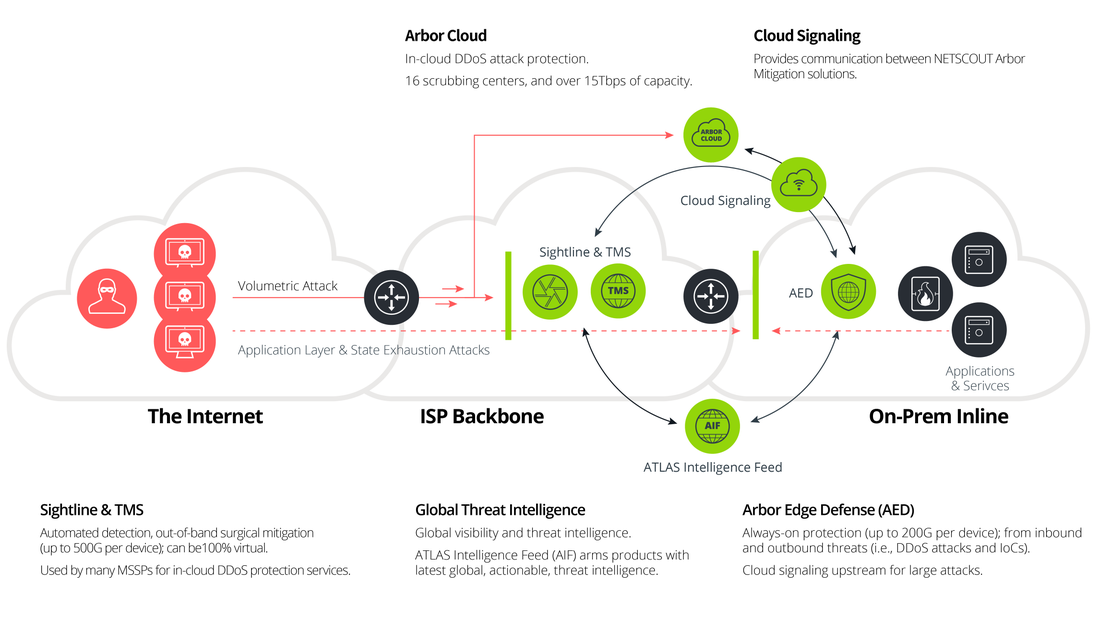
Chart showing one instance of strategy design for DDoS protection

Always-On, On-Premises Protection

Inline protection was deployed across data centers to provide continuous, real‑time detection and mitigation. This approach ensured that malicious traffic could be identified and stopped within milliseconds, directly at the network edge. Adaptive protection capabilities allowed the defenses to automatically adjust as attack signatures and behaviors changed—without requiring manual tuning or intervention.

Cloud-Based Volumetric Defense at Global Scale

Recognizing that on‑premises defenses alone are not sufficient for today’s largest attacks, the institution complemented local protection with a globally distributed cloud-based mitigation platform. High-capacity scrubbing centers were positioned to absorb and filter massive traffic volumes, regardless of where attacks originated.

A single, unified service plan protected all global sites, simplifying operations while ensuring consistent protection worldwide.

Always-Routed Architecture for Seamless Mitigation

One of the most critical design decisions was the use of an always‑routed architecture. Instead of waiting for traffic diversion during an attack—often a source of delay and complexity—clean traffic was already routed through the mitigation infrastructure.

When volumetric thresholds were exceeded, mitigation automatically shifted to high-capacity systems within the cloud environment. This ensured an immediate response, avoided routing changes, and eliminated the latency typically associated with manual or reactive diversion models.

Automation Backed by Human Expertise

Automation handled the speed and scale of the response, but human expertise remained a vital layer. A 24/7 security operations team provided oversight and deep expertise to manage complex, multivector attacks in real time, ensuring protection remained effective even as attack conditions shifted.

The Outcome: Seamless Defense, Full Availability

When the attack began, on‑premises DDoS defenses detected and mitigated malicious activity instantly. As traffic volumes rapidly escalated past 3Tbps, the cloud-based DDoS mitigation platform absorbed the surge without hesitation, distributing the load across global scrubbing infrastructure.

The transition required no manual intervention. Legitimate customer traffic flowed without disruption. Applications remained fully available.

Despite the unprecedented scale and complexity of the attack, the institution maintained uninterrupted online services, protecting revenue, preserving customer confidence, and avoiding potentially millions of dollars in losses.

Defending What Matters Most

This incident underscores a critical truth for modern enterprises: large-scale DDoS attacks are no longer theoretical. They are inevitable. The difference between disruption and resilience lies in preparation.

By combining always‑on on‑premises protection, globally scalable cloud mitigation, intelligent architecture, and round‑the‑clock expertise, this financial institution demonstrated what effective DDoS defense looks like at extreme scale.

When seconds matter, and downtime is not an option, defending at scale isn’t just a strategy. It’s a requirement.

Learn about NETSCOUT’s multilayer DDoS protection strategy.