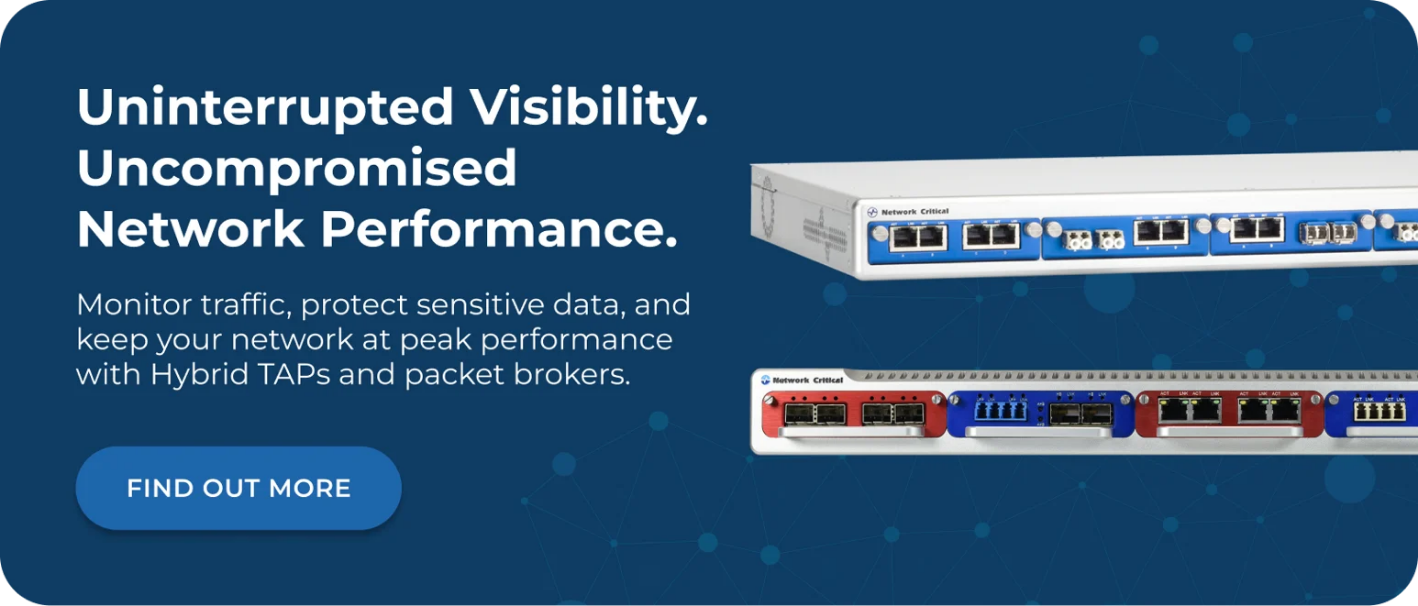
Modern enterprise networks carry more traffic, support more devices, and face more sophisticated threats than ever before. Security teams are investing heavily in specialized tools: Intrusion Detection Systems (IDS), Security Information and Event Management (SIEM) platforms, firewalls, and forensics appliances. Yet attacks still succeed, breaches still go undetected, and compliance audits still expose gaps. The reason is rarely a shortage of tools. It's a shortage of visibility. When your network TAPs and network packet brokers aren't providing complete, accurate traffic access to every tool on your stack, those tools are working blind. Understanding the most pressing network security challenges, and the architectural decisions that solve them, is the foundation of any effective defense. This article covers the eight biggest challenges organizations face today, and the practical steps you can take to address each one. The most fundamental network security challenge isn't a sophisticated attack vector. It's the gap between the traffic your security tools are supposed to see and the traffic they actually see. Most organizations rely on Switch Port Analyzer (SPAN) ports to mirror traffic to monitoring tools. SPAN ports are convenient, but they're not designed for security-grade monitoring. Under high traffic loads, switches prioritize production traffic and simply drop mirrored packets. Short frames, physical errors, and congestion events all cause silent packet loss, none of which is flagged or reported to your tools. The result is that your IDS, SIEM, and packet capture tools are analyzing an incomplete picture. Threats that pass through dropped packets are invisible. Forensic investigations are unreliable. Compliance reports based on SPAN-captured data are legally indefensible. Network TAPs solve this by creating a hardware-based copy of traffic at the physical layer, completely independent of switch processing. Key characteristics include: Network Critical's network TAPs are trusted by 90% of high-compliance organizations that have moved away from SPAN-based monitoring, specifically because they provide a legally defensible, 100% accurate traffic copy for every connected tool. Even when organizations recognize the limitations of SPAN ports, they often hit a practical constraint: there simply aren't enough ports to give every monitoring tool direct access to every network segment. A typical enterprise might run an IDS, a SIEM, an Application Performance Monitor (APM), a forensics platform, and a Data Loss Prevention (DLP) tool simultaneously. Each one needs traffic from multiple network links. Configuring SPAN ports for every combination quickly exhausts switch resources, introduces management complexity, and creates contention as different teams compete for access to the same ports. Direct connections between TAPs and tools create their own complexity. As your monitoring stack grows, the cabling becomes unmanageable, tool capacity is wasted on duplicate traffic, and adding a new tool requires network changes. A network packet broker sits between your TAPs and your tools, aggregating traffic from multiple sources and distributing the right packets to the right tools. This solves several problems simultaneously: The SmartNA-XL combines TAP and packet broker functionality in a single 1RU chassis, supporting 1G/10G/40G links and eliminating the need to deploy separate devices for access and aggregation. Its Drag-n-Vu™ interface makes port mapping and filter configuration fast and error-free, without requiring specialist engineering staff for routine changes. Many of the most effective security tools, including next-generation firewalls, Intrusion Prevention Systems (IPS), and SSL inspection appliances, operate inline. Traffic passes through them rather than being mirrored to them. This gives them the ability to block malicious traffic in real time. The problem is that inline tools become single points of failure. If the appliance crashes, loses power, or requires a maintenance window, traffic stops flowing. For most organizations, even a few minutes of network downtime has significant financial and operational consequences. In finance, healthcare, and telecommunications, the stakes are even higher. Compliance requirements may mandate continuous availability. And in many cases, security teams are reluctant to take inline tools offline for routine maintenance, leaving them running outdated signatures and unpatched firmware. Bypass TAPs solve this by continuously sending heartbeat signals through inline security appliances. When the appliance stops responding, the bypass TAP automatically redirects traffic around the failed device in real time, maintaining network flow without any manual intervention. Key benefits of bypass TAP deployment include: The SmartNA-XL supports bypass modules alongside TAP and packet broker modules, meaning you can build a complete visibility and resilience architecture in a compact, unified platform. Encryption is essential for protecting data in transit. It's also one of the biggest challenges facing network security teams. When traffic is encrypted, most security tools can't inspect the payload, which means malware, command-and-control communications, and data exfiltration can all travel across your network undetected. The vast majority of internet traffic is now encrypted, and attackers have adapted accordingly. Malicious payloads are routinely delivered over encrypted channels precisely because they know most organizations can't inspect them. Without a strategy for encrypted traffic, your IDS and DLP tools are effectively bypassed for a significant portion of network activity. Addressing encrypted traffic requires careful architecture, not just additional tools. Considerations include: Network packet brokers play a critical role here by filtering traffic before it reaches decryption appliances, ensuring those expensive tools only process the traffic that genuinely needs inspection. This improves efficiency and reduces the load on inline infrastructure. Enterprise networks are no longer a flat, defined perimeter. They span physical data centers, cloud environments, branch offices, remote workers, and operational technology (OT) networks. Maintaining consistent monitoring across all of these is one of the most operationally demanding challenges security teams face. Each environment has different characteristics. Cloud environments may support virtual TAPs or packet mirroring services, but these vary by provider and often have bandwidth limitations. Branch offices may have limited on-site infrastructure for hosting monitoring tools. OT networks have strict latency and availability requirements that make inline monitoring risky. Without a unified approach, monitoring coverage becomes inconsistent, with some segments well covered and others effectively blind. One effective approach is to use GRE (Generic Routing Encapsulation) tunneling to forward traffic from remote sites to a central monitoring location, where tools can be consolidated and managed efficiently. The SmartNA-XL supports IP/GRE/NVGRE/VXLAN encapsulation for exactly this purpose, enabling organizations to monitor multi-site networks from a centralized location without deploying full monitoring stacks at every branch. Practical strategies for consistent distributed monitoring include: Regulatory compliance is a growing driver of network visibility investment. Frameworks including Payment Card Industry Data Security Standard (PCI-DSS), the Health Insurance Portability and Accountability Act (HIPAA), Sarbanes-Oxley (SOX), and GDPR all require organizations to demonstrate that they can monitor, capture, and audit network traffic affecting regulated data. The core problem is that SPAN ports drop packets under load. This means any traffic capture or audit log generated from SPAN-sourced data contains gaps. During a compliance audit or forensic investigation, you cannot prove that the captured data represents all traffic on the monitored link. Auditors increasingly understand this distinction, and organizations relying on SPAN ports face growing scrutiny. GDPR fines can reach 4% of annual global revenue or 20 million euros, and PCI-DSS non-compliance can result in card scheme penalties and revoked processing rights. The financial exposure from a failed audit or a breach traced back to monitoring gaps is substantial. TAPs provide what SPAN ports cannot: a complete, hardware-level copy of every packet on the monitored link, independent of switch load and configuration. Because the TAP operates at the physical layer and has no management plane involvement, the captured data stream is a true representation of network traffic. Key compliance advantages of TAP-based monitoring include: As security stacks have grown, so has the operational burden of managing them. Security teams are adding tools faster than they're adding staff, and each new tool brings its own traffic requirements, capacity constraints, and management overhead. When every tool needs its own traffic feed and its own configuration, management complexity grows exponentially with each addition. Engineers spend significant time configuring SPAN ports, rerouting cables, and troubleshooting why a tool isn't seeing the traffic it needs. New projects slow down because provisioning tool access becomes a bottleneck. Duplicate packets are another common problem. Traffic seen by multiple TAPs and SPAN ports often arrives at tools with multiple copies of the same packet. This wastes tool capacity, generates false positives in security alerts, and distorts performance data. Duplicate packets can account for over 80% of total monitored traffic in some environments. A well-deployed packet broker addresses these challenges through centralized traffic management: The SmartNA-PortPlus and SmartNA-PortPlus HyperCore deliver these capabilities at scale, with the HyperCore supporting up to 25.6 Tbps throughput in a non-blocking architecture scaled to 256 ports across 10/25/40/50G speeds. For organizations managing large tool farms in high-speed data centers, this level of capacity ensures the visibility infrastructure doesn't become the bottleneck. Traditional perimeter-based security assumes that traffic inside the network is trustworthy. That assumption has been systematically disproved by insider threats, compromised credentials, and lateral movement by attackers who have already established a foothold. Zero-trust architecture addresses this by validating every user, application, and device regardless of where it sits in the network. Zero-trust is a policy framework, but it requires enforcement at the network layer to be effective. Traffic must be inspected, access must be validated, and anomalous behavior must be detected. Without complete network visibility, none of these controls work reliably. INVIKTUS from Network Critical takes a unique approach to zero-trust by operating as a completely invisible, unhackable device with no IP or MAC address. Because it has no network presence, it can't be discovered, targeted, or compromised by attackers. Its policy-based configuration validates all users, applications, and devices before granting network access, running in the background with minimal maintenance requirements. The three core principles of INVIKTUS are: This makes INVIKTUS particularly well suited to high-sensitivity environments including healthcare, education, and government networks where the consequences of a breach are severe and the operational overhead of complex security management must be minimized. A network TAP is a hardware device that creates a physical copy of traffic at the link layer, capturing 100% of packets regardless of switch load. A SPAN port is a software-configured mirror on a switch that drops packets under congestion. For security monitoring, TAPs provide a complete, verifiable traffic copy while SPAN ports provide a best-effort sample. A network packet broker aggregates traffic from multiple sources, filters out irrelevant packets, removes duplicates, and distributes targeted traffic streams to each tool. This means tools receive only the traffic relevant to their function, operate at higher efficiency, and generate fewer false positives from duplicate or irrelevant packets. Yes. Bypass TAPs use heartbeat monitoring to detect appliance failures and redirect traffic automatically, typically in milliseconds. During normal operation, traffic passes through the inline appliance with no additional latency introduced by the bypass TAP itself. TAPs provide a hardware-level, unalterable copy of every packet on a link. This creates a complete, legally defensible audit trail that SPAN-based monitoring cannot match, because SPAN ports drop packets under load without logging or reporting the loss. Frameworks like PCI-DSS and HIPAA require organizations to prove complete monitoring coverage, which requires TAP-based access. Zero-trust is a security model that eliminates the assumption that users and devices inside the network perimeter are trustworthy. Instead, every access request is validated regardless of origin. Implementing zero-trust at the network layer requires complete traffic visibility and policy-based access controls applied consistently across all network segments. The challenges covered in this article share a common root cause: incomplete, unreliable, or unmanageable access to network traffic. Solving them requires purpose-built visibility infrastructure, not workarounds built on SPAN ports or ad-hoc cabling. Network Critical has provided network visibility solutions to enterprises worldwide since 1997. Our TAPs, bypass TAPs, and packet brokers are deployed by high-compliance organizations in finance, healthcare, defense, and telecommunications, sectors where monitoring accuracy is non-negotiable. Our products carry zero latency, guarantee 100% packet capture, and are designed to integrate with every major monitoring and security tool on the market. Whether you're eliminating blind spots with network TAPs, managing complex tool farms with the SmartNA-PortPlus HyperCore, or protecting inline appliances with bypass TAPs, we can help you design an architecture that gives your security tools the complete, accurate traffic access they need to do their job. Contact our team to discuss your network visibility requirements.
Incomplete Network Visibility Creates Security Blind Spots
Why Visibility Gaps Are So Common
How TAPs Deliver Complete Visibility
Tool Overload and SPAN Port Contention
The Port Contention Problem
How Packet Brokers Eliminate Contention
Inline Security Tool Failures Bring Down the Network
The High Cost of Unplanned Downtime
How Bypass TAPs Protect Network Availability
Encrypted Traffic Hides Threats from Security Tools
The Scale of the Problem
Building an Encrypted Traffic Inspection Architecture
Network Complexity Makes Consistent Monitoring Difficult
The Challenge of Distributed Visibility
Centralizing Visibility with GRE Tunneling
Compliance Requirements Demand Verifiable Traffic Capture
Why SPAN-Based Monitoring Fails Compliance Audits
Building a Legally Defensible Monitoring Architecture
Managing Multiple Security Tools Efficiently
The Tool Sprawl Challenge
Intelligent Traffic Management with Packet Brokers
Zero-Trust Security and Network Access Control
Implementing Zero-Trust at the Network Layer
Frequently Asked Questions
What Is the Difference Between a Network TAP and a SPAN Port?
How Does a Network Packet Broker Improve Security Tool Performance?
Can Bypass TAPs Protect Inline Security Appliances Without Affecting Latency?
Why Do Compliance Frameworks Prefer TAP-Based Monitoring Over SPAN Ports?
What Is Zero-Trust Network Security?
How Network Critical Can Help