










Have you ever trained a neural network to solve the problem of multiclass classification? If yes, you know that the raw outputs of the neural network are often very difficult to interpret. The softmax activation function simplifies this for you by making the neural network’s outputs easier to interpret!
The softmax activation function transforms the raw outputs of the neural network into a vector of probabilities, essentially a probability distribution over the input classes. Consider a multiclass classification problem with N classes. The softmax activation returns an output vector that is N entries long, with the entry at index i corresponding to the probability of a particular input belonging to the class i.
In this tutorial, you’ll learn all about the softmax activation function. You’ll start by reviewing the basics of multiclass classification, then proceed to understand why you cannot use the sigmoid or argmax activations in the output layer for multiclass classification problems.
Finally, you’ll learn the mathematical formulation of the softmax function and implement it in Python.
Let’s get started.
Recall that in binary classification, there are only two possible classes. For example, a ConvNet trained to classify whether or not a given image is a panda is a binary classifier, whereas, in multiclass classification, there are more than two possible classes.
Let’s consider the following example: You’re given a dataset containing images of pandas, seals, and ducks. You’d like to train a neural network to predict whether a previously unseen image is that of a seal, a panda, or a duck.
Notice how the input class labels below are one-hot encoded, and the classes are mutually exclusive. In this context, mutual exclusivity means that a given image can only be one of {seal, panda, duck} at a time.
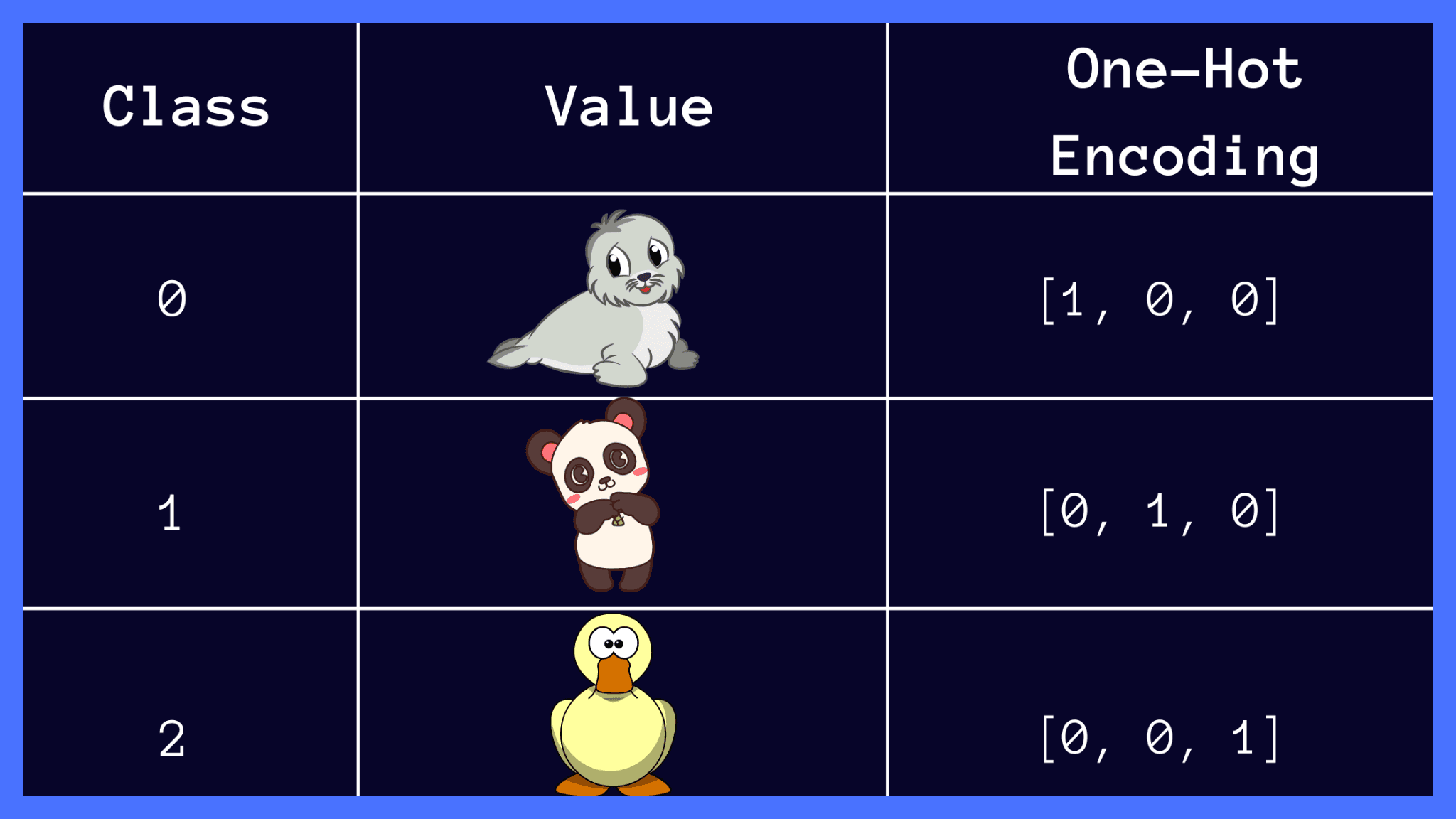
Multiclass Classification Example (Image by the author)
In this section, you’ll learn why the sigmoid and argmax functions are not the optimal choices for the output layer in a multiclass classification problem.
Mathematically, the sigmoid activation function is given by the following equation, and it squishes all inputs onto the range [0, 1].
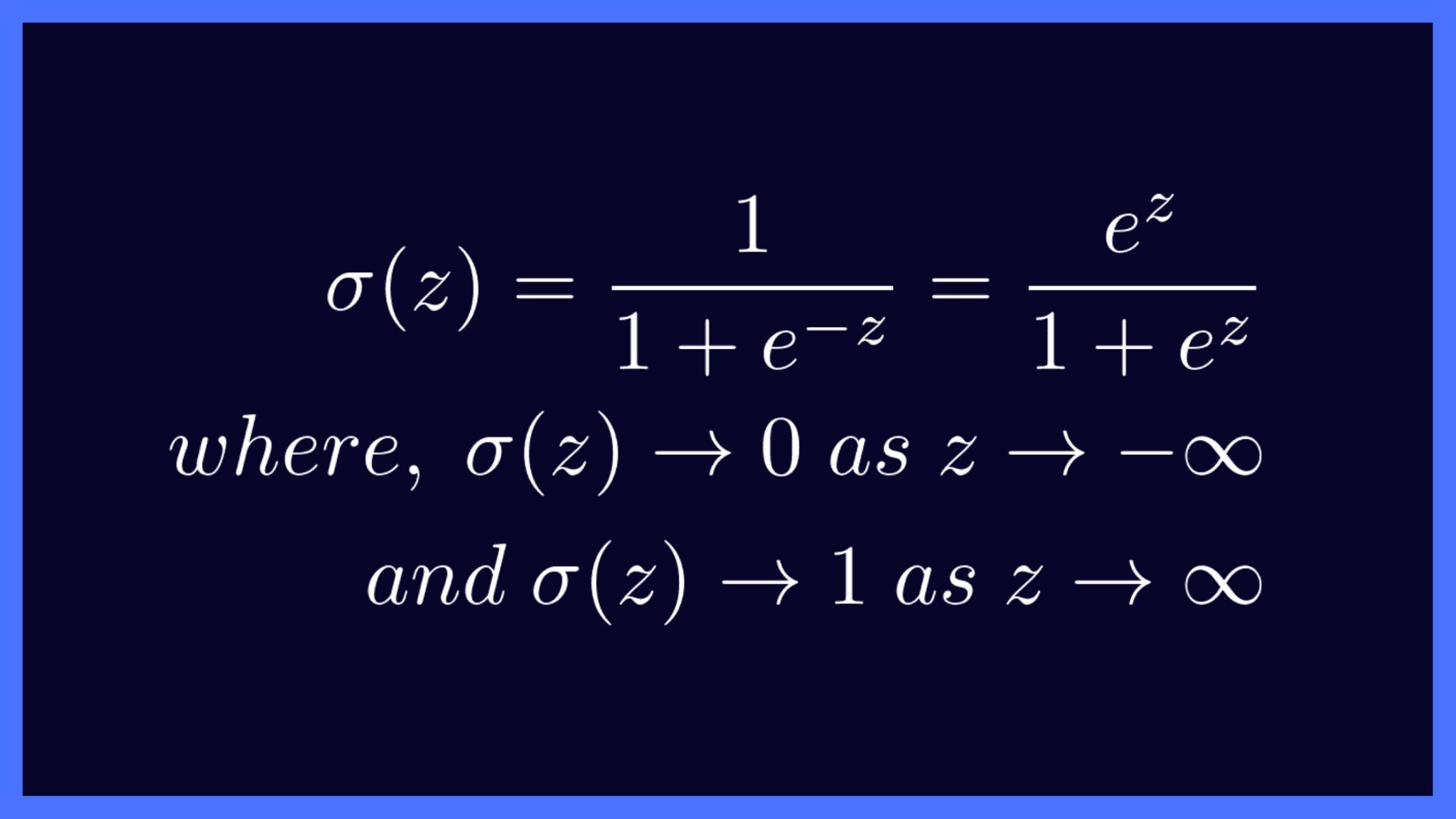
Sigmoid Function Equation (Image by the author)
The sigmoid function takes in any real number as the input and maps it to a number between 0 and 1. This is exactly why it’s well-suited for binary classification.
▶️ You may run the following code cell to plot the values of the sigmoid function over a range of numbers.
import numpy as np
import seaborn as sns

def sigmoid(x):
  exp_x = np.exp(x)
  return np.divide(exp_x,(1 + exp_x))

x = np.linspace(-10,10,num=200)
exp_x = np.exp(x)
sigmoid_arr = sigmoid(x)

sns.set_theme()
sns.lineplot(x = x,y = sigmoid_arr).set(title='Sigmoid Function')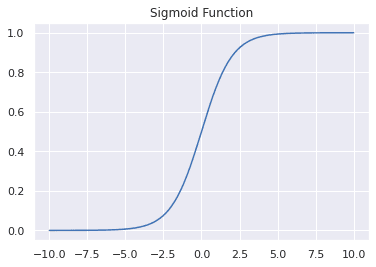
Plot of the Sigmoid Function
Let’s go back to our example of classifying whether an input image is that of a panda or not. In this case, let z be the raw output of the neural network. If σ(z) is the probability that the given image belongs to class 1 (is a panda), then 1 - σ(z) is the probability that the given image does not belong to class 1 and is not a panda. You can think of σ(z) as a probability score.
You can now fix a threshold, say T, and predict that class whose probability score is greater than the chosen threshold.
However, this won’t quite work when you have more than two classes. Softmax to the rescue!
In fact, you can think of the softmax function as a vector generalization of the sigmoid activation. We’ll revisit this later to confirm that for binary classification—when N = 2—the softmax and sigmoid activations are equivalent.
The argmax function returns the index of the maximum value in the input array.
Let’s suppose the neural network’s raw output vector is given by z = [0.25, 1.23, -0.8]. In this case, the maximum value is 1.23 and it occurs at index 1. In our image classification example, index 1 corresponds to the second class—and the image is predicted to be that of a panda.
In vector notation, you’ll have 1 at the index where the maximum occurs (at index 1 for the vector z). And you’ll have 0 at all other indices.
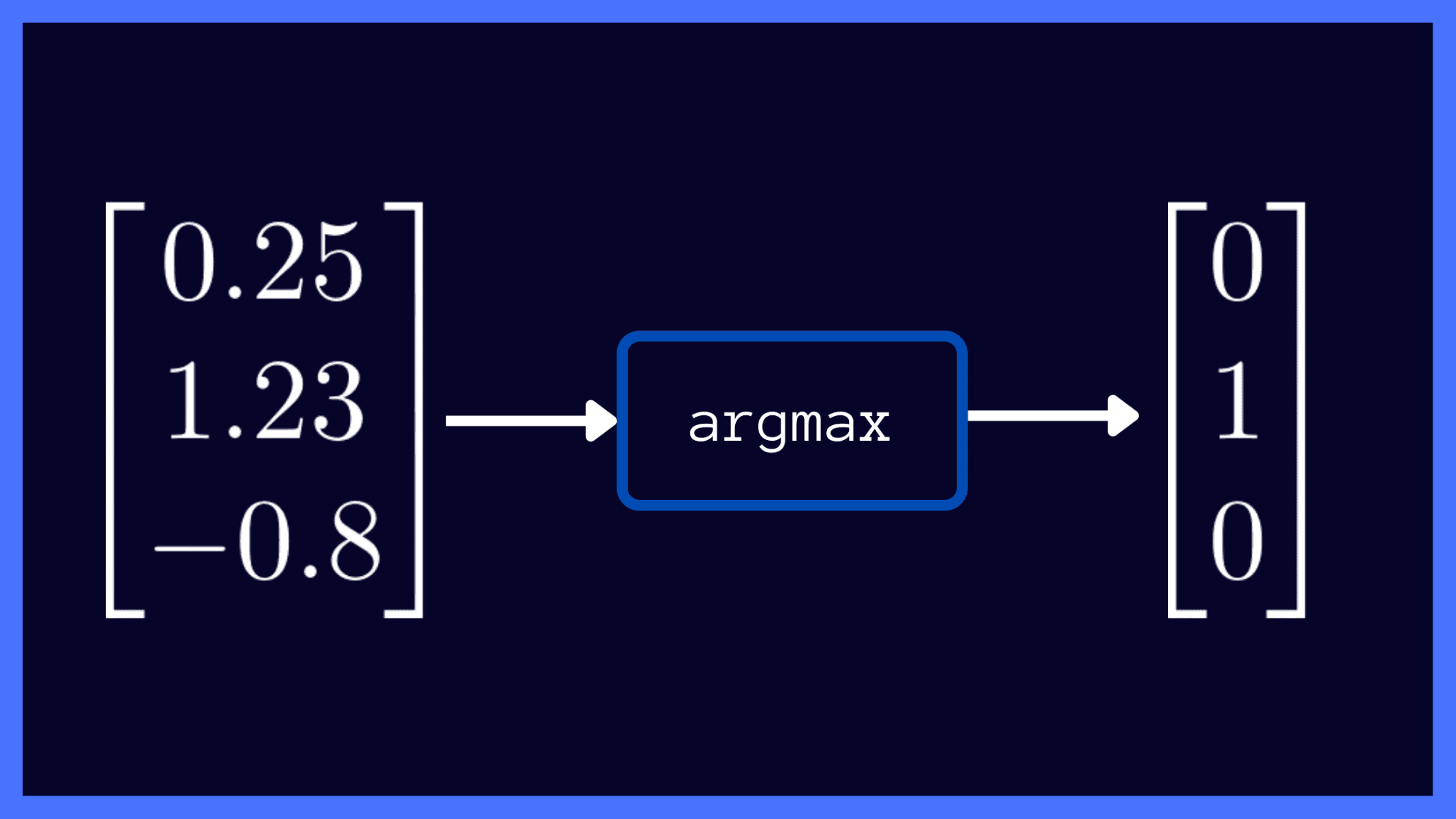
Argmax Output (Image by the author)
One limitation with using the argmax function is that its gradients with respect to the raw outputs of the neural networks are always zero. As you know, it’s the backpropagation of gradients that facilitates the learning process in neural networks.
As you’ll have to plug in the value 0 for all gradients of the argmax output during backpropagation, you cannot use the argmax function in training. Unless there’s backpropagation of gradients, the parameters of the neural network cannot be adjusted, and there’s effectively no learning!
From a probabilistic viewpoint, notice how the argmax function puts all the mass on index 1: the predicted class and 0 elsewhere. So it’s straightforward to infer the predicted class label from the argmax output. However, we would like to know how likely the image is to be that of a panda, a seal, or a duck, and the softmax scores help us with just that!
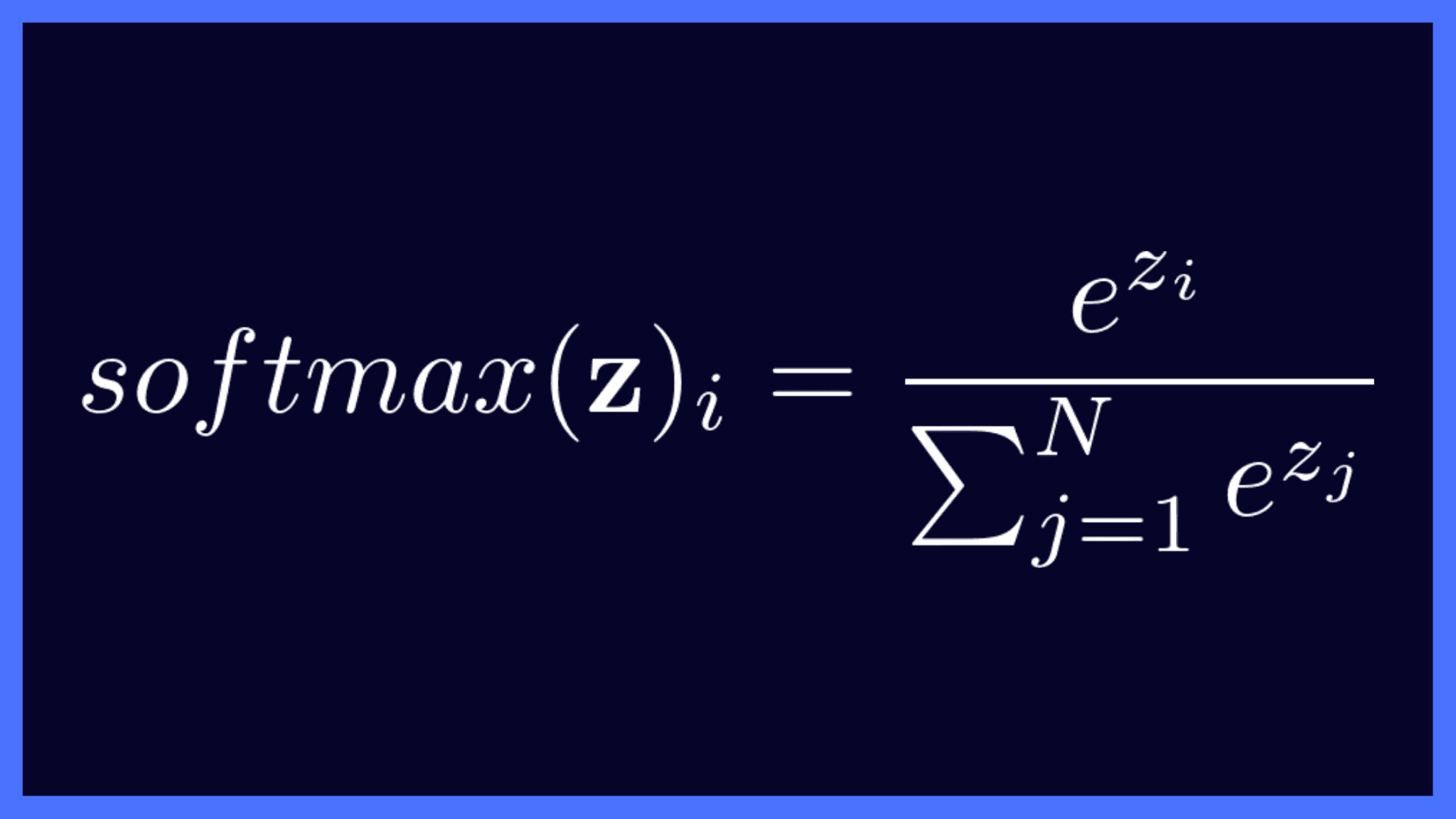
It’s finally time to learn about softmax activation. The softmax activation function takes in a vector of raw outputs of the neural network and returns a vector of probability scores.
The equation of the softmax function is given as follows:
Softmax Function Equation (Image by the author)
Here,
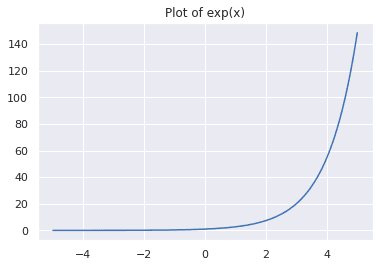
From the plot of e^x, you can see that, regardless of whether the input x is positive, negative, or zero, e^x is always a positive number.
Plot of exp(x)
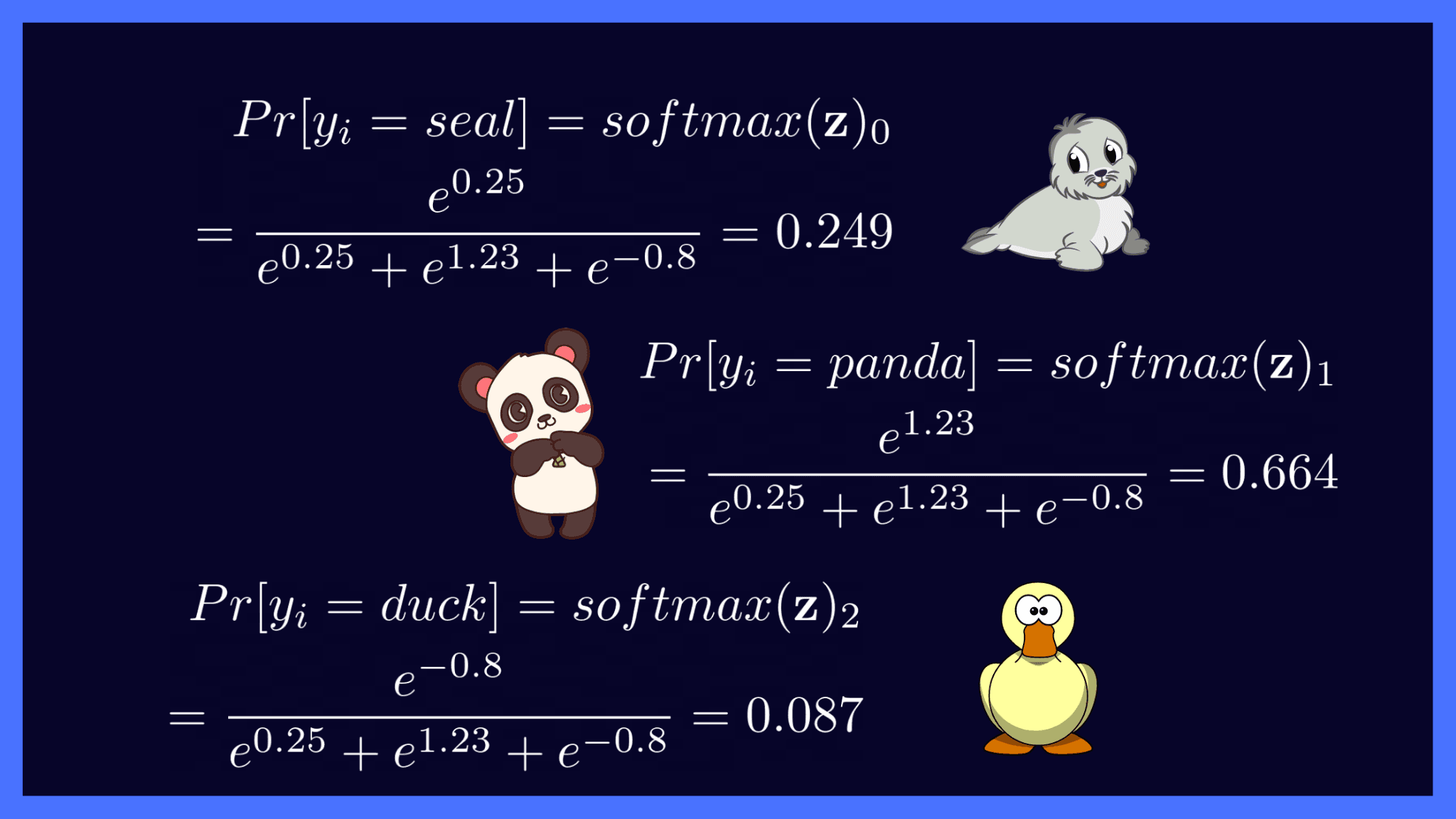
Recall that in our example, N = 3 as we have 3 classes: {seal, panda, duck}, and the valid indices are 0, 1, and 2. Suppose you’re given the vector z = [0.25, 1.23, -0.8] of raw outputs from the neural network.
Let’s apply the softmax formula on the vector z, using the steps below:
Computing softmax scores for the 3 classes (Image by the author)
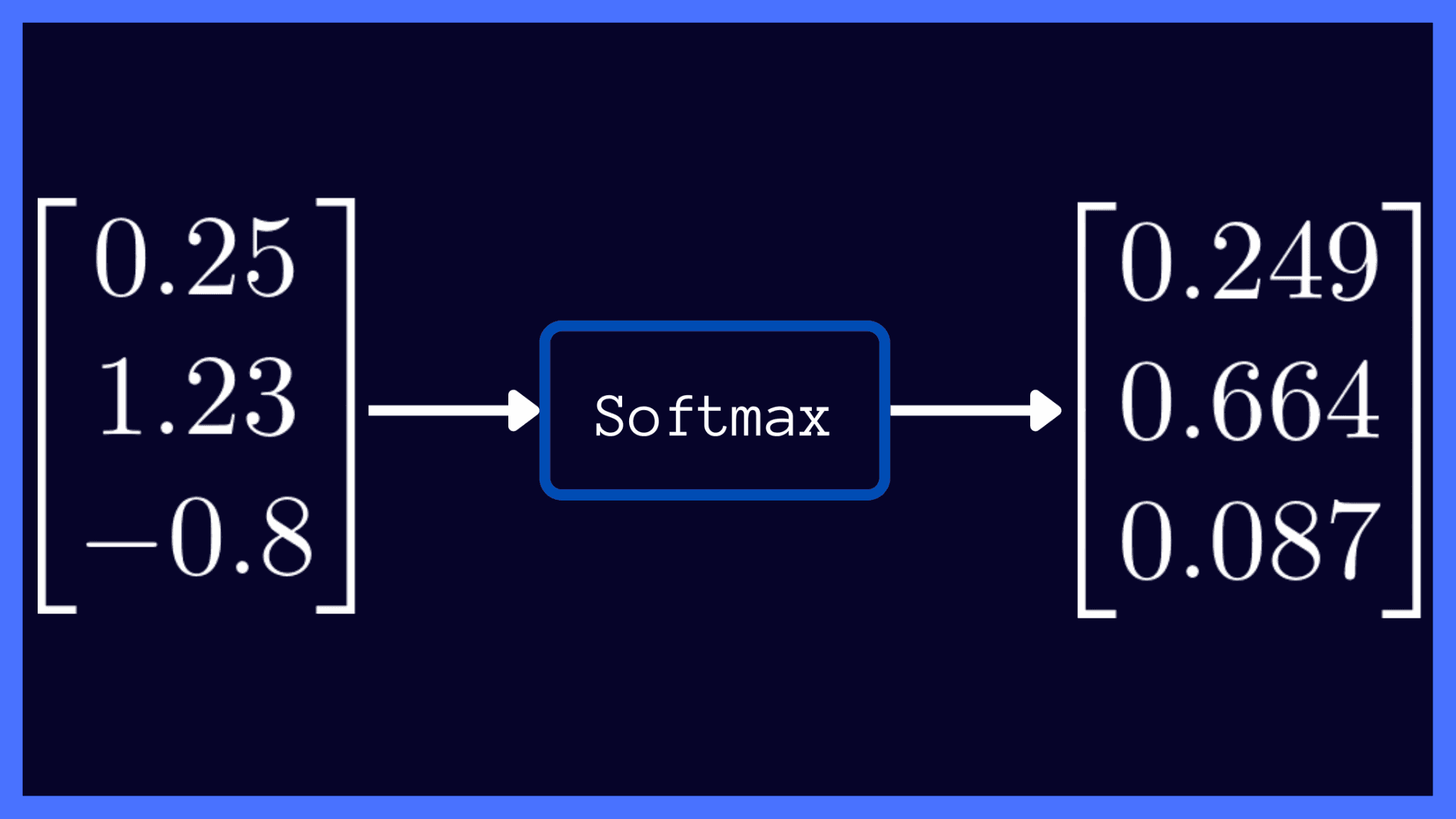
▶️ Now that we’ve computed the softmax scores, let’s collect them into a vector for succinct representation, as shown below:
Softmax Output (Image by the author)
From the softmax output above, we can make the following observations:
This is exactly why you can think of softmax output as a probability distribution over the input classes, that makes it readily interpretable.
As a next step, let’s examine the softmax output for our example.
In the vector softmax(z) = [0.664, 0.294, 0.087], 0.664 at index 1 is the largest value. This means there’s a 66.4% chance that the given image belongs to class 1, which from our one-hot encoding is a class panda.
And the input image has a 29.4% chance of being a seal and around 8.7% chance of being a duck.
Therefore, applying softmax gives instant interpretability, as you know how likely the test image is to belong to each of the 3 classes. In this particular example, it’s highly likely to be a panda and least likely to be a duck.
It now makes sense to call the argmax function on the softmax output to get the predicted class label. As the predicted class label is the one with the highest probability score, you can use argmax(softmax(z)) to obtain the predicted class label. In our example, the highest probability score of 0.664 occurs at index 1, corresponding to class 1 (panda).
In the previous section, we did some simple math to compute the softmax scores for the output vector z.
Now let’s translate the math operations into equivalent operations on NumPy arrays. You may use the following code snippet to get the softmax activation for any vector z.
import numpy as np

def softmax(z):
  '''Return the softmax output of a vector.'''
  exp_z = np.exp(z)
  sum = exp_z.sum()
  softmax_z = np.round(exp_z/sum,3)
  return softmax_z
We can parse the definition of the softmax function:
softmax_z.np.exp(z) to compute exp(z) for each z in z; call the resultant array exp_z.softmax_z.softmax_z.You may now call the function with the output array z as the argument and verify that the scores are identical to what we had computed manually.
z = [0.25, 1.23, -0.8]
softmax(z)

# Output
array([ 0.249, 0.664, 0.087])
Are you wondering if normalizing each value by the sum of entries will suffice, to get relative scores? Let’s see why it’s not an efficient solution.
Why use something math-heavy as the softmax activation? Can we not just divide each of the output values by the sum of all outputs?
Well, let’s try to answer this by taking a few examples.
Use the following function to return the array normalized by the sum.
def div_by_sum(z):
  sum_z = np.sum(z)
  out_z = np.round(z/sum_z,3)
  return out_z
1️⃣ Consider z1 = [0.25, 1.23, -0.8], and call the function div_by_sum. In this case, though the entries in the returned array sum up to 1, it has both positive and negative values. We still aren’t able to interpret the entries as probability scores.
z1 = [0.25,1.23,-0.8]
div_by_sum(z1)

# Output
array([ 0.368,  1.809, -1.176])
2️⃣ Let z2 = [-0.25, 1, -0.75]. In this case, all elements in the vector sum up to zero, so the denominator will always be 0. When you divide by the sum to normalize, you’ll face runtime warnings, as division by zero is not defined.
z2 = [-0.25,1,-0.75]
div_by_sum(z2)

# Output
RuntimeWarning: divide by zero encountered in true_divide
array([-inf,  inf, -inf])
3️⃣ In this example, z3 = [0.1, 0.9, 0.2]. Let’s check both the softmax and normalized scores.
z3 = [0.1,0.9,0.2] # ratio: 1:9:2
print(div_by_sum(z3))
print(softmax(z3))

# Output
[0.083 0.75  0.167] # ratio: 1:9:2
[0.231 0.514 0.255]
As shown in the code cell above, when all the inputs are positive, you may interpret the normalized scores as probability scores, but the scores are in the same ratio as in the array z3. In this example, the predicted class is still that of a panda.
However, you can’t guarantee that the neural network’s raw output won’t sum up to 0 or have negative entries.
4️⃣ In this example, z4 = [0, 0.9, 0.1]. Let’s check both the softmax and normalized scores.
z4 = [0,0.9,0.1]
print(div_by_sum(z4))
print(softmax(z4))

# Output
[0.  0.9 0.1]
[0.219 0.539 0.242]
As you can see, when one of the entries is 0, upon calling the div_by_sum function, the entry is still 0 in the normalized array. However, in the softmax output, you can see that 0 has been mapped to a score of 0.219.
In some sense you can think of the softmax activation function as a softer version of the argmax function: It maximizes the probability score corresponding to the predicted output label. At the same time, it’s soft because it does assign some probability mass to the less likely classes as well, unlike the argmax function that puts the entire probability mass of 1 on the maximum, and 0 everywhere else.
In essence, the softmax activation can be perceived as a smooth approximation to the argmax function.
Now let’s revisit our earlier claim that the sigmoid and softmax activations are equivalent for binary classification when N = 2.
Recall that in binary classification, you apply the sigmoid function to the neural network’s output to get a value in the range [0, 1].
When you’re using the softmax function for multiclass classification, the number of nodes in the output layer = the number of classes N.
You can think of binary classification as a special case of multiclass classification. Assume that the output layer has two nodes: one outputting the score z and the other 0.
Effectively, there’s only one node as the other is not given any weight at all. The raw output vector now becomes z = [z, 0]. Next, we may go ahead and apply softmax activation on this vector z and check how it’s equivalent to the sigmoid function we looked at earlier.
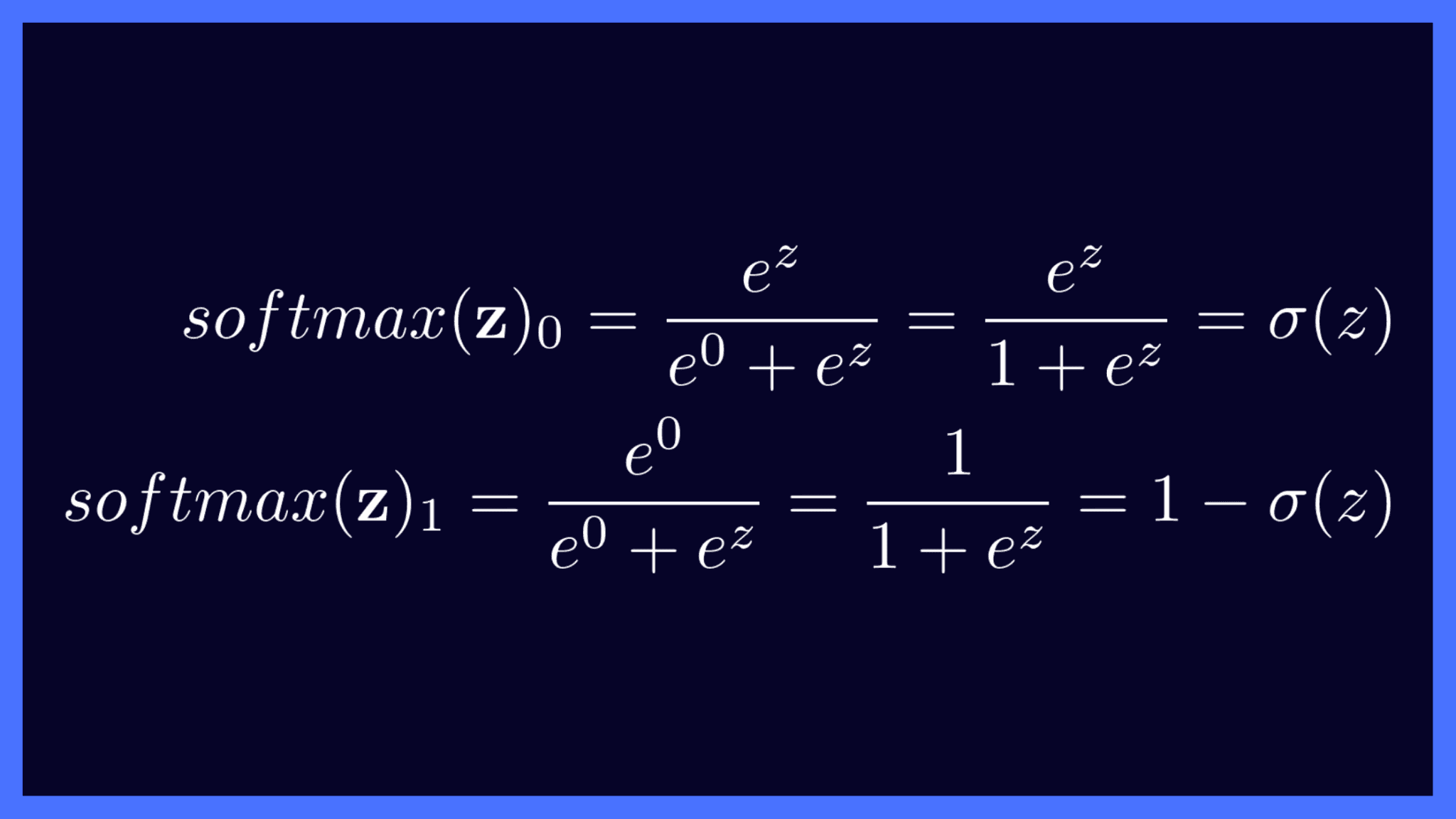
Equivalence of Sigmoid & Softmax Activations (Image by the author)
Observe how the softmax activation scores in this case are the same as the sigmoid activation scores: σ(z) and 1 - σ(z).
And with this, we wrap up our discussion on the softmax activation function. Let’s quickly summarize all that we’ve learned.
In this tutorial, you’ve learned the following:
In the next tutorial, we’ll delve deep into cross-entropy loss—a widely-used metric to assess how well your multiclass classification model performs.
Until then, check out other interesting NLP tutorials on vector search, algorithms, and more. Happy learning!
[1] Lesson on Backpropagation, Chain Rule, and Vectorization from CS231n
此内容由惯性聚合(RSS阅读器)自动聚合整理,仅供阅读参考。 原文来自 — 版权归原作者所有。