


Private connectivity bolsters the security and performance of Twilio’s products – and Twilio Interconnect makes it easier than ever for their customers to go private.
You probably know Twilio as one of the leading customer engagement platforms that give developers powerful APIs to integrate voice, SMS, and email into customer service. The publicly traded (NYSE: TWLO) company’s products are used by Stripe, Airbnb, Lyft, Coca-Cola, and many others to power personalized interactions and global communications. You might not know, however, about Twilio Interconnect, the company’s infrastructure solution that enables enterprises to connect directly to the Twilio network to ensure enterprise-grade quality for Twilio’s products. Customers can use Twilio Interconnect to connect using physical cross connects or encrypted VPN tunnels. They can also use third party exchanges, such as Megaport’s Network as a Service (NaaS).
In 2016, Twilio designed the first version of Twilio Interconnect in response to demand from enterprise customers and carriers seeking private connectivity for regulatory and network performance reasons. Some of the first connections were customers and carriers asking to use Megaport to connect privately to Twilio’s network.
“We want to make onboarding to Twilio as simple as possible, so we generally want to meet our customers where they’re at,” said Alex Seber, Director of Super Network at Twilio.
“Of the third party exchanges, I would say Megaport is one of our preferred providers, because their customer base lines up with ours pretty well – cloud-native…want to scale quickly, kind of a low-touch model.“
Twilio only uses seven Points of Presence (PoP) to operate in significantly more than 100 countries, partnering with companies like Megaport to expand their ability to connect quickly and easily to their global customers.
Lisha Tseng, Staff Product Manager at Twilio, said, “That’s been one of the biggest values of using third party exchanges because we’re not in the same physical locations as many of our customers. We use the exchanges to increase our global reach.”
Twilio Interconnect has been especially popular with companies in highly regulated industries such as financial services, which face more stringent security and compliance requirements. Private connectivity takes traffic off the public internet, which can be more vulnerable to cyberthreats such as BGP route hijacking. Twilio’s voice customers often use Twilio Interconnect to minimize the audio quality issues that become inevitable when a call flows over the public internet, moving from one network to another on its way to its final destination. With private connectivity, calls can go directly from Twilio’s network to the enterprise’s private network.
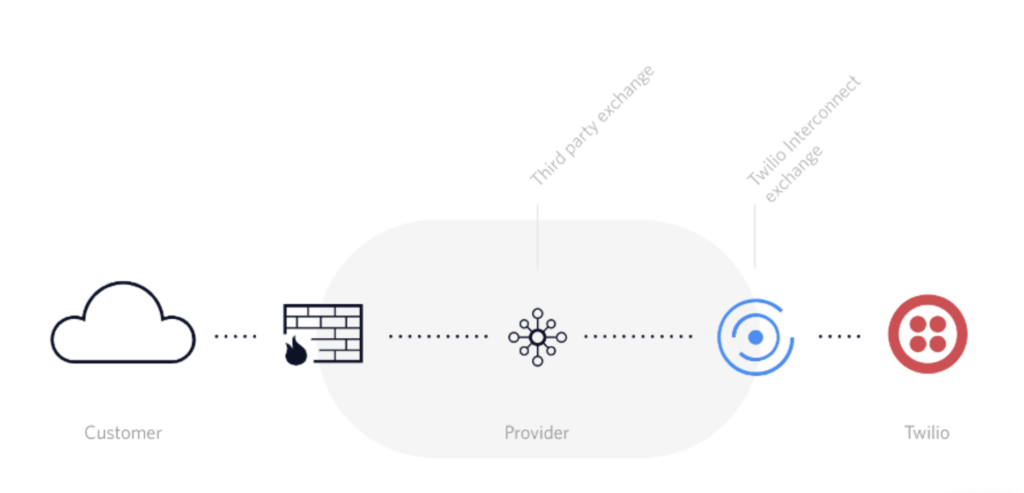
In addition to using Megaport for redundant connectivity to AWS, Twilio offers Megaport as one of several third party exchanges available on Twilio Interconnect. When searching for which NaaS to partner with, Seber said Twilio sought several key attributes.
“Megaport’s coverage is huge,” Seber said.
“We wanted the solution to be software-driven. Being able to do everything online and not having to talk to a salesperson were pretty key for us. And then the pay-as-you-go model is important because with our rapid growth it’s hard to have IP commits with carriers, so it’s nice to know we can spin up a connection pretty quickly. We’re one of the only products at Twilio that ties back to physical equipment, so provisioning can take a little longer as opposed to all the APIs we sell, so a lot of our customers are cloud-native and API-first. When we tell them they have to provision a circuit or a cross connect, they either don’t know what that is or they get scared about the lead times. So knowing that Megaport moves a bit quicker is also critical.”
“We definitely see our customers shifting.”
Twilio Interconnect has become a rapidly growing service within the Twilio product suite. The number of connections enabled by exchanges such as the Megaport network has increased 100% year over year. Tseng believes that third party exchanges like Megaport represent an area of growth for the product going forward.
“The Virtual Cross Connect has been a game-changer for our product suite,” Tseng said.
“We onboarded Megaport two years ago, and the first year, customers were just figuring it out, but in the second year, Megaport is becoming an integral part of Twilio Interconnect, and we definitely see our customers shifting.”
Twilio plans to enhance the customer experience, making it easier for enterprises to turn up private connectivity directly from the Twilio platform.
“Once the customer is online, we can turn them up within a few days, which is pretty quick for telecom,” Seber said.
“Customers who are coming from a legacy telecom background are generally pretty happy.”
Interested in how Twilio Interconnect can help you? Get in touch with Twilio here.
此内容由惯性聚合(RSS阅读器)自动聚合整理,仅供阅读参考。 原文来自 — 版权归原作者所有。