






This blog aims to be an in-depth analysis, using some analytical tools that you may not be familiar with. They should be reasonably intuitive, but take your time if you can, as I try to bring some new ways of looking at the Online Harms policy space, that government itself says it uses when dealing with complex policy problems.
To recap what measures have been imposed so far: This began with the UK persuading ISPs and mobile providers to have Internet filters on by default in 2013 The expectation was that these would largely restrict access to adult and harmful content for children and teens. In practice, users in households did not want filters installed across all adults and children. For mobile users, providers found it impractical to block much more than pornography. Most importantly, over-blocking has caused a lot of legitimate and entirely harmless material to be blocked, including advice for people at risk, as highlighted by ORG’s Blocked tool.
The Online Safety debate and then Act was a response to the limited impact of filters, with the policy process starting in 2017. The measures announced in 2019 centred around a ‘duty of care’ and attempted to impose restrictions on harmful content for adults as well as children. The Online Safety Act, passed in 2023, has fuelled the use of age verification to allow adults to access content that might be unsuitable for children. Age Verification remains improperly regulated and largely US processed. Even the poster child of ‘doing it right’, Yoti, has been fined by the Spanish data protection authorities and criticised by privacy researchers.
The OSA is too complicated for us to summarise everything about it. But clearly, segregating categories of content like ‘violence’ (including UK police or Israeli military violence), ‘sexuality’ (including LGBTQ+ advice and social discussions), ‘drugs’ (including discussion of managing harms and avoiding risks), and so on, is problematic. Firstly, because the aim is to prevent teenagers from accessing this content, and secondly because adults are required to age verify and sacrifice privacy to access what can include political and socially important content. Future measures will include automated takedowns, and could even include breaking encryption to scan content.
Finally, the OSA has ended up with small but incredibly safe sites from shutting down or blocking UK access, due to compliance problems. The OSA is in this dimension preventing solutions to the problem of online safety.
Now there are proposals to remove children from social media and games’ chat systems, and for phones to scan for user created sexual images by default. These proposals also mean age verification for adults to access social media or to stop phones from scanning what they take photos of.
Let’s take a step back and look at the way the policy process is designed, and why the measures seem less than effective. Firstly, I would like to introduce something about how government says it develops policy. It provides policy development guidance that is designed to ensure that unintended consequences are avoided, and that policy aims will deliver the intended results. To ensure this is done properly, the Government Office for Science provides an Introductory systems thinking toolkit for civil servants. Patrick Vallance explains:
The design of effective policies for citizens, communities and the UK requires policy makers to understand interconnected systems. For example, the role of transport in accessing healthcare. The most effective policy professionals across the UK Civil Service develop and deploy systems approaches in their work and I encourage all my colleagues to make full use of this toolkit.
What Vallance is pointing to is the problem of repeated policy failures like the War on Drugs, or the way that new roads generate new traffic and fail to stop traffic jams, or how the criminal justice system and longer sentences generate new crime. Highly complex systems and simplistic interventions really do not mix. Genuine solutions require careful thought to ensure that systems and policy goals actually align.
Online Safety is truly an “interconnected system” with a great deal of complexity. Following the government’s policy guidance, then, we can use some of their tools to describe at least some of their interconnections.
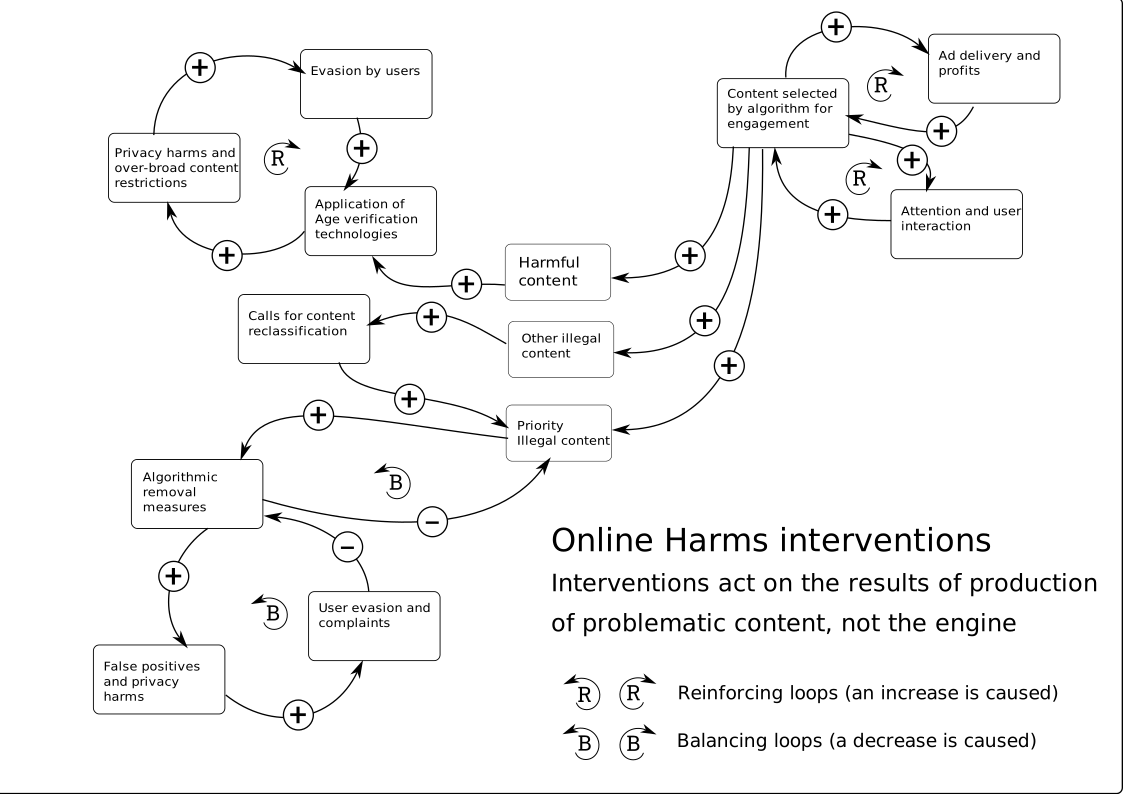
This is a basic flow diagram using Systems Dynamics, as the GOS advises. Systems Dynamics is a tool made famous by Limits to Growth, which presented a model of world resource usage that lead to the environmental sustainability debates of the 1970s, and by Peter Senge in the business world, with his book The Fifth Discipline.
The graph describes the social media and online harms dynamics. In the diagram, each measurable part of the system, or “stock”, causes changes in other parts, or “stocks”. Where the relationship is positive, ie causing an increase, such as users creating more content, the arrow is marked with a plus (+). Where negative, a minus (-) shows a negative causal reduction.
This allows us to see the pattern of interactions. While the graphs are my view of the system, most of the relations are generally accepted by people in the debate, including safety campaigners.
The graph shows on the top right the “attention economy”, with attention and user interaction being reinforced by algorithms, and these also reinforcing profits. These are reinforcing loops, or “virtuous cycles” in the view of social media companies. However, from the perspective of safety campaigners and free expression organisations like ORG, Amnesty and others, these cycles also cause increases in harmful content, and illegal content. These are shown in the centre of the diagram.
On the left of the diagram, we see the policy results. Harmful content generates calls for age verification; this generates Evasion by users; this generates calls for tougher age verification, such as application to VPNs, in a reinforcing cycle. As the pipeline of harmful content is not reduced, calls for age restrictions are unlikely to reduce.
For illegal content, we see pressure for more and more content to be moved from Other illegal content, which is anything illegal that a platform must remove if reported, to the Priority illegal content bucket, starting with terrorism and child abuse material, where platforms must remove the content through scanning and algorithmic identification. Here, there may be a bit more policy resistance where too much content is removed.
What is also apparent is that the measures are mostly burdens on users, rather than platforms. They cause privacy and free expression costs, introduce age verification and other barriers that act on users.
The graph illustrates a policy system where the measures are not really acting on the production of problematic content. The engine of online harms, ie algorithmic prioritisation, remains essentially untouched. The attention-seeking goal of the social media system is not changed, and the policy interventions seem to work against rather than with the overall system. This ought to call into question whether the online safety policy approach is really trying to act systemically and effectively. Could other interventions make more sense than simply trying to restrict content and access to content?
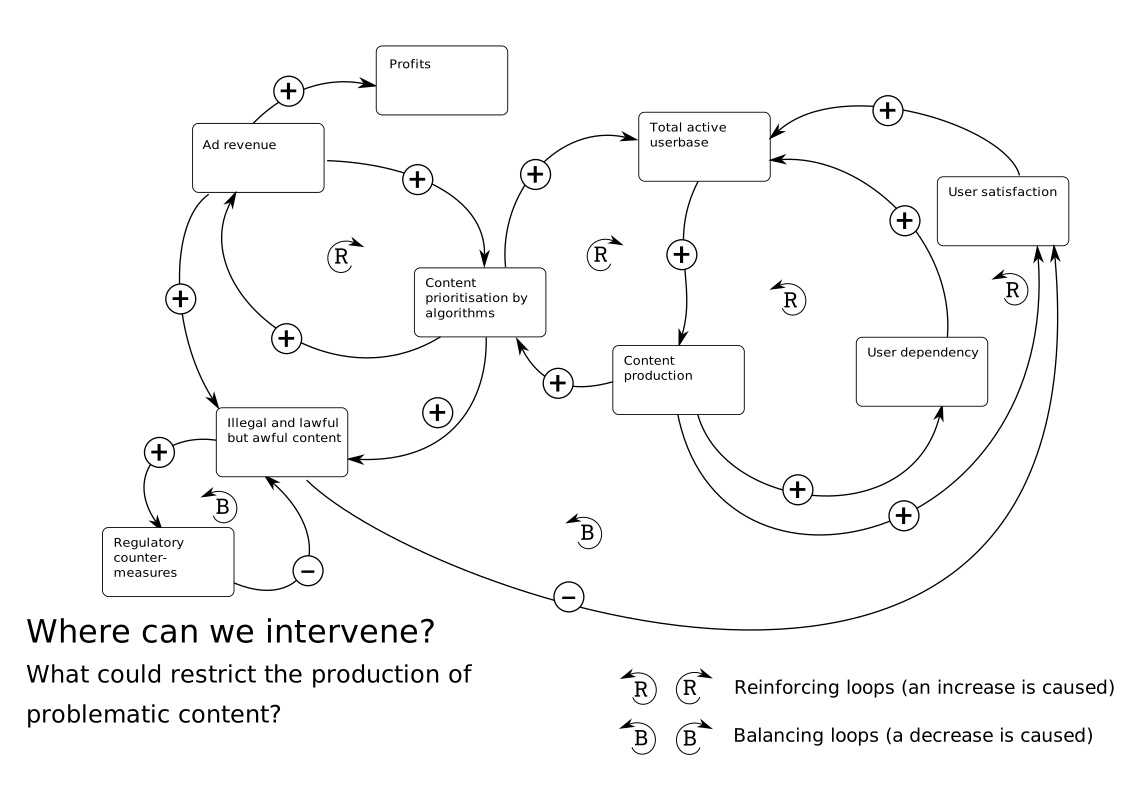
In this graph, I have mapped out the basics of the user attention economy that we saw above in a bit more detail. Again, none of the relationships depicted are unknown or controversial. The main loops we see are that the Total active userbase increases Content production, which leads to content prioritisation due to the glut of content. Content production also increases User dependency, which increases the Total active userbase. Content production also increases User satisfaction, also increasing the Total active userbase. So far, all great for the social media company, which also uses the loop of Content prioritisation by algorithms to increase Ad revenue (and thereby Profits).
As before, we note that Illegal and lawful but awful content is also produced by the algorithms system, while Regulatory counter-measures seek to reduce this.
What is illustrated in the graph but appears forgotten in the policy debate however, is that the presence of lawful but awful content, and poor interactions, ought to lead to a decrease in User satisfaction, (illustrated by the long arrow at the foot of the graph) which would then break the reinforcement loop holding up the Total user base. Yet it doesn’t, presumably because of User dependency.
As is noted in many guides to Systems Dynamics, these kinds of graphs help show you where the intervention points really are. What we are looking for is places where there are lots of arrows flowing in. Here the obvious ones are Total active userbase and Content prioritisation by algorithms, and perhaps Content production. These seem central to the system we are illustrating.
In other words, if we could find ways to change how the social media companies retain their Total active userbase, by reducing User dependency, then social media companies might have to re-evaluate what was causing customers to leave. Or perhaps Content production could be less of a driver of User dependency, if people could interact with the content through third parties.
Similarly, if government introduced interventions that acted on the algorithms, like letting users choose any prioritisation engine they liked, then users might act to reduce the harmful content they receive.
Lastly, we should note that in these graphs I have narrowed the policy space that we are looking at. Social media is embedded in society, and wider economics. We have not looked at the role of social media in children’s lives, or their own offline social experiences. There are questions around the way that educators and parents are supported.
However, the analysis above does show that there are a few immediately obvious interventions government could take to change the way the whole system works. They are not a silver bullet, and we do not claim they are the entire answer, nor necessarily politically easy; nor are they a replacement for content duties, but they could help better align the social media content system with the policy goal of safety. They are:
That is plenty to think about for now. The UK can stick to a policy ratchet where failed policies lead to more of the same, without really causing anyone at a social media company to blink. Or it can engage in more effective policy design, by looking at the social media system in its fuller context, and then shifting the measures from costs on users, to user empowerment, directly tackling the market power of social media which is generating online harms.

If you live in the UK and have a Facebook or Instagram account, you have probably received a message when you’ve logged in asking you if you “Want to subscribe or continue to use our Products for free with ads?
Musk’s latest venture, image generation in Grok that until Wednesday lacked sufficient guardrails to prevent the easy production of non-consensual sexual images and even child abuse images, provoked an Ofcom investigation and further EU Commission action as well as the promise of UK emergency legislation against apps that provide such images in less than a week.
Our report, “Hostile and Broken” released today, explains why e-Visas risk creating tens or hundreds of thousands of errors, with people potentially turned down for jobs, or unable to enter the country, as the result of electronic failures of the new online, real time re-checking inherent in the UK e-Visa scheme.
Meta, the company that runs Facebook and Instagram, has announced plans to repurpose most of the personal data that they ever collected about you, to train their “artificial intelligence (AI) technologies” — without, of course, asking your permission to do so.
As the House of Lords finally begins scrutiny of the UK data protection reform, Open Rights Group urges peers to support amendments that would strengthen the independence and effectiveness of the UK data protection authority, and bolster the public’s right of seeking a remedy against an infringement of their rights.
On a cycling forum, members who are rightly worried that their forum may be blocked by default filters, Skydancer posted a response he was given by Diane Abbott: I do not believe that the arrangements to protect children from hard core porn online will affect a forum to discuss cycling!
The motion laid down by Labour says: That this House deplores the growth in child abuse images online; deeply regrets that up to one and a half million people have seen such images; notes with alarm the lack of resources available to the police to tackle this problem; further notes the correlation between viewing such images and further child abuse; notes with concern the Government’s failure to implement the recommendations of the Bailey Review and the Independent Parliamentary Inquiry into Online Child Protection on ensuring children’s safe access to the internet; and calls on the Government to set a timetable for the introduction of safe search as a default, effective age verification and splash page warnings and to bring forward legislative proposals to ensure these changes are speedily implemented.
The Digital Surveillance report – to be launched at a public event on Monday – gives a history of surveillance policy, looks at the current state of the law, examines why technology poses a problem and offers alternative, more targeted and more accountable approaches.
Since we published our report ‘Mobile Internet censorship: what’s happening and what to do about it‘, jointly with LSE Media Policy project, a number of people have been in touch with us asking what to do if they discover their site is blocked incorrectly by mobile networks’ child protection filters.
Open Rights Group and Tor have established that UK mobile networks such as Vodafone, O2 and 3 are filtering UK users’ access to Tor’s primary website (meaning the HTTP version of the Tor Project website, rather than connections to the Tor network) on pre-paid contractless accounts.
To coincide with the start of the London Conference on Cyberspace, eleven organisations and experts on freedom of expression and privacy online have today written to the Foreign Secretary stating that Britain’s desire to promote these ideals internationally is being hampered by domestic policy.
In the sixth of our series on the challenges facing the new government, Jason Kitcat looks at proposals for changes to the way our elections are run, including dangerous calls for e-voting.
Wikipedia have announced that they are blocking Phorm as they consider the scanning and profiling of our visitors’ behavior by a third party to be an infringement on their privacy.
It’s difficult to tell which of today’s developments the UK’s major ISPs should be more worried about – the fact that Sir Tim Berners-Lee has publicly stated that he would change his ISP if it started employing systems, like Phorm, which could track his activity on the internet, or the news that UK digital rights gurus the Foundation for Information Policy Research (FIPR) have today written an open letter to the Information Commissioner, urging him to look at the legality of Phorm.
The Electoral Commission and the separate review by Ron Gould that the Commission instituted have published their reports on the Scottish elections of May 2007 The Gould Review in particular identifies a number of important issues, many of which ORG addressed in our own report on the elections published this June.
In a speech to the National Council of Voluntary Organisations this morning, Gordon Brown announced he would be convening a Speaker’s conference on voting reform: Today I am proposing to the Speaker that he calls a conference to consider, against the backdrop of a decline in turnout, a number of important issues, such as electoral registration, weekend voting, and the representation of women and ethnic minorities in the House of Commons.
While the Department for Constitutional Affairs have left us in the dark with no news at all about the e-voting pilots due for May 2007, The Open Rights Group and FIPR have been hard at work.
此内容由惯性聚合(RSS阅读器)自动聚合整理,仅供阅读参考。 原文来自 — 版权归原作者所有。