


Across financial services, AI is no longer just conducting basic predictive analysis — it's making complex decisions based on vast datasets. Risk models are running autonomously. Agents are answering regulatory queries. Trading systems are acting on signals generated by models that never pause to ask what the underlying data actually means. That's the problem. AI doesn't operate on raw data and large language models alone. It operates on a semantic layer — the representation of what data means, how concepts relate, and what questions can legitimately be asked of it. When that layer is solid, AI performs. When it isn't, AI doesn't fail loudly. It confidently produces incorrect answers to questions it was never equipped to solve. For financial services firms accelerating AI adoption, the semantic layer is no longer an architectural footnote. It's a risk surface. The Open Semantic Interchange (OSI) aims to address this long-standing challenge: how different technologies represent and exchange semantic information. For the first time, we're approaching a world where semantics — not just data — can move across platforms in a consistent way. That's meaningful progress. But financial services have learned, repeatedly, that agreeing on the envelope is not the same as agreeing on what's inside it.Standards have come a long way, just not far enough
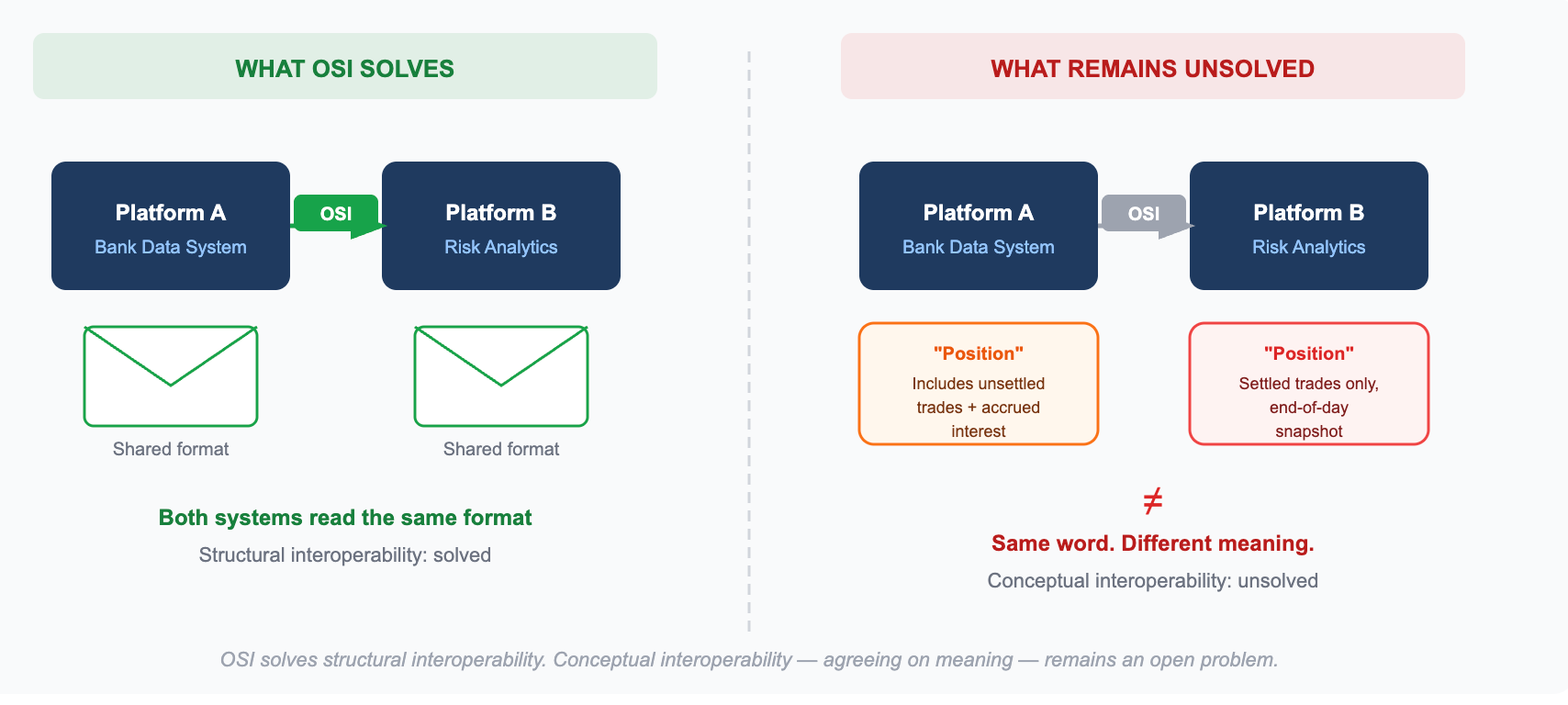
Simply put: we've standardized how systems exchange semantic models - not what those models mean. Structural interoperability asks: “Can systems exchange models in a format both sides can read?” This is an engineering problem. It has an engineering solution. OSI solves it. Conceptual interoperability asks: “Do both sides agree on what the model actually means?” This is not an engineering problem. It's a coordination problem — one that requires institutions, vendors and data providers to align on shared definitions before the first line of code is written. OSI intentionally addressed structural interoperability first. That was the right sequencing. But the industry is now discovering that structural interoperability without conceptual interoperability is not enough. Spend enough time inside banks, asset managers, insurers or data providers, and a pattern emerges. Every organization models the same core concepts: trades, positions, instruments, accounts, risk exposures, investment platform, FIBO and more. And every organization defines them slightly differently. Not radically — but enough to matter when data crosses a boundary. Consider a few examples: "Position." At one major bank, a position includes unsettled trades — transactions agreed but not yet cleared — plus accrued interest. At another, it's settled trades only, captured as an end-of-day snapshot. FIBO: A financial instrument that is fungible, negotiable and represents some type of financial value. These definitions are internally consistent, but the difference in wording causes three problems: We have all duplicated effort AI will not treat these the same without effort We will spend time mapping and normalizing our semantic layersThe half of interoperability nobody talks about
The problem every institution is quietly solving—over and over again
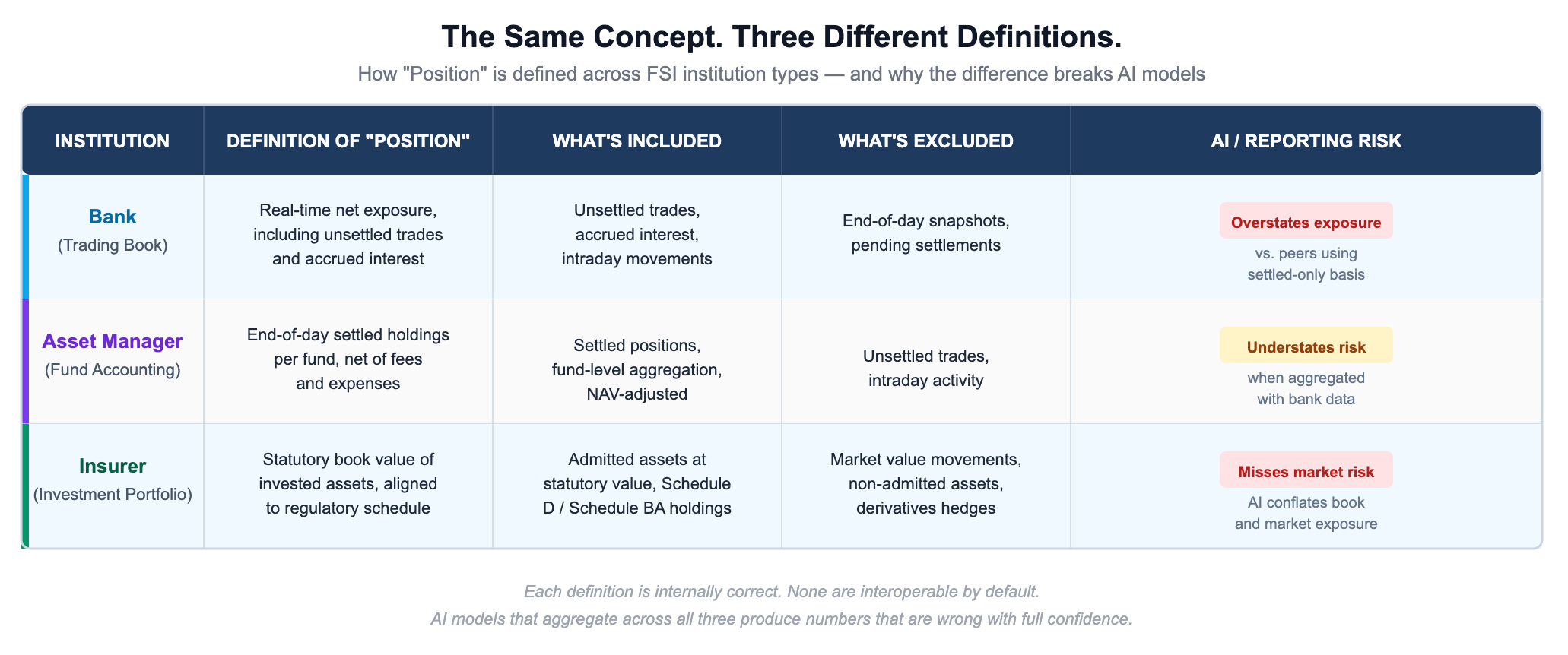
But when an AI risk aggregation model draws from both sources, it produces materially different exposure numbers for the same portfolio — with no warning, no flag and no way to trace which definition was applied at which step. The model doesn't fail. It just quietly produces the wrong answer. Concepts are consistent. Definitions of concepts are inconsistent. So every time data moves between systems — internally or across firms — teams are forced to reconcile differences or redefine semantics. This work is rarely visible. It doesn't appear in architecture diagrams or vendor demos. It lives in email threads, reconciliation spreadsheets and the institutional memory of the analyst who's been there long enough to remember why the numbers never quite matched. But it is everywhere. And it is expensive. This isn't a new problem. Financial services have always had fragmented semantics — every firm, every system, every vendor with its own definitions of the same core concepts. What's new is the cost of leaving it unresolved. 1. AI doesn't contain ambiguity — it operationalizes it When a human analyst encounters a definitional mismatch, they pause, flag it and resolve it– or they silently reconcile it by translating poor semantics into the true meaning. The reconciliation is slow, but it's contained. When an AI system encounters the same mismatch—it doesn't pause. It incorporates the inconsistency into its output, propagates it downstream, and recombines it with other inconsistencies across thousands of decisions before anyone notices something is wrong. And even if it were able to reconcile, just as with the human version, it imbues fragility and adds work (tokens). The problem hasn't changed. The speed at which it compounds has. 2. Every data boundary is now a semantic boundary Firms are no longer operating in isolation. A single credit risk workflow today might touch a market data vendor, a third-party risk platform, a regulatory reporting utility, and two internal datasets — each with its own definition of the same underlying concepts. Every integration is a new opportunity for semantic drift. And drift compounds: a small definitional gap at ingestion becomes a material discrepancy by the time it reaches the AI layer.Why this gap matters more now than it used to
A small definitional gap at ingestion becomes a material discrepancy by the time it reaches the AI layer.
3. Speed of integration is now a competitive variable The firms closing deals faster, onboarding data partners faster, and adapting to regulatory changes faster are the ones with cleaner semantic foundations. Semantic misalignment introduces friction here. It is the hidden tax on every new data product, every AI initiative, and every cross-firm collaboration. The scale and, thus, the urgency are what’s new. The industry has been aware of this problem for decades. The attempts to solve it are real, well-funded and well-intentioned. The Financial Industry Business Ontology (FIBO) is the most prominent example. Developed by the EDM Council and now maintained as an open standard, FIBO provides a comprehensive, formally structured vocabulary for financial concepts — thousands of classes, properties, and relationships covering everything from legal entities to derivative instruments. The ambition is exactly right. The demand for shared vocabulary is real, but the delivery mechanism hasn't worked. So the cycle repeats — firm by firm, integration by integration, AI project by AI project. The structural foundation exists and OSI provides the transport. The shared semantic meanings described in the previous sections are the missing piece — and building it is only partly a technology problem. It's mostly a coordination problem. That means the path forward looks less like a standards body producing a specification and more like an industry working group producing something immediately usable: a reference vocabulary. What the work actually involves: First, agreeing on what the problem is — precisely and collectively. Not every firm experiences semantic misalignment the same way, and the work starts by mapping where the gaps are most costly and most common. Then, agreeing on what a solution looks like, what the shared layer covers, what it doesn't, and what "done" means for the first iteration. Then, building toward it incrementally. One concept at a time, one working group at a time, with something usable at each step rather than a complete framework that arrives years later. Who needs to be at the table: Data providers who distribute financial data across firm boundaries and absorb the cost of semantic misalignment every time a client's definition diverges from theirs. Financial institutions whose data architecture teams rebuild the same mappings project after project and whose AI programs are quietly failing because of definitional inconsistency they can't yet name. Platform vendors whose semantic modeling tools sit at the point where firm-level definitions are created and who are best positioned to make the shared layer referenceable from within existing workflows. What partial alignment actually delivers: The goal is not consensus on everything. It's consensus on enough. Even aligning on 20 core concepts reduces the surface area of every subsequent integration. The teams that spend six months mapping "position" across three systems spend two weeks instead. The AI model that silently aggregated incompatible definitions now has a declared divergence to work with. The regulatory filing that required three rounds of reconciliation goes out clean on the first pass. The compounding works in both directions. Misalignment compounds into error. Alignment compounds into speed. If this work is relevant to your role, whether you're building semantic models, evaluating data platforms, or leading an AI data program at an FSI firm, the conversation is happening now. Get the latest insights on how AI is evolving. Join us at Snowflake Summit on June 1-4 in San Francisco. Interested in being part of the Open Semantic Interchange? Learn how you can get involved.The industry already knows this—but lacks a practical solution
From awareness to action
此内容由惯性聚合(RSS阅读器)自动聚合整理,仅供阅读参考。 原文来自 — 版权归原作者所有。