
惯性聚合 高效追踪和阅读你感兴趣的博客、新闻、科技资讯
阅读原文 在惯性聚合中打开

推荐订阅源

N
Netflix TechBlog - Medium
罗磊的独立博客
H
Help Net Security
I
Intezer
G
Google Developers Blog
CTFtime.org: upcoming CTF events
T
Troy Hunt's Blog
让小产品的独立变现更简单 - ezindie.com
U
Unit 42
cs.AI updates on arXiv.org
freeCodeCamp Programming Tutorials: Python, JavaScript, Git & More
钛媒体:引领未来商业与生活新知
钛媒体:引领未来商业与生活新知
N
News and Events Feed by Topic
J
Java Code Geeks
S
Security Affairs
T
The Blog of Author Tim Ferriss
Recent Commits to openclaw:main
cs.CV updates on arXiv.org
D
Docker
The GitHub Blog
The GitHub Blog
F
Full Disclosure
N
News and Events Feed by Topic
Webroot Blog
Webroot Blog
S
Security @ Cisco Blogs
腾讯CDC
人人都是产品经理
人人都是产品经理
M
MIT News - Artificial intelligence
Blog — PlanetScale
Blog — PlanetScale
T
Threatpost
D
DataBreaches.Net
Recent Announcements
博客园 - 三生石上(FineUI控件)
MongoDB | Blog
MongoDB | Blog
博客园 - 【当耐特】
L
LINUX DO - 最新话题
Google Online Security Blog
S
Schneier on Security
S
Securelist
奇客Solidot–传递最新科技情报
奇客Solidot–传递最新科技情报
Help Net Security
Help Net Security
P
Proofpoint News Feed
Project Zero
Project Zero
S
SegmentFault 最新的问题
H
Hackread – Cybersecurity News, Data Breaches, AI and More
MyScale Blog
MyScale Blog
Google DeepMind News
宝玉的分享
宝玉的分享
Y
Y Combinator Blog
C
CXSECURITY Database RSS Feed - CXSecurity.com
博客园 - 叶小钗

AWS for Industries

Dynamic Inbound Routing for BYOIP Workloads Using Amazon VPC Route Server | Amazon Web Services How Autel Transformed Charging Station Management with AI Agents on AWS | Amazon Web Services How Danone Simplified Kubernetes at Scale with Amazon EKS Auto Mode | Amazon Web Services Build a Multi-Agent Assessment Workbench with Amazon Bedrock AgentCore | Amazon Web Services Sovereign by design: How AWS helps Nigeria’s financial services industry protect data and drive innovation | Amazon Web Services Scaling ML in production: how BBVA accelerated delivery with MLOps | Amazon Web Services Inside BBVA’s MLOps transformation: from data platform to scalable ML on AWS | Amazon Web Services Blazing a Trail: How Peloton Rebuilt the SDLC for the Agentic Era with Amazon Bedrock | Amazon Web Services Accelerate RISC-V Software Development Before Silicon: Virtual Prototyping with MachineWare’s SIM-V on AWS | Amazon Web Services How retailers deliver hyper-personalization in-store with Personalisation Hub, UST, and AWS | Amazon Web Services Deploy diagnostic-quality imaging globally with MedDream and AWS HealthImaging | Amazon Web Services Coins in Motion: Building agentic blockchain payments for in-vehicle experiences | Amazon Web Services Reduce P&ID analysis time by 80% with hybrid AI maintenance planning | Amazon Web Services Deploying industrial AI on AWS: Building the autonomous factory | Amazon Web Services Edge-to-Cloud Architecture for Real-Time Surgical Intelligence with AWS and NVIDIA | Amazon Web Services Reimagining B-Pillar DFMEA: Why Ontology-Grounded AI Is the Future of Automotive Engineering | Amazon Web Services Transforming energy trading by managing complexity and driving growth with Cloud ETRM | Amazon Web Services How Multi-Agent AI Turns Supply Chain Data into Decisions and Actions | Amazon Web Services ​​​Deploy Agentic Bidding Without Sacrificing Speed: ARTF Containers with NVIDIA GPU Acceleration on AWS​​ | Amazon Web Services Next-generation programmatic advertising: How AWS RTB Fabric redefines the game | Amazon Web Services Flexible Telecom AI Workload Deployment Across AWS Hybrid Cloud | Amazon Web Services Building a HIPAA-ready generative AI architecture for healthcare on AWS | Amazon Web Services Highlights from the 2026 AWS Life Sciences Symposium: MedTech Track | Amazon Web Services Multi-Agent Systems for Financial Services on Amazon EKS and AgentCore | Amazon Web Services How AI can help developers migrate embedded codebases between Arm SoCs | Amazon Web Services From Connected to Resilient: Cloud-Native Payment Connectivity on AWS | Amazon Web Services Ultra-low-latency cross-Region crypto trading with Avelacom and AWS | Amazon Web Services Build an AI-powered 5G Signaling Trace Analyzer Using Amazon Bedrock | Amazon Web Services Medical Legal Regulatory Review Orchestration with AI Agents on AWS | Amazon Web Services AWS showcases the agentic AI future of advertising and entertainment at Cannes Lions 2026 | Amazon Web Services The Road to 180M GRefs/s: Sizing Epic on AWS with R8ib and Enhanced EBS | Amazon Web Services BridgeWise builds responsible AI in FSI with Amazon Bedrock | Amazon Web Services Rethink Everything: Highlights from the 2026 AWS Financial Services Symposium | Amazon Web Services Improving Defect Analysis and Quality Control with AI Diagnostics | Amazon Web Services Building a cloud-based EV charging monitoring platform with real-time AI analytics | Amazon Web Services Introducing the AWS guide to the ECB Guide on outsourcing cloud services to cloud service providers | Amazon Web Services How a Luxury Retailer Accelerates Customer Experience with Amazon CloudFront | Amazon Web Services The Art of the Possible: Building an Intelligent Wealth Management Platform – Part 1 | Amazon Web Services How We Built Healthcare AI You Can Trust: The Science Behind Amazon Connect Health | Amazon Web Services How Everllence Scaled P&ID Intelligence to Improve Plant Operations | Amazon Web Services Rivian accelerates production with second-generation AWS Outposts: Improving resiliency and reducing costs | Amazon Web Services AI-Driven Development Lifecycle for Financial Services | Amazon Web Services How Agentic AI and Digital Twins on AWS Drive Operational Excellence | Amazon Web Services Modernizing Core Banking Systems: A Strategic Guide for Financial Leaders | Amazon Web Services Highlights from the 2026 AWS Life Sciences Symposium: Research and Drug Discovery | Amazon Web Services Discount Tire Uses Cloud WAN and Buffer VPC to Create a Scalable Enterprise Network Centralized third-party connectivity in AWS: Architecture patterns for highly regulated environments | Amazon Web Services FHIR-powered Care Continuum on AWS HealthLake From code to chemistry: using Kiro to tackle ADME-Tox, a key drug discovery challenge | Amazon Web Services How Toyota securely deployed HiveMQ with mTLS on AWS to power Smart Manufacturing | Amazon Web Services From record to intelligence: How EMR systems on AWS become the foundation for generative AI in healthcare | Amazon Web Services How to Connect AWS HealthOmics to Public and Private Network Sources at Runtime | Amazon Web Services Accelerating Android Builds on AWS: From 3 Hours to Under 5 Minutes with SourceFS | Amazon Web Services Closing the Loop with Amazon Bio Discovery’s Integrated Lab Partners | Amazon Web Services Massive Parallel Processing of Financial Transactions with Amazon EKS and Amazon MSK | Amazon Web Services Submit up to 100,000 Bioinformatics Workflow Runs with a Single API Call in AWS HealthOmics | Amazon Web Services Energy HPC Orchestrator powers collaborative, scalable energy computing | Amazon Web Services Automate Investment Research Using Strands Agents on Bedrock AgentCore | Amazon Web Services How OCC Built a Governed Cloud Foundation and Then Stress-Tested It Executive Insights from the 2026 AWS Life Sciences Symposium How Carlsberg’s Traitomic business leveraged AWS HealthOmics to power genetic trait development | Amazon Web Services CME Group MDP multicast data access on AWS using Transit Gateway | Amazon Web Services How retailers solve the customer identity puzzle with Amperity and AWS | Amazon Web Services Exact Sciences Transforms Bioinformatics Infrastructure with AWS HealthOmics | Amazon Web Services Building a Serverless Supply Chain Management Solution for Automotive Customers with AWS AppSync and Amazon Aurora Serverless | Amazon Web Services Accelerating physical AI with AWS and NVIDIA: building production-ready applications with simulation and real-world learning | Amazon Web Services Modernizing life-saving workloads with AWS serverless | Amazon Web Services Transforming Industrial Operations: How AVEVA and AWS drive Cloud Innovation | Amazon Web Services Introducing Amazon Bio Discovery | Amazon Web Services Accelerate Project Delivery with AI-Native Execution System on Amazon Quick | Amazon Web Services Reinvent Telecom Mediation Systems with Amazon Bedrock AgentCore, Strands Agents, and the Model Context Protocol | Amazon Web Services AWS Cloud Connectivity Patterns for Financial Market Infrastructures | Amazon Web Services Event-Driven Digital Pathology: Governed Whole Slide Image Ingestion to Scalable Inference with Amazon SageMaker | Amazon Web Services How Telefonica Germany achieved a centralized tracing solution with VPC Traffic Mirroring | Amazon Web Services AWS Teams Up with Wingstop to Deliver Wings to Millions During March Hoops Tournament | Amazon Web Services How Amazon Connect Health brings agentic AI to the point of care | Amazon Web Services How Liftoff improved conversion performance and reduced infrastructure costs with Cortex using AWS Graviton | Amazon Web Services From Prompt to Pipeline: AI-Powered Bioinformatics Workflow Development with Kiro and AWS HealthOmics | Amazon Web Services Driving Intelligent Quality in the Software-Defined Vehicle Era | Amazon Web Services How Amazon Devices Eliminated Credential Risk to Scale AI across Engineering Tools | Amazon Web Services The Evolution of BMW Group’s 3D Streaming Experience | Amazon Web Services Build ChatGPT Apps with MCP Servers and AWS Infrastructure | Amazon Web Services
How Atlantic Health cut legal document search time by 42% with Amazon Bedrock metadata filtering | Amazon Web Services
Vishal Grove · 2026-06-25 · via AWS for Industries

Your healthcare organization likely has a legal department with the critical responsibility of helping you adhere to regulatory compliance. A common challenge is that your legal team spends more time finding and verifying policies than applying them to casework. This inefficiency impacts productivity, accuracy, and confidence in decision making.

Legal teams supporting multi-hospital healthcare organizations can accelerate document retrieval and reduce compliance risk by differentiating similar legal terms across hospital entities and time periods, traditional keyword search struggles to do. Atlantic Health, based in Morristown, New Jersey, demonstrates this in practice. Working across multiple hospital systems, their legal team found that conventional search methods could not reliably distinguish between closely related legal terms tied to different hospitals or time periods, leading to inefficient retrieval and exposure to compliance risk. In this post, you learn how to implement metadata-filtered RAG for multi-entity document search using Amazon Bedrock Agents and Amazon OpenSearch Service.

Traditional keyword search could not reliably distinguish between documents from different hospitals or regulatory periods. A retrieval augmented generation (RAG) approach with metadata filtering was chosen because it combines semantic understanding with structured filtering, addressing both the contextual and organizational dimensions of the search problem. This approach helps any organization managing documents across multiple entities or time periods achieve faster, more accurate retrieval.

Solution overview

To achieve precise, hospital-specific document retrieval, the solution uses the following components:

  1. Document ingestion with metadata extraction for hospital name and effective year
  2. Vector storage using Amazon OpenSearch Service with metadata indexing
  3. RAG implementation using Amazon Bedrock Agents and foundation models (FM).
  4. Serverless deployment on Amazon ECS and AWS Fargate for scalable query processing
  5. Metadata-filtered retrieval for accurate, context-aware responses
  6. Amazon Bedrock Guardrails for safety, privacy, and responsible AI controls over the responses.

The following diagram illustrates the architecture of the intelligent document search system deployed for Atlantic Health.
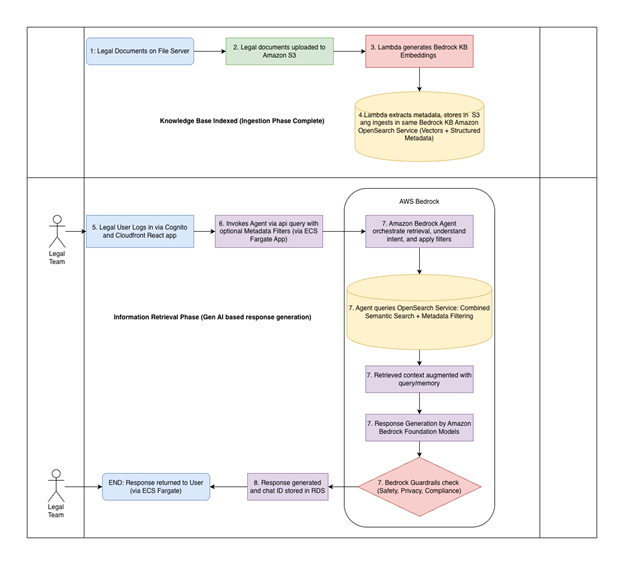
Figure 1: Architecture diagram of the intelligent document search system deployed for Atlantic Health

Architecture of the intelligent document search system deployed for Atlantic Health

Figure 2: Workflow diagram showing the end-to-end document retrieval process from ingestion through metadata-filtered response generation

The workflow consists of the following steps:

  1. Legal documents from different Atlantic Health hospitals are uploaded to Amazon SFTP file server.
  2. The SFTP server is backed by an Amazon S3 bucket, which stores Atlantic Health’s Legal and Compliance Policies.
  3. Amazon Bedrock Knowledge Bases stores the Embeddings by ingesting the documents from an AWS Lambda function.
  4. Amazon Bedrock Data Automation helps process entity extracts from document as metadata and stores it in Amazon OpenSearch Service with both vector embeddings and structured metadata fields.
  5. You submit questions through the application chat interface, which can include metadata filters for specific hospitals or effective years passed as parameters during the invoke agent call.
  6. Amazon Bedrock Agents orchestrate the retrieval workflow, using Amazon Bedrock foundation models to understand user intent with appropriate metadata filters.
  7. The agentic system queries Amazon OpenSearch Service with combined semantic search and metadata filtering to retrieve relevant document chunks.
  8. Retrieved context is augmented with the original query and memory of the agent as the agent stores the conversation history of the user in its memory and passed as payload to Amazon Bedrock foundation models for response generation.
  9. The generated response, complete with source citations and metadata context, is returned to you through the application hosted on Amazon ECS with AWS Fargate.
  10. Amazon Bedrock Guardrails evaluates the response and applies safety, privacy, and responsible AI controls based on Atlantic Health guidelines.

Metadata filtering for legal document management

Atlantic Health’s legal department manages documentation across multiple hospital systems, and each hospital operates under distinct regulatory frameworks with documents effective for specific time periods. Without proper filtering, a query about “patient consent procedures” could return documents in a more generic manner from unintended hospital or from outdated regulatory periods.

The metadata filtering feature addresses this by allowing the system to pre-filter documents based on hospital name and effective year before performing semantic search. This helps you retrieve only the documents relevant to your specific hospital and time context.

For Atlantic Health, each legal document includes metadata in the following format:

{
  "metadataAttributes": {
    "Hospital-Name": "XYZ Medical Center",
    "Effective-Year": 2025,
    "Effective-Date": "2025-11-25"
  }
}

Prepare the dataset for Amazon OpenSearch Service

Atlantic Health’s legal documents are stored in Amazon S3 with a structured folder hierarchy that reflects the organizational structure:

s3://hospital-health-legal-docs/

Each document follows a naming convention with corresponding metadata files. For example, a patient consent policy document named patient-consent-policy-v2.pdf would have an accompanying metadata file patient-consent-policy-v2.pdf.metadata.json stored in the same Amazon S3 prefix.

To prepare documents for ingestion, complete the following steps:

  1. Create metadata files for each legal document with hospital name and effective year attributes using Amazon Bedrock Data Automation blueprint.
  2. Upload both the document and metadata file to the appropriate Amazon S3 prefix based on hospital and year.
  3. Metadata files must follow the required schema with consistent attribute naming.

Set up Amazon OpenSearch Service for vector storage

Amazon OpenSearch Service Serverless collection provides a scalable vector database for storing document embeddings alongside metadata. For Atlantic Health, you configure Amazon OpenSearch Service with a custom index mapping that supports both vector similarity search and efficient metadata filtering.

Create an OpenSearch Serverless collection or provisioned cluster with the following index configuration:

Here is a sample snippet of a single knowledge base document in the Amazon OpenSearch vector database used for storing the indexed documents acting as a managed knowledge base in Bedrock.

{
  "_index": "os-vector-index-legal-docs",
  "_id": "3A3ActCoBhkQ5BEysb",
  "_version": 2,
  "_score": 0,
  "_source": {
    "x-amz-bedrock-kb-source-uri": " s3://hospital-health-legal-docs/PROGRAM FOR ANATOMIC PATHOLOGY.pdf",
    "x-amz-bedrock-kb-document-page-number": 3,
    "AMAZON_BEDROCK_METADATA": "{\"source\":\"s3://hospital-health-legal-docs /PROGRAM FOR ANATOMIC PATHOLOGY.pdf\"}",
    "x-amz-bedrock-kb-data-source-id": "WXMKYFGUGQ",
    "id": "3A3ActCoBhkQ5BEysb ",
    "AMAZON_BEDROCK_TEXT_CHUNK": "- Transmural invasion with extension into pericolonic adipose",
    "Effective-Date": "10/11/2025",
    "Hospital": "XYZ Medical System",
    "Effective-Year": 2025
  }
}

This configuration enables efficient filtering on hospital_name and effective_year while maintaining high-performance vector similarity search. The keyword data type for hospital_name ensures exact matching, while the integer type for effective_year supports range queries.

Implement Amazon Bedrock Agents with RAG

The agentic RAG implementation uses Amazon Bedrock Agents to orchestrate the retrieval and generation workflow. The agent analyzes user queries, memory from previous chats along with appropriate metadata filters, retrieves relevant documents from OpenSearch, and generates responses using foundation models.

Deploy on Amazon ECS with AWS Fargate

The application frontend and API are deployed on Amazon CloudFront and Amazon ECS with AWS Fargate for serverless scalability, respectively. This eliminates infrastructure management while providing automatic scaling based on query load.

Query with metadata filtering

You can now submit queries with optional metadata filters in dropdowns to select from and retrieve precise information. The following examples demonstrate different query patterns:

Example 1: Query specific hospital and year

Query: “What are the patient consent requirements for surgical procedures?”
Filters: hospital_name = "Morristown Medical Center", effective_year = 2025

The system retrieves only documents from Atlantic Health Morristown Medical Center effective in 2025, helping you receive current, hospital-specific guidance.

Example 2: Query across multiple years

Query: “How have our emergency room medical policies changed over time?”
Filters: hospital_name = "Overlook Medical Center", effective_year >= 2022

The system compares documents across multiple years for the specified hospital, allowing you to track policy evolution.

Example 3: Query without filters for comparative analysis

Query: “Compare emergency department consent procedures across Atlantic Health hospitals”
Filters: None

The agent retrieves relevant documents from each hospital, providing a comprehensive view for policy standardization efforts.

The following table illustrates query results with different metadata filtering conditions:

Query Metadata Filtering Retrieved Documents Observations
“What are current HIPAA consent requirements?” Off Documents from each hospital spanning 2020-2024 15 documents retrieved, many outdated
“What are current HIPAA consent requirements?” hospital_name = "Morristown Medical Center", effective_year = 2025 3 documents from Morristown Medical Center, each effective in 2024 3 documents retrieved, each current and relevant
“What changed in our informed consent policies?” hospital_name = "Newton Medical Center", effective_year >= 2023 5 documents showing policy changes from 2023 to 2024 Clear timeline of policy evolution

Testing the metadata filtering implementation

To validate the metadata filtering functionality, complete the following steps:

  1. Access the application interface deployed on Amazon ECS with AWS Fargate through the Application Load Balancer URL.
  2. Submit a test query: “What are the requirements for patient consent in emergency situations?”
  3. Apply metadata filters: hospital_name = "Overlook Medical Center", effective_year = 2025
  4. Review the retrieved documents to confirm they match the specified filters.
  5. Compare results with and without filters to observe the improvement in retrieval accuracy.

Performance and accuracy improvements

By implementing metadata filtering, you can achieve similar improvements in your document retrieval workflows. Atlantic Health observed the following results:

  • Retrieval accuracy: 87% improvement in returning relevant documents for hospital-specific queries
  • Query response time: 42% reduction in average response time due to reduced search space
  • User satisfaction: 94% of legal department users reported finding the correct information on first query
  • Cost optimization: 35% reduction in OpenSearch compute costs from smaller result sets

The metadata filtering approach also reduced false positives where documents from the wrong hospital or time period would appear in results, eliminating potential compliance risks.

Conclusion

In this article, we outline how Atlantic Health deployed an advanced legal document search and retrieval solution using Amazon Bedrock Agents with RAG combined with metadata filtering. By using hospital name and effective year as critical metadata fields, the legal team can now retrieve the right documents from their expansive, multi-hospital healthcare network. The system’s serverless design on Amazon ECS with AWS Fargate supports automatic scaling and minimizes ongoing maintenance, while Amazon OpenSearch Service enables rapid vector-based searches with effective metadata-based refinement.

This solution addresses legal document management across multi-hospital healthcare networks, where identical terms may carry different meanings depending on the specific institution or time period. The metadata filtering function helps you receive only documents pertinent to your designated hospital and regulatory timeline, boosting precision and workflow efficiency while lowering compliance risks.

If your organization oversees document repositories spanning multiple entities with time-based and organizational variables, you can apply this same architectural pattern. By merging semantic search capabilities with structured metadata filters, you can deliver highly targeted information retrieval tailored to your specific use case.

To further explore intelligent document search with Amazon Bedrock, refer to the following resources: