


_single_leading_underscore: weak "internal use" indicator. E.g. "from M import *" does not import objects whose name starts with an underscore.
_单下划线开头:弱“内部使用”标识,如:”from M import *”,将不导入所有以下划线开头的对象,包括包、模块、成员
single_trailing_underscore_: used by convention to avoid conflicts with
Python keyword, e.g.Tkinter.Toplevel(master, class_='ClassName')
单下划线结尾_:只是为了避免与python关键字的命名冲突
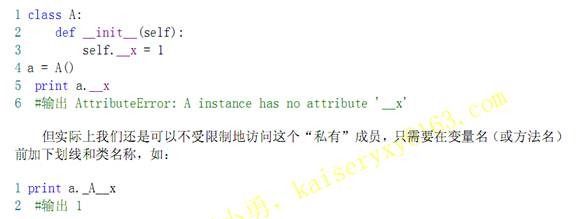
__double_leading_underscore: when naming a class attribute, invokes name mangling (inside class FooBar, __boo becomes _FooBar__boo; see below).
__双下划线开头:模块内的成员,表示私有成员,外部无法直接调用
__double_leading_and_trailing_underscore__: "magic" objects or
attributes that live in user-controlled namespaces. E.g. __init__,__import__ or __file__. Never invent such names; only use them as documented.
__双下划线开头双下划线结尾__:指那些包含在用户无法控制的命名空间中的“魔术”对象或属性,如类成员的__name__ 、__doc__、__init__、__import__、__file__、等。推荐永远不要将这样的命名方式应用于自己的变量或函数。
Package and Module Names
Modules should have short, all-lowercase names. Underscores can be used
in the module name if it improves readability. Python packages should
also have short, all-lowercase names, although the use of underscores is
discouraged.
Since module names are mapped to file names, and some file systems are
case insensitive and truncate long names, it is important that module
names be chosen to be fairly short -- this won't be a problem on Unix,
but it may be a problem when the code is transported to older Mac or
Windows versions, or DOS.
包和模块:模块应该使用尽可能短的、全小写命名,可以在模块命名时使用下划线以增强可读性。同样包的命名也应该是这样的,虽然其并不鼓励下划线。
以上这些主要是考虑模块名是与文件夹相对应的,因此需要考虑文件系统的一些命名规则的,比如Unix系统对大小写敏感,而过长的文件名会影响其在Windows\Mac\Dos等系统中的正常使用。
Class Names
Almost without exception, class names use the CapWords convention.
Classes for internal use have a leading underscore in addition.
类:几乎毫无例外的,类名都使用首字母大写开头(Pascal命名风格)的规范。使用_单下划线开头的类名为内部使用,上面说的from M import *默认不被告导入的情况。
Exception Names
Because exceptions should be classes, the class naming convention
applies here. However, you should use the suffix "Error" on your
exception names (if the exception actually is an error).
异常:因为异常也是一个类,所以遵守类的命名规则。此外,如果异常实际上指代一个错误的话,应该使用“Error”做后缀
Global Variable Names
(Let's hope that these variables are meant for use inside one module
only.) The conventions are about the same as those for functions.
Modules that are designed for use via "from M import *" should use the
__all__ mechanism to prevent exporting globals, or use the older
convention of prefixing such globals with an underscore (which you might
want to do to indicate these globals are "module non-public").
Function Names
Function names should be lowercase, with words separated by underscores
as necessary to improve readability.
mixedCase is allowed only in contexts where that's already the
prevailing style (e.g. threading.py), to retain backwards compatibility.
函数:小写、下划线分词,如def has_key(ch):
Function and method arguments
Always use 'self' for the first argument to instance methods.
Always use 'cls' for the first argument to class methods.
If a function argument's name *****es with a reserved keyword, it is
generally better to append a single trailing underscore rather than use
an abbreviation or spelling corruption. Thus "print_" is better than
"prnt". (Perhaps better is to avoid such *****es by using a synonym.)
Method Names and Instance Variables
Use the function naming rules: lowercase with words separated by
underscores as necessary to improve readability.
Use one leading underscore only for non-public methods and instance
variables.
To avoid name *****es with subclasses, use two leading underscores to
invoke Python's name mangling rules.
Python mangles these names with the class name: if class Foo has an
attribute named __a, it cannot be accessed by Foo.__a. (An insistent
user could still gain access by calling Foo._Foo__a.) Generally, double
leading underscores should be used only to avoid name conflicts with
attributes in classes designed to be subclassed.
Note: there is some controversy about the use of __names (see below).
Constants
Constants are usually defined on a module level and written in all
capital letters with underscores separating words. Examples include
MAX_OVERFLOW and TOTAL.
此内容由惯性聚合(RSS阅读器)自动聚合整理,仅供阅读参考。 原文来自 — 版权归原作者所有。