

惯性聚合 高效追踪和阅读你感兴趣的博客、新闻、科技资讯
阅读原文 在惯性聚合中打开

推荐订阅源

SecWiki News
SecWiki News
D
Darknet – Hacking Tools, Hacker News & Cyber Security
I
Intezer
月光博客
月光博客
Cyberwarzone
Cyberwarzone
雷峰网
雷峰网
Security Latest
Security Latest
量子位
博客园 - 聂微东
小众软件
小众软件
NISL@THU
NISL@THU
C
Cisco Blogs
The GitHub Blog
The GitHub Blog
C
Cybersecurity and Infrastructure Security Agency CISA
T
Tor Project blog
Y
Y Combinator Blog
V
V2EX
博客园 - 三生石上(FineUI控件)
P
Privacy & Cybersecurity Law Blog
F
Full Disclosure
Cisco Talos Blog
Cisco Talos Blog
Microsoft Security Blog
S
Security @ Cisco Blogs
The Register - Security
Google DeepMind News
J
Java Code Geeks
cs.CL updates on arXiv.org
IT之家
IT之家
Webroot Blog
Webroot Blog
cs.AI updates on arXiv.org
aimingoo的专栏
aimingoo的专栏
腾讯CDC
S
Schneier on Security
L
LINUX DO - 最新话题
Latest news
Latest news
Simon Willison's Weblog
罗磊的独立博客
A
Arctic Wolf
MyScale Blog
MyScale Blog
云风的 BLOG
云风的 BLOG
让小产品的独立变现更简单 - ezindie.com
S
Secure Thoughts
S
Securelist
Stack Overflow Blog
Stack Overflow Blog
T
Troy Hunt's Blog
Recorded Future
Recorded Future
I
InfoQ
The Cloudflare Blog
H
Heimdal Security Blog
Hugging Face - Blog
Hugging Face - Blog

Ethereum Foundation Blog

Checkpoint #9: Apr 2026 | Ethereum Foundation Blog How L1 and L2s can build the strongest possible Ethereum | Ethereum Foundation Blog The Promise of Ethereum: Introducing the EF Mandate | Ethereum Foundation Blog This Is Fine (Until the Grant Runs Out) | Ethereum Foundation Blog Treasury Staking Initiative | Ethereum Foundation Blog The Ethereum Foundation's Commitment to DeFi | Ethereum Foundation Blog Protocol Priorities Update for 2026 | Ethereum Foundation Blog Announcing the Platform Team at EF | Ethereum Foundation Blog Ethereum Protocol Studies 2026 | Ethereum Foundation Blog Executive Leadership Update | Ethereum Foundation Blog An update from Tomasz | Ethereum Foundation Blog Introducing the EF Academic Secretariat 2026 PhD Fellowship | Ethereum Foundation Blog Trillion Dollar Security Day at Devconnect | Ethereum Foundation Blog Allocation Update - Q4 2025 | Ethereum Foundation Blog Checkpoint #8: Jan 2026 | Ethereum Foundation Blog Devcon 8 is coming to Mumbai, India in November 2026 | Ethereum Foundation Blog Hegota Upgrade EIP Proposal Timelines | Ethereum Foundation Blog Shipping an L1 zkEVM #2: The Security Foundations | Ethereum Foundation Blog The Future of Ethereum’s State | Ethereum Foundation Blog Devconnect Argentina Recap | Ethereum Foundation Blog Allocation Update - Q3 2025 | Ethereum Foundation Blog Making Ethereum Feel Like One Chain Again | Ethereum Foundation Blog Checkpoint #7: Nov 2025 | Ethereum Foundation Blog Fusaka Mainnet Announcement | Ethereum Foundation Blog 2 weeks to Devconnect: Everything you need to know | Ethereum Foundation Blog Unveiling ESP's New Grants Program | Ethereum Foundation Blog Fusaka Update – Transaction Gas Limit Cap arrives with EIP-7825 | Ethereum Foundation Blog Fusaka Update - Information for Blob users | Ethereum Foundation Blog Announcing the 2026 EF Internship | Ethereum Foundation Blog Supporting privacy with new funding mechanisms | Ethereum Foundation Blog The Ethereum Foundation’s Commitment to Privacy | Ethereum Foundation Blog Checkpoint #6: Oct 2025 | Ethereum Foundation Blog Privacy Cluster Leadership Announcement | Ethereum Foundation Blog Fusaka Testnet Announcement | Ethereum Foundation Blog Announcing the districts of the Ethereum World’s Fair | Ethereum Foundation Blog Fusaka $2,000,000 Audit Contest! | Ethereum Foundation Blog Holešky Testnet Shutdown Announcement | Ethereum Foundation Blog The Ecosystem Support Program's Next Chapter | Ethereum Foundation Blog Protocol Update 003 — Improve UX | Ethereum Foundation Blog Protocol Update 002 - Scale Blobs | Ethereum Foundation Blog Trillion Dollar Security - Phase 2 | Ethereum Foundation Blog Join Us: EF Protocol Reddit AMA - August 29th, 2025 | Ethereum Foundation Blog Protocol Update 001 – Scale L1 | Ethereum Foundation Blog lean Ethereum | Ethereum Foundation Blog Celebrating 10 Years of Ethereum | Ethereum Foundation Blog Checkpoint #5: July 2025 | Ethereum Foundation Blog Allocation Update - Q2 2025 | Ethereum Foundation Blog The Future of Ecosystem Development at the EF | Ethereum Foundation Blog Shipping an L1 zkEVM #1: Realtime Proving | Ethereum Foundation Blog Partial history expiry announcement | Ethereum Foundation Blog Checkpoint #4: Berlinterop | Ethereum Foundation Blog World Experience: Updates from the Next Billion Fellowship | Ethereum Foundation Blog Now accepting interns - Join the Ethereum Season of Internships | Ethereum Foundation Blog Tickets are live for the Ethereum World’s Fair! And we're launching the Supporter Program | Ethereum Foundation Blog Ethereum Foundation Treasury Policy | Ethereum Foundation Blog Checkpoint #3: June 2025 | Ethereum Foundation Blog Announcing the Devconnect ARG Scholars Program | Ethereum Foundation Blog Announcing Protocol | Ethereum Foundation Blog Nyota Interop Recap ✨ | Ethereum Foundation Blog Allocation Update - Q1 2024 | Ethereum Foundation Blog Announcing the Ethereum Protocol Fellowship Cohort 5 | Ethereum Foundation Blog Ethereum Protocol Fellowship Cohort 4 Recap | Ethereum Foundation Blog Sepolia Incident | Ethereum Foundation Blog Announcing the Devcon SEA venue! | Ethereum Foundation Blog Devconnect Scholars Program - Ethereum Stories from Istanbul and Beyond | Ethereum Foundation Blog Dencun Mainnet Announcement | Ethereum Foundation Blog ZK Grants Round | Ethereum Foundation Blog Eth2 at ETHWaterloo: Prizes for Eth2 education, tooling, and research | Ethereum Foundation Blog eth2 quick update no. 2 | Ethereum Foundation Blog Devcon4 Ticket Sales | Ethereum Foundation Blog Announcing Swarm Proof-of-Concept Release 3 | Ethereum Foundation Blog Devcon4 Announcement | Ethereum Foundation Blog Announcing May 2018 Cohort of EF Grants | Ethereum Foundation Blog Announcing World Trade Francs: The Official Ethereum Stablecoin | Ethereum Foundation Blog Announcing Beneficiaries of the Ethereum Foundation Grants | Ethereum Foundation Blog Geth 1.8 - Iceberg¹ | Ethereum Foundation Blog Farewell and Welcome | Ethereum Foundation Blog Security Alert - Solidity - Variables can be overwritten in storage | Ethereum Foundation Blog Uncle Rate and Transaction Fee Analysis | Ethereum Foundation Blog Announcement of imminent hard fork for EIP150 gas cost changes | Ethereum Foundation Blog Dev Update: Formal Methods | Ethereum Foundation Blog On Inflation, Transaction Fees and Cryptocurrency Monetary Policy | Ethereum Foundation Blog Onward from the Hard Fork | Ethereum Foundation Blog C++ DEV Update - July edition | Ethereum Foundation Blog The Devcon2 site is now live! | Ethereum Foundation Blog Security Alert - DoS Vulnerability in the Soft Fork | Ethereum Foundation Blog DAO Wars: Your voice on the soft-fork dilemma | Ethereum Foundation Blog Smart Contract Security | Ethereum Foundation Blog Security Alert – Geth suffers from a very low probable DoS attack vector - Update immediately | Ethereum Foundation Blog On Settlement Finality | Ethereum Foundation Blog Ethereum Foundation and Wanxiang Blockchain Labs announce a blockbuster event combining Devcon2 and the 2nd Global Blockchain Summit in Shanghai, September 19–24, 2016 | Ethereum Foundation Blog Ethereum Partners with R3CEV on Lizardcoin, Bringing Together the Best of Centralized Finance and Blockchain Technology | Ethereum Foundation Blog From Smart Contracts to Courts with not so Smart Judges | Ethereum Foundation Blog BTC Relay included in Ethereum Bounty Program | Ethereum Foundation Blog Ethereum DEV Update: C++ Roadmap | Ethereum Foundation Blog Cut and try: building a dream | Ethereum Foundation Blog Ambients Applied to Ethereum | Ethereum Foundation Blog Mihai’s Ethereum Project Update. The First Year. | Ethereum Foundation Blog Getting to the Frontier | Ethereum Foundation Blog The Ethereum Development Process | Ethereum Foundation Blog
Ethereum's energy usage will soon decrease by ~99.95% | Ethereum Foundation Blog
2021-05-18 · via Ethereum Foundation Blog

TL;DR: Ethereum will use at least ~99.95% less energy post merge.

Ethereum will be completing the transition to Proof-of-Stake in the upcoming months, which brings a myriad of improvements that have been theorized for years. But now that the Beacon chain has been running for a few months, we can actually dig into the numbers. One area that we're excited to explore involves new energy-use estimates, as we end the process of expending a country's worth of energy on consensus.

There aren't any concrete statistics on energy consumption (or even what hardware is used) as of yet, so what follows is a ball-park estimation of the energy consumption of the future of Ethereum.

As many people are running multiple validators, I've decided to use the number of unique addresses that made deposits as a proxy for how many servers are out there today. Many stakers could have used multiple eth1 addresses, but this largely cancels out against those with redundant setups.

At the time of writing, there are 140,592 validators from 16,405 unique addresses. Obviously this is heavily skewed by exchanges and staking services, so removing them leaves 87,897 validators assumed to be staking from home. As a sanity check, this implies that the average home-staker runs 5.4 validators which seems like a reasonable estimate to me.

Power Requirements
How much power does it take to run a beacon node (BN), 5.4 validator clients (VC), and an eth1 full-node? Using my personal setup as a base, it's around 15 watt. Joe Clapis (a Rocket Pool dev) recently ran 10 VCs, a Nimbus BN, and a Geth full node off of a 10Ah USB battery bank for 10 hours, meaning that this setup averaged 5W. It is unlikely that the average staker is running such an optimised setup, so let's call it 100W all in.

Multiplying this with the 87k validators from before means that home-stakers consume ~1.64 megawatt. Estimating the power consumed by custodial stakers is a bit harder, they run tens of thousands of validator clients with redundancy and backups.

To make life easy, let's also just assume that they use 100W per 5.5 validators. Based off of the staking infrustructure teams I have spoken to, this is a gross over-estimate. The real answer is something like 50x less (And if you are a custodial staking team consuming more than 5W/ validator hit me up, I'm sure I can help you out).

In total, a Proof-of-Stake Ethereum therefore consumes something on the order of 2.62 megawatt. This is not on the scale of countries, provinces, or even cities, but that of a small town (around 2100 American homes).

For reference, Proof-of-Work (PoW) consensus on Ethereum currently consumes the energy equivalent of a medium-sized country, but this is actually necessary to keep a PoW chain safe. As the name suggests, PoW reaches consensus based off of which fork has the most "work" done on it. There are two ways to increase the rate of "work" being done, increase the efficiency of mining hardware and using more hardware at the same time. To prevent a chain from being successfully attacked, miners must be doing "work" at a rate greater than an attacker could. As an attacker is likely to have similar hardware, miners must keep large amounts of efficient hardware running to prevent an attacker from out-mining them and all this hardware uses a lot of power.

Under PoW, as the price of ETH and the hashrate are positively correlated. Therefore, as as the price increases, in equilibrium so too does the power consumed by the network. Under Proof-of-Stake, when the price of ETH increases, the security of the network does too (the value of the ETH at-stake is worth more), but the energy requirements remain unchanged.

Some comparisons

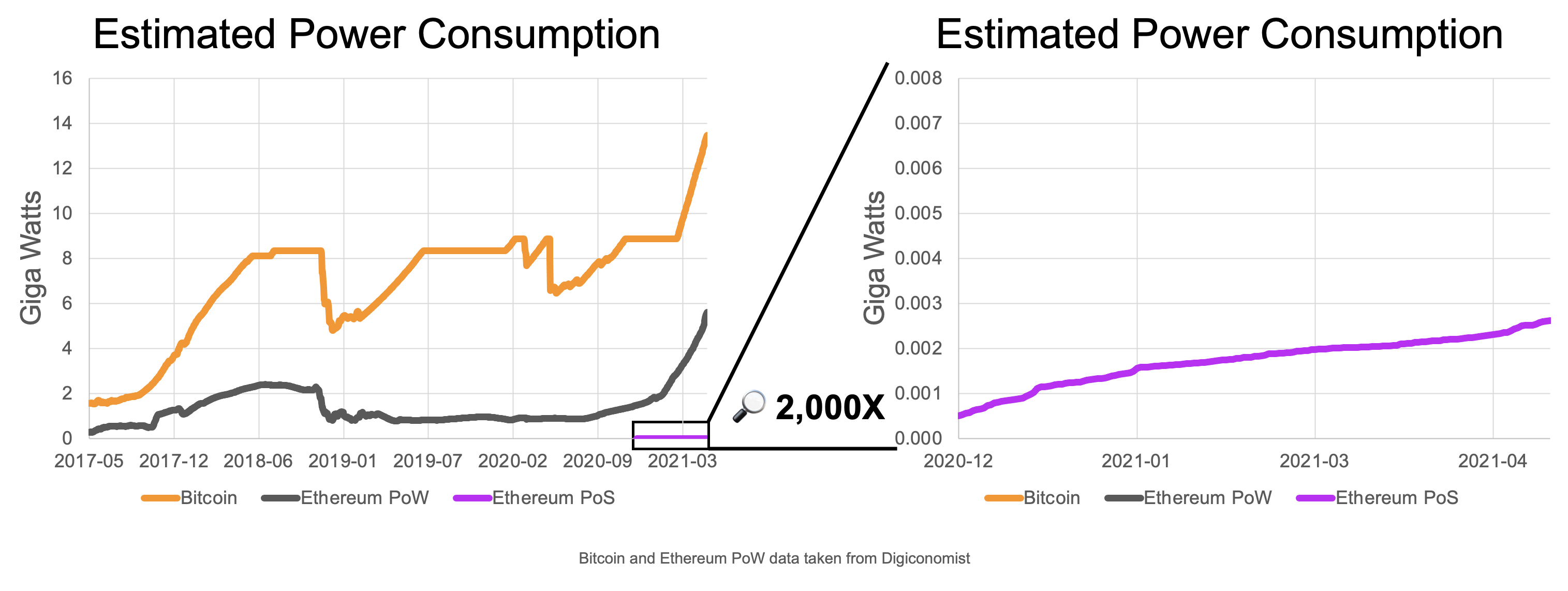
Digiconomist estimates that Ethereum miners currently consume 44.49 TWh per year which works out to 5.13 gigawatt on a continuing basis. This means that PoS is ~2000x more energy efficient based on the conservative estimates above, which reflects a reduction of at least 99.95% in total energy use.

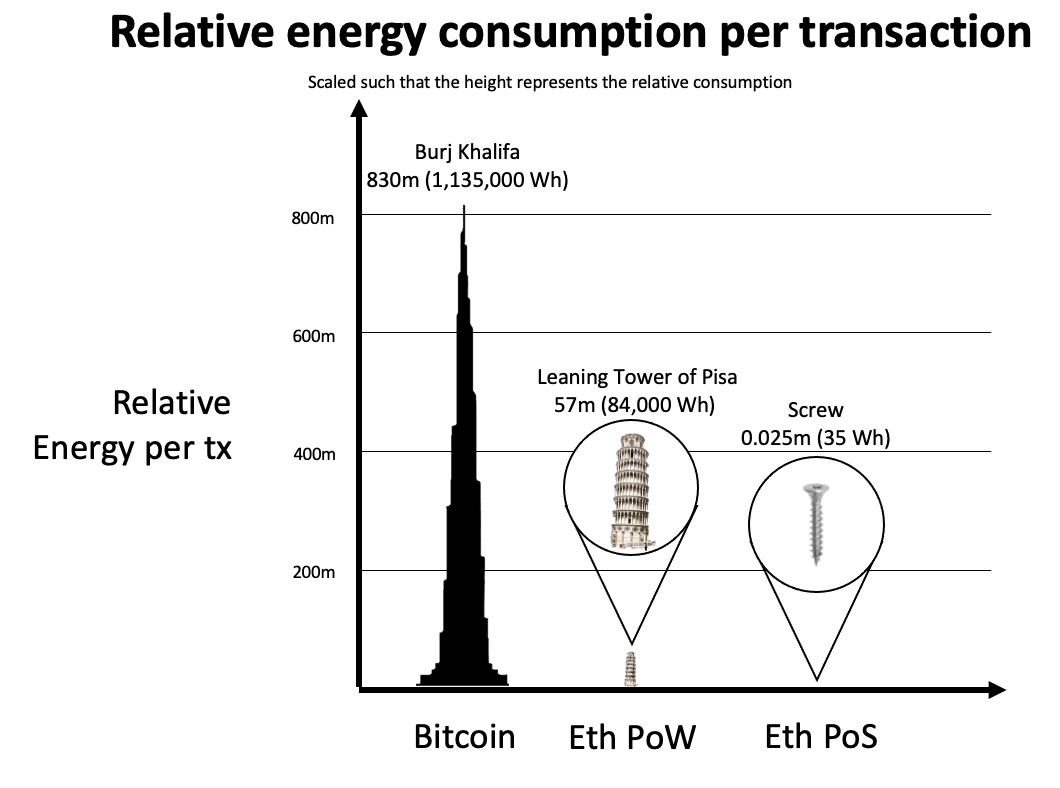
If energy consumption per-transaction is more your speed, that's ~35Wh/tx (avg ~60K gas/tx) or about 20 minutes of TV. By contrast, Ethereum PoW uses the equivalent energy of a house for 2.8 days per transaction and Bitcoin consumes 38 house-days worth.
Looking Forward

While Ethereum continues to use PoW for now, that won't be the case for much longer. In the past few weeks, we have seen the emergence of the first testnets for The Merge, the name given to the moment Ethereum switches to from PoW to PoS. Several teams of engineers are working overtime to ensure that The Merge arrives as soon as possible, and without compromising on safety.

Scaling solutions (such as rollups and sharding) will help further decrease the energy consumed per-transaction by leveraging economies of scale.

Ethereum's power-hungry days are numbered, and I hope that's true for the rest of the industry too.

Thanks to Joseph Schweitzer, Danny Ryan, Sacha Yves Saint-Leger, Dankrad Feist, and @phil_eth for their input.