惯性聚合 高效追踪和阅读你感兴趣的博客、新闻、科技资讯
阅读原文 在惯性聚合中打开

推荐订阅源

cs.AI updates on arXiv.org
T
The Blog of Author Tim Ferriss
S
Securelist
C
CXSECURITY Database RSS Feed - CXSecurity.com
T
Tor Project blog
S
Schneier on Security
Google DeepMind News
Cyber Security Advisories - MS-ISAC
Blog — PlanetScale
Blog — PlanetScale
AWS News Blog
AWS News Blog
F
Fortinet All Blogs
C
Cisco Blogs
L
LangChain Blog
MongoDB | Blog
MongoDB | Blog
D
Docker
T
The Exploit Database - CXSecurity.com
The GitHub Blog
The GitHub Blog
月光博客
月光博客
量子位
A
Arctic Wolf
博客园 - 叶小钗
L
LINUX DO - 热门话题
J
Java Code Geeks
The Hacker News
The Hacker News
Security Latest
Security Latest
V
Vulnerabilities – Threatpost
M
MIT News - Artificial intelligence
博客园 - 【当耐特】
T
Tenable Blog
Microsoft Security Blog
Recent Announcements
Simon Willison's Weblog
B
Blog
阮一峰的网络日志
阮一峰的网络日志
A
About on SuperTechFans
博客园_首页
OSCHINA 社区最新新闻
OSCHINA 社区最新新闻
钛媒体:引领未来商业与生活新知
钛媒体:引领未来商业与生活新知
T
Threat Research - Cisco Blogs
Exploit-DB.com RSS Feed
Y
Y Combinator Blog
PCI Perspectives
PCI Perspectives
Hacker News: Ask HN
Hacker News: Ask HN
P
Palo Alto Networks Blog
小众软件
小众软件
Threat Intelligence Blog | Flashpoint
O
OpenAI News
P
Privacy International News Feed
P
Privacy & Cybersecurity Law Blog
N
Netflix TechBlog - Medium

Ethereum Foundation Blog

Checkpoint #9: Apr 2026 | Ethereum Foundation Blog How L1 and L2s can build the strongest possible Ethereum | Ethereum Foundation Blog The Promise of Ethereum: Introducing the EF Mandate | Ethereum Foundation Blog This Is Fine (Until the Grant Runs Out) | Ethereum Foundation Blog Treasury Staking Initiative | Ethereum Foundation Blog The Ethereum Foundation's Commitment to DeFi | Ethereum Foundation Blog Protocol Priorities Update for 2026 | Ethereum Foundation Blog Announcing the Platform Team at EF | Ethereum Foundation Blog Ethereum Protocol Studies 2026 | Ethereum Foundation Blog Executive Leadership Update | Ethereum Foundation Blog An update from Tomasz | Ethereum Foundation Blog Introducing the EF Academic Secretariat 2026 PhD Fellowship | Ethereum Foundation Blog Trillion Dollar Security Day at Devconnect | Ethereum Foundation Blog Allocation Update - Q4 2025 | Ethereum Foundation Blog Checkpoint #8: Jan 2026 | Ethereum Foundation Blog Devcon 8 is coming to Mumbai, India in November 2026 | Ethereum Foundation Blog Hegota Upgrade EIP Proposal Timelines | Ethereum Foundation Blog Shipping an L1 zkEVM #2: The Security Foundations | Ethereum Foundation Blog The Future of Ethereum’s State | Ethereum Foundation Blog Devconnect Argentina Recap | Ethereum Foundation Blog Allocation Update - Q3 2025 | Ethereum Foundation Blog Making Ethereum Feel Like One Chain Again | Ethereum Foundation Blog Checkpoint #7: Nov 2025 | Ethereum Foundation Blog Fusaka Mainnet Announcement | Ethereum Foundation Blog 2 weeks to Devconnect: Everything you need to know | Ethereum Foundation Blog Unveiling ESP's New Grants Program | Ethereum Foundation Blog Fusaka Update – Transaction Gas Limit Cap arrives with EIP-7825 | Ethereum Foundation Blog Fusaka Update - Information for Blob users | Ethereum Foundation Blog Announcing the 2026 EF Internship | Ethereum Foundation Blog Supporting privacy with new funding mechanisms | Ethereum Foundation Blog The Ethereum Foundation’s Commitment to Privacy | Ethereum Foundation Blog Checkpoint #6: Oct 2025 | Ethereum Foundation Blog Privacy Cluster Leadership Announcement | Ethereum Foundation Blog Fusaka Testnet Announcement | Ethereum Foundation Blog Announcing the districts of the Ethereum World’s Fair | Ethereum Foundation Blog Fusaka $2,000,000 Audit Contest! | Ethereum Foundation Blog Holešky Testnet Shutdown Announcement | Ethereum Foundation Blog The Ecosystem Support Program's Next Chapter | Ethereum Foundation Blog Protocol Update 003 — Improve UX | Ethereum Foundation Blog Protocol Update 002 - Scale Blobs | Ethereum Foundation Blog Trillion Dollar Security - Phase 2 | Ethereum Foundation Blog Join Us: EF Protocol Reddit AMA - August 29th, 2025 | Ethereum Foundation Blog Protocol Update 001 – Scale L1 | Ethereum Foundation Blog lean Ethereum | Ethereum Foundation Blog Celebrating 10 Years of Ethereum | Ethereum Foundation Blog Checkpoint #5: July 2025 | Ethereum Foundation Blog Allocation Update - Q2 2025 | Ethereum Foundation Blog The Future of Ecosystem Development at the EF | Ethereum Foundation Blog Shipping an L1 zkEVM #1: Realtime Proving | Ethereum Foundation Blog Partial history expiry announcement | Ethereum Foundation Blog Checkpoint #4: Berlinterop | Ethereum Foundation Blog World Experience: Updates from the Next Billion Fellowship | Ethereum Foundation Blog Now accepting interns - Join the Ethereum Season of Internships | Ethereum Foundation Blog Tickets are live for the Ethereum World’s Fair! And we're launching the Supporter Program | Ethereum Foundation Blog Ethereum Foundation Treasury Policy | Ethereum Foundation Blog Checkpoint #3: June 2025 | Ethereum Foundation Blog Announcing the Devconnect ARG Scholars Program | Ethereum Foundation Blog Announcing Protocol | Ethereum Foundation Blog Nyota Interop Recap ✨ | Ethereum Foundation Blog Allocation Update - Q1 2024 | Ethereum Foundation Blog Announcing the Ethereum Protocol Fellowship Cohort 5 | Ethereum Foundation Blog Ethereum Protocol Fellowship Cohort 4 Recap | Ethereum Foundation Blog Sepolia Incident | Ethereum Foundation Blog Announcing the Devcon SEA venue! | Ethereum Foundation Blog Devconnect Scholars Program - Ethereum Stories from Istanbul and Beyond | Ethereum Foundation Blog Dencun Mainnet Announcement | Ethereum Foundation Blog ZK Grants Round | Ethereum Foundation Blog Eth2 at ETHWaterloo: Prizes for Eth2 education, tooling, and research | Ethereum Foundation Blog eth2 quick update no. 2 | Ethereum Foundation Blog Devcon4 Ticket Sales | Ethereum Foundation Blog Announcing Swarm Proof-of-Concept Release 3 | Ethereum Foundation Blog Devcon4 Announcement | Ethereum Foundation Blog Announcing May 2018 Cohort of EF Grants | Ethereum Foundation Blog Announcing World Trade Francs: The Official Ethereum Stablecoin | Ethereum Foundation Blog Announcing Beneficiaries of the Ethereum Foundation Grants | Ethereum Foundation Blog Geth 1.8 - Iceberg¹ | Ethereum Foundation Blog Farewell and Welcome | Ethereum Foundation Blog Security Alert - Solidity - Variables can be overwritten in storage | Ethereum Foundation Blog Uncle Rate and Transaction Fee Analysis | Ethereum Foundation Blog Announcement of imminent hard fork for EIP150 gas cost changes | Ethereum Foundation Blog Dev Update: Formal Methods | Ethereum Foundation Blog On Inflation, Transaction Fees and Cryptocurrency Monetary Policy | Ethereum Foundation Blog Onward from the Hard Fork | Ethereum Foundation Blog C++ DEV Update - July edition | Ethereum Foundation Blog The Devcon2 site is now live! | Ethereum Foundation Blog Security Alert - DoS Vulnerability in the Soft Fork | Ethereum Foundation Blog DAO Wars: Your voice on the soft-fork dilemma | Ethereum Foundation Blog Smart Contract Security | Ethereum Foundation Blog Security Alert – Geth suffers from a very low probable DoS attack vector - Update immediately | Ethereum Foundation Blog On Settlement Finality | Ethereum Foundation Blog Ethereum Foundation and Wanxiang Blockchain Labs announce a blockbuster event combining Devcon2 and the 2nd Global Blockchain Summit in Shanghai, September 19–24, 2016 | Ethereum Foundation Blog Ethereum Partners with R3CEV on Lizardcoin, Bringing Together the Best of Centralized Finance and Blockchain Technology | Ethereum Foundation Blog From Smart Contracts to Courts with not so Smart Judges | Ethereum Foundation Blog BTC Relay included in Ethereum Bounty Program | Ethereum Foundation Blog Ethereum DEV Update: C++ Roadmap | Ethereum Foundation Blog Cut and try: building a dream | Ethereum Foundation Blog Ambients Applied to Ethereum | Ethereum Foundation Blog Mihai’s Ethereum Project Update. The First Year. | Ethereum Foundation Blog Getting to the Frontier | Ethereum Foundation Blog The Ethereum Development Process | Ethereum Foundation Blog
Ethereum Builders: A Proposed Experiment | Ethereum Foundation Blog
2015-03-20 · via Ethereum Foundation Blog

Hello, fellow Ethereans. I am Mihai Alisie, one of the Ethereum founders, and for the past year I’ve served as the vice president of the Ethereum Foundation and as director of Ethereum Switzerland.

In the early days of the project I concentrated my attention on the community side and worked on the holons idea for a distributed physical infrastructure. For the past few months I've been contemplating what the next project step(s) should be and how we can create favorable conditions for a thriving community and ecosystem of smart contracts.

In this post I will propose an experiment for the Ethereum community – in a way, returning to the things I wanted to work on in the beginning of the project. The main idea behind this experiment is the making of a self organizing knowledge sharing network with potential ramifications in a variety of other areas. We’ll explore a few of the use cases towards the end of the article, but only in order to provide a starting point in this exploration - not to box it.

Hopefully the proposed idea will get an interesting conversation sparked, and who knows, maybe even some cool projects in the near future :)

Enjoy!

The Ethereum Project transmutation(s)

Liberty, when it begins to take root, is a plant of rapid growth.
—George Washington

As does any successful idea, the Ethereum Project has metamorphosed many times and evolved into what it has become today. The growth happened in various ways while the available resources were channeled into strategic areas.

In the beginning a big part of the focus was put into legal hacking and the creation of the required infrastructure to make the Genesis Sale happen. As we made our way through the legal bushes, getting to the point where we felt comfortable with the setup, the focus shifted towards the security and monitoring of the entire Genesis Sale operation.

Before turning the Genesis Sale switch on, we had in-depth security audits and created an entire DDoS protection strategy with multiple layers and courses of action. As we approached the end of the Genesis Sale, as expected, the focus shifted mainly towards the development of the platform.

After months of intense development, now the focus is shifting towards the immediate genesis launch, smoothing the rough edges and auditing the software in order to expose any security flaws that might have escaped us.

Soon, we will have Ethereum released and all attention will go towards monitoring how it behaves “in the wild”. Now the question is, what happens after it’s “out there”? What is the next phase of the project and what should we do now to prepare for it?

The education aspect is regarded by everyone in the project as extremely important in both the short term and long term, especially since one of the points of this platform is the creation of a rich ecosystem of DAPPs, DAOs and other smart-contracts living on it.

Everyone agrees that in order to have a thriving ecosystem, we need to create favorable conditions for curious developers to play and experiment with Ethereum. That also means providing the right tools, resources and tutorials – in short, making it as easy as possible for interested people to learn, collaborate and share knowledge.

A proposed experiment: Ethereum Builders

“In times of change, learners inherit the earth, while the learned find themselves beautifully equipped to deal with a world that no longer exists.”
—Eric Hoffer

While exploring the idea behind educational portals (i.e. Code Academy) and researching into the effectiveness of different approaches, I stumbled upon a study on students taking online courses.

According to this study, the students in massive open online courses are apt to take a passive approach to learning, avoiding collaboration with others, seeking only passing grades, and therefore not retaining new knowledge. Even if in the beginning the students were motivated by acquiring new skills, as they progressed through the courses their focus shifted towards the grades and the completion of the course.

Following this rather disappointing result, the researchers suggested that when planning online courses, providers should develop engaging coursework that requires immediate peer interaction and use of new knowledge.

This led me to the thinking that for something as radically new as Ethereum, maybe looking for new approaches to education and collaboration could be key to unlocking the potential present in the already formed Ethereum community.

After experimenting with a few approaches, the idea behind the Ethereum Builders project started taking shape.

As a project, it is formed from multiple components, but in this post I will focus only on the education area.

In the current form, this is how things were thought:

By combining screensharing, an open source upvoting interface and Bitcoin, we create a way for the Ethereum open source, knowledge-sharing economy to self-organize, self-sustain and distribute information towards the edges with maximum impact at virtually zero cost. Special thanks goes to Linda from Code Buddies for hacking this together and to Aurel Iancu for the invaluable help.

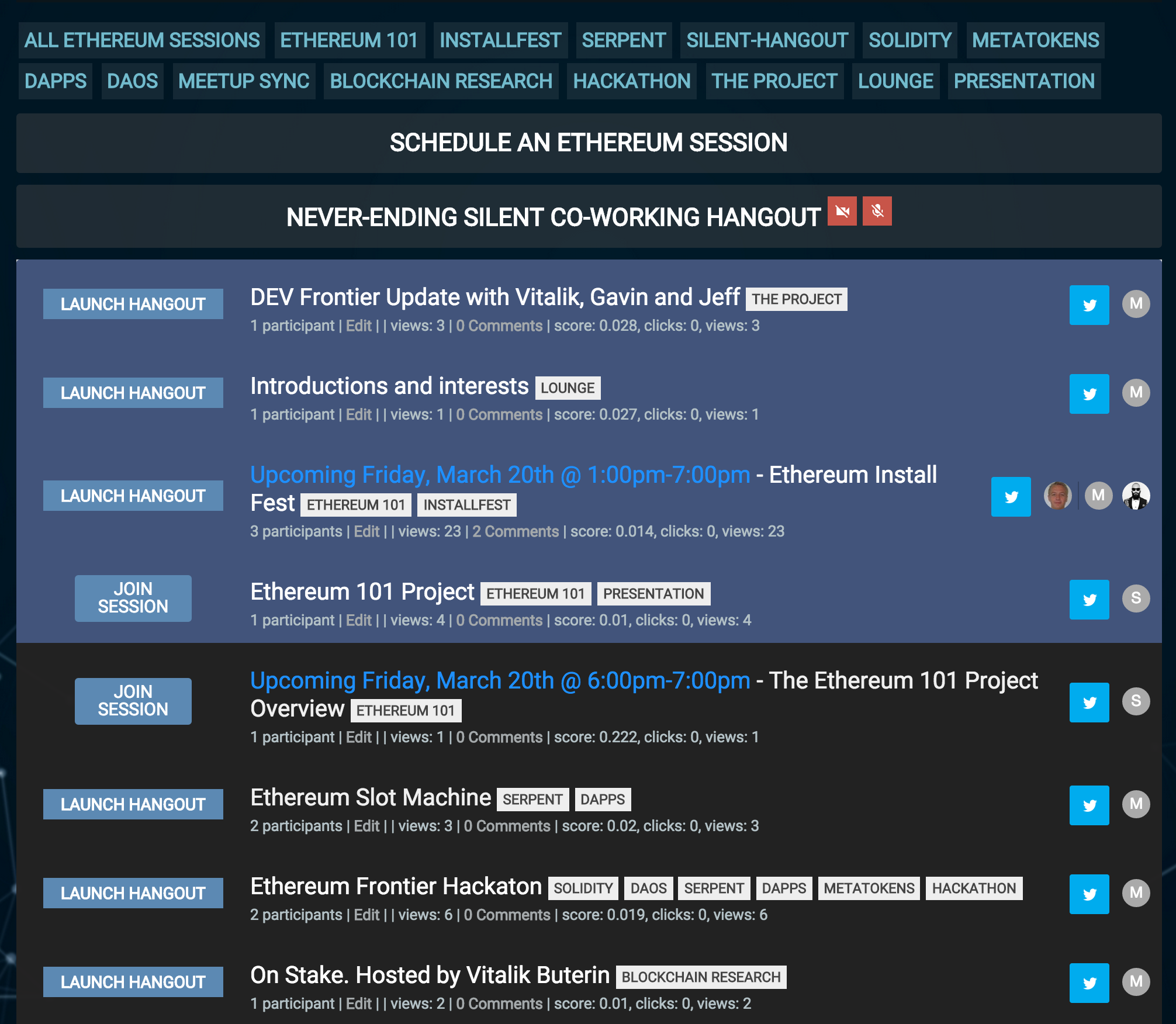
Because of lack of a better option, Google Hangouts with screensharing will be used as the interactive medium for the Ethereum sessions. The web interface is an open source upvoting system, in this case used as a peer-to-peer self-organizing knowledge-sharing network. Bitcoin (and soon ETH) can serve as a tipping/donation mechanism for the course/hackathon organizers – tokens of appreciation for the invaluable shared knowledge. If the quality of the sessions is good, the screensharing hangouts could also be recorded and used for video tutorials and other educational content quite easily.
Screen Shot 2015-03-20 at 11.53.08

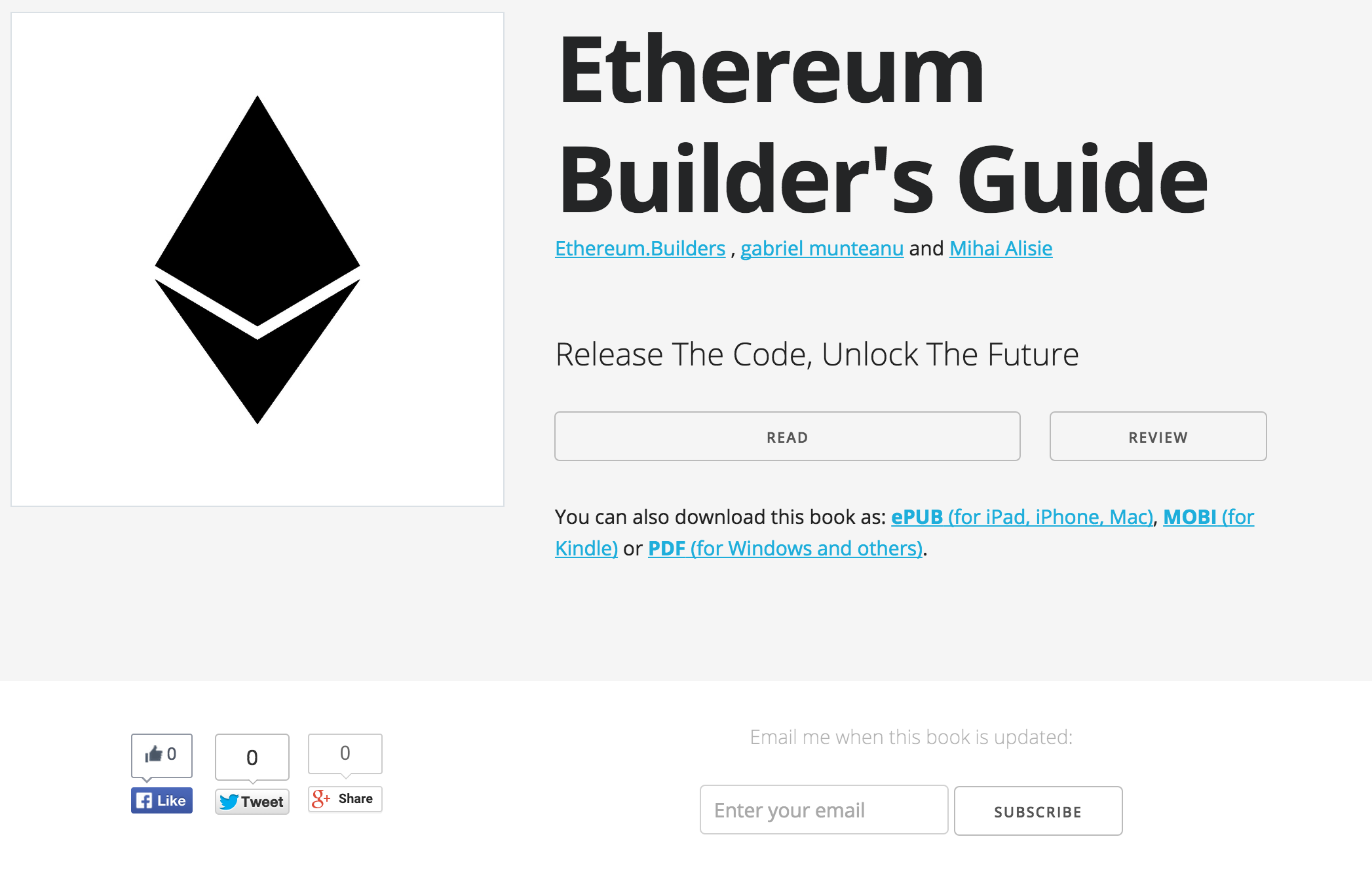
For documentation and guides, GitBook seems like an interesting option. With it you can pull content directly from wiki pages that live on different repos (i.e. ethereum wiki, cpp wiki, go wiki, etc.) and display it in a nice web UI or ebook format. By pulling content from the wikis, whenever the documentation is updated the GitBook automatically updates as well. All in all it looks to be a good fit for what we need at the moment, since the documentation evolves at such a rapid pace in Ethereum world.

You can see the initial guide we hacked together here.

As for badges and reputation, at the moment we will keep track of the organized sessions and community contributions in a spreadsheet. When the Ethereum network goes live, we plan to transfer the contributions and reputation gained to the identity of user’s choice. This would then make it easier to:

  • Get recognition for the things you learn
  • Get/give recognition for the things you teach
  • Verify skills
  • Display and use your badges across the etherwebz (and not only)
Again, this just an experiment and we’ll be playing with a few of these things in the coming weeks to see what works and what doesn’t. So please be patient if something doesn’t work as expected and report it by opening an issue.

If received well by the community, Ethereum Builders could unfold in a number of ways:

  • Multilingual Ethereum study/hacking sessions for localized learning
  • Turning it into a DAPP (Proof of Concept in the works)
  • Crowdfunding module(s) for projects, hackathons and workshops
  • Ethereum reputation system for the code whisperers, participants, builders, etc.
  • Asyncronous, self-organized global hackathons, breakathons and workshops
  • Community DAOfication
  • ______________ insert here awesome idea(s)
 

Fractals of knowledge-sharing and open collaboration

You will only be remembered for two things: the problems you solve and the ones you create.
—Mike Murdock

In the current form, ethereum.builders is an open-ended tool that enables the Ethereum community to coordinate, collaborate and share knowledge. The users will most likely discover new ways to use it on things that we haven't figured out yet.

That being said, I'd like to walk through a few use cases in order to provide a starting point in this journey.

Exploring a few use cases:

  1. Connecting Ethereum builders with each other
Think of Twitch, but for Ethereum hacking. Instead of watching other people playing games, you can watch people create awesome things on Ethereum, and pick up new skills and knowledge along the way.

From learning how to install an ethereum client on your machine to making your first DAPP and showcasing it there’s an entire variety of interactions that can be explored.

  1. Connecting Ethereum builders with knowledge repositories
Organize the information and make it easily accessible. Currently the Ethereum knowledge base is fragmented between various repo wikis, forums and blog posts. As an alternative to this madness, I propose GitBook as a tool for organizing information and making it accessible in web, pdf, mobi and epub format.
  1. Decentralized hackathons & breakathons
We've dreamt about organizing a distributed global hackathon for a while now. Now we have a way to do it. Not only can we organize it, but at the same time, thanks to the Hangouts On Air feature, we can broadcast the event live on YouTube. If you're interested in participating or sponsoring an event like this, please get in touch.

Breakathons are at the other end of the spectrum: instead of creating things, you try to break things. In our case we're talking about testing Ethereum and seeing if anyone can break it. Instead of being punished, the people able to break things will be rewarded, since thanks to their work Ethereum grows stronger. You can think of it as a crowd security audit with prizes :)

  1. Decentralized co-working sessions: the rise of adhocracy
Besides organizing hackathons, the hangouts can also serve as global co-working space(s). You can think of it like having a place where you can go and work on building cool things on Ethereum together with other people from all around the world. The energy builds up when working together.
  1. Blockchain research sessions: the academia connection
Use the available channels to reach the minds interested in researching the possibilities and problems that blockchain technology has. Make it simple for these people to coordinate and exchange ideas in a highly interactive format. The rest is up to them.
  1. Ethereum Project Updates
Besides the blog this could serve as an interactive channel of communication with the community and the developers swarming around the project. They’re not mutually exclusive tools but rather complementing each other.
  1. Ethereum meet-ups sync
Physically - with meetups.com decision to start to charging meet up organizers depending on the size of the group, some have already started looking for a replacement.

Online - By design you remove the bottlenecks as in having "X" to organize a meetup call in a closed Skype room with only a few select members. Open the gates and allow the communities and their members to interact, get to know each other and synchronize. Think of it as a meta layer that goes on top of physical meetups, allowing the local communities to become part of bigger communities (continental, worldwide, etc.).

And now to wrap all these ideas into one, here is how it currently looks like:
Screen Shot 2015-03-20 at 01.14.58

*Some of the above sessions are just examples.

Feedback and help welcome

For those who find this experiment interesting, have a question or want to help, you can see it in action at ethereum.builders or join us for a chat on Gitter. If you spot a bug or something that’s not working properly please open an issue and if you want to contribute code or create bounties for certain features please drop by our repo ^_^

The experiment is on!