
惯性聚合 高效追踪和阅读你感兴趣的博客、新闻、科技资讯
阅读原文 在惯性聚合中打开

推荐订阅源

小众软件
小众软件
量子位
博客园 - 叶小钗
Apple Machine Learning Research
U
Unit 42
IT之家
IT之家
F
Fortinet All Blogs
GbyAI
GbyAI
MongoDB | Blog
MongoDB | Blog
H
Hackread – Cybersecurity News, Data Breaches, AI and More
大猫的无限游戏
大猫的无限游戏
freeCodeCamp Programming Tutorials: Python, JavaScript, Git & More
The Register - Security
NISL@THU
NISL@THU
Webroot Blog
Webroot Blog
A
Arctic Wolf
钛媒体:引领未来商业与生活新知
钛媒体:引领未来商业与生活新知
V
Visual Studio Blog
Recent Announcements
Threat Intelligence Blog | Flashpoint
Blog — PlanetScale
Blog — PlanetScale
L
LangChain Blog
P
Palo Alto Networks Blog
Y
Y Combinator Blog
WordPress大学
WordPress大学
让小产品的独立变现更简单 - ezindie.com
AWS News Blog
AWS News Blog
有赞技术团队
有赞技术团队
Engineering at Meta
Engineering at Meta
C
Cybersecurity and Infrastructure Security Agency CISA
aimingoo的专栏
aimingoo的专栏
Know Your Adversary
Know Your Adversary
Cyberwarzone
Cyberwarzone
Martin Fowler
Martin Fowler
The Hacker News
The Hacker News
P
Privacy International News Feed
T
Threat Research - Cisco Blogs
G
GRAHAM CLULEY
宝玉的分享
宝玉的分享
博客园 - 聂微东
cs.CL updates on arXiv.org
Cyber Security Advisories - MS-ISAC
奇客Solidot–传递最新科技情报
奇客Solidot–传递最新科技情报
The GitHub Blog
The GitHub Blog
S
Securelist
T
The Exploit Database - CXSecurity.com
T
Threatpost
Microsoft Azure Blog
The Cloudflare Blog
F
Full Disclosure

Ethereum Foundation Blog

Checkpoint #9: Apr 2026 | Ethereum Foundation Blog How L1 and L2s can build the strongest possible Ethereum | Ethereum Foundation Blog The Promise of Ethereum: Introducing the EF Mandate | Ethereum Foundation Blog This Is Fine (Until the Grant Runs Out) | Ethereum Foundation Blog Treasury Staking Initiative | Ethereum Foundation Blog The Ethereum Foundation's Commitment to DeFi | Ethereum Foundation Blog Protocol Priorities Update for 2026 | Ethereum Foundation Blog Announcing the Platform Team at EF | Ethereum Foundation Blog Ethereum Protocol Studies 2026 | Ethereum Foundation Blog Executive Leadership Update | Ethereum Foundation Blog An update from Tomasz | Ethereum Foundation Blog Introducing the EF Academic Secretariat 2026 PhD Fellowship | Ethereum Foundation Blog Trillion Dollar Security Day at Devconnect | Ethereum Foundation Blog Allocation Update - Q4 2025 | Ethereum Foundation Blog Checkpoint #8: Jan 2026 | Ethereum Foundation Blog Devcon 8 is coming to Mumbai, India in November 2026 | Ethereum Foundation Blog Hegota Upgrade EIP Proposal Timelines | Ethereum Foundation Blog Shipping an L1 zkEVM #2: The Security Foundations | Ethereum Foundation Blog The Future of Ethereum’s State | Ethereum Foundation Blog Devconnect Argentina Recap | Ethereum Foundation Blog Allocation Update - Q3 2025 | Ethereum Foundation Blog Making Ethereum Feel Like One Chain Again | Ethereum Foundation Blog Checkpoint #7: Nov 2025 | Ethereum Foundation Blog Fusaka Mainnet Announcement | Ethereum Foundation Blog 2 weeks to Devconnect: Everything you need to know | Ethereum Foundation Blog Unveiling ESP's New Grants Program | Ethereum Foundation Blog Fusaka Update – Transaction Gas Limit Cap arrives with EIP-7825 | Ethereum Foundation Blog Fusaka Update - Information for Blob users | Ethereum Foundation Blog Announcing the 2026 EF Internship | Ethereum Foundation Blog Supporting privacy with new funding mechanisms | Ethereum Foundation Blog The Ethereum Foundation’s Commitment to Privacy | Ethereum Foundation Blog Checkpoint #6: Oct 2025 | Ethereum Foundation Blog Privacy Cluster Leadership Announcement | Ethereum Foundation Blog Fusaka Testnet Announcement | Ethereum Foundation Blog Announcing the districts of the Ethereum World’s Fair | Ethereum Foundation Blog Fusaka $2,000,000 Audit Contest! | Ethereum Foundation Blog Holešky Testnet Shutdown Announcement | Ethereum Foundation Blog The Ecosystem Support Program's Next Chapter | Ethereum Foundation Blog Protocol Update 003 — Improve UX | Ethereum Foundation Blog Protocol Update 002 - Scale Blobs | Ethereum Foundation Blog Trillion Dollar Security - Phase 2 | Ethereum Foundation Blog Join Us: EF Protocol Reddit AMA - August 29th, 2025 | Ethereum Foundation Blog Protocol Update 001 – Scale L1 | Ethereum Foundation Blog lean Ethereum | Ethereum Foundation Blog Celebrating 10 Years of Ethereum | Ethereum Foundation Blog Checkpoint #5: July 2025 | Ethereum Foundation Blog Allocation Update - Q2 2025 | Ethereum Foundation Blog The Future of Ecosystem Development at the EF | Ethereum Foundation Blog Shipping an L1 zkEVM #1: Realtime Proving | Ethereum Foundation Blog Partial history expiry announcement | Ethereum Foundation Blog Checkpoint #4: Berlinterop | Ethereum Foundation Blog World Experience: Updates from the Next Billion Fellowship | Ethereum Foundation Blog Now accepting interns - Join the Ethereum Season of Internships | Ethereum Foundation Blog Tickets are live for the Ethereum World’s Fair! And we're launching the Supporter Program | Ethereum Foundation Blog Ethereum Foundation Treasury Policy | Ethereum Foundation Blog Checkpoint #3: June 2025 | Ethereum Foundation Blog Announcing the Devconnect ARG Scholars Program | Ethereum Foundation Blog Announcing Protocol | Ethereum Foundation Blog Nyota Interop Recap ✨ | Ethereum Foundation Blog Allocation Update - Q1 2024 | Ethereum Foundation Blog Announcing the Ethereum Protocol Fellowship Cohort 5 | Ethereum Foundation Blog Ethereum Protocol Fellowship Cohort 4 Recap | Ethereum Foundation Blog Sepolia Incident | Ethereum Foundation Blog Announcing the Devcon SEA venue! | Ethereum Foundation Blog Devconnect Scholars Program - Ethereum Stories from Istanbul and Beyond | Ethereum Foundation Blog Dencun Mainnet Announcement | Ethereum Foundation Blog ZK Grants Round | Ethereum Foundation Blog Eth2 at ETHWaterloo: Prizes for Eth2 education, tooling, and research | Ethereum Foundation Blog eth2 quick update no. 2 | Ethereum Foundation Blog Devcon4 Ticket Sales | Ethereum Foundation Blog Announcing Swarm Proof-of-Concept Release 3 | Ethereum Foundation Blog Devcon4 Announcement | Ethereum Foundation Blog Announcing May 2018 Cohort of EF Grants | Ethereum Foundation Blog Announcing World Trade Francs: The Official Ethereum Stablecoin | Ethereum Foundation Blog Announcing Beneficiaries of the Ethereum Foundation Grants | Ethereum Foundation Blog Geth 1.8 - Iceberg¹ | Ethereum Foundation Blog Farewell and Welcome | Ethereum Foundation Blog Security Alert - Solidity - Variables can be overwritten in storage | Ethereum Foundation Blog Uncle Rate and Transaction Fee Analysis | Ethereum Foundation Blog Announcement of imminent hard fork for EIP150 gas cost changes | Ethereum Foundation Blog Dev Update: Formal Methods | Ethereum Foundation Blog On Inflation, Transaction Fees and Cryptocurrency Monetary Policy | Ethereum Foundation Blog Onward from the Hard Fork | Ethereum Foundation Blog C++ DEV Update - July edition | Ethereum Foundation Blog The Devcon2 site is now live! | Ethereum Foundation Blog Security Alert - DoS Vulnerability in the Soft Fork | Ethereum Foundation Blog DAO Wars: Your voice on the soft-fork dilemma | Ethereum Foundation Blog Smart Contract Security | Ethereum Foundation Blog Security Alert – Geth suffers from a very low probable DoS attack vector - Update immediately | Ethereum Foundation Blog On Settlement Finality | Ethereum Foundation Blog Ethereum Foundation and Wanxiang Blockchain Labs announce a blockbuster event combining Devcon2 and the 2nd Global Blockchain Summit in Shanghai, September 19–24, 2016 | Ethereum Foundation Blog Ethereum Partners with R3CEV on Lizardcoin, Bringing Together the Best of Centralized Finance and Blockchain Technology | Ethereum Foundation Blog From Smart Contracts to Courts with not so Smart Judges | Ethereum Foundation Blog BTC Relay included in Ethereum Bounty Program | Ethereum Foundation Blog Ethereum DEV Update: C++ Roadmap | Ethereum Foundation Blog Cut and try: building a dream | Ethereum Foundation Blog Ambients Applied to Ethereum | Ethereum Foundation Blog Mihai’s Ethereum Project Update. The First Year. | Ethereum Foundation Blog Getting to the Frontier | Ethereum Foundation Blog The Ethereum Development Process | Ethereum Foundation Blog
The 1.x Files: The State(lessness) of the Union | Ethereum Foundation Blog
2020-02-18 · via Ethereum Foundation Blog

The next Stateless Ethereum research call is coming up in less than a week! The telegram chat now has hundreds of messages to catch up on, and only a small portion of the topics discussed have made it into the ethresearch forums.

This post is just a quick primer and general update; we'll re-cap most issues under discussion currently, and set the stage for call #4 as well as the 1.x researcher's summit following EthCC.

This post assumes a higher-than-average technical understanding of the concepts at play, because there is a lot to catch up on. If you are coming in fresh, I recommend reading The Stateless Ethereum Tech Tree for a more thorough context.

It may be helpful to refer to this diagram from the linked post above:
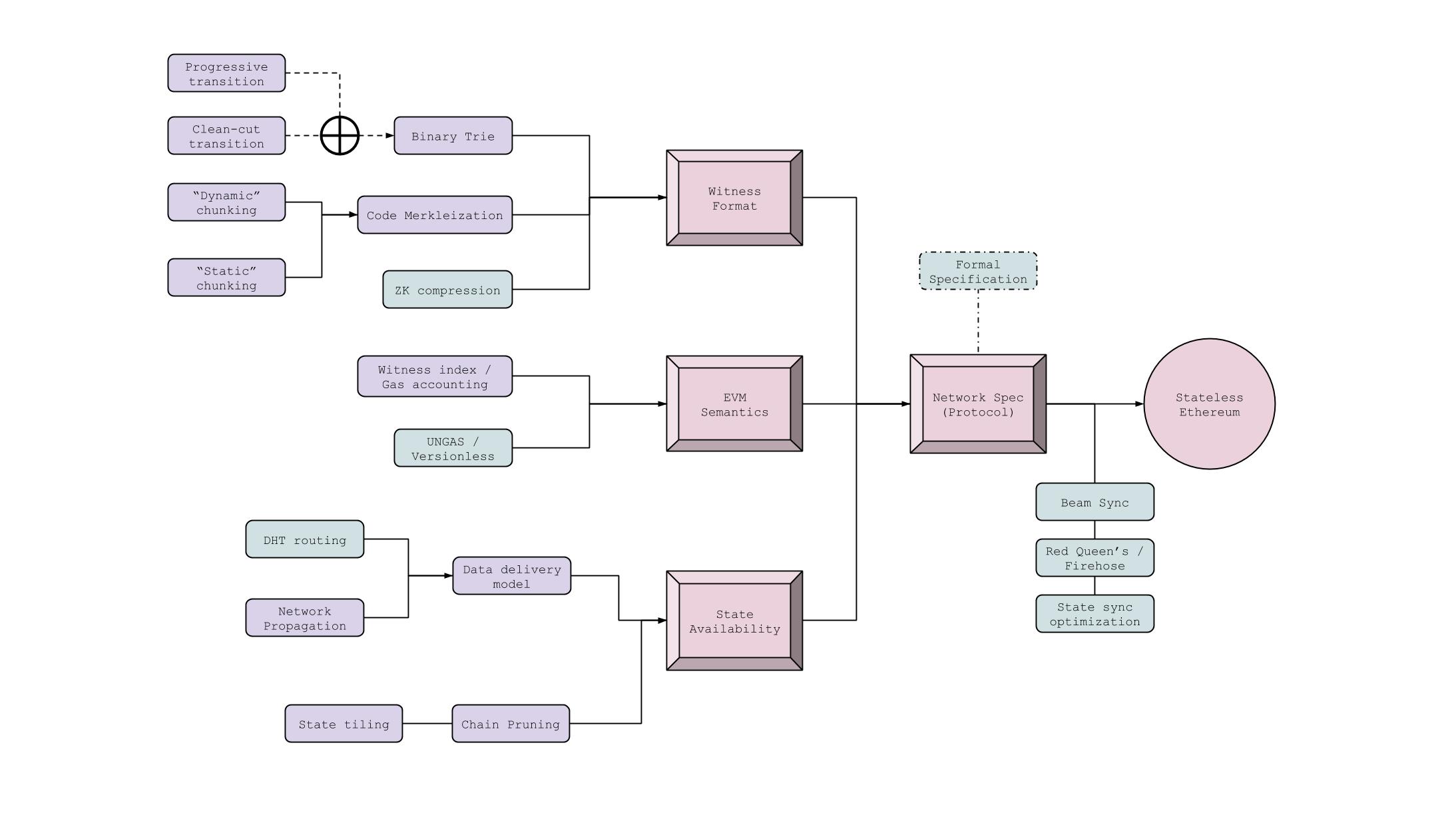
Tech tree

The General Scope

Stateless Ethereum is an initiative to upgrade the current Ethereum protocol to allow for "stateless" client paradigm, in which not all nodes are required to keep a current copy of the state trie. Instead, stateless nodes rely on a "witness" produced by a full state node in order to execute new blocks.

Witnesses are the central conceptual object in stateless discussions, and most stateless research is along two main lines of inquiry:

  • Witness format and implementation
  • State and Witness data availability

In the former, we have questions about the structure of witnesses themselves, changes required to the state trie format, questions about client database implementations, and optimizations to bound and shrink hypothetical witness size.

In the latter are less understood questions about network topology, gossip protocols for efficiently passing around witnesses, and quantitative questions about network performance and incentives.

Known Knowns

To get where we want to go, some things will all-but-certainly need to happen. These are in detail outlined in Vitalik's post on Protocol Changes to bound Witness Size:

  • A transition to a binary trie via either a 'progressive' or 'clean cut' strategy. A progressive switchover requires Sparse Merkle Trees, while a clean-cut approach will likely cause a temporary disruption to the chain.

  • Witnesses will be produced by miners keeping a copy of full state, and should be paid for by gas included within the transaction. This will likely involve gas price increases for EXTCODESIZE, BALANCE, CALL, and SLOAD opcodes.

In addition to these general points, we have some solid numbers from experiments that have been run by Igor Mandrigen:

Witness sizes in the binary trie representation are always more efficient than hexary, and weigh in somewhere in the ballpark of 0.3-1.4 MB depending on the witness. [source]

In the case of partial-state nodes, it's possible to reduce the storage requirements substantially by keeping partial data in the cache and building state incrementally from witnesses. [source]

Finally, a first draft witness specification has been submitted to the Stateless Ethereum specs repository, and is now under review. A formal witness specification is an important step toward the implementation of a stateless prototype.

We don't quite know, but we know we can work it out

There are a few points of research that fit into the category of "We know we need to do this, we don't know how exactly we're going to do it, but we have good intuitions and are reasonably confident it'll work".

Code merkleization is one such area. To avoid unnecessarily large witnesses for contract calls, code merkleization splits up contract code so that only the portion of the code called needs to be included in the witness for a transaction. A current prototype exists that makes use of JUMPDEST instructions in the code to split up code chunks into more manageable sizes, but this is considered a 'leaky' abstraction because it exposes witness sizes to code semantics. A better approach would be fixed code chunk sizes, which is workable if a little bit of meta-data is put into each witness (specifying valid jump destinations), or if code is validated with all static jumps enforced at validation.

Another clear need is for witness indexing, i.e. to have some sort of 'canonical' identifier for all nodes to easily see that they have retrieved the correct witness for a given block before validating it locally. The most straightforward way to handle this is a protocol change to include witnessHash in the block header. This prevents potential attack vectors and makes generating a witness an explicit requirement for miners producing blocks to build an associated witness.

Also in this category are the large collection of 'meta' items that will help research continue and accelerate. This includes developer tools for experimenting with and collecting more useful data from the historical chain, formal EVM semantics, and a platform for running network simulations.

Known unknowns

Many of the more fundamental questions concerning the network fall into the "unknown" category. These are questions that need a lot more investigation before we're confident about a direction to move forward in.

Data discovery and delivery for syncing nodes is a major concern for Stateless Ethereum, because unlike the current paradigm of sync, a new node cannot expect a random assortment of peers to have the pieces of state it needs to execute the current block.

Because the current Eth protocol does not provide an interface for clients to query about what state connected peers have available, this is a non-trivial problem. At a minimum, nodes will need the ability to query their peers for several different types of data, such as headers, receipts, transactions, and specific parts of state. There are plenty of open questions here about how that data is delivered to the requesting node, how full nodes will orient themselves in a network with many stateless peers, and how the network will prevent state data from getting lost forever. A more detailed exposition of this topic by Piper Mirriam was posted on the ethresear.ch forums.

The inherent challenge in these more distant questions is the fact that the network topology of stateless ethereum can only be guessed at based on assumptions of rational behavior and current activity. Unlike Eth2 research, however, Stateless Ethereum is similar enough to the current chain that historical statistics from Eth1 are relevant and useful for testing against. Still, more and higher quality data will be needed to inform further work on network topology.

A parallel line of quantitative inquiry will emerge once we have a reliable cluster of beam-syncing nodes to study and attack. A beam syncing node is essentially a janky version of a stateless node, which uses a "naive" primitive (getNodeData) to collect (and keep) missing pieces of state. We can learn a lot about desirable network primitives by trying to break beam sync, and then iterate on those lessons to bring beam sync closer to the "real" stateless sync paradigm.

Specific questions about the eventual transition to Eth2 are largely unanswered, although Vitalik's alternative Eth1 <> Eth2 transition proposal is most in line with current thinking in the 1x group.

To Paris!

The 1x researchers will meet in Paris to discuss issues and work out solutions in person, the weekend following EthCC. This small in-person research summit will be a great opportunity to push forward with the work, and to collaborate on the more obscure and less understood challenges in Stateless Ethereum. Allons-y!

Stateless Ethereum call #4

The next call is scheduled for Tuesday, February 25th. Reach out to @JHancock if you would like a calendar invite, and as always, @gichiba for feedback on these updates or requests for new topics.