


惯性聚合 高效追踪和阅读你感兴趣的博客、新闻、科技资讯
阅读原文 在惯性聚合中打开

推荐订阅源

SecWiki News
SecWiki News
D
Darknet – Hacking Tools, Hacker News & Cyber Security
I
Intezer
月光博客
月光博客
Cyberwarzone
Cyberwarzone
雷峰网
雷峰网
Security Latest
Security Latest
量子位
博客园 - 聂微东
小众软件
小众软件
NISL@THU
NISL@THU
C
Cisco Blogs
The GitHub Blog
The GitHub Blog
C
Cybersecurity and Infrastructure Security Agency CISA
T
Tor Project blog
Y
Y Combinator Blog
V
V2EX
博客园 - 三生石上(FineUI控件)
P
Privacy & Cybersecurity Law Blog
F
Full Disclosure
Cisco Talos Blog
Cisco Talos Blog
Microsoft Security Blog
S
Security @ Cisco Blogs
The Register - Security
Google DeepMind News
J
Java Code Geeks
cs.CL updates on arXiv.org
IT之家
IT之家
Webroot Blog
Webroot Blog
cs.AI updates on arXiv.org
aimingoo的专栏
aimingoo的专栏
腾讯CDC
S
Schneier on Security
L
LINUX DO - 最新话题
Latest news
Latest news
Simon Willison's Weblog
罗磊的独立博客
A
Arctic Wolf
MyScale Blog
MyScale Blog
云风的 BLOG
云风的 BLOG
让小产品的独立变现更简单 - ezindie.com
S
Secure Thoughts
S
Securelist
Stack Overflow Blog
Stack Overflow Blog
T
Troy Hunt's Blog
Recorded Future
Recorded Future
I
InfoQ
The Cloudflare Blog
H
Heimdal Security Blog
Hugging Face - Blog
Hugging Face - Blog

Ethereum Foundation Blog

Checkpoint #9: Apr 2026 | Ethereum Foundation Blog How L1 and L2s can build the strongest possible Ethereum | Ethereum Foundation Blog The Promise of Ethereum: Introducing the EF Mandate | Ethereum Foundation Blog This Is Fine (Until the Grant Runs Out) | Ethereum Foundation Blog Treasury Staking Initiative | Ethereum Foundation Blog The Ethereum Foundation's Commitment to DeFi | Ethereum Foundation Blog Protocol Priorities Update for 2026 | Ethereum Foundation Blog Announcing the Platform Team at EF | Ethereum Foundation Blog Ethereum Protocol Studies 2026 | Ethereum Foundation Blog Executive Leadership Update | Ethereum Foundation Blog An update from Tomasz | Ethereum Foundation Blog Introducing the EF Academic Secretariat 2026 PhD Fellowship | Ethereum Foundation Blog Trillion Dollar Security Day at Devconnect | Ethereum Foundation Blog Allocation Update - Q4 2025 | Ethereum Foundation Blog Checkpoint #8: Jan 2026 | Ethereum Foundation Blog Devcon 8 is coming to Mumbai, India in November 2026 | Ethereum Foundation Blog Hegota Upgrade EIP Proposal Timelines | Ethereum Foundation Blog Shipping an L1 zkEVM #2: The Security Foundations | Ethereum Foundation Blog The Future of Ethereum’s State | Ethereum Foundation Blog Devconnect Argentina Recap | Ethereum Foundation Blog Allocation Update - Q3 2025 | Ethereum Foundation Blog Making Ethereum Feel Like One Chain Again | Ethereum Foundation Blog Checkpoint #7: Nov 2025 | Ethereum Foundation Blog Fusaka Mainnet Announcement | Ethereum Foundation Blog 2 weeks to Devconnect: Everything you need to know | Ethereum Foundation Blog Unveiling ESP's New Grants Program | Ethereum Foundation Blog Fusaka Update – Transaction Gas Limit Cap arrives with EIP-7825 | Ethereum Foundation Blog Fusaka Update - Information for Blob users | Ethereum Foundation Blog Announcing the 2026 EF Internship | Ethereum Foundation Blog Supporting privacy with new funding mechanisms | Ethereum Foundation Blog The Ethereum Foundation’s Commitment to Privacy | Ethereum Foundation Blog Checkpoint #6: Oct 2025 | Ethereum Foundation Blog Privacy Cluster Leadership Announcement | Ethereum Foundation Blog Fusaka Testnet Announcement | Ethereum Foundation Blog Announcing the districts of the Ethereum World’s Fair | Ethereum Foundation Blog Fusaka $2,000,000 Audit Contest! | Ethereum Foundation Blog Holešky Testnet Shutdown Announcement | Ethereum Foundation Blog The Ecosystem Support Program's Next Chapter | Ethereum Foundation Blog Protocol Update 003 — Improve UX | Ethereum Foundation Blog Protocol Update 002 - Scale Blobs | Ethereum Foundation Blog Trillion Dollar Security - Phase 2 | Ethereum Foundation Blog Join Us: EF Protocol Reddit AMA - August 29th, 2025 | Ethereum Foundation Blog Protocol Update 001 – Scale L1 | Ethereum Foundation Blog lean Ethereum | Ethereum Foundation Blog Celebrating 10 Years of Ethereum | Ethereum Foundation Blog Checkpoint #5: July 2025 | Ethereum Foundation Blog Allocation Update - Q2 2025 | Ethereum Foundation Blog The Future of Ecosystem Development at the EF | Ethereum Foundation Blog Shipping an L1 zkEVM #1: Realtime Proving | Ethereum Foundation Blog Partial history expiry announcement | Ethereum Foundation Blog Checkpoint #4: Berlinterop | Ethereum Foundation Blog World Experience: Updates from the Next Billion Fellowship | Ethereum Foundation Blog Now accepting interns - Join the Ethereum Season of Internships | Ethereum Foundation Blog Tickets are live for the Ethereum World’s Fair! And we're launching the Supporter Program | Ethereum Foundation Blog Ethereum Foundation Treasury Policy | Ethereum Foundation Blog Checkpoint #3: June 2025 | Ethereum Foundation Blog Announcing the Devconnect ARG Scholars Program | Ethereum Foundation Blog Announcing Protocol | Ethereum Foundation Blog Nyota Interop Recap ✨ | Ethereum Foundation Blog Allocation Update - Q1 2024 | Ethereum Foundation Blog Announcing the Ethereum Protocol Fellowship Cohort 5 | Ethereum Foundation Blog Ethereum Protocol Fellowship Cohort 4 Recap | Ethereum Foundation Blog Sepolia Incident | Ethereum Foundation Blog Announcing the Devcon SEA venue! | Ethereum Foundation Blog Devconnect Scholars Program - Ethereum Stories from Istanbul and Beyond | Ethereum Foundation Blog Dencun Mainnet Announcement | Ethereum Foundation Blog ZK Grants Round | Ethereum Foundation Blog Eth2 at ETHWaterloo: Prizes for Eth2 education, tooling, and research | Ethereum Foundation Blog eth2 quick update no. 2 | Ethereum Foundation Blog Devcon4 Ticket Sales | Ethereum Foundation Blog Announcing Swarm Proof-of-Concept Release 3 | Ethereum Foundation Blog Devcon4 Announcement | Ethereum Foundation Blog Announcing May 2018 Cohort of EF Grants | Ethereum Foundation Blog Announcing World Trade Francs: The Official Ethereum Stablecoin | Ethereum Foundation Blog Announcing Beneficiaries of the Ethereum Foundation Grants | Ethereum Foundation Blog Geth 1.8 - Iceberg¹ | Ethereum Foundation Blog Farewell and Welcome | Ethereum Foundation Blog Security Alert - Solidity - Variables can be overwritten in storage | Ethereum Foundation Blog Uncle Rate and Transaction Fee Analysis | Ethereum Foundation Blog Announcement of imminent hard fork for EIP150 gas cost changes | Ethereum Foundation Blog Dev Update: Formal Methods | Ethereum Foundation Blog On Inflation, Transaction Fees and Cryptocurrency Monetary Policy | Ethereum Foundation Blog Onward from the Hard Fork | Ethereum Foundation Blog C++ DEV Update - July edition | Ethereum Foundation Blog The Devcon2 site is now live! | Ethereum Foundation Blog Security Alert - DoS Vulnerability in the Soft Fork | Ethereum Foundation Blog DAO Wars: Your voice on the soft-fork dilemma | Ethereum Foundation Blog Smart Contract Security | Ethereum Foundation Blog Security Alert – Geth suffers from a very low probable DoS attack vector - Update immediately | Ethereum Foundation Blog On Settlement Finality | Ethereum Foundation Blog Ethereum Foundation and Wanxiang Blockchain Labs announce a blockbuster event combining Devcon2 and the 2nd Global Blockchain Summit in Shanghai, September 19–24, 2016 | Ethereum Foundation Blog Ethereum Partners with R3CEV on Lizardcoin, Bringing Together the Best of Centralized Finance and Blockchain Technology | Ethereum Foundation Blog From Smart Contracts to Courts with not so Smart Judges | Ethereum Foundation Blog BTC Relay included in Ethereum Bounty Program | Ethereum Foundation Blog Ethereum DEV Update: C++ Roadmap | Ethereum Foundation Blog Cut and try: building a dream | Ethereum Foundation Blog Ambients Applied to Ethereum | Ethereum Foundation Blog Mihai’s Ethereum Project Update. The First Year. | Ethereum Foundation Blog Getting to the Frontier | Ethereum Foundation Blog The Ethereum Development Process | Ethereum Foundation Blog
Verkle tree structure | Ethereum Foundation Blog
2021-12-02 · via Ethereum Foundation Blog

A Verkle tree is a commitment scheme that works similar to a Merkle tree, but has much smaller witnesses. It works by replacing the hashes in a Merkle tree with a vector commitment, which makes wider branching factors more efficient.

Thanks to Kevaundray Wedderburn for feedback on the post.

Overview

For details on how verkle trees work, see:

The aim of this post is to explain the concrete layout of the draft verkle tree EIP. It is aimed at client developers who want to implement verkle trees and are looking for an introduction before delving deeper into the EIP.

Verkle trees introduce a number of changes to the tree structure. The most significant changes are:

  • a switch from 20 byte keys to 32 byte keys (not to be confused with 32 byte addresses, which is a separate change);
  • the merge of the account and storage tries; and finally
  • The introduction of the verkle trie itself, which uses vector commitments instead of hashes.

As the vector commitment scheme for the verkle tree, we use Pedersen commitments. Pedersen commitments are based on elliptic curves. For an introduction to Pedersen commitments and how to use them as polynomial or vector commitments using Inner Product Argumentss, see here.

The curve we are using is Bandersnatch. This curve was chosen because it is performant, and also because it will allow efficient SNARKs in BLS12_381 to reason about the verkle tree in the future. This can be useful for rollups as well as allowing an upgrade where all witnesses can be compressed into one SNARK once that becomes practical, without needing a further commitment update.

The curve order/scalar field size of bandersnatch is p = 13108968793781547619861935127046491459309155893440570251786403306729687672801, which is a 253 bit prime. As a result of this, we can only safely commit to bit strings of at most 252 bits, otherwise the field overflows. We chose a branching factor (width) of 256 for the verkle tree, which means each commitment can commit to up to 256 values of 252 bits each (or to be precise, integers up to p - 1). We write this as Commit(v₀, v₁, ..., v₂₅₅) to commit to the list v of length 256.

Layout of the verkle tree

One of the design goals with the verkle tree EIP is to make accesses to neighbouring positions (e.g. storage with almost the same address or neighbouring code chunks) cheap to access. In order to do this, a key consists of a stem of 31 bytes and a suffix of one byte for a total of 32 bytes. The key scheme is designed so that "close" storage locations are mapped to the same stem and a different suffix. For details please look at the EIP draft.

The verkle tree itself is then composed of two types of nodes:

  • Extension nodes, that represent 256 values with the same stem but different suffixes
  • Inner nodes, that have up to 256 children, which can be either other inner nodes or extension nodes.

The commitment to an extension node is a commitment to a 4 element vector; the remaining positions will be 0. It is:

C₁ and C₂ are two further commitments that commit to all the values with stem equal to stem. The reason we need two commitments is that values have 32 bytes, but we can only store 252 bits per field element. A single commitment would thus not be enough to store 256 values. So instead C₁ stores the values for suffix 0 to 127, and C₂ stores 128 to 255, where the values are split in two in order to fit into the field size (we'll come to that later.)

The extension together with the commitments C₁ and C₂ are referred to as "extension-and-suffix tree" (EaS for short).
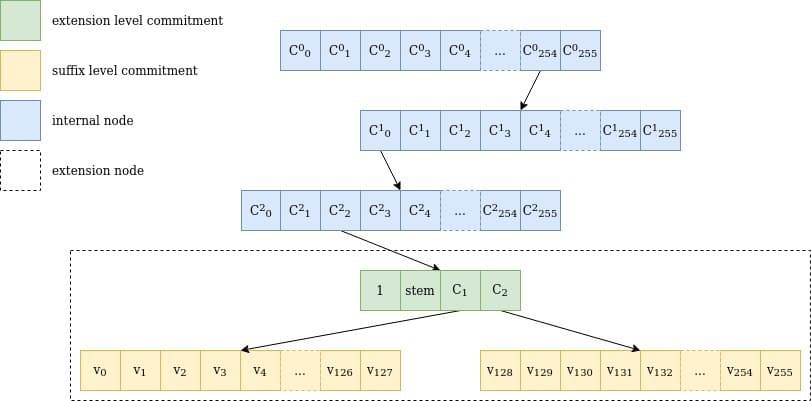
Figure 1 Representation of a walk through a verkle tree for the key 0xfe0002abcd..ff04: the path goes through 3 internal nodes with 256 children each (254, 0, 2), one extension node representing abcd..ff and the two suffix tree commitments, including the value for 04, v₄. Note that stem is actually the first 31 bytes of the key, including the path through the internal nodes.

Commitment to the values leaf nodes

Each extension and suffix tree node contains 256 values. Because a value is 256 bits wide, and we can only store 252 bits safely in one field element, four bits would be lost if we simply tried so store one value in one field element.

To circumvent this problem, we chose to partition the group of 256 values into two groups of 128 values each. Each 32-byte value in a group is split into two 16-byte values. So a value vᵢ∈ 𝔹₃₂ is turned into v⁽ˡᵒʷᵉʳ⁾ᵢ ∈ 𝔹₁₆ and v⁽ᵘᵖᵖᵉʳ⁾ᵢ∈ 𝔹₁₆ such that v⁽ˡᵒʷᵉʳ⁾ᵢ ++ v⁽ᵘᵖᵖᵉʳ⁾ᵢ= vᵢ.

A "leaf marker" is added to the v⁽ˡᵒʷᵉʳ⁾ᵢ, to differentiate between a leaf that has never been accessed and a leaf that has been overwritten with 0s. No value ever gets deleted from a verkle tree. This is needed for upcoming state expiry schemes. That marker is set at the 129th bit, i.e. v⁽ˡᵒʷᵉʳ ᵐᵒᵈⁱᶠⁱᵉᵈ⁾ᵢ = v⁽ˡᵒʷᵉʳ⁾ᵢ + 2¹²⁸ if vᵢ has been accessed before, and v⁽ˡᵒʷᵉʳ ᵐᵒᵈⁱᶠⁱᵉᵈ⁾ᵢ = 0 if vᵢ has never been accessed.

The two commitments C₁ and C₂ are then defined as

Commitment of extension nodes

The commitment to an extension node is composed of an "extension marker", which is just the number 1, the two subtree commitments C₁ and C₂, and the stem of the key leading to this extension node.

Unlike extension nodes in the Merkle-Patricia tree, which only contain the section of the key that bridges the parent internal node to the child internal node, the stem covers the whole key up to that point. This is because verkle trees are designed with stateless proofs in mind: if a new key is inserted that "splits" the extension in two, the older sibling need not be updated, which allows for a smaller proof.

Commitment of Internal nodes

Internal nodes have the simpler calculation method for their commitments: the node is seen as a vector of 256 values, that are the (field representation of the) root commitment of each of their 256 subtrees. The commitment for an empty subtree is 0. If the subtree is not empty, then the commitment for the internal node is

where the Cᵢ are the children of the internal node, and 0 if a child is empty.

Insertion into the tree

Figure 2 is an illustration of the process of inserting a new value into the tree, which gets interesting when the stems collide on several initial bytes.
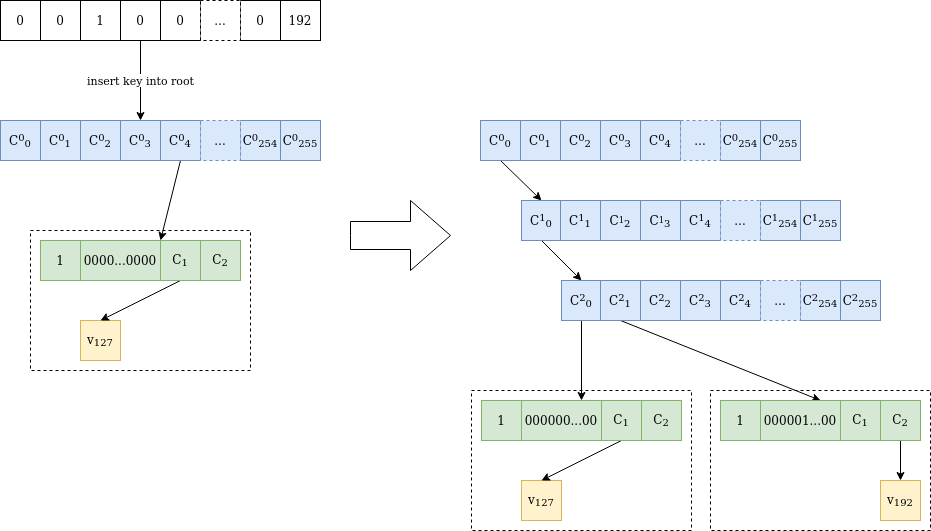
Figure 2 Value v₁₉₂ is inserted at location 0000010000...0000 in a verkle tree containing only value v₁₂₇ at location 0000000000...0000. Because the stems differ at the third byte, two internal nodes are added until the differing byte. Then another "extension-and-suffix" tree is inserted, with a full 31-byte stem. The initial node is untouched, and C²₀ has the same value as C⁰₀ before the insertion.

Shallower trees, smaller proofs

The verkle tree structure makes for shallower trees, which reduces the amount of stored data. Its real power, however, comes from the ability to produce smaller proofs, i.e. witnesses. This will be explained in the next article.