

惯性聚合 高效追踪和阅读你感兴趣的博客、新闻、科技资讯
阅读原文 在惯性聚合中打开

推荐订阅源

爱范儿
爱范儿
P
Palo Alto Networks Blog
月光博客
月光博客
H
Hackread – Cybersecurity News, Data Breaches, AI and More
I
InfoQ
aimingoo的专栏
aimingoo的专栏
腾讯CDC
T
Threatpost
D
DataBreaches.Net
Vercel News
Vercel News
F
Fortinet All Blogs
Engineering at Meta
Engineering at Meta
C
Cybersecurity and Infrastructure Security Agency CISA
Forbes - Security
Forbes - Security
U
Unit 42
C
Check Point Blog
Blog — PlanetScale
Blog — PlanetScale
O
OpenAI News
量子位
TaoSecurity Blog
TaoSecurity Blog
Microsoft Azure Blog
cs.AI updates on arXiv.org
V
Visual Studio Blog
Recorded Future
Recorded Future
云风的 BLOG
云风的 BLOG
Security Archives - TechRepublic
The Last Watchdog
The Last Watchdog
S
Security Affairs
Attack and Defense Labs
罗磊的独立博客
Stack Overflow Blog
Stack Overflow Blog
Microsoft Security Blog
让小产品的独立变现更简单 - ezindie.com
V
V2EX
小众软件
小众软件
S
SegmentFault 最新的问题
www.infosecurity-magazine.com
W
WeLiveSecurity
AI
AI
Threat Intelligence Blog | Flashpoint
博客园 - 聂微东
I
Intezer
Know Your Adversary
Know Your Adversary
Exploit-DB.com RSS Feed
P
Proofpoint News Feed
freeCodeCamp Programming Tutorials: Python, JavaScript, Git & More
The Cloudflare Blog
博客园_首页
NISL@THU
NISL@THU
K
KPMG report finds enterprise disconnect between AI and its ROI | CIO

Ethereum Foundation Blog

Checkpoint #9: Apr 2026 | Ethereum Foundation Blog How L1 and L2s can build the strongest possible Ethereum | Ethereum Foundation Blog The Promise of Ethereum: Introducing the EF Mandate | Ethereum Foundation Blog This Is Fine (Until the Grant Runs Out) | Ethereum Foundation Blog Treasury Staking Initiative | Ethereum Foundation Blog The Ethereum Foundation's Commitment to DeFi | Ethereum Foundation Blog Protocol Priorities Update for 2026 | Ethereum Foundation Blog Announcing the Platform Team at EF | Ethereum Foundation Blog Ethereum Protocol Studies 2026 | Ethereum Foundation Blog Executive Leadership Update | Ethereum Foundation Blog An update from Tomasz | Ethereum Foundation Blog Introducing the EF Academic Secretariat 2026 PhD Fellowship | Ethereum Foundation Blog Trillion Dollar Security Day at Devconnect | Ethereum Foundation Blog Allocation Update - Q4 2025 | Ethereum Foundation Blog Checkpoint #8: Jan 2026 | Ethereum Foundation Blog Devcon 8 is coming to Mumbai, India in November 2026 | Ethereum Foundation Blog Hegota Upgrade EIP Proposal Timelines | Ethereum Foundation Blog Shipping an L1 zkEVM #2: The Security Foundations | Ethereum Foundation Blog The Future of Ethereum’s State | Ethereum Foundation Blog Devconnect Argentina Recap | Ethereum Foundation Blog Allocation Update - Q3 2025 | Ethereum Foundation Blog Making Ethereum Feel Like One Chain Again | Ethereum Foundation Blog Checkpoint #7: Nov 2025 | Ethereum Foundation Blog Fusaka Mainnet Announcement | Ethereum Foundation Blog 2 weeks to Devconnect: Everything you need to know | Ethereum Foundation Blog Unveiling ESP's New Grants Program | Ethereum Foundation Blog Fusaka Update – Transaction Gas Limit Cap arrives with EIP-7825 | Ethereum Foundation Blog Fusaka Update - Information for Blob users | Ethereum Foundation Blog Announcing the 2026 EF Internship | Ethereum Foundation Blog Supporting privacy with new funding mechanisms | Ethereum Foundation Blog The Ethereum Foundation’s Commitment to Privacy | Ethereum Foundation Blog Checkpoint #6: Oct 2025 | Ethereum Foundation Blog Privacy Cluster Leadership Announcement | Ethereum Foundation Blog Fusaka Testnet Announcement | Ethereum Foundation Blog Announcing the districts of the Ethereum World’s Fair | Ethereum Foundation Blog Fusaka $2,000,000 Audit Contest! | Ethereum Foundation Blog Holešky Testnet Shutdown Announcement | Ethereum Foundation Blog The Ecosystem Support Program's Next Chapter | Ethereum Foundation Blog Protocol Update 003 — Improve UX | Ethereum Foundation Blog Protocol Update 002 - Scale Blobs | Ethereum Foundation Blog Trillion Dollar Security - Phase 2 | Ethereum Foundation Blog Join Us: EF Protocol Reddit AMA - August 29th, 2025 | Ethereum Foundation Blog Protocol Update 001 – Scale L1 | Ethereum Foundation Blog lean Ethereum | Ethereum Foundation Blog Celebrating 10 Years of Ethereum | Ethereum Foundation Blog Checkpoint #5: July 2025 | Ethereum Foundation Blog Allocation Update - Q2 2025 | Ethereum Foundation Blog The Future of Ecosystem Development at the EF | Ethereum Foundation Blog Shipping an L1 zkEVM #1: Realtime Proving | Ethereum Foundation Blog Partial history expiry announcement | Ethereum Foundation Blog Checkpoint #4: Berlinterop | Ethereum Foundation Blog World Experience: Updates from the Next Billion Fellowship | Ethereum Foundation Blog Now accepting interns - Join the Ethereum Season of Internships | Ethereum Foundation Blog Tickets are live for the Ethereum World’s Fair! And we're launching the Supporter Program | Ethereum Foundation Blog Ethereum Foundation Treasury Policy | Ethereum Foundation Blog Checkpoint #3: June 2025 | Ethereum Foundation Blog Announcing the Devconnect ARG Scholars Program | Ethereum Foundation Blog Announcing Protocol | Ethereum Foundation Blog Nyota Interop Recap ✨ | Ethereum Foundation Blog Allocation Update - Q1 2024 | Ethereum Foundation Blog Announcing the Ethereum Protocol Fellowship Cohort 5 | Ethereum Foundation Blog Ethereum Protocol Fellowship Cohort 4 Recap | Ethereum Foundation Blog Sepolia Incident | Ethereum Foundation Blog Announcing the Devcon SEA venue! | Ethereum Foundation Blog Devconnect Scholars Program - Ethereum Stories from Istanbul and Beyond | Ethereum Foundation Blog Dencun Mainnet Announcement | Ethereum Foundation Blog ZK Grants Round | Ethereum Foundation Blog Eth2 at ETHWaterloo: Prizes for Eth2 education, tooling, and research | Ethereum Foundation Blog eth2 quick update no. 2 | Ethereum Foundation Blog Devcon4 Ticket Sales | Ethereum Foundation Blog Announcing Swarm Proof-of-Concept Release 3 | Ethereum Foundation Blog Devcon4 Announcement | Ethereum Foundation Blog Announcing May 2018 Cohort of EF Grants | Ethereum Foundation Blog Announcing World Trade Francs: The Official Ethereum Stablecoin | Ethereum Foundation Blog Announcing Beneficiaries of the Ethereum Foundation Grants | Ethereum Foundation Blog Geth 1.8 - Iceberg¹ | Ethereum Foundation Blog Farewell and Welcome | Ethereum Foundation Blog Security Alert - Solidity - Variables can be overwritten in storage | Ethereum Foundation Blog Uncle Rate and Transaction Fee Analysis | Ethereum Foundation Blog Announcement of imminent hard fork for EIP150 gas cost changes | Ethereum Foundation Blog Dev Update: Formal Methods | Ethereum Foundation Blog On Inflation, Transaction Fees and Cryptocurrency Monetary Policy | Ethereum Foundation Blog Onward from the Hard Fork | Ethereum Foundation Blog C++ DEV Update - July edition | Ethereum Foundation Blog The Devcon2 site is now live! | Ethereum Foundation Blog Security Alert - DoS Vulnerability in the Soft Fork | Ethereum Foundation Blog DAO Wars: Your voice on the soft-fork dilemma | Ethereum Foundation Blog Smart Contract Security | Ethereum Foundation Blog Security Alert – Geth suffers from a very low probable DoS attack vector - Update immediately | Ethereum Foundation Blog On Settlement Finality | Ethereum Foundation Blog Ethereum Foundation and Wanxiang Blockchain Labs announce a blockbuster event combining Devcon2 and the 2nd Global Blockchain Summit in Shanghai, September 19–24, 2016 | Ethereum Foundation Blog Ethereum Partners with R3CEV on Lizardcoin, Bringing Together the Best of Centralized Finance and Blockchain Technology | Ethereum Foundation Blog From Smart Contracts to Courts with not so Smart Judges | Ethereum Foundation Blog BTC Relay included in Ethereum Bounty Program | Ethereum Foundation Blog Ethereum DEV Update: C++ Roadmap | Ethereum Foundation Blog Cut and try: building a dream | Ethereum Foundation Blog Ambients Applied to Ethereum | Ethereum Foundation Blog Mihai’s Ethereum Project Update. The First Year. | Ethereum Foundation Blog Getting to the Frontier | Ethereum Foundation Blog The Ethereum Development Process | Ethereum Foundation Blog
The Issuance Model in Ethereum | Ethereum Foundation Blog
2014-04-10 · via Ethereum Foundation Blog

Ether (ETH), the cryptofuel that powers distributed applications on the Ethereum platform, will be issued at a constant annual linear rate via the block mining process. This rate is 0.3 times the total amount of ETH that will be purchased in the pre-sale.

While the best metaphor for ETH is “fuel for running the contract processing engine,” for the purposes of this post, we will treat ETH purely as a currency.

There are two common definitions of “inflation.”  The first relates to prices and the second relates to the total amount of money in a system – the monetary base or supply.  Similarly for the term “deflation.”  In this post we will distinguish between “price inflation,” the rise in the general price level of goods and services in an economy, and “monetary inflation,” the growth in the supply of money in an economy due to some sort of issuance mechanism.  Often, but not always, monetary inflation is a cause of price inflation.

Though the issuance of ETH is in a fixed amount each year, the rate of growth of the monetary base (monetary inflation) is not constant.  This monetary inflation rate decreases every year making ETH a disinflationary currency (in terms of monetary base).  Disinflation is a special case of inflation in which the amount of inflation shrinks over time.

It is expected that the amount of ETH that will be lost each year caused by transmissions to addresses which are no longer accessible is estimated to be on the order of 1% of the monetary base. ETH may be lost due to loss of private keys, death of owner without transmission of private keys, or purposeful destruction by sending to an address that never had an associated private key generated.

If we assume that Ethereum sells 40,000 BTC worth of ETH in the pre-sale, and if we assume that the average price is 1500 ETH/ BTC, 60,000,000 ETH will be created in the genesis block and assigned to purchasers. Every year, in perpetuity, 18,000,000 ETH will be issued though the mining process.  Taking into account both creation of new ETH and loss of existing ETH, in the first year, this represents a monetary inflation rate of 22.4%.  In the second year the rate drops to 18.1%.  By the tenth year, the rate is 7.0%.  In year 38, it hits 1.9%. And in the 64th year, the level of 1.0% is reached.
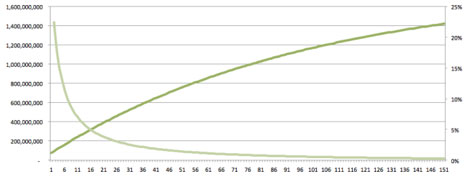
Figure 1.  Amount of ETH in existence (dark green curve) on the left axis.  Monetary base inflation rate (light green curve) on the right axis.  Years on the horizontal axis.  (Adapted from Arun Mittal with thanks.)

Figure 1. Amount of ETH in existence (dark green curve) on the left axis. Monetary base inflation rate (light green curve) on the right axis. Years on the horizontal axis. (Adapted from Arun Mittal with thanks.)

By approximately the year 2140, the issuance of BTC ceases and since some BTC will likely be lost each year, the monetary base of Bitcoin is expected to start shrinking at that point.

At approximately the same time, the expected rate of annual loss and destruction of ETH will balance the rate of issuance.  Under this dynamic, a quasi-steady state is reached and the amount of extant ETH no longer grows. If the demand for ETH is still growing at that point due to an expanding economy, prices will be in a deflationary regime.  This is not an existential problem for the system since ETH is theoretically infinitely divisible. As long as the rate of price deflation is not too rapid, pricing mechanisms will adjust and the system will operate smoothly.  The traditional main objection to deflationary economies, wage stickiness, is likely not to be an issue since all payments systems will be fluid.  Another frequent objection, borrowers forced to repay loans with a currency that grows in purchasing power over time, will also not be a problem if this regime is persistent, since terms of lending will be defined to account for this.

Note that while the monetary inflation remains greater than zero for many years, price levels (tracked as price inflation and deflation) are dependent on supply and demand, so are related to, but not totally controlled by the rate of issuance (supply).  Over time it is anticipated that growth of the Ethereum economy will significantly outpace growth of the supply of ETH, which could lead to an increase in the value of ETH with respect to legacy currencies and BTC.

One of Bitcoin’s great value propositions was the algorithmically fixed total issuance of the currency which mandated that only 21,000,000 BTC will ever be created.  In a time of profligate legacy currency printing in an exponentially doomed attempt to patch over the fact that there is too much debt in the global economic system (with more debt), the prospect of a universally accepted cryptocurrency that can serve eventually as a relatively stable store of value is attractive.  Ethereum recognizes this and seeks to emulate this core value proposition.

Ethereum also recognizes that a system intended to serve as a distributed, consensus-based application platform for global economic and social systems, must strongly emphasize inclusiveness. One of the many ways we intend to foster inclusiveness is by maintaining an issuance system which possesses some churn.  New participants in the system will be able to purchase new ETH or mine for new ETH whether they are living in the year 2015 or 2115. We believe we have a achieved a good balance between the two goals of fostering inclusiveness and maintaining a stable store of value. And the constant issuance, especially in the early years, will likely make using ETH to build businesses in the Ethereum economy more lucrative than hoarding speculatively.