







To the users and the builders,
We’ve said it before and we’ll say it again: Ethereum’s future is bright, and this year we are seeing much of that future come to life as the Ethereum ecosystem builds on a foundation laid by dedicated research and development over the last years.
This update will focus on how the Ethereum Foundation aims to help further Ethereum’s progress, on what we’ve been working on in terms of allocations and more, and on why our outlook is brighter now more than ever.
Who we are, and where we’ve been
The focus of the Ethereum Foundation’s work as a non-profit remains only on doing what is best for Ethereum. And we remain aware that what began as a small open-source project in 2014 grew into the biggest community in the industry. Ethereum’s unique advantage is what we last year referred to as the global collection of developers, entrepreneurs, researchers, and passionate users that make up our ever-growing family.
We often aim to work on the things that either only the Foundation can do, or that it can do better than others to support Ethereum and its community. But thanks to this ecosystem of participants, we must begin with a thank you for elevating yourselves and for further decentralizing Ethereum each day. To all that have continued to build in the face of unique challenges: your accomplishments and ability to reach milestones have been and continue to be breathtaking. And to those users that have helped over the last year to explode activity around real-world applications already thriving on Ethereum: your support and engagement inspire us to work even harder to maximize Ethereum’s potential.
With that, we’ll outline below how the Ethereum Foundation will further its work as a resource allocator, and talk about how that process works. As an advocate for Ethereum both within our ecosystem and to the outside world, we’ll also cover how and where to follow the latest progress, all in the year that we’ll realize the long-awaited beacon chain launch and proof of stake on Ethereum.
Where we’re going, how we get there
The Foundation itself is more akin to a bazaar than it is a cathedral. That means that every release and function that exist under the “EF” label are really different groups and teams acting in various capacities to help to move Ethereum forward. This is how we view Ethereum as well, and just as Ethereum has multiple layers, so does the Ethereum Foundation's portfolio of allocations.
With that in mind, today we’re going to speak a bit about how those allocation decisions are made.
As a whole, no single or centralized distribution method has been a cure-all for the many recurring research and development teams, community building efforts, or independent builders that we support. This has become clear through a great deal of iteration over time that has helped us to develop a multi-pronged approach to allocating resources.
Let’s dive in by imaging the entire budget allocation process as a layered cake that helps us to make decisions. Here’s how it works.
Type A: Recurring Support
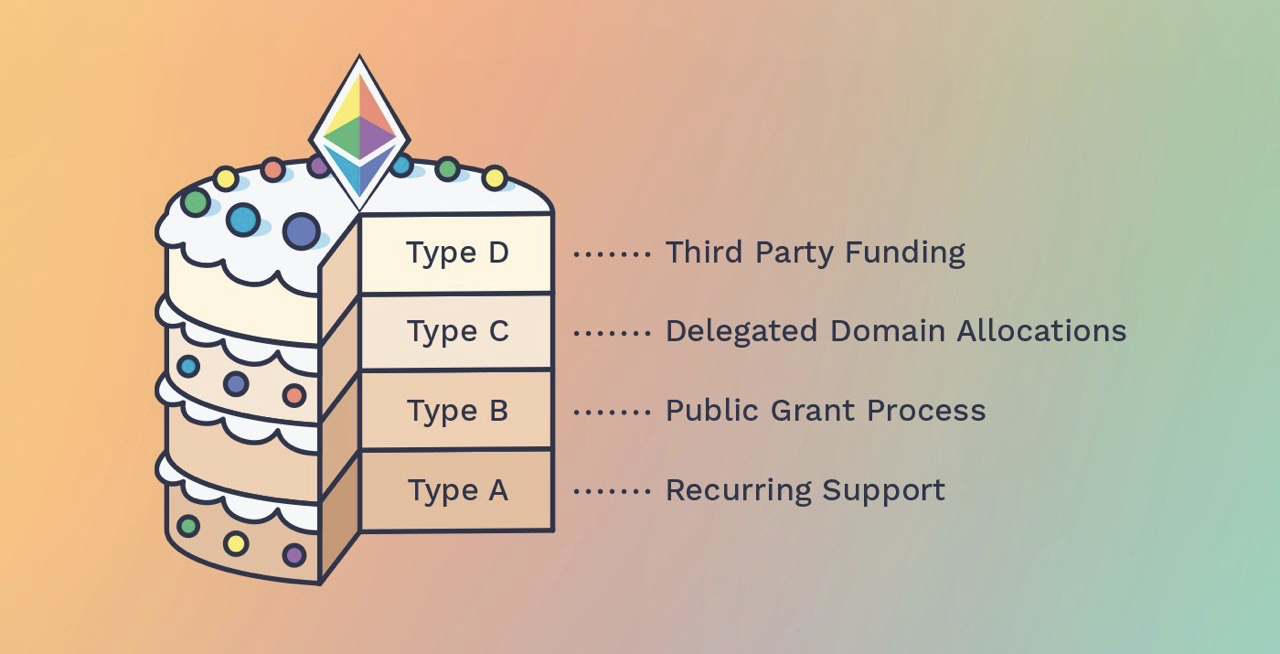
Areas of recurring support are our first stop, and the most familiar process for most readers. Some supported teams included here, like Geth and Solidity, represent where things began. Others, like Eth1.x and Stateless research, the EF’s Eth2 Research team and formal verification (among others) came later but are essential for Ethereum to succeed. Also under this branch are administrative and operations roles, like the people behind the ESP team, communications and community, or administration and legal.
There was a time when the EF was home to these and other (most) supported Ethereum projects, but the Foundation’s purpose has changed alongside the larger ecosystem. Today, these teams fit into a category of support that EF is best-suited to provide at this time.
In the last two years, the Foundation has given more autonomy to Type A teams over their own budgets. We think that this structure better reflects how supported teams are actually operating as teams.
Each year, teams are asked to submit roadmaps and budget proposals, while others work to evaluate and approve their asks by evaluating their own needs. Think of this as a system of checks and balances where there are few enough for us to work together on a personal level. This way, we see which projects are working, what needs help, where the most progress and new achievements can be made, and what types of support help teams reach those goals.
Elsewhere, we’ve pushed opportunities outward as stated on previous occasions, taking an ecosystem-wide approach that helped to remove the line between internal and external. This helps us to minimize our operational footprint, and avoid having too much sway over developmental progress.
As time progressed, this outward movement has taken on a few different forms, resulting in the other types of allocation that we’ll speak to today. Each of these can generally be thought of as ecosystem support. To help manage the next area of focus, Type B funding, the aptly-named Ecosystem Support Program (ESP for short) leads the way.
Type B: Public Grant Process
A bit more on the ESP team!
Since the EF Grants Program evolved into the Ecosystem Support Program, the definition of resources has expanded to include both financial and non-financial support. Their aim is to allocate resources where they will have the biggest impact on Ethereum’s growth and adoption.
Recently, the Ecosystem Support Program: Allocation Update detailed how we allocated grants to external teams in 2019. Going forward, allocation updates will be posted quarterly, with the Q1 update already live. The ESP team will also be making an effort in the coming months to share more about how non-financial support is allocated, and how teams have made use of these resources!
One of the most important functions of ESP is to expand access to support, using a public inquiry process to discover and engage new projects. The Ecosystem Support team evaluates proposals that come in through the public inquiry form, incorporating peer review, discussions with the applicant, and expert advisors as needed to form a plan to help teams succeed. When making decisions about allocations, financial and otherwise, the ESP team digs into everything from timeline, execution and team structure, to available alternatives, potential milestones and impact forecasts in order to find the right fit. In short, ESP’s decisions move through a more thorough process than ever before, designed to help projects at any stage of completion to refine their ideas and connect with the support they need.
Of course, it’s hard to imagine that all needed “ecosystem support” allocations could be initiated through incoming public inquiries, which are by definition reactive. There will inevitably remain neglected areas and unfulfilled needs in the Ethereum ecosystem that require a more proactive approach that builds on our experiences with both Types A and B to create something new, which brings us to Type C.
Type C: Delegated Domain Allocations
Imagine an example where a new and potentially game-changing Layer 2 scaling solution gains steam, but it suffers from an initial lack of organization and funding. In Type C, this new area of focus would be called a “domain”, and the tool available to us in this case is to “delegate” to one or more confidence-inspiring domain experts the allocation and milestone-setting abilities that they need to make progress, whether they work for the EF or not.
These domain experts can identify specific problems to solve, and connect with builders to get work funded through grant-based allocations. Importantly, they can do so without EF onboarding new teams, and with a more proactive, targeted, and collaborative approach than is feasible for the open grant process.
Each domain tends to begin with smaller budgets and grants, such as those for the local grants programs last year in South Korea, Japan, and Taiwan, but these can grow in size over time. Examples of more mature domains include applied zero knowledge work, eth2 coordination, developer experience, the Ethereum.org project, and more.
While Type B and C represent a diverse range of allocations, frankly, our team will always have blindspots in what we lead on — this is something that no organization can overcome on its own. So what about everything else? That’s where you come in.
Type D: Third Party Funding
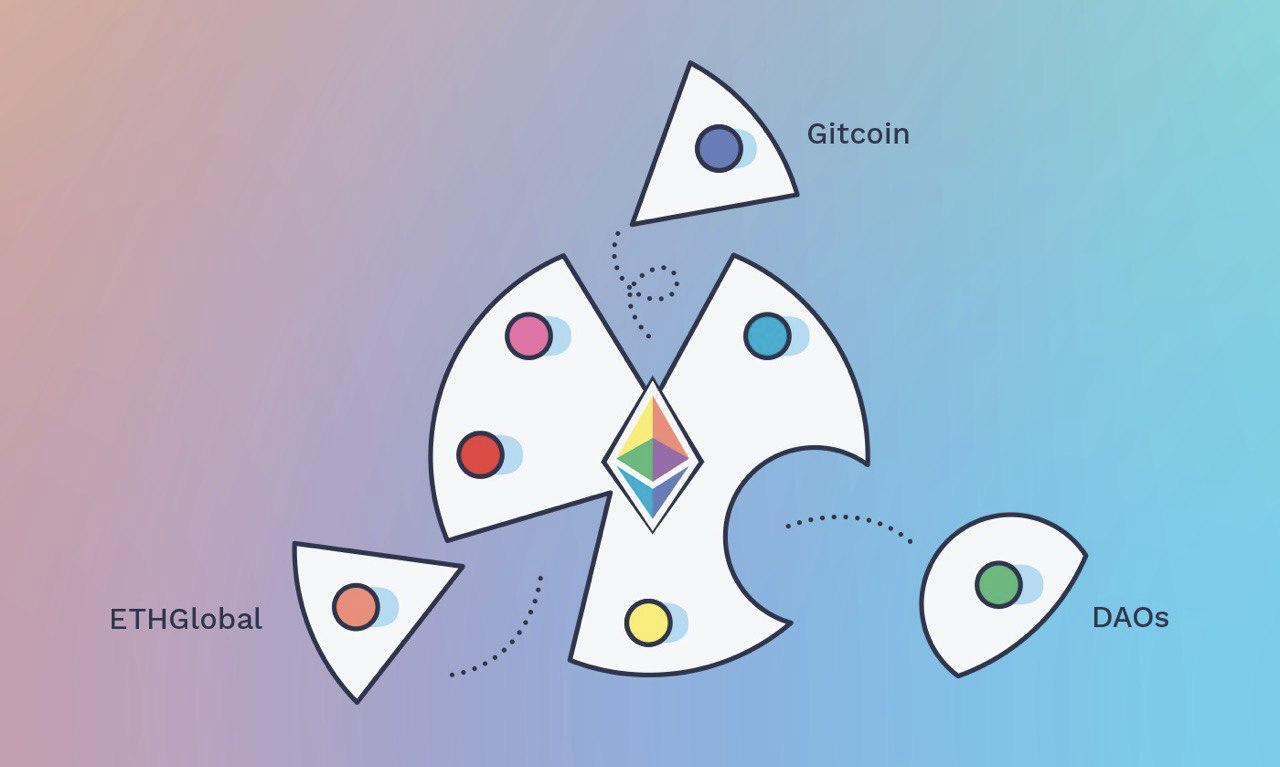
Redistribution to independent funding models and groups can help us to even further decentralize our allocation process. While we’re proud of how refined and targeted our efforts are becoming, redistribution helps funds reach where some of the EF’s teams may have never known they needed to go.
Examples here include community driven grant matching, like Gitcoin’s CLR rounds (where you can help to decide how funding is distributed) and DAO funding, like Moloch. Third party allocators fit into Type D too. These include our support for UNICEF’s Crypto Fund, which selects and distributes funds to projects that their team works to identify, and to ETHGlobal, which retains independence and redistributes funds via hack bounties, among other activities. Admittedly, it’s still early-days for Type D, but our work in these areas are well underway.
While this may appear experimental or radical to some, there are many members within the Ethereum ecosystem that have long sought out ways to guide funding efforts, and now some of their decisions have already opened new doors.
Some of this work is complementary to EF’s other funding types, but may have been edge cases not covered by Types A-C, while other pieces may be controversial or even competitive. But while we have an opinion on how the initial funding decisions are made (in an initial transfer to a DAO, for example), what's decided after this point is in your hands, which has been a net-positive in terms of innovation and participation.
We know that we must also ensure allocation accountability along the way, which can be challenging, but we can overcome those difficulties by diversifying how we fund. Examples include smaller initial disbursements to identify strong performers, and diversification of sources like those to DAOs and matching programs. Together, these approaches help to limit areas of risk like popularity contests and groupthink, and help us to reach a healthy equilibrium.
Working together
A high-level view of these efforts have helped us to see that, while every allocation-type has its benefits and limitations, they are symbiotic and help to create a stronger funding model together.
Type A
↑: As the only area that is by default recurring, this allows teams to comfortably focus on long-term roadmaps.
↓: Not everything can be solved through hiring and team-building in a fast moving ecosystem, since teams often have a long-term focus.
Type B
↑: Inquiry-based allocations can be more diverse and targeted.
↓: Not everything can be covered through reactive grants, and the team is limited by what is received from across the ecosystem.
Type C
↑: Allows for more proactive prioritizing by those with the expertise, with added flexibility to boot.
↓: These projects are often experimental, and the rate of Type C funding can be limited by EF’s capacity to identify appropriate needs and fits.
Type D
↑: People-powered, and where we see things trending over time.
↓: Highly experimental, with a delay in measurable impact/return for Ethereum.
Each option that we have available to us helps EF to more effectively empower others to innovate, and as we’ve matured, the distribution of our cake has continued to evolve too:
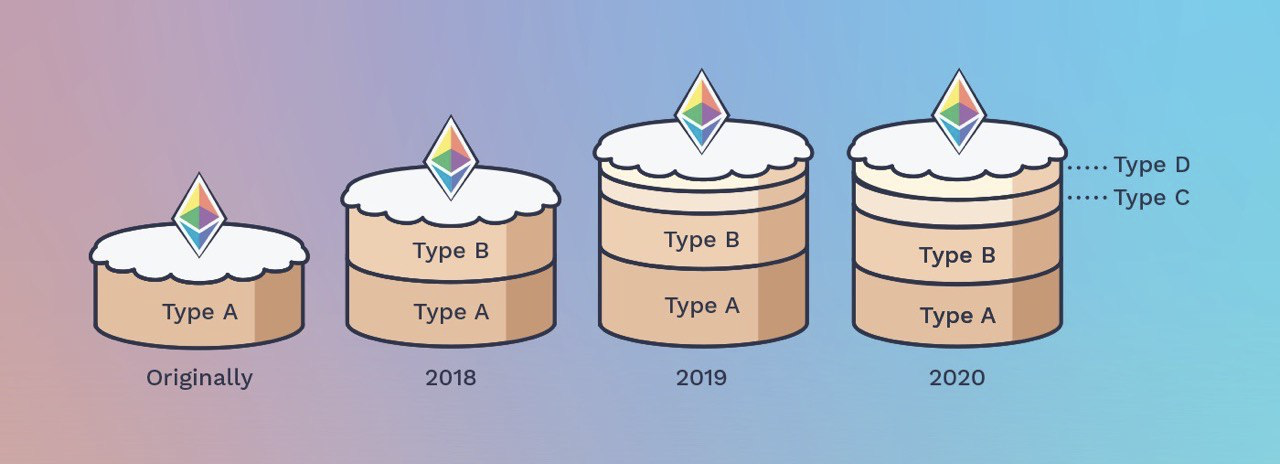
As you can see above, prior to the launch of the EF Grants Program (a precursor to ESP) in 2018, nearly all funding was geared toward "EF teams". In 2018, substantial allocations were made to invest in quality work in areas determined to have the greatest need. This helped to create a firmer foundation, on top of which the energy and sheer number of new contributors could be more sustainable into the future. We’re glad to see that some of that timely decision-making is now paying off as big changes soon come to life on the public network.
In short, while gradual shifts toward Type B, and later to Types C and D are relatively new, they are the start of a trend that will continue in the near-future, and we know that it’s for the better.
What’s ahead in 2020?
This year, the Foundation is in a position to comfortably meet or exceed the commitment made last May. Specifically, we’ll likely fall within the range of 25-40 million USD in total allocations, depending on the need of the ecosystem, the number and quality of ESP applicants, and progress in scaling our new allocation types.
Our support for efforts related to eth2 will also continue to ramp up as needed. Additionally, our funding for eth1.x related research and development remains firm at this critical moment, and we recognize (just as some of eth2’s progress relies on Stateless Ethereum) that we can't focus on one without the other.
On our resources, the Foundation has available to it about 0.53% of all ETH at the time of this post. This number has steadily decreased since the launch of the network years ago as we’ve continued to spend in line with our mission to grow and advance the network and ecosystem.
Follow the journey, or come along
Keep up to date with Ecosystem Support
Beginning this year, we’re increasing communication around the assistance provided by the ESP, including highlighting milestones and updates from supported projects.
To share all of this, the team launched a major update to the ESP website. These changes improve the information that was already available, and add new sections to make it easier to follow along:
- On the featured projects page you can learn more about some of the projects we’ve supported
- The front page is your source for the latest news on the program
- A new “wishlist” includes some of the areas for support on which we’re focusing in the near future.
New sections will update and rotate regularly, and there are more additions in the pipeline, so make sure to keep an eye out for updates. To stay up to date on even more current events, follow @EF_ESP on Twitter, and sign up to get ESP news to your inbox!
And of course we want to fund quality work that helps Ethereum to grow and thrive, and we’d appreciate your help to identify those builders and teams in need of support. If this applies to you or someone you know, we invite you to get in touch today.
More from supported teams
We also invite all fans of Ethereum to keep up to date on the progress of network-level efforts through multiple new series right here on the EF Blog, brought to you by the researchers and developers that are bringing the future of Ethereum to life.
The eth1.x Files, with Griffin Ichiba Hotchkiss
Learn more about what’s happening with Ethereum today, Stateless Ethereum research and more.
Recent Updates:
- The 1.x Files: A Primer for the Witness Specification - 2020-05-04
- The 1.x Files: The Updated Stateless Tech Tree - 2020-04-02
- The 1.x Files: Stateless Summit Summary - 2020-03-12
Eth2 Quick Update, with Danny Ryan
As the title implies, follow along for the latest news and breakthroughs on eth2 leading up to the launch of the beacon chain.
Recent Updates:
- Eth2 quick update no. 11 - 2020-05-06
- Eth2 quick update no. 10 - 2020-03-31
- Eth2 quick update no. 9 - 2020-03-17
Validated - Staking on eth2, with Carl Beekhuizen
It’s about time to put your Ether to use in a whole new way. Learn more about staking on eth2 and the science behind it with regular updates including those below.
Recent Updates:
- Validated, staking on eth2: #3 - Sharding Consensus - 2020-03-27
- Validated, staking on eth2: #2 - Two ghosts in a trench coat - 2020-02-12
- Validated, staking on eth2: #1 - Incentives - 2020-01-13
and more…
And stay tuned for more for continued supported-team updates from other EF-supported efforts, and find the latest release here!
Over the last year, more and more essential teams have continued to populate our distributed ecosystem, and we’re proud of the strength that comes from having a distributed network without a center. But as an entity, we’ll continue our work to provide opportunity for everyone to create without enveloping each project under one large tent. In the year ahead, we’ll witness the launch of eth2, which will be powered by multiple clients — all of which will have been built and maintained by independent teams.
until then…
We’ll primarily keep our heads down and continue our work in and around the Ethereum ecosystem, but expect to hear more about new programs and new ways to get involved soon! For now, keep posted to the EF Blog and @Ethereum, dive into the new Ethereum.org community page, and get ready for big news coming soon from the Scholars and Devcon teams too.
And if you’re interested in seeing something that we haven’t covered today, just ask! Whether you have questions, concerns, asks or recommendations, feel free to reach out to press@ethereum.org with your suggestions. We'll get back with feedback or with external resources from a large community that continues to produce incredible material that we want to support, and we even may publish a Q&A in the months to come with some of what’s received.
Until then, our focus will remain on performing where we're needed most, and on doing what only the EF can. We can’t wait to see where your work and the rest of this year takes Ethereum, and we hope to see you all along the way.
🦄