


惯性聚合 高效追踪和阅读你感兴趣的博客、新闻、科技资讯
阅读原文 在惯性聚合中打开

推荐订阅源

SecWiki News
SecWiki News
D
Darknet – Hacking Tools, Hacker News & Cyber Security
I
Intezer
月光博客
月光博客
Cyberwarzone
Cyberwarzone
雷峰网
雷峰网
Security Latest
Security Latest
量子位
博客园 - 聂微东
小众软件
小众软件
NISL@THU
NISL@THU
C
Cisco Blogs
The GitHub Blog
The GitHub Blog
C
Cybersecurity and Infrastructure Security Agency CISA
T
Tor Project blog
Y
Y Combinator Blog
V
V2EX
博客园 - 三生石上(FineUI控件)
P
Privacy & Cybersecurity Law Blog
F
Full Disclosure
Cisco Talos Blog
Cisco Talos Blog
Microsoft Security Blog
S
Security @ Cisco Blogs
The Register - Security
Google DeepMind News
J
Java Code Geeks
cs.CL updates on arXiv.org
IT之家
IT之家
Webroot Blog
Webroot Blog
cs.AI updates on arXiv.org
aimingoo的专栏
aimingoo的专栏
腾讯CDC
S
Schneier on Security
L
LINUX DO - 最新话题
Latest news
Latest news
Simon Willison's Weblog
罗磊的独立博客
A
Arctic Wolf
MyScale Blog
MyScale Blog
云风的 BLOG
云风的 BLOG
让小产品的独立变现更简单 - ezindie.com
S
Secure Thoughts
S
Securelist
Stack Overflow Blog
Stack Overflow Blog
T
Troy Hunt's Blog
Recorded Future
Recorded Future
I
InfoQ
The Cloudflare Blog
H
Heimdal Security Blog
Hugging Face - Blog
Hugging Face - Blog

Ethereum Foundation Blog

Checkpoint #9: Apr 2026 | Ethereum Foundation Blog How L1 and L2s can build the strongest possible Ethereum | Ethereum Foundation Blog The Promise of Ethereum: Introducing the EF Mandate | Ethereum Foundation Blog This Is Fine (Until the Grant Runs Out) | Ethereum Foundation Blog Treasury Staking Initiative | Ethereum Foundation Blog The Ethereum Foundation's Commitment to DeFi | Ethereum Foundation Blog Protocol Priorities Update for 2026 | Ethereum Foundation Blog Announcing the Platform Team at EF | Ethereum Foundation Blog Ethereum Protocol Studies 2026 | Ethereum Foundation Blog Executive Leadership Update | Ethereum Foundation Blog An update from Tomasz | Ethereum Foundation Blog Introducing the EF Academic Secretariat 2026 PhD Fellowship | Ethereum Foundation Blog Trillion Dollar Security Day at Devconnect | Ethereum Foundation Blog Allocation Update - Q4 2025 | Ethereum Foundation Blog Checkpoint #8: Jan 2026 | Ethereum Foundation Blog Devcon 8 is coming to Mumbai, India in November 2026 | Ethereum Foundation Blog Hegota Upgrade EIP Proposal Timelines | Ethereum Foundation Blog Shipping an L1 zkEVM #2: The Security Foundations | Ethereum Foundation Blog The Future of Ethereum’s State | Ethereum Foundation Blog Devconnect Argentina Recap | Ethereum Foundation Blog Allocation Update - Q3 2025 | Ethereum Foundation Blog Making Ethereum Feel Like One Chain Again | Ethereum Foundation Blog Checkpoint #7: Nov 2025 | Ethereum Foundation Blog Fusaka Mainnet Announcement | Ethereum Foundation Blog 2 weeks to Devconnect: Everything you need to know | Ethereum Foundation Blog Unveiling ESP's New Grants Program | Ethereum Foundation Blog Fusaka Update – Transaction Gas Limit Cap arrives with EIP-7825 | Ethereum Foundation Blog Fusaka Update - Information for Blob users | Ethereum Foundation Blog Announcing the 2026 EF Internship | Ethereum Foundation Blog Supporting privacy with new funding mechanisms | Ethereum Foundation Blog The Ethereum Foundation’s Commitment to Privacy | Ethereum Foundation Blog Checkpoint #6: Oct 2025 | Ethereum Foundation Blog Privacy Cluster Leadership Announcement | Ethereum Foundation Blog Fusaka Testnet Announcement | Ethereum Foundation Blog Announcing the districts of the Ethereum World’s Fair | Ethereum Foundation Blog Fusaka $2,000,000 Audit Contest! | Ethereum Foundation Blog Holešky Testnet Shutdown Announcement | Ethereum Foundation Blog The Ecosystem Support Program's Next Chapter | Ethereum Foundation Blog Protocol Update 003 — Improve UX | Ethereum Foundation Blog Protocol Update 002 - Scale Blobs | Ethereum Foundation Blog Trillion Dollar Security - Phase 2 | Ethereum Foundation Blog Join Us: EF Protocol Reddit AMA - August 29th, 2025 | Ethereum Foundation Blog Protocol Update 001 – Scale L1 | Ethereum Foundation Blog lean Ethereum | Ethereum Foundation Blog Celebrating 10 Years of Ethereum | Ethereum Foundation Blog Checkpoint #5: July 2025 | Ethereum Foundation Blog Allocation Update - Q2 2025 | Ethereum Foundation Blog The Future of Ecosystem Development at the EF | Ethereum Foundation Blog Shipping an L1 zkEVM #1: Realtime Proving | Ethereum Foundation Blog Partial history expiry announcement | Ethereum Foundation Blog Checkpoint #4: Berlinterop | Ethereum Foundation Blog World Experience: Updates from the Next Billion Fellowship | Ethereum Foundation Blog Now accepting interns - Join the Ethereum Season of Internships | Ethereum Foundation Blog Tickets are live for the Ethereum World’s Fair! And we're launching the Supporter Program | Ethereum Foundation Blog Ethereum Foundation Treasury Policy | Ethereum Foundation Blog Checkpoint #3: June 2025 | Ethereum Foundation Blog Announcing the Devconnect ARG Scholars Program | Ethereum Foundation Blog Announcing Protocol | Ethereum Foundation Blog Nyota Interop Recap ✨ | Ethereum Foundation Blog Allocation Update - Q1 2024 | Ethereum Foundation Blog Announcing the Ethereum Protocol Fellowship Cohort 5 | Ethereum Foundation Blog Ethereum Protocol Fellowship Cohort 4 Recap | Ethereum Foundation Blog Sepolia Incident | Ethereum Foundation Blog Announcing the Devcon SEA venue! | Ethereum Foundation Blog Devconnect Scholars Program - Ethereum Stories from Istanbul and Beyond | Ethereum Foundation Blog Dencun Mainnet Announcement | Ethereum Foundation Blog ZK Grants Round | Ethereum Foundation Blog Eth2 at ETHWaterloo: Prizes for Eth2 education, tooling, and research | Ethereum Foundation Blog eth2 quick update no. 2 | Ethereum Foundation Blog Devcon4 Ticket Sales | Ethereum Foundation Blog Announcing Swarm Proof-of-Concept Release 3 | Ethereum Foundation Blog Devcon4 Announcement | Ethereum Foundation Blog Announcing May 2018 Cohort of EF Grants | Ethereum Foundation Blog Announcing World Trade Francs: The Official Ethereum Stablecoin | Ethereum Foundation Blog Announcing Beneficiaries of the Ethereum Foundation Grants | Ethereum Foundation Blog Geth 1.8 - Iceberg¹ | Ethereum Foundation Blog Farewell and Welcome | Ethereum Foundation Blog Security Alert - Solidity - Variables can be overwritten in storage | Ethereum Foundation Blog Uncle Rate and Transaction Fee Analysis | Ethereum Foundation Blog Announcement of imminent hard fork for EIP150 gas cost changes | Ethereum Foundation Blog Dev Update: Formal Methods | Ethereum Foundation Blog On Inflation, Transaction Fees and Cryptocurrency Monetary Policy | Ethereum Foundation Blog Onward from the Hard Fork | Ethereum Foundation Blog C++ DEV Update - July edition | Ethereum Foundation Blog The Devcon2 site is now live! | Ethereum Foundation Blog Security Alert - DoS Vulnerability in the Soft Fork | Ethereum Foundation Blog DAO Wars: Your voice on the soft-fork dilemma | Ethereum Foundation Blog Smart Contract Security | Ethereum Foundation Blog Security Alert – Geth suffers from a very low probable DoS attack vector - Update immediately | Ethereum Foundation Blog On Settlement Finality | Ethereum Foundation Blog Ethereum Foundation and Wanxiang Blockchain Labs announce a blockbuster event combining Devcon2 and the 2nd Global Blockchain Summit in Shanghai, September 19–24, 2016 | Ethereum Foundation Blog Ethereum Partners with R3CEV on Lizardcoin, Bringing Together the Best of Centralized Finance and Blockchain Technology | Ethereum Foundation Blog From Smart Contracts to Courts with not so Smart Judges | Ethereum Foundation Blog BTC Relay included in Ethereum Bounty Program | Ethereum Foundation Blog Ethereum DEV Update: C++ Roadmap | Ethereum Foundation Blog Cut and try: building a dream | Ethereum Foundation Blog Ambients Applied to Ethereum | Ethereum Foundation Blog Mihai’s Ethereum Project Update. The First Year. | Ethereum Foundation Blog Getting to the Frontier | Ethereum Foundation Blog The Ethereum Development Process | Ethereum Foundation Blog
How The Merge Impacts Ethereum’s Application Layer | Ethereum Foundation Blog
2021-11-29 · via Ethereum Foundation Blog

Ethereum's transition to proof of stake -- The Merge -- is near: devnets are being stood up, specifications are being finalized and community outreach has begun in earnest. The Merge is designed to have minimal impact on how Ethereum operates for end users, smart contracts and dapps. That said, there are some minor changes worth highlighting. Before we dive into them, here are a few links to provide context about the overall Merge architecture:

The rest of this post will assume the reader is familiar with the above. For those wanting to dig even deeper, the full specifications for The Merge are available here:

Block structure

After The Merge, proof of work blocks will no longer exist on the network. Instead, the former contents of proof of work blocks become a component of blocks created on the Beacon Chain. You can then think of the Beacon Chain as becoming the new proof of stake consensus layer of Ethereum, superseding the previous proof of work consensus layer. Beacon chain blocks will contain ExecutionPayloads, which are the post-merge equivalent of blocks on the current proof of work chain. The image below shows this relationship:
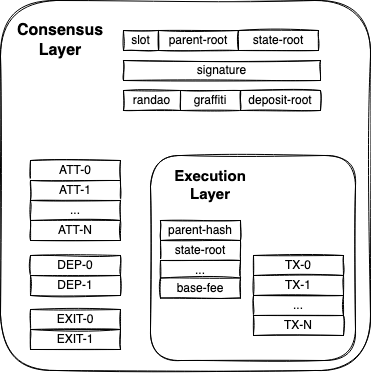
For end users and application developers, these ExecutionPayloads are where interactions with Ethereum happen. Transactions on this layer will still be processed by execution layer clients (Besu, Erigon, Geth, Nethermind, etc.). Fortunately, due to the stability of the execution layer, The Merge introduces only minimal breaking changes.

Mining & Ommer Block Fields

Post-merge, several fields previously contained in proof of work block headers become unused as they are irrelevant to proof of stake. In order to minimize disruption to tooling and infrastructure, these fields are set to 0, or their data structure's equivalent, rather than being entirely removed from the data structure. The full changes to block fields can be found in EIP-3675.

FieldConstant valueComment
ommers[]RLP([]) = 0xc0
ommersHash0x1dcc4de8dec75d7aab85b567b6ccd41ad312451b948a7413f0a142fd40d49347= Keccak256(RLP([]))
difficulty0
nonce0x0000000000000000

Because proof of stake does not naturally produce ommers (a.k.a. uncle blocks) like proof of work, the list of these in each block (ommers) will be empty, and the hash of this list (ommersHash) will become the RLP-encoded hash of an empty list. Similarly, because difficulty and nonce are features of proof of work, these will be set to 0, while respecting their byte-size values.

mixHash, another mining-related field, won't be set to 0 but will instead contain the beacon chain's RANDAO value. More on this below.

BLOCKHASH & DIFFICULTY opcodes changes

Post-merge, the BLOCKHASH opcode will still be available for use, but given that it will no longer be forged through the proof of work hashing process, the pseudorandomness provided by this opcode will be much weaker.

Relatedly, the DIFFICULTY opcode (0x44) will be updated and renamed to PREVRANDAO. Post-merge, it will return the output of the randomness beacon provided by the beacon chain. This opcode will thus be a stronger, albeit still biasable, source of randomness for application developers to use than BLOCKHASH.

The value exposed by PREVRANDAO will be stored in the ExecutionPayload where mixHash, a value associated with proof of work computation, was stored. The payload's mixHash field will also be renamed prevRandao.

Here is an illustration of how the DIFFICULTY & PREVRANDAO opcodes work pre and post-merge:
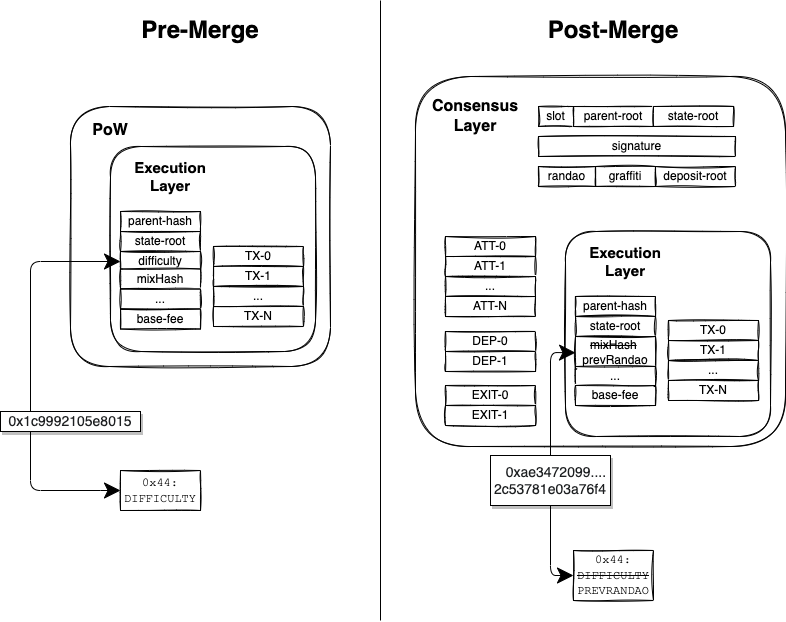
Pre-merge, we see the 0x44 opcode returns the difficulty field in the block header. Post-merge, the opcode, renamed to PREVRANDAO, points to the header field which previously contained mixHash and now stores the prevRandao value from the beacon chain state.

This change, formalized in EIP-4399, also provides on-chain applications a way to assess whether The Merge has happened. From the EIP:

Additionally, changes proposed by this EIP allow for smart contracts to determine whether the upgrade to the PoS has already happened. This can be done by analyzing the return value of the DIFFICULTY opcode. A value greater than 2**64 indicates that the transaction is being executed in the PoS block.

Block time

The Merge will impact the average block time on Ethereum. Currently under proof of work, blocks come in on average every ~13 seconds with a fair amount of variance in actual block times. Under proof of stake, blocks come in exactly each 12 seconds except when a slot is missed either because a validator is offline or because they do not submit a block in time. In practice, this currently happens in <1% of slots.

This implies a ~1 second reduction of average block times on the network. Smart contracts which assume a particular average block time in their calculations will need to take this into account.

Finalized Blocks & Safe Head

Under proof of work there is always the potential for reorgs. Applications usually wait for several blocks to be mined on top of a new head before treating it as unlikely to be removed from the canonical chain, or "confirmed". After The Merge, we instead have the concepts of finalized blocks and safe head exposed on the execution layer. These blocks can be used more reliably than the "confirmed" proof of work blocks but require a shift in understanding to use correctly.

A finalized block is one which has been accepted as canonical by >2/3 of validators. To create a conflicting block, an attacker would have to burn at least 1/3 of the total staked ether. While stake amounts may vary, such an attack is always expected to cost the attacker millions of ETH.

A safe head block is one which has been justified by the Beacon Chain, meaning that >2/3 of validators have attested to it. Under normal network conditions, we expect it to be included in the canonical chain and eventually finalized. For this block to not be part of the canonical chain, a majority of validators would need to be colluding to attack the network, or the network would have to be experiencing extreme levels of latency in block propagation. Post-merge, execution layer APIs (e.g. JSON RPC) will expose the safe head using a safe tag.

Finalized blocks will also be exposed via JSON RPC, via a new finalized flag. These can then serve as a stronger substitute for proof of work confirmations. The table below summarizes this:

Block TypeConsensus MechanismJSON RPCConditions for reorg
headProof of WorklatestTo be expected, must be used with care.
safe headProof of StakesafePossible, requires either large network delay or attack on network.
confirmedProof of WorkN/AUnlikely, requires a majority of hashrate to mine a competing chain of depth > # of confirmations.
finalizedProof of StakefinalizedExtremely unlikely, requires >2/3 of validators to finalize a competing chain, requiring at least 1/3 to be slashed.

Note: the JSON RPC specification is still under active development. Naming changes should still be expected.

Next Steps

We hope this post helps application developers prepare for the much-anticipated transition to proof of stake. In the next few weeks, a long-lived testnet will be made available for testing by the broader community. There is also an upcoming Merge community call for infrastructure, tooling and application developers to ask questions and hear the latest technical updates about The Merge. See you there 👋🏻


Thank you to Mikhail Kalinin, Danny Ryan & Matt Garnett for reviewing drafts of this post.