


惯性聚合 高效追踪和阅读你感兴趣的博客、新闻、科技资讯
阅读原文 在惯性聚合中打开

推荐订阅源

小众软件
小众软件
量子位
博客园 - 叶小钗
Apple Machine Learning Research
U
Unit 42
IT之家
IT之家
F
Fortinet All Blogs
GbyAI
GbyAI
MongoDB | Blog
MongoDB | Blog
H
Hackread – Cybersecurity News, Data Breaches, AI and More
大猫的无限游戏
大猫的无限游戏
freeCodeCamp Programming Tutorials: Python, JavaScript, Git & More
The Register - Security
NISL@THU
NISL@THU
Webroot Blog
Webroot Blog
A
Arctic Wolf
钛媒体:引领未来商业与生活新知
钛媒体:引领未来商业与生活新知
V
Visual Studio Blog
Recent Announcements
Threat Intelligence Blog | Flashpoint
Blog — PlanetScale
Blog — PlanetScale
L
LangChain Blog
P
Palo Alto Networks Blog
Y
Y Combinator Blog
WordPress大学
WordPress大学
让小产品的独立变现更简单 - ezindie.com
AWS News Blog
AWS News Blog
有赞技术团队
有赞技术团队
Engineering at Meta
Engineering at Meta
C
Cybersecurity and Infrastructure Security Agency CISA
aimingoo的专栏
aimingoo的专栏
Know Your Adversary
Know Your Adversary
Cyberwarzone
Cyberwarzone
Martin Fowler
Martin Fowler
The Hacker News
The Hacker News
P
Privacy International News Feed
T
Threat Research - Cisco Blogs
G
GRAHAM CLULEY
宝玉的分享
宝玉的分享
博客园 - 聂微东
cs.CL updates on arXiv.org
Cyber Security Advisories - MS-ISAC
奇客Solidot–传递最新科技情报
奇客Solidot–传递最新科技情报
The GitHub Blog
The GitHub Blog
S
Securelist
T
The Exploit Database - CXSecurity.com
T
Threatpost
Microsoft Azure Blog
The Cloudflare Blog
F
Full Disclosure

Ethereum Foundation Blog

Checkpoint #9: Apr 2026 | Ethereum Foundation Blog How L1 and L2s can build the strongest possible Ethereum | Ethereum Foundation Blog The Promise of Ethereum: Introducing the EF Mandate | Ethereum Foundation Blog This Is Fine (Until the Grant Runs Out) | Ethereum Foundation Blog Treasury Staking Initiative | Ethereum Foundation Blog The Ethereum Foundation's Commitment to DeFi | Ethereum Foundation Blog Protocol Priorities Update for 2026 | Ethereum Foundation Blog Announcing the Platform Team at EF | Ethereum Foundation Blog Ethereum Protocol Studies 2026 | Ethereum Foundation Blog Executive Leadership Update | Ethereum Foundation Blog An update from Tomasz | Ethereum Foundation Blog Introducing the EF Academic Secretariat 2026 PhD Fellowship | Ethereum Foundation Blog Trillion Dollar Security Day at Devconnect | Ethereum Foundation Blog Allocation Update - Q4 2025 | Ethereum Foundation Blog Checkpoint #8: Jan 2026 | Ethereum Foundation Blog Devcon 8 is coming to Mumbai, India in November 2026 | Ethereum Foundation Blog Hegota Upgrade EIP Proposal Timelines | Ethereum Foundation Blog Shipping an L1 zkEVM #2: The Security Foundations | Ethereum Foundation Blog The Future of Ethereum’s State | Ethereum Foundation Blog Devconnect Argentina Recap | Ethereum Foundation Blog Allocation Update - Q3 2025 | Ethereum Foundation Blog Making Ethereum Feel Like One Chain Again | Ethereum Foundation Blog Checkpoint #7: Nov 2025 | Ethereum Foundation Blog Fusaka Mainnet Announcement | Ethereum Foundation Blog 2 weeks to Devconnect: Everything you need to know | Ethereum Foundation Blog Unveiling ESP's New Grants Program | Ethereum Foundation Blog Fusaka Update – Transaction Gas Limit Cap arrives with EIP-7825 | Ethereum Foundation Blog Fusaka Update - Information for Blob users | Ethereum Foundation Blog Announcing the 2026 EF Internship | Ethereum Foundation Blog Supporting privacy with new funding mechanisms | Ethereum Foundation Blog The Ethereum Foundation’s Commitment to Privacy | Ethereum Foundation Blog Checkpoint #6: Oct 2025 | Ethereum Foundation Blog Privacy Cluster Leadership Announcement | Ethereum Foundation Blog Fusaka Testnet Announcement | Ethereum Foundation Blog Announcing the districts of the Ethereum World’s Fair | Ethereum Foundation Blog Fusaka $2,000,000 Audit Contest! | Ethereum Foundation Blog Holešky Testnet Shutdown Announcement | Ethereum Foundation Blog The Ecosystem Support Program's Next Chapter | Ethereum Foundation Blog Protocol Update 003 — Improve UX | Ethereum Foundation Blog Protocol Update 002 - Scale Blobs | Ethereum Foundation Blog Trillion Dollar Security - Phase 2 | Ethereum Foundation Blog Join Us: EF Protocol Reddit AMA - August 29th, 2025 | Ethereum Foundation Blog Protocol Update 001 – Scale L1 | Ethereum Foundation Blog lean Ethereum | Ethereum Foundation Blog Celebrating 10 Years of Ethereum | Ethereum Foundation Blog Checkpoint #5: July 2025 | Ethereum Foundation Blog Allocation Update - Q2 2025 | Ethereum Foundation Blog The Future of Ecosystem Development at the EF | Ethereum Foundation Blog Shipping an L1 zkEVM #1: Realtime Proving | Ethereum Foundation Blog Partial history expiry announcement | Ethereum Foundation Blog Checkpoint #4: Berlinterop | Ethereum Foundation Blog World Experience: Updates from the Next Billion Fellowship | Ethereum Foundation Blog Now accepting interns - Join the Ethereum Season of Internships | Ethereum Foundation Blog Tickets are live for the Ethereum World’s Fair! And we're launching the Supporter Program | Ethereum Foundation Blog Ethereum Foundation Treasury Policy | Ethereum Foundation Blog Checkpoint #3: June 2025 | Ethereum Foundation Blog Announcing the Devconnect ARG Scholars Program | Ethereum Foundation Blog Announcing Protocol | Ethereum Foundation Blog Nyota Interop Recap ✨ | Ethereum Foundation Blog Allocation Update - Q1 2024 | Ethereum Foundation Blog Announcing the Ethereum Protocol Fellowship Cohort 5 | Ethereum Foundation Blog Ethereum Protocol Fellowship Cohort 4 Recap | Ethereum Foundation Blog Sepolia Incident | Ethereum Foundation Blog Announcing the Devcon SEA venue! | Ethereum Foundation Blog Devconnect Scholars Program - Ethereum Stories from Istanbul and Beyond | Ethereum Foundation Blog Dencun Mainnet Announcement | Ethereum Foundation Blog ZK Grants Round | Ethereum Foundation Blog Eth2 at ETHWaterloo: Prizes for Eth2 education, tooling, and research | Ethereum Foundation Blog eth2 quick update no. 2 | Ethereum Foundation Blog Devcon4 Ticket Sales | Ethereum Foundation Blog Announcing Swarm Proof-of-Concept Release 3 | Ethereum Foundation Blog Devcon4 Announcement | Ethereum Foundation Blog Announcing May 2018 Cohort of EF Grants | Ethereum Foundation Blog Announcing World Trade Francs: The Official Ethereum Stablecoin | Ethereum Foundation Blog Announcing Beneficiaries of the Ethereum Foundation Grants | Ethereum Foundation Blog Geth 1.8 - Iceberg¹ | Ethereum Foundation Blog Farewell and Welcome | Ethereum Foundation Blog Security Alert - Solidity - Variables can be overwritten in storage | Ethereum Foundation Blog Uncle Rate and Transaction Fee Analysis | Ethereum Foundation Blog Announcement of imminent hard fork for EIP150 gas cost changes | Ethereum Foundation Blog Dev Update: Formal Methods | Ethereum Foundation Blog On Inflation, Transaction Fees and Cryptocurrency Monetary Policy | Ethereum Foundation Blog Onward from the Hard Fork | Ethereum Foundation Blog C++ DEV Update - July edition | Ethereum Foundation Blog The Devcon2 site is now live! | Ethereum Foundation Blog Security Alert - DoS Vulnerability in the Soft Fork | Ethereum Foundation Blog DAO Wars: Your voice on the soft-fork dilemma | Ethereum Foundation Blog Smart Contract Security | Ethereum Foundation Blog Security Alert – Geth suffers from a very low probable DoS attack vector - Update immediately | Ethereum Foundation Blog On Settlement Finality | Ethereum Foundation Blog Ethereum Foundation and Wanxiang Blockchain Labs announce a blockbuster event combining Devcon2 and the 2nd Global Blockchain Summit in Shanghai, September 19–24, 2016 | Ethereum Foundation Blog Ethereum Partners with R3CEV on Lizardcoin, Bringing Together the Best of Centralized Finance and Blockchain Technology | Ethereum Foundation Blog From Smart Contracts to Courts with not so Smart Judges | Ethereum Foundation Blog BTC Relay included in Ethereum Bounty Program | Ethereum Foundation Blog Ethereum DEV Update: C++ Roadmap | Ethereum Foundation Blog Cut and try: building a dream | Ethereum Foundation Blog Ambients Applied to Ethereum | Ethereum Foundation Blog Mihai’s Ethereum Project Update. The First Year. | Ethereum Foundation Blog Getting to the Frontier | Ethereum Foundation Blog The Ethereum Development Process | Ethereum Foundation Blog
Validated: Staking on eth2 #0 | Ethereum Foundation Blog
2019-11-27 · via Ethereum Foundation Blog

Thanks to Danny and Joe for review.

As the launch of the beacon chain grows nearer and eth2 becomes ever more final, the time has come to fast-sync the community with the latest on the inner workings of eth2 and on the concrete requirements, incentives and experience of being a validator. This article will provide a high-level overview of eth2 which will form the basis for a series on all aspects of eth2 relevant to validators. eth2 has been in the works for a long time now and has improved dramatically over the years. What were initially separate sharding and Proof of Stake (PoS) efforts managed via smart contracts has transmogrified into a highly interconnected design which yields dramatic improvements regarding efficiency, scalability and security.

The phases

As parts of eth2 have become more interconnected, other pieces have been separated out into phases to allow for better pipelining of the different aspects of eth2. At the time of writing, Phase 0 is nearing launch as developers put the finishing touches on the client software. Meanwhile, the specification for Phase 1 is being completed, and Phase 2 is under active R&D.

  • Phase 0 is concerned with the beacon chain, the core of eth2, which manages validators and the coordination of shards. The beacon chain is the source of ground truth from which all other aspects of eth2 are bootstrapped.
  • Phase 1 builds upon this by allowing data to be put into shards. The implementation complexity of this component is much smaller than the others as phase 0 lays most of the ground work for the shards.
  • Phase 2 adds execution to eth2 basically upgrading eth2 from a robust database to a fully decentralised computing platform.

What exactly is Phase 0?

As mentioned previously, the beacon chain tracks the state of both the set of validators and the shards. In practice this means that if you (periodically) follow what is happening on the beacon chain, you will know enough to verify anything said to be happening within eth2. Trust, but verify.

In order for a PoS system to function, there needs to be consensus on who the validators are, and on what each of their stakes are in order to know how much their votes are worth, and to appropriately reward and/or punish them for their behaviour. The beacon chain also manages the sharding aspects of eth2 by assigning validator duties in the shards as well as tracking the current state of each shard.

Part of what differentiates eth2 from other PoS systems is the sheer number of validators that can participate in the protocol. In contrast to the 10s, 100s, and 1000s of participants that are possible in other systems, eth2 scales to hundreds of thousands or even millions of validators. This level of decentralisation is only possible due to the intermediate levels of consensus achieved by groups of validators called committees. The beacon chain uses the eponymous random beacon at its core to assign validators to committees which are tasked with evaluating what is and isn't a part of the beacon and shard chains. A committee's votes are then cryptographically aggregated into an attestation meaning that verifying an entire committee's votes is only marginally more effort than checking a single vote. Therefore, to check the validity of the beacon chain, only a few aggregated signatures need to be considered to evaluate the votes of many validators.

The beacon chain also tracks the eth1 chain and the deposits thereupon so that new validators can join eth2 by sending 32 Ether to the deposit contract on eth1. As a result of the beacon chain voting on the eth1 chain, eth2 will, at some point in the future, enhance the security of eth1 by providing an economic guarantee that blocks that are a part of the canonical eth1 chain.

Nodes vs. Clients

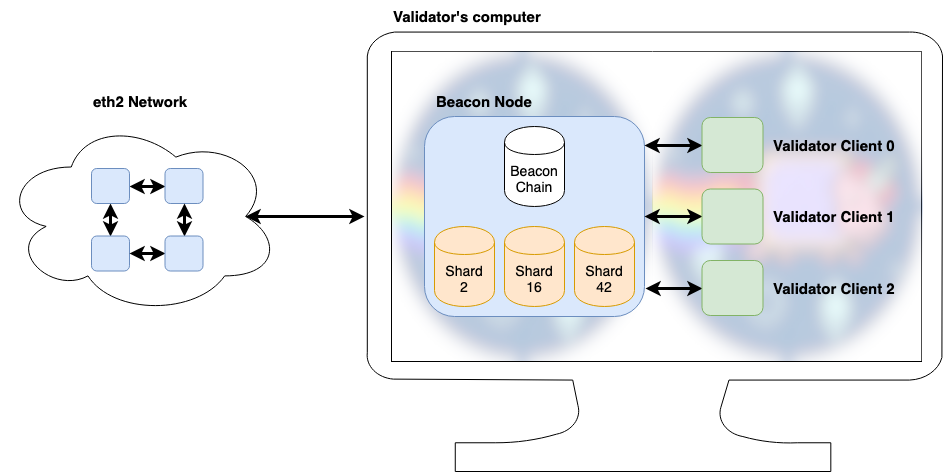
eth2 makes the distinction between beacon nodes and validator clients, and validators will need both in order to perform their duties. A beacon node (or just node) concerns itself with maintaining a view of the beacon chain as well as whichever shards may be needed by a user or validator.

As their name suggests, validator clients (or just clients) handle the logic of a single validator. This is achieved by communicating with the beacon node to understand the current state of the chain, by attesting to and proposing blocks as well when appropriate, and finally by asking the beacon node to send this information on to its peers.

If you are not running a validator, a beacon node contains all of the information you need to trustlessly interact with eth2, much like a full node in eth1.
carlimg1

Below are some of the many arguments for this separation:

  • Each validator needs to be initiated with a deposit of exactly 32 Ether and therefore people who wish to stake more ETH will need to run multiple validator instances. The node-client separation allows such users to only run a single beacon node with multiple validators connected to it thereby reducing computation, memory, and storage requirements.
  • By having validator nodes be separate modules, they will likely be more secure as it is easier to write, reason about, and audit smaller code modules.
  • For users particularly worried about redundancy, multiple nodes can be run in parallel, thus reducing the chance of a validator going offline.
  • Because validator clients can only interact with the rest of the eth2 network via a beacon node, and even then via a restricted API, the attack surface of a validator node is greatly reduced.
  • For users who wish to interact with eth2, but don't want to be a validator, they need only operate a beacon node which will grant them access to the beacon chain and all the shards they require.

Design Philosophy

The design philosophy of eth2 provides useful context for all the decisions made within eth2 and in many instances encapsulate the differences between eth2 and other protocols.

  • Protocol über alles: With the acknowledgement that everything is a trade off, the protocol's safety and liveness take precedence over other design desiderata.
  • Hope for the best, but expect the worst: eth2 assumes validators will be lazy, take bribes, and that they will try to attack the system unless they are otherwise incentivised not to. Furthermore, the network is assumed not to be entirely reliable and that catastrophic events could force large numbers of validators to go offline. For these reasons, eth2 should be capable of surviving World War 3.
  • Minimally viable complexity: Wherever possible, eth2 has been simplified as this makes it easier to reason about, explain to others, audit, write bug free clients, and generally avoid edge cases.
  • Maximally decentralised: Proof of stake protocols commonly compromise on the number of validators that can participate, eth2 is designed to scale to millions of validators while encouraging these validators to work independently of one another.
  • Expect the unexpected: All components of eth2 are resistant to quantum computers or can be swapped out for those that are in the event of a quantum apocalypse.
  • By the people for the people: eth2 must be able to run on a consumer laptop. The lower the barrier to entry, the more people who can participate which translates into a higher degree of decentralisation.

Wrapping up

Now that you have the basics of eth2 under your belt, the next posts in this series will tackle the juicy details of what makes eth2 tick.