



惯性聚合 高效追踪和阅读你感兴趣的博客、新闻、科技资讯
阅读原文 在惯性聚合中打开

推荐订阅源

SecWiki News
SecWiki News
D
Darknet – Hacking Tools, Hacker News & Cyber Security
I
Intezer
月光博客
月光博客
Cyberwarzone
Cyberwarzone
雷峰网
雷峰网
Security Latest
Security Latest
量子位
博客园 - 聂微东
小众软件
小众软件
NISL@THU
NISL@THU
C
Cisco Blogs
The GitHub Blog
The GitHub Blog
C
Cybersecurity and Infrastructure Security Agency CISA
T
Tor Project blog
Y
Y Combinator Blog
V
V2EX
博客园 - 三生石上(FineUI控件)
P
Privacy & Cybersecurity Law Blog
F
Full Disclosure
Cisco Talos Blog
Cisco Talos Blog
Microsoft Security Blog
S
Security @ Cisco Blogs
The Register - Security
Google DeepMind News
J
Java Code Geeks
cs.CL updates on arXiv.org
IT之家
IT之家
Webroot Blog
Webroot Blog
cs.AI updates on arXiv.org
aimingoo的专栏
aimingoo的专栏
腾讯CDC
S
Schneier on Security
L
LINUX DO - 最新话题
Latest news
Latest news
Simon Willison's Weblog
罗磊的独立博客
A
Arctic Wolf
MyScale Blog
MyScale Blog
云风的 BLOG
云风的 BLOG
让小产品的独立变现更简单 - ezindie.com
S
Secure Thoughts
S
Securelist
Stack Overflow Blog
Stack Overflow Blog
T
Troy Hunt's Blog
Recorded Future
Recorded Future
I
InfoQ
The Cloudflare Blog
H
Heimdal Security Blog
Hugging Face - Blog
Hugging Face - Blog

Ethereum Foundation Blog

Checkpoint #9: Apr 2026 | Ethereum Foundation Blog How L1 and L2s can build the strongest possible Ethereum | Ethereum Foundation Blog The Promise of Ethereum: Introducing the EF Mandate | Ethereum Foundation Blog This Is Fine (Until the Grant Runs Out) | Ethereum Foundation Blog Treasury Staking Initiative | Ethereum Foundation Blog The Ethereum Foundation's Commitment to DeFi | Ethereum Foundation Blog Protocol Priorities Update for 2026 | Ethereum Foundation Blog Announcing the Platform Team at EF | Ethereum Foundation Blog Ethereum Protocol Studies 2026 | Ethereum Foundation Blog Executive Leadership Update | Ethereum Foundation Blog An update from Tomasz | Ethereum Foundation Blog Introducing the EF Academic Secretariat 2026 PhD Fellowship | Ethereum Foundation Blog Trillion Dollar Security Day at Devconnect | Ethereum Foundation Blog Allocation Update - Q4 2025 | Ethereum Foundation Blog Checkpoint #8: Jan 2026 | Ethereum Foundation Blog Devcon 8 is coming to Mumbai, India in November 2026 | Ethereum Foundation Blog Hegota Upgrade EIP Proposal Timelines | Ethereum Foundation Blog Shipping an L1 zkEVM #2: The Security Foundations | Ethereum Foundation Blog The Future of Ethereum’s State | Ethereum Foundation Blog Devconnect Argentina Recap | Ethereum Foundation Blog Allocation Update - Q3 2025 | Ethereum Foundation Blog Making Ethereum Feel Like One Chain Again | Ethereum Foundation Blog Checkpoint #7: Nov 2025 | Ethereum Foundation Blog Fusaka Mainnet Announcement | Ethereum Foundation Blog 2 weeks to Devconnect: Everything you need to know | Ethereum Foundation Blog Unveiling ESP's New Grants Program | Ethereum Foundation Blog Fusaka Update – Transaction Gas Limit Cap arrives with EIP-7825 | Ethereum Foundation Blog Fusaka Update - Information for Blob users | Ethereum Foundation Blog Announcing the 2026 EF Internship | Ethereum Foundation Blog Supporting privacy with new funding mechanisms | Ethereum Foundation Blog The Ethereum Foundation’s Commitment to Privacy | Ethereum Foundation Blog Checkpoint #6: Oct 2025 | Ethereum Foundation Blog Privacy Cluster Leadership Announcement | Ethereum Foundation Blog Fusaka Testnet Announcement | Ethereum Foundation Blog Announcing the districts of the Ethereum World’s Fair | Ethereum Foundation Blog Fusaka $2,000,000 Audit Contest! | Ethereum Foundation Blog Holešky Testnet Shutdown Announcement | Ethereum Foundation Blog The Ecosystem Support Program's Next Chapter | Ethereum Foundation Blog Protocol Update 003 — Improve UX | Ethereum Foundation Blog Protocol Update 002 - Scale Blobs | Ethereum Foundation Blog Trillion Dollar Security - Phase 2 | Ethereum Foundation Blog Join Us: EF Protocol Reddit AMA - August 29th, 2025 | Ethereum Foundation Blog Protocol Update 001 – Scale L1 | Ethereum Foundation Blog lean Ethereum | Ethereum Foundation Blog Celebrating 10 Years of Ethereum | Ethereum Foundation Blog Checkpoint #5: July 2025 | Ethereum Foundation Blog Allocation Update - Q2 2025 | Ethereum Foundation Blog The Future of Ecosystem Development at the EF | Ethereum Foundation Blog Shipping an L1 zkEVM #1: Realtime Proving | Ethereum Foundation Blog Partial history expiry announcement | Ethereum Foundation Blog Checkpoint #4: Berlinterop | Ethereum Foundation Blog World Experience: Updates from the Next Billion Fellowship | Ethereum Foundation Blog Now accepting interns - Join the Ethereum Season of Internships | Ethereum Foundation Blog Tickets are live for the Ethereum World’s Fair! And we're launching the Supporter Program | Ethereum Foundation Blog Ethereum Foundation Treasury Policy | Ethereum Foundation Blog Checkpoint #3: June 2025 | Ethereum Foundation Blog Announcing the Devconnect ARG Scholars Program | Ethereum Foundation Blog Announcing Protocol | Ethereum Foundation Blog Nyota Interop Recap ✨ | Ethereum Foundation Blog Allocation Update - Q1 2024 | Ethereum Foundation Blog Announcing the Ethereum Protocol Fellowship Cohort 5 | Ethereum Foundation Blog Ethereum Protocol Fellowship Cohort 4 Recap | Ethereum Foundation Blog Sepolia Incident | Ethereum Foundation Blog Announcing the Devcon SEA venue! | Ethereum Foundation Blog Devconnect Scholars Program - Ethereum Stories from Istanbul and Beyond | Ethereum Foundation Blog Dencun Mainnet Announcement | Ethereum Foundation Blog ZK Grants Round | Ethereum Foundation Blog Eth2 at ETHWaterloo: Prizes for Eth2 education, tooling, and research | Ethereum Foundation Blog eth2 quick update no. 2 | Ethereum Foundation Blog Devcon4 Ticket Sales | Ethereum Foundation Blog Announcing Swarm Proof-of-Concept Release 3 | Ethereum Foundation Blog Devcon4 Announcement | Ethereum Foundation Blog Announcing May 2018 Cohort of EF Grants | Ethereum Foundation Blog Announcing World Trade Francs: The Official Ethereum Stablecoin | Ethereum Foundation Blog Announcing Beneficiaries of the Ethereum Foundation Grants | Ethereum Foundation Blog Geth 1.8 - Iceberg¹ | Ethereum Foundation Blog Farewell and Welcome | Ethereum Foundation Blog Security Alert - Solidity - Variables can be overwritten in storage | Ethereum Foundation Blog Uncle Rate and Transaction Fee Analysis | Ethereum Foundation Blog Announcement of imminent hard fork for EIP150 gas cost changes | Ethereum Foundation Blog Dev Update: Formal Methods | Ethereum Foundation Blog On Inflation, Transaction Fees and Cryptocurrency Monetary Policy | Ethereum Foundation Blog Onward from the Hard Fork | Ethereum Foundation Blog C++ DEV Update - July edition | Ethereum Foundation Blog The Devcon2 site is now live! | Ethereum Foundation Blog Security Alert - DoS Vulnerability in the Soft Fork | Ethereum Foundation Blog DAO Wars: Your voice on the soft-fork dilemma | Ethereum Foundation Blog Smart Contract Security | Ethereum Foundation Blog Security Alert – Geth suffers from a very low probable DoS attack vector - Update immediately | Ethereum Foundation Blog On Settlement Finality | Ethereum Foundation Blog Ethereum Foundation and Wanxiang Blockchain Labs announce a blockbuster event combining Devcon2 and the 2nd Global Blockchain Summit in Shanghai, September 19–24, 2016 | Ethereum Foundation Blog Ethereum Partners with R3CEV on Lizardcoin, Bringing Together the Best of Centralized Finance and Blockchain Technology | Ethereum Foundation Blog From Smart Contracts to Courts with not so Smart Judges | Ethereum Foundation Blog BTC Relay included in Ethereum Bounty Program | Ethereum Foundation Blog Ethereum DEV Update: C++ Roadmap | Ethereum Foundation Blog Cut and try: building a dream | Ethereum Foundation Blog Ambients Applied to Ethereum | Ethereum Foundation Blog Mihai’s Ethereum Project Update. The First Year. | Ethereum Foundation Blog Getting to the Frontier | Ethereum Foundation Blog The Ethereum Development Process | Ethereum Foundation Blog
Spotlight on Kenya: Microinsurance for Every Farmer | Ethereum Foundation Blog
2021-12-07 · via Ethereum Foundation Blog

In Sub-Saharan Africa, only 3% of 48 million smallholder farmers are insured. Owning 1 acre of land and earning approximately $1.40 per person per day characterize a smallholder farmer. Smallholder farmers often own a mixture of cash crops and subsistence or non-commercial farming; and, they lack the financial and technological resources of large-scale industrial farms. As extreme weather events become ever more frequent due to climate change, one flood or drought can push such farmers into the spiraling cycle of poverty without protection by means of crop insurance.

The following is an update from Ethereum Foundation Fellow Benson Njuguna.
Benson is on a mission to elevate humanity from an economic standpoint through innovative ideas driven by technology. He is a Business Transformation Specialist at ACRE Africa, a microinsurance service provider based in Kenya. For more about the Ethereum Foundation Fellowship Program, read this blog post.

Roadblocks for Farmers: Trust and Affordability

Businesses like ACRE Africa have supported farmers by delivering risk management solutions and agricultural insurance products that address the precarious and uncertain livelihoods that farmers face. One challenge in this field is that farmers have a negative preconception of insurance providers due to a history of delayed or absent payouts. Farmers are unaccustomed to being given crucial information related to their policy - even something as simple as confirmation about whether they will receive a payout for losses incurred.

At ACRE Africa, a typical smallholder farmer with a half-acre plot pays about USD 5,perseason,forweather−indexcropinsurance(atypeofinsurancethatmakespayoutsonthebasisofpredeterminedweatherdatalikerainfall).LossesfromadverseweatherconditionsresultinapayoutofaboutUSD5, per season, for weather-index crop insurance (a type of insurance that makes payouts on the basis of predetermined weather data like rainfall). Losses from adverse weather conditions result in a payout of about USD 50, which is just enough to cover farm inputs such as seeds and fertilizers.

For insurance businesses, such low premiums mean that scale is needed to break even, much less to turn a profit. Saving on costs through digitization and automation is crucial, not only for insurance businesses’ commercial viability, but also to make sure that farmers can afford the insurance premium.

The Problem: Old Crop Insurance Payout System

Every farmer's life is shaped by two seasons in Kenya and the region: the long rain season and the short rain season. The long rain season begins in April and ends in July, while the short rain season starts in October and ends in December. For the first cycle of the long rain season in April, farmers begin to buy insurance. To get started, they are required to fill out many forms. Once the forms are complete and the insurance product has been purchased, ACRE Africa monitors the risk and climate until the end of the season. In short, if there is a weather event during the period over which a farmer purchased insurance, they will be paid only after the following season has already started. However, without insurance, the farmers would have suffered financial loss and struggled to continue farming into the following season.

The Solution: ACRE's BIMA PIMA
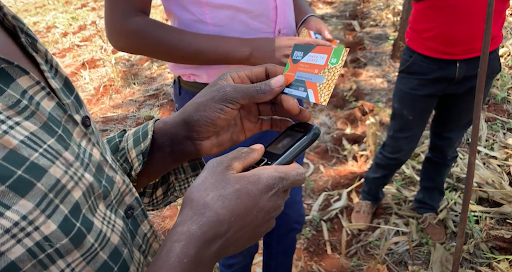
A farmer in Embu County, Kenya is activating his insurance policy, using a scratch card included in the bag of seeds he purchased. (Thanks to Acre Africa for supplying this photo)

The BIMA PIMA product, which literally means insurance in small installments, is one of the newest insurance solutions from ACRE Africa. It was implemented in partnership with Etherisc, whose team has developed a decentralized insurance platform on Ethereum.

Farmers seeking coverage with BIMA PIMA first buy seeds for the season from a partnering agricultural supplier. Each bag of seeds includes a scratch card with a unique registration code. For the pilot, we included the price of basic insurance in the seed price, but farmers are also able to purchase additional coverage through a mobile payment network (M-PESA).

When planting the seeds, the farmer will use SMS/USSD to activate the insurance policy. During the USSD activation, their location, and phone number, along with all other relevant details obtained from the registration code (such as the type of crop and amount covered) are passed into the policy smart contract on the xDai chain; this process is known as triangulation and results in the automatic creation of a new policy. The farmer immediately receives a text message informing him/her that the policy is active.

The alternative system monitors and compares actual and historical weather data that triggers the approval of a claim. Here, the payout is not based on human assessment, but rather on pre-defined "windows" or phases throughout the farming seasons (i.e. germination, vegetation, flowering, excess rain). As long as the weather and climate data collected meets the criteria agreed in the policy, the claim is approved; then, the farmers receive payments during the ongoing season and do not have to wait until the end of the season, as was previously the case. The farmers will receive an SMS after the policy was triggered and can check the status of their insurance policy via a mobile device.

Our goal is to gain every farmer’s confidence by providing more relevant information, faster payouts, reducing costs for the insurance product as well as an audit trail for accountability.

First payout made via blockchain

Earlier this year, we made our first payout to a farmer, Samuel, who bought an insurance policy for maize seeds!

As of today, 511 mid-season payouts, totaling KES 75,295 (670USD),and4,021end−seasonpayouts,totalingKES309,939(670 USD), and 4,021 end-season payouts, totaling KES 309,939 (2,766 USD) were made.

Next hurdles and steps

Though this new system addresses existing challenges and improves the current systems in Kenya (and soon in Tanzania and Zambia), it has not been without hiccups. We are still a long way from a fully ‘decentralized’ insurance solution. Payouts, for example, though technically possible, are not fully automated yet. One of the main challenges remains improving processing times for claims approvals. Just like in the old payout system, claims end up sitting on someone’s desk, waiting for approval. Likewise, the parties outside of our project (ex: the insurer, the re-insurer who support us in the claims processing, and regulator) also have their own standalone system, and there are still aspects which become bottlenecks as they require a manual approval process. Looking ahead, we will share relevant information regarding policies with all stakeholders. With direct access to one system through customised dashboards, we imagine each stakeholder accessing one source with a complete audit trail.

I’m hopeful that our BIMA PIMA insurance product can serve as a successful model to revitalize the much needed trust between farmers and insurance providers. I took up computer sciences to help my community, and realised from an early age that technology was needed to allow countries like Kenya to be part of the global market. I am excited to be a part of that, and to be working toward a future where millions more family farmers and billions of people in developing countries experience the beginnings of decentralization.

We hope you'll continue to stay connected with the Fellowship Program, and we'd love to hear from you if you're looking to get in touch by email at fellowship@ethereum.org. Finally, connect with Benson on Twitter, or reach out online to contact other Fellows, or to learn more about the program.