


惯性聚合 高效追踪和阅读你感兴趣的博客、新闻、科技资讯
阅读原文 在惯性聚合中打开

推荐订阅源

Scott Helme
Scott Helme
宝玉的分享
宝玉的分享
B
Blog RSS Feed
博客园 - 司徒正美
Stack Overflow Blog
Stack Overflow Blog
博客园_首页
H
Help Net Security
T
The Blog of Author Tim Ferriss
让小产品的独立变现更简单 - ezindie.com
月光博客
月光博客
F
Full Disclosure
爱范儿
爱范儿
罗磊的独立博客
G
Google Developers Blog
Last Week in AI
Last Week in AI
Jina AI
Jina AI
量子位
Hacker News: Ask HN
Hacker News: Ask HN
aimingoo的专栏
aimingoo的专栏
PCI Perspectives
PCI Perspectives
酷 壳 – CoolShell
酷 壳 – CoolShell
Application and Cybersecurity Blog
S
Secure Thoughts
L
LINUX DO - 最新话题
Exploit-DB.com RSS Feed
Project Zero
Project Zero
云风的 BLOG
云风的 BLOG
V
V2EX
H
Heimdal Security Blog
Engineering at Meta
Engineering at Meta
I
InfoQ
D
Darknet – Hacking Tools, Hacker News & Cyber Security
Hugging Face - Blog
Hugging Face - Blog
博客园 - 聂微东
S
Security Affairs
Security Archives - TechRepublic
Cyberwarzone
Cyberwarzone
G
GRAHAM CLULEY
Apple Machine Learning Research
The GitHub Blog
The GitHub Blog
T
Tor Project blog
Recent Commits to openclaw:main
Attack and Defense Labs
Know Your Adversary
Know Your Adversary
CTFtime.org: upcoming CTF events
D
Docker
Vercel News
Vercel News
Cyber Security Advisories - MS-ISAC
有赞技术团队
有赞技术团队
J
Java Code Geeks

Ethereum Foundation Blog

Checkpoint #9: Apr 2026 | Ethereum Foundation Blog How L1 and L2s can build the strongest possible Ethereum | Ethereum Foundation Blog The Promise of Ethereum: Introducing the EF Mandate | Ethereum Foundation Blog This Is Fine (Until the Grant Runs Out) | Ethereum Foundation Blog Treasury Staking Initiative | Ethereum Foundation Blog The Ethereum Foundation's Commitment to DeFi | Ethereum Foundation Blog Protocol Priorities Update for 2026 | Ethereum Foundation Blog Announcing the Platform Team at EF | Ethereum Foundation Blog Ethereum Protocol Studies 2026 | Ethereum Foundation Blog Executive Leadership Update | Ethereum Foundation Blog An update from Tomasz | Ethereum Foundation Blog Introducing the EF Academic Secretariat 2026 PhD Fellowship | Ethereum Foundation Blog Trillion Dollar Security Day at Devconnect | Ethereum Foundation Blog Allocation Update - Q4 2025 | Ethereum Foundation Blog Checkpoint #8: Jan 2026 | Ethereum Foundation Blog Devcon 8 is coming to Mumbai, India in November 2026 | Ethereum Foundation Blog Hegota Upgrade EIP Proposal Timelines | Ethereum Foundation Blog Shipping an L1 zkEVM #2: The Security Foundations | Ethereum Foundation Blog The Future of Ethereum’s State | Ethereum Foundation Blog Devconnect Argentina Recap | Ethereum Foundation Blog Allocation Update - Q3 2025 | Ethereum Foundation Blog Making Ethereum Feel Like One Chain Again | Ethereum Foundation Blog Checkpoint #7: Nov 2025 | Ethereum Foundation Blog Fusaka Mainnet Announcement | Ethereum Foundation Blog 2 weeks to Devconnect: Everything you need to know | Ethereum Foundation Blog Unveiling ESP's New Grants Program | Ethereum Foundation Blog Fusaka Update – Transaction Gas Limit Cap arrives with EIP-7825 | Ethereum Foundation Blog Fusaka Update - Information for Blob users | Ethereum Foundation Blog Announcing the 2026 EF Internship | Ethereum Foundation Blog Supporting privacy with new funding mechanisms | Ethereum Foundation Blog The Ethereum Foundation’s Commitment to Privacy | Ethereum Foundation Blog Checkpoint #6: Oct 2025 | Ethereum Foundation Blog Privacy Cluster Leadership Announcement | Ethereum Foundation Blog Fusaka Testnet Announcement | Ethereum Foundation Blog Announcing the districts of the Ethereum World’s Fair | Ethereum Foundation Blog Fusaka $2,000,000 Audit Contest! | Ethereum Foundation Blog Holešky Testnet Shutdown Announcement | Ethereum Foundation Blog The Ecosystem Support Program's Next Chapter | Ethereum Foundation Blog Protocol Update 003 — Improve UX | Ethereum Foundation Blog Protocol Update 002 - Scale Blobs | Ethereum Foundation Blog Trillion Dollar Security - Phase 2 | Ethereum Foundation Blog Join Us: EF Protocol Reddit AMA - August 29th, 2025 | Ethereum Foundation Blog Protocol Update 001 – Scale L1 | Ethereum Foundation Blog lean Ethereum | Ethereum Foundation Blog Celebrating 10 Years of Ethereum | Ethereum Foundation Blog Checkpoint #5: July 2025 | Ethereum Foundation Blog Allocation Update - Q2 2025 | Ethereum Foundation Blog The Future of Ecosystem Development at the EF | Ethereum Foundation Blog Shipping an L1 zkEVM #1: Realtime Proving | Ethereum Foundation Blog Partial history expiry announcement | Ethereum Foundation Blog Checkpoint #4: Berlinterop | Ethereum Foundation Blog World Experience: Updates from the Next Billion Fellowship | Ethereum Foundation Blog Now accepting interns - Join the Ethereum Season of Internships | Ethereum Foundation Blog Tickets are live for the Ethereum World’s Fair! And we're launching the Supporter Program | Ethereum Foundation Blog Ethereum Foundation Treasury Policy | Ethereum Foundation Blog Checkpoint #3: June 2025 | Ethereum Foundation Blog Announcing the Devconnect ARG Scholars Program | Ethereum Foundation Blog Announcing Protocol | Ethereum Foundation Blog Nyota Interop Recap ✨ | Ethereum Foundation Blog Allocation Update - Q1 2024 | Ethereum Foundation Blog Announcing the Ethereum Protocol Fellowship Cohort 5 | Ethereum Foundation Blog Ethereum Protocol Fellowship Cohort 4 Recap | Ethereum Foundation Blog Sepolia Incident | Ethereum Foundation Blog Announcing the Devcon SEA venue! | Ethereum Foundation Blog Devconnect Scholars Program - Ethereum Stories from Istanbul and Beyond | Ethereum Foundation Blog Dencun Mainnet Announcement | Ethereum Foundation Blog ZK Grants Round | Ethereum Foundation Blog Eth2 at ETHWaterloo: Prizes for Eth2 education, tooling, and research | Ethereum Foundation Blog eth2 quick update no. 2 | Ethereum Foundation Blog Devcon4 Ticket Sales | Ethereum Foundation Blog Announcing Swarm Proof-of-Concept Release 3 | Ethereum Foundation Blog Devcon4 Announcement | Ethereum Foundation Blog Announcing May 2018 Cohort of EF Grants | Ethereum Foundation Blog Announcing World Trade Francs: The Official Ethereum Stablecoin | Ethereum Foundation Blog Announcing Beneficiaries of the Ethereum Foundation Grants | Ethereum Foundation Blog Geth 1.8 - Iceberg¹ | Ethereum Foundation Blog Farewell and Welcome | Ethereum Foundation Blog Security Alert - Solidity - Variables can be overwritten in storage | Ethereum Foundation Blog Uncle Rate and Transaction Fee Analysis | Ethereum Foundation Blog Announcement of imminent hard fork for EIP150 gas cost changes | Ethereum Foundation Blog Dev Update: Formal Methods | Ethereum Foundation Blog On Inflation, Transaction Fees and Cryptocurrency Monetary Policy | Ethereum Foundation Blog Onward from the Hard Fork | Ethereum Foundation Blog C++ DEV Update - July edition | Ethereum Foundation Blog The Devcon2 site is now live! | Ethereum Foundation Blog Security Alert - DoS Vulnerability in the Soft Fork | Ethereum Foundation Blog DAO Wars: Your voice on the soft-fork dilemma | Ethereum Foundation Blog Smart Contract Security | Ethereum Foundation Blog Security Alert – Geth suffers from a very low probable DoS attack vector - Update immediately | Ethereum Foundation Blog On Settlement Finality | Ethereum Foundation Blog Ethereum Foundation and Wanxiang Blockchain Labs announce a blockbuster event combining Devcon2 and the 2nd Global Blockchain Summit in Shanghai, September 19–24, 2016 | Ethereum Foundation Blog Ethereum Partners with R3CEV on Lizardcoin, Bringing Together the Best of Centralized Finance and Blockchain Technology | Ethereum Foundation Blog From Smart Contracts to Courts with not so Smart Judges | Ethereum Foundation Blog BTC Relay included in Ethereum Bounty Program | Ethereum Foundation Blog Ethereum DEV Update: C++ Roadmap | Ethereum Foundation Blog Cut and try: building a dream | Ethereum Foundation Blog Ambients Applied to Ethereum | Ethereum Foundation Blog Mihai’s Ethereum Project Update. The First Year. | Ethereum Foundation Blog Getting to the Frontier | Ethereum Foundation Blog The Ethereum Development Process | Ethereum Foundation Blog
Ether Sale: A Statistical Overview | Ethereum Foundation Blog
2014-08-08 · via Ethereum Foundation Blog

The first two weeks of the ether sale are over, and we have to date received over 25000 BTC from selling over 50 million ETH. This marks the largest cryptographic token sale to date, and with the two endowments places ETH as being the token with the 8th highest total value, even beating out the beloved Dogecoin at 17.3MUSDvs17.3M USD vs 15.5M. A total of 6670 transactions have been made, with values ranging from the minimum 0.01 BTC to a high of 500 BTC, and purchases continue to come in every hour. Additionally, the ether sale marks the largest use of multisig to date; because of our sale, the percentage of all BTC stored in multisig has shot up from 0.23% to 0.41% over the last two weeks alone - in other words, the 3-of-4 private keys split between our various sites control 45% of all BTC stored in multisig addresses in existence.

The purpose of this post will be to provide an overview of some statistics from the sale so far. Data was taken yesterday, when we had 24000 BTC, and assumes that all purchases were for 2000 ETH / BTC (an assumption that is not strictly true, but the error term is sufficiently tiny that it can safely be discounted). First we have this spreadsheet, which shows the ether purchases over time.

The individual spikes are per-block; the chart shows that the distribution is heavily divided into two clusters, with one cluster closer to the start of the sale and the other close to the end of the full-discount period. Purchases drop off sharply once the new price level of 1970 ETH/BTC (now 1910 ETH/BTC) kicked in. Theoretically, purchasing near the end of the full-discount period is the more optimal strategy from a naive game-theoretic model; if you purchase near the end of the full-discount period then you get the same price as people who purchased at the start, but also gain the benefit of having more information - namely, a better idea of the exact percentage of all ETH that you are going to get. Thus, the fact that the majority of purchases occurred at the end shows that ether purchasers are generally a rather sophisticated audience - which I suppose you should be if you managed to be convinced to trade your hard-earned BTC for some cryptographic tokens backed by a concept of "generalized consensus computing".

Of course, it is important to note that there are reasons to buy at the start too. Some people are participating in the sale out of a desire to support the project, and some large purchasers may have perhaps had the priming effect in mind, where putting larger sums of money (eg. bills) into a tipping jar at the very beginning increases the total amount received because it creates the impression that the recipient is significant and merits more and larger contributions.

At this point, we can expect to see a declining flow that will stabilize over the next few days, and then a smaller final spike on day 42. The chart below shows the cumulative ether sold up until this point:

https://docs.google.com/a/ethereum.org/spreadsheets/d/1H5w9YVp1eRoNP8N9UFFvCcz51Q5DxzJaOVliCAAT46g/gviz/chartiframe?oid=831527247

The other interesting thing to analyze is the distribution of purchases. This spreadsheet contains a list of purchases arranged by purchase size. The largest single purchase was 500 BTC (1 million ether), followed by one at 466 BTC (933,580 ETH) and 330 BTC (660,360 ETH). We have not received any requests at largepurchases@ethereum.org. If we arrange purchases by size, we get the following two graphs, one for the quantity of purchases and one for the amount of ETH purchased, by purchase size:

https://docs.google.com/a/ethereum.org/spreadsheets/d/1GS9pzSdMx9lK0XGSKEDr_aoi02riq3MPRyvEntVUm68/gviz/chartiframe?oid=168457404

https://docs.google.com/a/ethereum.org/spreadsheets/d/1GS9pzSdMx9lK0XGSKEDr_aoi02riq3MPRyvEntVUm68/gviz/chartiframe?oid=846945325

Note that this only applies to purchases. There is also another slice of ether which will soon be distributed, which is the endowment. The portions in which the endowment is planned to be distributed are on the spreadsheet; the largest is equal to 0.922% of all ether purchased (ie. 0.369% of the total supply after five years) and the smallest is 0.004%, with 81 people total receiving a share. If you are one of the recipients, you will be contacted shortly; if you are not then there is still a second slice whose distribution has not been decided.

Distribution and Gini Indices

As a final set of interesting statistics, we have calculated three Gini indices:

  • Gini index of ether purchasers: 0.832207
  • Gini index of endowment: 0.599638
  • Gini index of entire set: 0.836251

A Gini index is a common measure of inequality; the way the Gini index is calculated is by drawing a chart, with both axes going from 0% to 100%, and drawing a line where the Y coordinate at a particular X coordinate is calculated as the portion of all income (or wealth) which is owned by the bottom X percent of the population. The area between this curve and a diagonal line, as a portion of the area of the entire triangle under the diagonal line, is the Gini index:
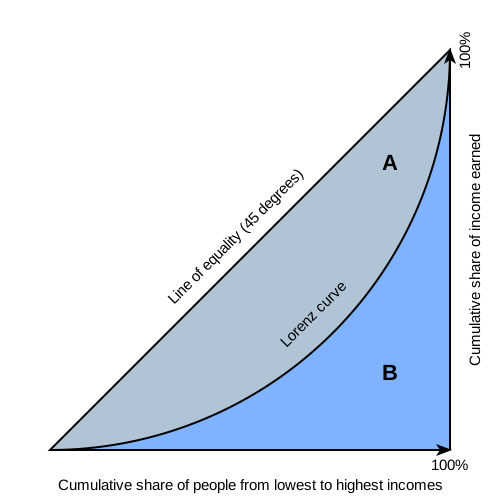
In an ideal society of perfect equality, the coefficient would be zero; the bottom X% of the population would obviously have X% of the wealth, just like any other X% of the population, so the cumulative wealth distribution graph would be exactly the diagonal line and thus the area between the graph and the diagonal line would be zero. In the opposite scenario, an ultimate dictatorship where one person controls everything, the bottom X% would have exactly nothing all the way up until the last person, who would have everything; hence, the area between that curve and the diagonal line would be equal to the entire area under the diagonal line, and the coefficient would be exactly one. Most real-world scenarios are in between the two.

Note that Gini coefficients of wealth and Gini coefficients of income are different things; one measures how much people have and one measures the rate at which people receive. Because savings are superlinear in income, coefficients of wealth tend to be higher; the Gini coefficient of wealth in the US, for example, is 0.801, and the coefficient of the world is 0.804. Given that Gini coefficients in the real world measure inequality of access to resources, and Gini coefficients in cryptocurrency distribution arise from both inequality of resources and inequality of interest (some people care about Ethereum slightly, some care about it a whole lot), 0.836 is a pretty decent result - as a point of comparison, the Gini coefficient of Bitcoin has been measured at 0.877. The top 100 current ETH holders are responsible for 45.7% of all ETH, a lower percentage than the top 100 holders of the mainstream altcoins, where that statistic tends to be between 55% and 70%.

Of course, these last two comparisons are misleading - the Ethereum ecosystem has not even started to actually run, and services like exchanges which centralize control over currency units into a few wallets without centralizing legal ownership do end up artificially inflating both the Gini index and the top-100 score of cryptocurrency networks that are actually live. Once Ethereum launches, the Gini index may well prove to be impossible to accurately estimate, since large quantities of ether will be stored inside decentralized applications running arbitrary, Turing-complete, and thus in many cases mathematically inscrutable, rulesets for how the ether can be withdrawn.

The sale still has 28 days left to go; although we are not expecting much out of this remaining period, anything is possible. With organizational issues being wrapped up, the organization is getting ready to substantially scale up development, putting us on the fast track to finally completing the Ethereum code and launching the genesis block; ETA winter 2014-2015.