Fee-Based Advertising Business Model: 2026 Guide - FourWe...
Gennaro Cuofano·2026-05-27·via FourWeekMBA
Last Updated: May 2026 — Enhanced with AI business impact analysis
The advertising business model is a revenue generation strategy supported by the sale of advertising. In general, a business must first establish an audience by generating content or facilitating interaction and then earn revenue by selling access to that audience. The advertising business model has become popular in the web era, where companies like Google and Facebook have been able to build the largest digital advertising machines on earth.
Business Model Explorers
Understanding the advertising business model
The advertising business model has long been associated with newspapers, magazines, radio, television, and any other medium where advertising revenue is critical to the survival of the business.
Today, the model is a staple of many online businesses, from eCommerce sites such as Amazon to search engines such as Google and everything in between. In most cases, the model is only successful if the business can generate large volumes of targeted traffic. Revenue in this context is generated in three main ways:
Advertisers pay website owners to display advertising on their site.
Advertisers pay website owners to refer visitors to the advertiser’s website.
Advertisers pay website owners to display advertising messages with the ability for the consumer to click through to their website.
As more businesses monetize their content, website owners have tried to counter the rising prevalence of ad-blockers by serving native ads which mimic normal content. This, some suggest, has caused an arms race between consumers using ad-blockers and businesses hiding their content behind paywalls.
Despite recent conjecture that it may become obsolete, the advertising business model will continue to be a significant strategy moving forward. Once established, the model enables businesses to make money without the hassle of selling a product or a service. What’s more, advertisers are often willing to pay more for access to a highly targeted or engaged audience.
Four basic advertising strategies
While there are many ways a business can earn money from advertising, the following four categories cover the vast majority of advertisement models in the digital space:
Display advertising
Most of these are banner ads, which have been declining in popularity as consumers become more averse to them. These ads are small, digital billboards placed around content and can be animated or static. They are commonly used to depict a fast visual story that promotes brand identity, with revenue collected according to the cost-per-impression (CPM) model.
Video advertising
Unsurprisingly, video ads are now the predominant form of advertising because they are entertaining and can tell a brand story in a way that a banner ad never could. They are typically shown pre-roll, mid-roll, or post-roll in a video the consumer is already watching. Since they are relevant and contextual, the viewer is more open to watching them.
Mobile advertising
These are optimized for mobile content consumption and include video, app, display, search, and social-based ads. Mobile advertising often works under the cost-per-lead model.
Native advertising
Considered the least disruptive ads because they are incorporated into a piece of content. Like many video ads, native ads are relevant and contextual. They may take the form of videos, photos, or blog posts with a simple text link to the product manufacturer’s website. Google Adsense is one example of native advertising where advertisers pay website owners whenever their ads are clicked on by the user.
Key takeaways:
The advertising business model is a revenue generation strategy supported by the sale of advertising. The business must first establish an audience by generating content or facilitating interaction and then earn revenue by selling access to that audience.
The advertising business model is still relevant today as online consumers become more averse to traditional promotional strategies. What’s more, the strategy is attractive to website owners who want to monetize their audiences and earn revenue without the hassle of selling a product or service.
There are four general advertising types under the advertising business model: display advertising, video advertising, mobile advertising, and native advertising. Many argue display advertising is now redundant as consumers become savvier and spend more of their time watching videos on smartphones.
Key Highlights
Definition and Concept: The advertising business model is centered around generating revenue by selling advertising space to businesses. It involves building an audience through content creation or interactions and then capitalizing on that audience by offering access to advertisers.
Evolution in the Digital Era: While the advertising model has long been used in traditional media like newspapers and TV, it has gained immense popularity in the digital age. Giants like Google and Facebook have created vast digital advertising platforms.
Online Application: The advertising model is prevalent in various online businesses, from e-commerce platforms like Amazon to search engines like Google. Success hinges on generating significant amounts of targeted traffic.
Revenue Generation Methods: Revenue in this model is typically generated through three primary avenues:
Displaying advertisements on a website for payment.
Referring visitors to advertisers’ websites for a fee.
Displaying clickable ads that direct users to the advertiser’s site.
Ad-Blockers and Native Ads: To counter the rise of ad-blockers, businesses have adopted native ads that blend seamlessly with content. This has sparked a competition between users using ad-blockers and businesses trying to bypass them with native content.
Future Outlook: Despite speculation about obsolescence, the advertising model will likely remain significant. It allows businesses to profit without selling products or services directly and offers access to targeted audiences that advertisers are willing to pay for.
Four Major Advertising Strategies:
Display Advertising: Typically banner ads, displayed around content, but their popularity has declined due to consumer aversion. Revenue is often based on the cost-per-impression (CPM) model.
Video Advertising: Dominant in the modern landscape due to its storytelling potential. Shown pre-roll, mid-roll, or post-roll in videos. Viewers are more receptive due to relevance and context.
Mobile Advertising: Optimized for mobile devices, covering video, app, display, search, and social ads. Commonly uses the cost-per-lead model.
Native Advertising: Less disruptive, as ads are integrated into content. They appear as videos, photos, or blog posts, often with a link to the product’s website. Example: Google Adsense.
AI is fundamentally reshaping how advertising companies generate and capture revenue by transforming audience targeting precision and pricing mechanisms. Traditional advertising models relied on broad demographic segments and estimated reach, but AI enables real-time behavioral prediction and micro-targeting that can increase ad effectiveness by 30-50% according to recent industry studies. This shift allows advertising platforms to command premium rates for highly targeted placements while reducing waste for advertisers.
The operational transformation is equally significant. AI-powered programmatic advertising now accounts for over 85% of digital display ad spending, automating the buying and selling process that previously required extensive human intervention. Machine learning algorithms can optimize ad placement, timing, and creative elements in milliseconds, creating new revenue streams through performance-based pricing models rather than simple impressions or clicks.
For competitive positioning, AI creates both opportunities and threats. Companies with sophisticated AI capabilities can offer superior targeting and measurement, while those without risk obsolescence. The technology also enables new entrants to compete with established players by leveraging AI tools to build efficient advertising platforms without massive infrastructure investments. By 2026, advertising companies will likely operate as AI-first businesses where human expertise focuses on strategic oversight rather than tactical execution.
An effective business model has to focus on two dimensions: the people dimension and the financial dimension. The people dimension will allow you to build a product or service that is 10X better than existing ones and a solid brand. The financial dimension will help you develop proper distribution channels by identifying the people that are willing to pay for your product or service and make it financially sustainable in the long run.
Business model innovation is about increasing the success of an organization with existing products and technologies by crafting a compelling value proposition able to propel a new business model to scale up customers and create a lasting competitive advantage. And it all starts by mastering the key customers.
Digital and tech business models can be classified according to four levels of transformation into digitally-enabled, digitally-enhanced, tech or platform business models, and business platforms/ecosystems.
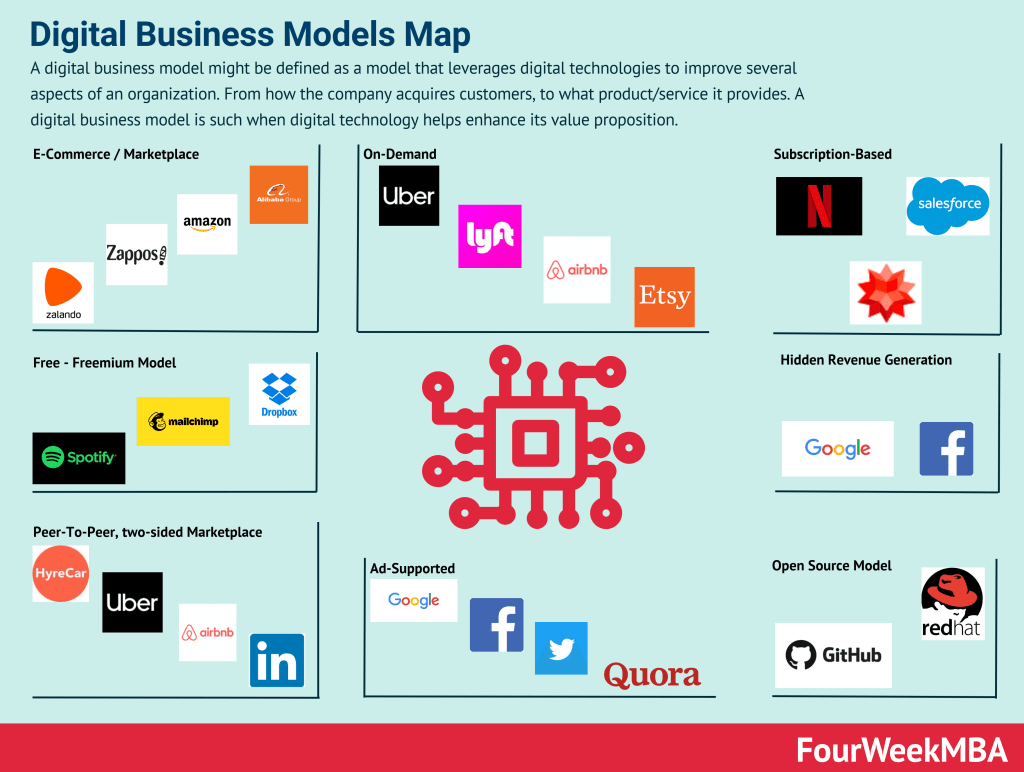
A digital business model might be defined as a model that leverages digital technologies to improve several aspects of an organization. From how the company acquires customers, to what product/service it provides. A digital business model is such when digital technology helps enhance its value proposition.
A tech business model is made of four main components: value model (value propositions, mission, vision), technological model (R&D management), distribution model (sales and marketing organizational structure), and financial model (revenue modeling, cost structure, profitability and cash generation/management). Those elements coming together can serve as the basis to build a solid tech business model.
A platform business model generates value by enabling interactions between people, groups, and users by leveraging network effects. Platform business models usually comprise two sides: supply and demand. Kicking off the interactions between those two sides is one of the crucial elements for a platform business model success.
A Blockchain Business Model is made of four main components: Value Model (Core Philosophy, Core Value and Value Propositions for the key stakeholders), Blockchain Model (Protocol Rules, Network Shape and Applications Layer/Ecosystem), Distribution Model (the key channels amplifying the protocol and its communities), and the Economic Model (the dynamics through which protocol players make money). Those elements coming together can serve as the basis to build and analyze a solid Blockchain Business Model.
In an asymmetric businessmodel, the organization doesn’t monetize the user directly, but it leverages the data users provide coupled with technology, thus have a key customer pay to sustain the core asset. For example, Google makes money by leveraging users’ data, combined with its algorithms sold to advertisers for visibility.
In an asymmetric businessmodel, the organization doesn’t monetize the user directly, but it leverages the data users provide coupled with technology, thus having a key customer pay to sustain the core asset. For example, Google makes money by leveraging users’ data, combined with its algorithms sold to advertisers for visibility. This is how attention merchants make monetize their business models.
While the term has been coined by Andrew Lampitt, open-core is an evolution of open-source. Where a core part of the software/platform is offered for free, while on top of it are built premium features or add-ons, which get monetized by the corporation who developed the software/platform. An example of the GitLab open core model, where the hosted service is free and open, while the software is closed.
Cloud business models are all built on top of cloud computing, a concept that took over around 2006 when former Google’s CEO Eric Schmit mentioned it. Most cloud-based business models can be classified as IaaS (Infrastructure as a Service), PaaS (Platform as a Service), or SaaS (Software as a Service). While those models are primarily monetized via subscriptions, they are monetized via pay-as-you-go revenue models and hybrid models (subscriptions + pay-as-you-go).
Open source is licensed and usually developed and maintained by a community of independent developers. While the freemium is developed in-house. Thus the freemium give the company that developed it, full control over its distribution. In an open-source model, the for-profit company has to distribute its premium version per its open-source licensing model.
The freemium – unless the whole organization is aligned around it – is a growth strategy rather than a business model. A free service is provided to a majority of users, while a small percentage of those users convert into paying customers through the sales funnel. Free users will help spread the brand through word of mouth.
A freeterprise is a combination of free and enterprise where free professional accounts are driven into the funnel through the free product. As the opportunity is identified the company assigns the free account to a salesperson within the organization (inside sales or fields sales) to convert that into a B2B/enterprise account.
A marketplace is a platform where buyers and sellers interact and transact. The platform acts as a marketplace that will generate revenues in fees from one or all the parties involved in the transaction. Usually, marketplaces can be classified in several ways, like those selling services vs. products or those connecting buyers and sellers at B2B, B2C, or C2C level. And those marketplaces connecting two core players, or more.
B2B, which stands for business-to-business, is a process for selling products or services to other businesses. On the other hand, a B2C sells directly to its consumers.
A B2B2C is a particular kind of business model where a company, rather than accessing the consumer market directly, it does that via another business. Yet the final consumers will recognize the brand or the service provided by the B2B2C. The company offering the service might gain direct access to consumers over time.
Direct-to-consumer (D2C) is a business model where companies sell their products directly to the consumer without the assistance of a third-party wholesaler or retailer. In this way, the company can cut through intermediaries and increase its margins. However, to be successful the direct-to-consumers company needs to build its own distribution, which in the short term can be more expensive. Yet in the long-term creates a competitive advantage.
The C2C business model describes a market environment where one customer purchases from another on a third-party platform that may also handle the transaction. Under the C2C model, both the seller and the buyer are considered consumers. Customer to customer (C2C) is, therefore, a business model where consumers buy and sell directly between themselves. Consumer-to-consumer has become a prevalent business model especially as the web helped disintermediate various industries.
A retail business model follows a direct-to-consumer approach, also called B2C, where the company sells directly to final customers a processed/finished product. This implies a business model that is mostly local-based, it carries higher margins, but also higher costs and distribution risks.
The wholesale model is a selling model where wholesalers sell their products in bulk to a retailer at a discounted price. The retailer then on-sells the products to consumers at a higher price. In the wholesale model, a wholesaler sells products in bulk to retail outlets for onward sale. Occasionally, the wholesaler sells direct to the consumer, with supermarket giant Costco the most obvious example.
The term “crowdsourcing” was first coined by Wired Magazine editor Jeff Howe in a 2006 article titled Rise of Crowdsourcing. Though the practice has existed in some form or another for centuries, it rose to prominence when eCommerce, social media, and smartphone culture began to emerge. Crowdsourcing is the act of obtaining knowledge, goods, services, or opinions from a group of people. These people submit information via social media, smartphone apps, or dedicated crowdsourcing platforms.
In a franchained business model (a short-term chain, long-term franchise) model, the company deliberately launched its operations by keeping tight ownership on the main assets, while those are established, thus choosing a chain model. Once operations are running and established, the company divests its ownership and opts instead for a franchising model.
Businesses employing the brokerage business model make money via brokerage services. This means they are involved with the facilitation, negotiation, or arbitration of a transaction between a buyer and a seller. The brokerage business model involves a business connecting buyers with sellers to collect a commission on the resultant transaction. Therefore, acting as a middleman within a transaction.
Dropshipping is a retail business model where the dropshipper externalizes the manufacturing and logistics and focuses only on distribution and customer acquisition. Therefore, the dropshipper collects final customers’ sales orders, sending them over to third-party suppliers, who ship directly to those customers. In this way, through dropshipping, it is possible to run a business without operational costs and logistics management.