惯性聚合 高效追踪和阅读你感兴趣的博客、新闻、科技资讯
阅读原文 在惯性聚合中打开

推荐订阅源

The GitHub Blog
The GitHub Blog
P
Privacy International News Feed
博客园_首页
Hugging Face - Blog
Hugging Face - Blog
A
About on SuperTechFans
量子位
钛媒体:引领未来商业与生活新知
钛媒体:引领未来商业与生活新知
雷峰网
雷峰网
Cyber Security Advisories - MS-ISAC
V
V2EX
Recent Announcements
博客园 - 叶小钗
B
Blog RSS Feed
Apple Machine Learning Research
Microsoft Azure Blog
H
Help Net Security
C
Check Point Blog
N
Netflix TechBlog - Medium
Y
Y Combinator Blog
P
Proofpoint News Feed
T
The Blog of Author Tim Ferriss
D
DataBreaches.Net
月光博客
月光博客
Engineering at Meta
Engineering at Meta
博客园 - 【当耐特】
Martin Fowler
Martin Fowler
小众软件
小众软件
博客园 - 司徒正美
大猫的无限游戏
大猫的无限游戏
爱范儿
爱范儿
M
MIT News - Artificial intelligence
G
Google Developers Blog
MyScale Blog
MyScale Blog
Google DeepMind News
D
Docker
有赞技术团队
有赞技术团队
H
Hackread – Cybersecurity News, Data Breaches, AI and More
V
Visual Studio Blog
Recorded Future
Recorded Future
I
InfoQ
T
Tailwind CSS Blog
MongoDB | Blog
MongoDB | Blog
人人都是产品经理
人人都是产品经理
云风的 BLOG
云风的 BLOG
美团技术团队
Vercel News
Vercel News
GbyAI
GbyAI
aimingoo的专栏
aimingoo的专栏
奇客Solidot–传递最新科技情报
奇客Solidot–传递最新科技情报
WordPress大学
WordPress大学

FourWeekMBA

Musk vs Altman: The $90B Fight That Will Define AI’s Future Why DeepMind’s $1.1B Bet Signals the End of Human-Trained AI The AI Orchestrator's Leverage Points AI & The Harness Theory Why AI Companies Are Selling Fiction as Partnership Strategy Google’s $40B Anthropic Bet Reveals AI Infrastructure Wars Anthropic’s Agent Economy Signals End of Human-Mediated Commerce Claude OS: The AI Strategy Skill That Turns Claude Into Your Analyst Agent Harness OS: Build AI-Augmented Strategic Operations 🔥 AI & The Harness Theory 🔥 The Harnessing Players Map of AI 🔥 The Business Engineer’s Claude Code OS 🔥 Skills as the Architecture of the Personal OS Google's $40B Anthropic Bet Exposes Big Tech's AI Desperation Google's $40B Anthropic Bet Signals Platform Wars 2.0 20 Mental Models For AI Business Google's TPU Gambit: Why Hardware Will Crown the AI King LinkedIn Business Model: How LinkedIn Makes Money (2026) Netflix Organizational Structure: The Culture of Freedom (2026) Amazon Pricing Strategy: How Amazon Uses Price to Win Amazon Supply Chain: The Logistics Empire (2026) Apple Supply Chain: How Apple Built the World’s Best Supply Chain Tesla Supply Chain: Vertical Integration Strategy (2026) Anthropic Business Model: How Anthropic Makes Money (2026) OpenAI Business Model: How OpenAI Makes Money (2026) Meta (Facebook) Organizational Structure 2026 Google's Agentic TPUs Signal the Death of Traditional SaaS Google's $40B Anthropic Bet Signals The End of AI Independence The OpenAI–Anthropic Convergent Bets Google’s $40B Anthropic Bet Signals the End of Open AI Innovation The Business Engineer's Claude Code OS Pentagon’s $54B Drone Budget Reveals the New Defense Economy Google's $40B Anthropic Bet Signals the End of Open AI Markets Apple’s CEO Transition Reveals the Platform Monopoly Trap Why Worldcoin’s Fake Partnership Signals AI’s Trust Crisis Google's TPU Play Signals the End of GPU Monopoly Artisan’s “Stop Hiring Humans” Stunt Reveals AI’s Marketing Problem GaaS vs SaaS: Why AI Agents Kill Per-Seat Pricing Defensible Moats in AI: What Actually Protects an AI Company The Software Collapse: When Code Becomes a Liability Apple's Subscription Empire Signals The End of Product Innovation Google’s TPU Gambit: The Hardware War for AI Agents AI & The Importance of System Thinking Why Prego’s Kitchen Surveillance Signals Audio’s Next Battleground Apple’s Subscription Pivot Reveals Platform Monopoly Endgame Tesla’s $25B Bet Signals Manufacturing’s AI Revolution Physical AI Market Map: Where Real-World AI Creates Value From SaaS to AgaaS: How AI Agents Are Killing Per-Seat Pricing Prego’s Kitchen Surveillance Reveals Big Food’s Data Desperation Tim Cook’s Subscription Trap Is Killing Apple’s Innovation DNA The Chinese AI Economy OpenAI-OpenClaw Deal & the War for Personal Agents The Shape of the Agentic Interface The RLVR-to-Agentic Use Case Map The Agentic Architecture Race The SaaS Destruction Map The State of Agentic AI The Turning Point The Post-SaaS Expansion Map Five Predictions for the Agentic Economy The Five Scaling Phases of AI The Great Interface Inversion The Agent-Native API The AI Value Chain of Work Capacity-Priority Mismatch Matrix Salesforce & The Agentic Cannibalization NVIDIA & The State of AI The System of Action The Strategic Bet Matrix AI Agents & The New Payment Infrastructure Why World Chose Tinder as Its Humanness Beachhead Uber's Assetmaxxing Era: The Robotaxi Reckoning AI Business Brief: OpenAI’s 12-Month Window and the Great Consolidation — April 20, 2026 Content Marketing Strategy vs Meta/Facebook Growth Strategy: Key Differences & When to Use Each [2026] Netflix Business Model vs Disney Business Model: Key Differences & When to Use Each [2026] Facebook/Meta Business Model vs Amazon Business Model: Key Differences & When to Use Each [2026] DTC Model vs Wholesale Model: Key Differences & When to Use Each [2026] Marketplace Model vs Platform Model: Key Differences & When to Use Each [2026] Value Chain Analysis vs Supply Chain: Key Differences & When to Use Each [2026] Apple Business Model vs Samsung Business Model: Key Differences & When to Use Each [2026] Uber Business Model vs Lyft Business Model: Key Differences & When to Use Each [2026] Cost Leadership vs Differentiation Strategy: Key Differences & When to Use Each [2026] Freemium vs Subscription Model: Key Differences & When to Use Each [2026] Porter’s Five Forces vs SWOT Analysis: Key Differences & When to Use Each [2026] Porter’s Five Forces vs PESTEL Analysis: Key Differences & When to Use Each [2026] Salesforce & The Agentic Cannibalization: Interactive Analysis Micron & The AI Memory Bottleneck: Constraint Map The AI Reasoning Growth Loop: Memory & Flywheel Framework - FourWeekMBA The Inference Economy: Interactive Framework - FourWeekMBA Amazon in the AI Era: From E-Commerce Giant to AI Infrastructure Power - FourWeekMBA Google in the AI Era: How the Business Model Is Evolving - FourWeekMBA AI Strategy Cheat Sheets: Top 10 Frameworks in One Page - FourWeekMBA AI Landscape Explorer: Every Company Analyzed - FourWeekMBA AI Strategy Learning Paths: Four Guided Journeys - FourWeekMBA Which AI Framework Do You Need? Interactive Quiz - FourWeekMBA NVIDIA’s Industrial AI Thesis: Five Structural Trends - FourWeekMBA The Business Engineer Database: 663 AI & Business Strategy Analyses - FourWeekMBA The State of Business AI — March 2026 Executive Report - FourWeekMBA The State of Agentic AI: Interactive Report - FourWeekMBA The SaaS Destruction Map: $2T Revenue Repriced - FourWeekMBA
Microsoft’s 7 Key Divisions: Org Chart & Structure 2026
Gennaro Cuof · 2026-05-05 · via FourWeekMBA

M

Microsoft Organizational Structure

Product Divisional

Satya Nadella ~228,000 Redmond, WA Founded 1975

Satya Nadella CEO Group A 💼 Productivity & B… ☁️ Intelligent Clou… Group B 💻 Personal Computi… 🧠 AI Platform Group C 🎮 Gaming 🔗 LinkedIn

💼

Productivity & Business

Office 365, LinkedIn, Dynamics 365

☁️

Intelligent Cloud

Azure, server products, GitHub, AI services

💻

Personal Computing

Windows, Xbox, Surface, Search/Bing

🧠

AI Platform

Copilot, Azure OpenAI, AI infrastructure

🎮

Gaming

Xbox, Activision Blizzard, Game Pass

🔗

LinkedIn

Professional network, Talent Solutions

Explore In-Depth AI & Business Strategy →

fourweekmba.com data card

Microsoft’s Organizational Structure in 2026: What Changed

Microsoft underwent significant restructuring in 2025-2026, consolidating from traditional product silos into seven AI-integrated divisions. The company eliminated its separate AI division, instead embedding Copilot and AI capabilities across all business units. Cloud revenue now represents 65% of total revenue, up from 50% in 2023. The new structure reflects CEO Satya Nadella’s “AI-first” mandate, with each division required to demonstrate measurable AI integration. Workforce expanded to 285,000 employees globally, with 40% focused on cloud and AI initiatives.

Key Metrics

Total Employees 285,000
AI/Cloud Workforce 114,000 (40%)
Annual Revenue (2026) $295 billion
Cloud Revenue Share 65%
Active Copilot Users 180 million
Geographic Presence 190+ countries
R&D Investment $32 billion (11% of revenue)

Why This Matters in the AI Era

Microsoft’s unified AI-across-divisions structure represents the new organizational paradigm for tech giants. Rather than isolating AI in separate units, the company demonstrates how artificial intelligence becomes foundational infrastructure. This model influences enterprise customers’ own digital transformation strategies, showing that AI integration requires structural reorganization, not just technology adoption. For competitors and business leaders, Microsoft’s approach validates that successful AI scaling demands organizational restructuring around intelligence-augmented workflows rather than traditional functional boundaries.

Microsoft has a product-type divisional organizational structure — as explored in the new organizational architecture for the AI era — based on functions and engineering groups. As the company scaled over time it also became more hierarchical, however still keeping its hybrid approach between functions, engineering groups, and management.

Microsoft divisions refer to the company's seven primary organizational segments that structure its operations and revenue streams. These divisions include Productivity and Business Processes, Intelligent Cloud, More Personal Computing, Gaming, LinkedIn, Devices, and Corporate functions, each managing distinct product portfolios and business functions within Microsoft's corporate hierarchy.

DepartmentStructureDetailsAdvantagesDrawbacks
Product DivisionsDivisional– Separate divisions for products like Windows, Office, Azure, and Xbox. Each division has its leadership and teams.– Focused product development and innovation. – Specialization in product areas.– Potential challenges in integrating products and services across divisions. – Siloed decision-making within divisions.
Engineering TeamsMatrix– Cross-functional teams with members reporting to both product leaders and functional managers (e.g., engineering).– Enhanced collaboration and coordination between product development and functional expertise.– Potential conflicts and complexity due to dual reporting structures. – Challenges in resource allocation and decision-making.
Sales and MarketingFunctional– Functional departments for sales, marketing, and business development. Functional managers lead these departments.– Specialization in sales and marketing strategies. – Efficient customer engagement and business growth.– Potential misalignment between sales/marketing and product development. – Limited agility in responding to market changes.
Research and DevelopmentFunctional– Functional teams responsible for research and product development. Functional managers oversee R&D activities.– Focused innovation and technology development. – Efficient product research and development processes.– Potential disconnect between R&D and market needs. – Challenges in translating research into market-ready products.
Corporate FunctionsFunctional– Functional departments for finance, HR, legal, and IT services. Functional managers oversee corporate functions.– Expertise in corporate support services. – Efficient handling of financial, legal, and HR matters.– Limited integration between corporate functions and product development. – Potential misalignment with operational needs.
Cloud and AIDivisional– Division focusing on cloud services and AI technologies. Led by a division president.– Specialization in cloud and AI offerings. – Competitive advantage in the rapidly growing cloud and AI market.– Potential challenges in coordinating cloud and AI efforts with other product divisions. – Risk of siloed development and competition with internal teams.

Understanding Microsoft’s organizational structure

Microsoft has a product-type divisional organizational structure, with each division focusing on a specific line of goods and services. Furthermore, each has a separate research and development arm and dedicated sales and customer support staff.

Since current CEO Satya Nadella was appointed in 2015, the company has undergone several structural changes. Presently, Microsoft has two core engineering (product development) divisions:

  1. Cloud and Artificial Intelligence Platforms.
  2. Experiences and Devices.

Functional structure

Microsoft has a further seven functional divisions:

  1. Business Development and Evangelism.
  2. Finance.
  3. Human Resources.
  4. Legal and Corporate Affairs.
  5. Engineering (operating systems, devices, studios, applications, services, and cloud and enterprise units).
  6. Dynamics.
  7. Advanced Strategy and Research.

Despite each division having some autonomy, divisional heads must still report directly to Nadella.

Geographic divisions

Microsoft also contains two geographic divisions: United States and International.

Other characteristics of Microsoft organizational structure

Span of control

Microsoft has a wide span of control (SOC). This means the company has a comparatively higher number of subordinates under a single manager.

Centralization

Unlike Apple – where decision-making is made by all levels of management – Microsoft remains predominantly centralized with decisions made by those with authority.

Instituted by Bill Gates, centralized decision-making standardizes work output and removes the potential for personal biases. This creates a unified company with universal standards of performance and progression.

Advantages and disadvantages of Microsoft’s corporate structure

Advantages

  • Streamlined innovation. With a product-based divisional structure, employees work on projects that suit their skills and expertise. Supportive leadership with access to the CEO gives product specialists the freedom and resources to innovate. This ties in nicely with Microsoft’s core strategy of creating a family of integrated devices and services.
  • Minimization of internal conflict. With little overlap in the scope of each division’s activities, there is little chance for conflict over resources or skills. 
  • Flexibility and responsiveness. Each division operates as a pseudo-entity, equipped with the functions and resources necessary to accomplish its mission. As a whole, this makes the divisional structure of Microsoft more adaptative. Divisions can be added, removed, or merged as required and do not impact other units.

Disadvantages

  • Incompatibility. The divisional structure has led to a scenario where Microsoft’s own products were incompatible with each other. This occurred when the business software division was unable to integrate Microsoft SharePoint with Windows Live.
  • Minimal consideration for international markets. Microsoft has a sole geographic division for the rest of the world sans the United States. It could be argued that a single geographic division fails to capture the nuanced differences of regional markets.

Comparison with Top Related Companies

  • Apple: Apple employs a more centralized, product-based divisional structure. Unlike Microsoft’s matrix structure, Apple’s approach focuses more on integration across its product lines, resulting in tightly coordinated product development and marketing strategies.
  • Google (Alphabet Inc.): Google, under Alphabet, operates with a hybrid structure that blends elements of a functional organization with those of a divisional structure based on projects or products (like Google Cloud, Ads, YouTube). Google’s structure is less formal and more fluid compared to Microsoft’s, allowing for more innovation and flexibility in new project development.
  • Amazon: Amazon uses a hybrid divisional structure, where each business unit operates almost like a separate company (e.g., Amazon Web Services, Amazon Retail, and Amazon Devices). This structure is similar to Microsoft’s in terms of divisional autonomy but differs in the scale and scope of operations per division.

Similarities and Differences

  • Similarities: All these companies use elements of divisional structuring, allowing specialized teams to focus on specific product areas or market segments. There is also a common emphasis on geographical divisions to cater to global markets effectively.
  • Differences: Microsoft’s matrix structure is designed to balance between functional expertise and product specialization, which contrasts with Apple’s more centralized approach and Google’s fluid, project-based structure. Amazon’s divisional autonomy is broader in scope compared to Microsoft’s more integrated approach across functions.

Implications

  • Innovation: Microsoft’s matrix structure promotes both specialization within product groups and collaboration across functional units, potentially leading to more integrated and innovative solutions compared to structures with less cross-functional interaction.
  • Responsiveness and Flexibility: The matrix structure allows Microsoft to be responsive to both technological changes and market demands. However, this structure can sometimes lead to conflicts or slower decision-making compared to more centralized structures like Apple’s.
  • Operational Efficiency: While providing benefits in innovation and responsiveness, Microsoft’s matrix structure can also create challenges in terms of management complexity and alignment among different units.

In conclusion, Microsoft’s organizational structure reflects its strategy to maintain leadership and foster innovation in a competitive and rapidly evolving technology landscape. The matrix structure supports a balance of specialization, collaboration, and global reach, which is essential for a company of Microsoft’s scale and diversity of offerings. Comparing these structures sheds light on how each company’s organizational design supports its business goals and market strategies.

Key takeaways:

  • Microsoft has a product-based divisional organizational structure. The company has sought to streamline product development over the years, with current CEO Satya Nadella creating just two product divisions. These are Cloud and Artificial Intelligence Platforms and Experiences and Devices.
  • Microsoft has a further seven functional divisions, with each divisional head reporting directly to Nadella.
  • Microsoft’s divisional structure helps it streamline innovation and support a core strategy of integrated products and services. Divisions also help the company operate as a collection of flexible and adaptive entities with separate missions and access to resources.

Key Highlights of Microsoft’s Organizational Structure:

  • Product-Type Divisional Structure: Microsoft employs a divisional organizational structure based on products and services. Each division focuses on specific goods and services, with its own R&D, sales, and customer support teams.
  • Engineering Divisions: Under CEO Satya Nadella’s leadership, Microsoft has two core engineering divisions: Cloud and Artificial Intelligence Platforms, and Experiences and Devices.
  • Functional Divisions: Microsoft also has seven functional divisions:
    • Business Development and Evangelism.
    • Finance.
    • Human Resources.
    • Legal and Corporate Affairs.
    • Engineering (operating systems, devices, applications, etc.).
    • Dynamics.
    • Advanced Strategy and Research.
  • Geographic Divisions: The company has two geographic divisions: United States and International.
  • Span of Control: Microsoft employs a wide span of control, meaning a higher number of subordinates report to a single manager.
  • Centralization: Decision-making at Microsoft is predominantly centralized, allowing for standardized work output and a unified company approach.
  • Advantages:
    • Streamlined Innovation: Divisional structure allows specialists to focus on projects that match their expertise.
    • Minimized Internal Conflict: Limited overlap between division activities reduces conflicts over resources.
    • Flexibility and Responsiveness: Each division operates as a semi-independent entity, enhancing adaptability.
  • Disadvantages:
    • Incompatibility Issues: Divisional structure led to cases of Microsoft products being incompatible with each other.
    • Limited Consideration for International Markets: Single geographic division might not fully address regional market differences.
  • Key Takeaways:
    • Microsoft’s structure includes product divisions, functional divisions, and geographic divisions.
    • Nadella’s leadership streamlined the company’s structure to enhance innovation and adaptability.
    • The divisional structure supports Microsoft’s strategy of integrated products and services.
    • However, incompatibility issues and limited regional market considerations have been drawbacks.

Read Next: Microsoft Business Model, Who Owns Microsoft?, Microsoft Organizational Structure, Microsoft SWOT Analysis, Microsoft Mission Statement, Microsoft Acquisitions, Microsoft Subsidiaries, Bill Gates Companies.

How AI Is Changing This

Microsoft has fundamentally restructured its organization around AI capabilities, most notably through the creation of a dedicated AI platform division following its partnership with OpenAI — as explored in the intelligence factory race between AI labs — . In 2023, CEO Satya Nadella established Microsoft AI, a new business unit that consolidated teams from across the company, including researchers from Microsoft Research, Azure AI engineers, and product developers from various divisions. This reorganization broke down traditional silos between research and product development, enabling faster integration of AI technologies like GPT models into Microsoft’s entire product suite. The structural change represents a shift from AI being a feature within existing products to becoming the foundational technology that drives organizational decision-making. Teams now operate under a “AI-first” mandate, where product roadmaps and resource allocation prioritize AI integration, fundamentally altering how Microsoft develops software and serves customers across its enterprise and consumer divisions.

For deeper analysis: The Business Engineer — AI Strategy Intelligence

Related Visual Stories

Who Owns Microsoft

who-owns-microsoft
Major shareholders comprise co-founder Bill Gates, who stepped down from the company’s board in 2020, which is why these shares are no longer publicly reported. In 2019, Gates still owned a stake of 103 million stocks, which accounted for 1.34% of the company’s ownership (worth over $23 billion in January 2023). Other individual shareholders comprise Satya Nadella, the company’s CEO, Brad Smith (former president), Jean-Philippe Courtois (EVP), and Amy Hood (former CFO).

Microsoft Financials

microsoft-financials
In 2023, on nearly $212 billion in revenue, Microsoft generated over $72 billion in profits. The company had over $111 billion in liquid assets (which can be easily converted into cash).

Microsoft Revenue

microsoft-revenues

Microsoft Subsidiaries

microsoft-subsidiaries
Microsoft is among the largest companies on earth, with a diversified portfolio. Owned by billionaire Bill Gates, Microsoft acquired other companies like LinkedIn, GitHub, Skype, and more over the years. Today, Microsoft is a tech empire that spans software, social media, gaming, and more.

Microsoft Revenue Per Employee

microsoft-revenue-per-employee
In 2022, Microsoft generated $928,663 in revenue per employee post-mass layoffs, vs. $939,668 in 2021.

Google vs. Bing

google-vs-bing
In 2023, Google’s search advertising machine, generated over 175 billion dollars. Whereas Microsoft’s Bing generated 12.2 billion dollars. Thus, as of 2023, Google’s search advertising machine is over 14x larger than Microsoft’s search advertising machine.

Satya Nadella Net Worth

satya-nadella-net-worth
As of 2023-4, Satya Nadella had 800,667, valued at over $300 million at Microsoft’s current market value. Nadella also got a $2.5 million base salary in 2022, plus $39.23 million in stock awards and over $6.4 million in non-stock incentives, for a total of $48.5 million in 2023. Nadella sold hundreds of millions of dollars of Microsoft stocks in the last ten years, making him a centi-millionaire. In 2023, 95% of Nadella’s salary was performance-based, whereas only about 5% comprised a base salary.

Microsoft Acquisitions

microsoft-acquisitions
Microsoft’s first acquisition in 1987, Forethought, was the developer of a presentation program that would later become PowerPoint. Since then, the company has made an average of six purchases every year, with fourteen of those exceeding the $1 billion mark. Today’s Microsoft business model spans various segments thanks to an acquisition strategy, which saw Microsoft involved in multiple acquisitions.

Microsoft Mission Statement

microsoft-mission-statement
Microsoft’s mission is to empower every person and every organization on the planet to achieve more. With over $110 billion in revenues in 2018, Office Products and Windows are still the main products. Yet the company also operates in Gaming (Xbox), Search Advertising (Bing), Hardware, LinkedIn, Cloud, and more.

Microsoft Business Model

microsoft-business-model
Microsoft has a diversified business model, spanning from Office to gaming (with Xbox), LinkedIn, search (with Bing), and enterprise services (with GitHub). In 2023, Microsoft made almost $212 billion in revenues, of which almost $80 billion came from Server products and cloud services, and almost $49 billion came from Office products and cloud services. Windows generated $21.5 billion, Gaming generated over $15.4 billion, LinkedIn over $15 billion, and search advertising (through Bing) over $12 billion. Enterprise (GitHub) generated $7.7 billion, and devices (PC) generated $5.5 billion.

Microsoft SWOT Analysis

microsoft-swot-analysis
Founded in 1975 by Bill Gates and Paul Allen, Microsoft is a revolutionary company in the world of personal computing. The company designs and manufactures software, hardware, operating systems, apps, and devices. Indeed, Windows and Microsoft Office are staples in billions of homes worldwide.

Microsoft Organizational Structure

microsoft-organizational-structure
Microsoft has a product-type divisional organizational structure based on functions and engineering groups. As the company scaled over time, it also became more hierarchical while maintaining its hybrid approach between functions, engineering groups, and management.

OpenAI Organizational Structure

openai-organizational-structure
OpenAI is an artificial intelligence research laboratory that transitioned into a for-profit organization in 2019. The corporate structure is organized around two entities: OpenAI, Inc., which is a single-member Delaware LLC controlled by OpenAI non-profit, And OpenAI LP, which is a capped, for-profit organization. The OpenAI LP is governed by the board of OpenAI, Inc (the foundation), which acts as a General Partner. At the same time, Limited Partners comprise employees of the LP, some of the board members, and other investors like Reid Hoffman’s charitable foundation, Khosla Ventures, and Microsoft, the leading investor in the LP.

OpenAI Business Model

how-does-openai-make-money
OpenAI has built the foundational layer of the AI industry. With large generative models like GPT-3 and DALL-E, OpenAI offers API access to businesses that want to develop applications on top of its foundational models while being able to plug these models into their products and customize these models with proprietary data and additional AI features. On the other hand, OpenAI also released ChatGPT, developing around a freemium model. Microsoft also commercializes opener products through its commercial partnership.

OpenAI/Microsoft

openai-microsoft
OpenAI and Microsoft partnered up from a commercial standpoint. The history of the partnership started in 2016 and consolidated in 2019, with Microsoft investing a billion dollars into the partnership. It’s now taking a leap forward, with Microsoft in talks to put $10 billion into this partnership. Microsoft, through OpenAI, is developing its Azure AI Supercomputer while enhancing its Azure Enterprise Platform and integrating OpenAI’s models into its business and consumer products (GitHub, Office, Bing).

Stability AI Business Model

how-does-stability-ai-make-money
Stability AI is the entity behind Stable Diffusion. Stability makes money from our AI products and from providing AI consulting services to businesses. Stability AI monetizes Stable Diffusion via DreamStudio’s APIs. While it also releases it open-source for anyone to download and use. Stability AI also makes money via enterprise services, where its core development team offers the chance to enterprise customers to service, scale, and customize Stable Diffusion or other large generative models to their needs.

Stability AI Ecosystem

stability-ai-ecosystem

Organizational Structure Case Studies

OpenAI Organizational Structure

openai-organizational-structure
OpenAI is an artificial intelligence research laboratory that transitioned into a for-profit organization in 2019. The corporate structure is organized around two entities: OpenAI, Inc., which is a single-member Delaware LLC controlled by OpenAI non-profit, And OpenAI LP, which is a capped, for-profit organization. The OpenAI LP is governed by the board of OpenAI, Inc (the foundation), which acts as a General Partner. At the same time, Limited Partners comprise employees of the LP, some of the board members, and other investors like Reid Hoffman’s charitable foundation, Khosla Ventures, and Microsoft, the leading investor in the LP.

Airbnb Organizational Structure

airbnb-organizational-structure
Airbnb follows a holacracy model, or a sort of flat organizational structure, where teams are organized for projects, to move quickly and iterate fast, thus keeping a lean and flexible approach. Airbnb also moved to a hybrid model where employees can work from anywhere and meet on a quarterly basis to plan ahead, and connect to each other.

Amazon Organizational Structure

amazon-organizational-structure
The Amazon organizational structure is predominantly hierarchical with elements of function-based structure and geographic divisions. While Amazon started as a lean, flat organization in its early years, it transitioned into a hierarchical organization with its jobs and functions clearly defined as it scaled.

Apple Organizational Structure

apple-organizational-structure
Apple has a traditional hierarchical structure with product-based grouping and some collaboration between divisions.

Coca-Cola Organizational Structure

coca-cola-organizational-structure
The Coca-Cola Company has a somewhat complex matrix organizational structure with geographic divisions, product divisions, business-type units, and functional groups.

Costco Organizational Structure

costco-organizational-structure
Costco has a matrix organizational structure, which can simply be defined as any structure that combines two or more different types. In this case, a predominant functional structure exists with a more secondary divisional structure. Costco’s geographic divisions reflect its strong presence in the United States combined with its expanding global presence. There are six divisions in the country alone to reflect its standing as the source of most company revenue. Compared to competitor Walmart, for example, Costco takes more a decentralized approach to management, decision-making, and autonomy. This allows the company’s stores and divisions to more flexibly respond to local market conditions.

Dell Organizational Structure

dell-organizational-structure
Dell has a functional organizational structure with some degree of decentralization. This means functional departments share information, contribute ideas to the success of the organization and have some degree of decision-making power.

eBay Organizational Structure

ebay-organizational-structure
eBay was until recently a multi-divisional (M-form) organization with semi-autonomous units grouped according to the services they provided. Today, eBay has a single division called Marketplace, which includes eBay and its international iterations.

Facebook Organizational Structure

facebook-organizational-structure
Facebook is characterized by a multi-faceted matrix organizational structure. The company utilizes a flat organizational structure in combination with corporate function-based teams and product-based or geographic divisions. The flat organization structure is organized around the leadership of Mark Zuckerberg, and the key executives around him. On the other hand, the function-based teams are based on the main corporate functions (like HR, product management, investor relations, and so on).

Goldman Sachs’ Organizational Structure

goldman-sacks-organizational-structures
Goldman Sachs has a hierarchical structure with a clear chain of command and defined career advancement process. The structure is also underpinned by business-type divisions and function-based groups.

Google Organizational Structure

Frequently Asked Questions

Q. Q: What are Microsoft's main business segments in 2026?

Microsoft operates seven key divisions: Productivity and Business Processes (Office, Teams), Intelligent Cloud (Azure, Windows Server), More Personal Computing (Windows, Surface), Gaming (Xbox), LinkedIn, Devices, and Corporate functions.

Q. How is Microsoft's organizational structure divided?

Microsoft's structure follows a divisional model with each of the seven divisions operating semi-independently under CEO leadership, allowing specialized focus on different markets while maintaining coordinated corporate strategy and shared resources.

Q. Why does Microsoft organize into separate business divisions?

Microsoft uses divisional structure to enable focused management of diverse product lines, streamline decision-making processes, optimize resource allocation across different markets, and provide clear accountability for financial performance in each business segment.

google-organizational-structure
Google (Alphabet) has a cross-functional (team-based) organizational structure known as a matrix structure with some degree of flatness. Over the years, as the company scaled and it became a tech giant, its organizational structure is morphing more into a centralized organization.

IBM Organizational Structure

ibm-organizational-structure
IBM has an organizational structure characterized by product-based divisions, enabling its strategy to develop innovative and competitive products in multiple markets. IBM is also characterized by function-based segments that support product development and innovation for each product-based division, which include Global Markets, Integrated Supply Chain, Research, Development, and Intellectual Property.

McDonald’s Organizational Structure

mcdonald-organizational-structure
McDonald’s has a divisional organizational structure where each division – based on geographical location – is assigned operational responsibilities and strategic objectives. The main geographical divisions are the US, internationally operated markets, and international developmental licensed markets. And on the other hand, the hierarchical leadership structure is organized around regional and functional divisions.

McKinsey Organizational Structure

mckinsey-organizational-structure
McKinsey & Company has a decentralized organizational structure with mostly self-managing offices, committees, and employees. There are also functional groups and geographic divisions with proprietary names.

Microsoft Organizational Structure

microsoft-organizational-structure
Microsoft has a product-type divisional organizational structure based on functions and engineering groups. As the company scaled over time it also became more hierarchical, however still keeping its hybrid approach between functions, engineering groups, and management.

Nestlé Organizational Structure

nestle-organizational-structure
Nestlé has a geographical divisional structure with operations segmented into five key regions. For many years, Swiss multinational food and drink company Nestlé had a complex and decentralized matrix organizational structure where its numerous brands and subsidiaries were free to operate autonomously.

Nike Organizational Structure

nike-organizational-structure
Nike has a matrix organizational structure incorporating geographic divisions. Nike’s matrix structure is also present at the regional and sub-regional levels. Managerial responsibility is segmented according to business unit (apparel, footwear, and equipment) and function (human resources, finance, marketing, sales, and operations).

Patagonia Organizational Structure

patagonia-organizational-structure
Patagonia has a particular organizational structure, where its founder, Chouinard, disposed of the company’s ownership in the hands of two non-profits. The Patagonia Purpose Trust, holding 100% of the voting stocks, is in charge of defining the company’s strategic direction. And the Holdfast Collective, a non-profit, holds 100% of non-voting stocks, aiming to re-invest the brand’s dividends into environmental causes.

Samsung Organizational Structure

samsung-organizational-structure (1)
Samsung has a product-type divisional organizational structure where products determine how resources and business operations are categorized. The main resources around which Samsung’s corporate structure is organized are consumer electronics, IT, and device solutions. In addition, Samsung leadership functions are organized around a few career levels grades, based on experience (assistant, professional, senior professional, and principal professional).

Sony Organizational Structure

sony-organizational-structure
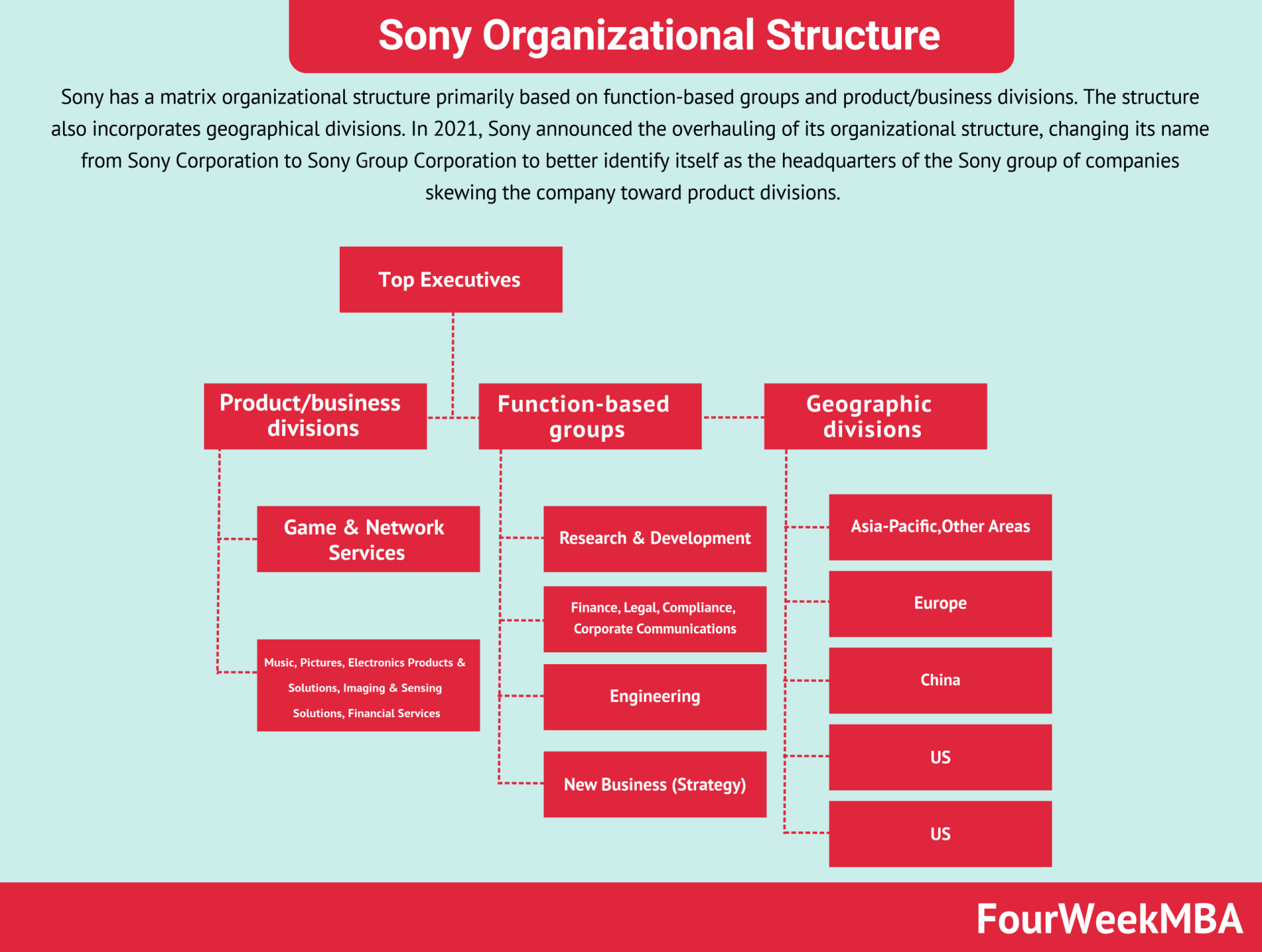
Sony has a matrix organizational structure primarily based on function-based groups and product/business divisions. The structure also incorporates geographical divisions. In 2021, Sony announced the overhauling of its organizational structure, changing its name from Sony Corporation to Sony Group Corporation to better identify itself as the headquarters of the Sony group of companies skewing the company toward product divisions.

Starbucks Organizational Structure

starbucks-organizational-structure
Starbucks follows a matrix organizational structure with a combination of vertical and horizontal structures. It is characterized by multiple, overlapping chains of command and divisions.

Tesla Organizational Structure

tesla-organizational-structure
Tesla is characterized by a functional organizational structure with aspects of a hierarchical structure. Tesla does employ functional centers that cover all business activities, including finance, sales, marketing, technology, engineering, design, and the offices of the CEO and chairperson. Tesla’s headquarters in Austin, Texas, decide the strategic direction of the company, with international operations given little autonomy.

Toyota Organizational Structure

toyota-organizational-structure
Toyota has a divisional organizational structure where business operations are centered around the market, product, and geographic groups. Therefore, Toyota organizes its corporate structure around global hierarchies (most strategic decisions come from Japan’s headquarter), product-based divisions (where the organization is broken down, based on each product line), and geographical divisions (according to the geographical areas under management).

Walmart Organizational Structure

walmart-organizational-structure
Walmart has a hybrid hierarchical-functional organizational structure, otherwise referred to as a matrix structure that combines multiple approaches. On the one hand, Walmart follows a hierarchical structure, where the current CEO Doug McMillon is the only employee without a direct superior, and directives are sent from top-level management. On the other hand, the function-based structure of Walmart is used to categorize employees according to their particular skills and experience.

Main Free Guides: