


Visual Overview
Distribution Channels: Typ Why a distribution cha Types of distribution Distribution channel v Why you need to unders B2B, B2C, and distribu B2B2C distribution str Traditional distributi Distribution managemenKey Components
Why a distribution channel strategy matters
Often companies undervalue distribution channels as they think that a good product or service will automatically create its distribution.
Types of distribution channels
At a higher level, distribution channels can be broken down into direct channels and indirect channels.
Distribution channel vs. supply chain
It is easy to confuse and mix up the definition of distribution channels with the supply chain even though the distribution channels and strategies might sometimes cross with the supply chain.
Why you need to understand the demand chain
Demand chain management is a complex endeavor that involves the relations among suppliers and customers and how those interested in growing the demand for the product or service.
B2B, B2C, and distribution channels
A distribution strategy and therefore, the distribution channels involved will change based on the target customer.
Another form of distribution strategy is a B2B2C , where a brand can leverage existing pipelines to access the market.
Traditional distribution channels vs. digital distribution channels
Over time, to build a sustainable digital strategy, you need to move from third-party to owned distribution, as explained below:
Distribution management: marketing or sales?
Understanding whether distribution management is a matter of sales or marketing is superfluous as it might make us switch the focus from what’s important.
How do you assess the right mix for your distribution strategy?
When building up a distribution strategy, it’s important to balance speed and control.
What is distribution
Distribution is a process of enabling a product or service to be easily accessible to the critical customer and consumer who needs that kind of product and service.
When To Use
▶– Effective for selling complex products or services requiring explanation or demonstration
Real-World Examples
Airbnb Alibaba Amazon Apple Costco Ebay
Quick Answers
What are the why a distribution channel strategy matters?
Often companies undervalue distribution channels as they think that a good product or service will automatically create its distribution.
What are the types of distribution channels?
At a higher level, distribution channels can be broken down into direct channels and indirect channels.
What is Distribution channel vs. supply chain?
It is easy to confuse and mix up the definition of distribution channels with the supply chain even though the distribution channels and strategies might sometimes cross with the supply chain.
Key Insight
Distribution Types Database Why a distribution channel strategy matters Types of distribution channels Case study: Apple’s direct and indirect distribution mix Distribution channel vs. supply chain Case study: Tesla and Google, from physical to digital integration Supply chain vs. demand chain Internal vs. external Process-centric vs.
Exec Package + Claude OS Master Skill | Business Engineer Founding Plan
FourWeekMBA x Business Engineer | Updated 2026
Last Updated: April 2026
Business Model at a Glance
Distribution Channels
Total Revenue: Apple: $391B through multi-channel distribution
Revenue Breakdown
Direct Online (DTC) (30%)
Owned Retail Stores (25%)
Business Model Patterns
Key Facts
Types
Direct, indirect, hybrid
DTC Trend
Brands going direct (Nike 44%)
Digital First
E-commerce now 20%+ of retail
Key Decision
Control vs. reach tradeoff
A distribution channel is the set of steps it takes for a product to get into the hands of the key customer or consumer. Distribution channels can be direct or indirect. Distribution can also be physical or digital, depending on the kind of business and industry.
| Company | Distribution Type | Description |
| Amazon Business Model | Hybrid (direct to consumers + digital marketing growth strategy) | In the case of Amazon, the company is among the most robust tech brands today, and it follows a hybrid strategy, where hundreds of millions of users go straight to the Amazon brand through its website and apps. On the other hand, Amazon also relies on digital distribution to enhance its visibility. For instance, Google search is also a great contributor to traffic for Amazon and many other digital channels. |
| Apple Business Model | Hybrid (direct to consumers + subsidized by mobile carriers) | Apple relies both on its stores and on third-party carriers who enhance the distribution of Apple devices across the world. For instance, when it comes to the iPhone, for example, in 2021, Apple’s net sales through its direct and indirect distribution channels accounted for 36% and 64%. The direct channel (Apple’s owned stores) it’s critical to guarantee brand awareness, control over the distribution, customer support & service provisioning. The indirect channel is essential to enhancing the sales of expensive devices like the iPhone. For instance, a good chunk of iPhone sales is subsidized by phone carriers players, who amortize the cost of the phone into the plan, thus enabling more people to afford an expensive smartphone, like the iPhone. |
| Facebook (Meta) Business Model | Direct to consumer (Digital) | Facebook is a tech player that primarily relies on direct digital distribution. In fact, over the years, the company has managed to first keep a strong brand for its main product (Facebook). After that, Facebook acquired Instagram, WhatsApp, and Oculus. These powerful brands enabled Facebook to get a direct relationship with users. However, it’s worth highlighting that Facebook (Meta) does not own the platform through which users get to the brand (the Apple Store and Google Play). Users can download and experience the brand’s products are owned by Apple and Google, respectively). Thus, its ability to distribute the product is highly reliant on the ability of the company to keep its brand strong. |
| Google (Alphabet) Business Model | Digital Vertical Integration | Google (now called Alphabet) is a great example of digital vertical integration. The company follows each step of the data supply chain, from data harvesting to data repackaging and its exchange within Google’s proprietary advertising marketplaces. On the desktop side, Google owns the Chrome browser, the Google search engine, and the advertising platforms (AdSense, Google Ads, and YouTube Ads) to monetize the data. On the mobile side, Google owns the Android operating system, the Google Play Store, and the Google AdMob advertising platform. In this segment, Google also produced smartphone devices, and it’s now revamping its AR glass business segment. |
| Luxottica Business Model | Phisical Vertical Integration | Luxottica is an excellent example of physical vertical integration and complete control over its distribution strategy. The company not only manufactures most eyeglasses frames and lenses but also distributes them across its owned stores and its wholesale distribution. |
| Tesla Business Model | Direct to consumer (Physical) | Tesla sells its cars directly from its online stores, distributing them directly to customers. The company also owns Tesla physical stores worldwide, where customers can buy cars directly from them. The company has been spending a substantial effort in building its own stores to bypass classic car distributors, which has been a rule of thumb for a long time. |
Often companies undervalue distribution channels as they think that a good product or service will automatically create its distribution.
While this might happen, it is more of a utopia than a reality.
Distribution needs to be created, at times with sheer force combined with strategic planning and a deep understanding of customers’ needs or desire generation.
A traditional distribution strategy looks at the classic 4 Ps (product, promotion, price, and placement).
Those are the key ingredients to growing the revenues of a business, quickly and sustainably. Thus, a distribution strategy starts from:
Without an appropriate strategy for distribution, it is hard to have a successful and sustainable business model.
At a higher level, distribution channels can be broken down into direct channels and indirect channels.
This primarily depends on how long is the chain between who makes the product and the final consumer.
The number of steps it takes will make the distribution channel direct or indirect.
Let’s visualize a distribution chain to understand the difference between direct and indirect strategy:

Where in a direct distribution strategy a producer can access the consumer, in an indirect distribution strategy, the producer will meet its consumer demands via third-parties wholesalers or retailers.
Thus, a direct approach makes the value chain shorter and at the same time allows more control by the producer on how the final customer experiences the product or service offered.
At the same time, a direct-to-consumer strategy is quite expensive and not always effective enough to allow proper distribution.
Therefore, companies often use a mixture of direct and indirect distribution strategies, which determine their marketing mix.

Between the direct-to-consumer and entirely indirect distribution strategy (where the producer sells to a wholesaler), there are several indirect variations based on how many steps it takes to reach the final consumer and how long is the value chain.
For instance, in the scenarios in which a producer sells to a wholesaler, the wholesaler sells to retailers, who reach the final consumers.
However, in some other cases, the distribution channels might be shorter.
Think of the Costco business model, where the company purchases a selected variety of goods in bulk from producers.

Yet instead of reselling that to retailers, Costco itself acts as a retailer by leveraging its membership-based business model and selling those items in bulk quantity directly to consumers, who appreciate the convenience of its prices together with the selection of high-quality products.
In other cases yet, the distribution channels strategy might be even shorter. Take the example of the Apple business model, where the company sells part of its products via its retail stores.
That creates a unique experience for Apple‘s consumers and makes the value chain shorter but it also leverages an indirect strategy to make those same products (usually quite expensive) more accessible to mass consumers.

Related: Successful Types of Business Models You Need to Know

It is easy to confuse and mix up the definition of distribution channels with the supply chain even though the distribution channels and strategies might sometimes cross with the supply chain.
The distribution strategy concerns primarily with bringing the product in front of customers, especially customers that are willing and ready to buy it.
Therefore, in some cases, bringing a product in front of the right people might be a matter for the supply chain.
For instance, in the Luxottica business model, vertical integration means the ability to control the full customer experience and to choose also the location of the retail stores.

Thus, this is a case in which supply chain management also becomes a distribution strategy. That is why, other players, in the same space, try to enter by using, initially, an opposite strategy.
That of owning only part of the supply chain.

It is critical to maintain a clear difference between supply chain and distribution channel strategy.
While the supply chain comprises all the planning, manufacturing, and logistics activities that make the product go from the purchase of raw materials to transformation into a final product that might get delivered to the final customer (Zara business model leverages supply chain management as a distribution strategy).
In short, where supply chain management concerns itself with integrating supply and demand, a distribution strategy involves itself primarily in the demand chain.
To have a deep understanding of the difference between the supply chain and distribution strategy it is important to consider three main aspects.


Where a supply chain seeks efficiencies that can, for instance, reduce the cost of purchasing raw materials, integrate several parts of the supply chain, or at creating better logistics.
Distribution channels and strategies look more at creating demand for a product or service by leveraging several strategies.
For instance, having insight into potential customers can allow a company to generate demand via distribution and marketing, just like in the Nike business model.

A supply chain relates to all the aspects that begin with sourcing raw materials, production processes, inventory management, and all the other processes that bring a product or service in front of the final customer.
On the other hand, a distribution strategy primarily concerns the demand chain. Therefore, the difference is primarily internal vs. external.
The supply chain affects costs and how to reduce them via efficiencies.
Distribution channels and strategies look at how to grow the demand. Thus, increasing revenues for the business.
This distinction is not absolute. As in some cases when a core competence of a company is its supply chain management, then that also becomes a distribution strategy, just like in the Amazon business model case study.

Via efficient inventory management, Amazon can keep large facilities where most tasks are automated.
This allows Amazon to host third-party inventories of sellers that are part of the Amazon network.
That in turn, makes Amazon stores more interesting for final customers as they can find more products they need, they can get them faster, and purchase them in a bundle.
In this case, the Amazon supply chain strategy in part crosses with its distribution strategy.
Where the supply chain is often process-centric.
In short, it wants to improve efficiency, reduce steps among several parts of the chain, and make the process as smooth as possible. Distribution channels and strategies focus on the customer.
Where is the customer? How do we get more of them? Is that a matter of price? Value or product?
A distribution strategy is obsessed with customers.
Once again, this is a rough distinction as, in some cases, companies have a customer-centric approach at any company level.
That’s what Jeff Bezos means when he says that successful companies need to stay in “Day One.“

Demand chain management is a complex endeavor that involves the relations among suppliers and customers and how those interested in growing the demand for the product or service.
At the core, it is about designing a business model that allows the organization to meet customer needs and create desire and demand with an existing supply chain.
Thus, the demand chain is the value chain from your customers’ perspective.
This implies synergies between the supply chain and distribution and marketing to design a business model that delivers the most suited value proposition and generates higher revenues for the business.

It is almost like demand chain management allows supply chain management to look outside the company’s boundaries and understand the market.
Therefore, demand management will primarily understand, generate, and stimulate customer demand and align the supply chain processes with that.
A proper distribution strategy focuses on understanding the supply and value chain to design a sustainable business model, where, for instance:

A distribution strategy and therefore, the distribution channels involved will change based on the target customer.
Indeed, selling to a business clientele is not the same thing as selling to consumers.
This implies different capabilities and distribution strategies.
For instance, a B2B (business-to-business) distribution strategy might be shorter, as you can directly reach the businesses that will act as intermediaries between you and the final consumer.
Think of the case of a company selling software as a service (so-called SaaS). If that software is complex and requires a certain degree of expertise, it will be better suited to be sold via other agencies and third parties, which in turn will have access to the consumer business.
This will imply a distribution strategy focused on acquiring the proper sales force to manage the more complex clients.
On the other hand, if a company sells an app for the iPhone which doesn’t require any particular expertise from the final user.
The company will have direct access to its consumers and will use marketing channels which don’t necessarily require a complex salesforce.
This is a critical difference between marketing and sales.


Another form of distribution strategy is a B2B2C, where a brand can leverage existing pipelines to access the market.
In this case, the B2B2C strategy to work has to enable the brand to be known by a larger customer base or audience while it leverages existing players with an established distribution platform.
That is how you can structure your company’s strategy around a B2B2C business model.

Over time, to build a sustainable digital strategy, you need to move from third-party to owned distribution, as explained below:
As consumer behaviors had swiftly changed in the last decades, more and more people purchase via the internet, and they feel more and more comfortable buying expensive items on the web.

For instance, Tesla allows you to order a $65K car directly on its site.
Therefore, digital distribution strategies are critical for any business, also one that has always operated offline.
As explained by Gabriel Weinberg, CEO, and founder of DuckDuckGo, there are at least 19 distribution channels between online and off-line:
Each of those channels can be a critical ingredient to enhance the revenues of a business.
What matters is to experiment, according to the Bullseye Framework:

Related: Growth Marketing Strategies For Your Online Business
Understanding whether distribution management is a matter of sales or marketing is superfluous as it might make us switch the focus from what’s important.
However, it makes sense to draw some lines as this allows proper attribution of responsibility and accountability across the departments of an organization.
Thus, distribution management is typically seen as a marketing function. Yet, once again it depends on the kind of organization you’re running.
Imagine the case of a company that sells to wholesalers or retailers; this means most of the contracts might be managed by salespeople, as they require an understanding of deal terms, relationships, and partnerships in place.
In that case, your salesforce will be able to give you insights that can help you improve the distribution strategy.
In the opposite scenario, where the company sells a product directly to consumers, most of the processes might be automated. Thus, most of the insights will be in the hands of the marketing department.

When building up a distribution strategy, it’s important to balance speed and control.
And to leverage those channels that can give momentum to the business.
Yet also, in the long-term prioritize those channels that make the company viable and its business model solid.
At any time, businesses can leverage open and closed strategies to enhance and create ecosystems that enable the business to thrive.
In short, companies like Google, Amazon, GitHub, Uber, Airbnb, Twitter, Facebook, LinkedIn and many others that we discussed in this blog while growing managed to create parallel ecosystems of developers, publishers, small businesses, entrepreneurs, and users that are really the base and foundation for those companies business model success.
In short, the turnover those companies make is just the tip of the iceberg of an ecosystem, which is often hard to control.
The Internet, enabled ways for these organizations to involve thousands of publishers, developers, and users, where an organization, generating profits, built a strong distribution platform, thus making it compelling to other key players to participate in the growth of the ecosystem.
At the center of those open, and uncontrollable ecosystems, there is a strong distribution network, controlled by the organization in charge of the platform, that is able to monetize the ecosystem.
Thus, the distribution network is, in many cases, among the most valuable assets a company has in the long run.
Even if that’s expensive to develop, a distribution network is always worth it, because that is how you build a business you can control and a platform where you make the rules of the game.
This is the essence of business platforms!

To finish this up, how can you plan an entry strategy based on the distribution context in which we’re operating?
| Distribution Channel | Description | Implications |
|---|---|---|
| Direct Sales | Companies sell their products or services directly to customers without intermediaries, often through company-owned stores, websites, or sales teams. | – Allows for direct control over the customer experience. – Enables personalized customer interactions. – Higher profit margins due to no middlemen. – Requires significant sales and marketing efforts. |
| Retail Distribution | Products are sold through physical retail stores, which can be owned and operated by the manufacturer (company-owned stores) or by independent retailers (third-party retailers). | – Expands market reach and visibility through various retail locations. – Relies on intermediaries to handle inventory and distribution. – Requires negotiation and partnerships with retailers. |
| E-commerce | Sales occur through online platforms or websites, allowing customers to browse and purchase products or services electronically. | – Offers convenience and a global reach. – Lowers operational costs compared to physical stores. – Requires effective online marketing and a user-friendly website. |
| Wholesale Distribution | Companies sell products in bulk to wholesalers or distributors, who then sell them to retailers or other businesses. | – Efficient way to reach a broad network of retailers. – Reduces the need for direct customer engagement. – Requires negotiations and relationships with wholesalers and distributors. |
| Direct-to-Consumer (DTC) | Companies sell products directly to consumers through their websites or specialized DTC channels, bypassing traditional retail intermediaries. | – Offers full control over the customer experience and pricing. – Provides valuable customer data for personalized marketing. – Requires effective online marketing and customer support. |
| Franchise Distribution | Businesses grant individuals or entities the right to operate a business using their brand, products, or services in exchange for fees or royalties. | – Expands the brand’s reach rapidly with minimal investment. – Requires stringent franchise agreements and support. – Maintains brand consistency across franchise locations. |
| Agent or Broker | Independent sales agents or brokers are used to represent a company’s products or services in specific regions or markets, earning commissions on sales. | – Provides market expertise and access to local markets. – Lowers the cost of maintaining a direct sales force. – Requires managing and compensating agents or brokers effectively. |
| Online Marketplaces | Companies list and sell their products on third-party online marketplaces, such as Amazon, eBay, or Alibaba, reaching a large customer base without managing their own e-commerce platforms. | – Access to a massive customer base and global market. – Exposure to competition and marketplace fees. – Relinquishing some control over branding and customer experience. |
| Telecommerce | Sales are conducted through phone calls, telemarketing, or interactive voice response (IVR) systems, allowing companies to reach and engage customers via phone. | – Effective for selling complex products or services requiring explanation or demonstration. – Requires trained telemarketing staff and effective lead generation. – May face challenges due to call volume and regulations. |
| Subscription Services | Companies offer subscription-based models where customers pay a recurring fee to access products, services, or content regularly. | – Provides recurring revenue and predictable cash flow. – Encourages customer loyalty and retention. – Requires delivering ongoing value and managing subscription billing effectively. |
| Catalog and Direct Mail | Companies distribute printed catalogs or direct mail materials to potential customers’ homes, allowing them to browse and order products by mail or phone. | – Targets specific demographics or customer segments through mailings. – May require significant design, printing, and mailing costs. – Effectiveness varies based on audience and product. |
| Trade Shows and Events | Companies participate in trade shows, industry exhibitions, or events to showcase products, network with potential clients, and generate leads. | – Offers direct access to a concentrated audience of industry professionals. – Requires booth design, event logistics, and effective follow-up. – Success hinges on effective event strategy and presentation. |
| Affiliate Marketing | Companies partner with affiliates or third-party marketers who promote their products or services to their own audiences in exchange for commissions on sales or leads. | – Expands the reach and marketing efforts through affiliate networks. – Incentivizes affiliates to drive traffic and conversions. – Requires tracking and managing affiliate relationships and commissions. |
| International Distributors | Companies collaborate with local distributors or partners in foreign markets to sell and distribute products or services internationally. | – Enables market entry and expansion into foreign regions. – Requires understanding of local regulations, logistics, and cultural considerations. – Involves negotiation and partnership with international distributors. |
| Online Advertising | Companies leverage online advertising platforms such as Google Ads, Facebook Ads, or display advertising networks to reach target audiences with targeted ads and promotions. | – Allows precise targeting based on user behavior and demographics. – Provides measurable results and ROI tracking. – Requires ongoing optimization and budget management. |
| Multi-level Marketing (MLM) | Businesses recruit individuals as distributors who not only sell products but also recruit others to become distributors, creating a hierarchical sales structure with commission structures. | – Rapid expansion through a network of distributors. – Offers potential for high earnings for top-level distributors. – Faces legal and ethical considerations regarding pyramid schemes. |
| Convenience Stores | Products are distributed through convenience stores, which are small, easily accessible retail outlets that offer a limited selection of goods, often in high-traffic locations. | – Provides convenient access to products for consumers on the go. – Requires efficient supply chain management to keep stores stocked. – Products should have broad appeal for convenience store shoppers. |
| Manufacturer’s Representatives | Independent sales representatives or agencies are contracted to sell a manufacturer’s products to distributors, wholesalers, or retailers on behalf of the manufacturer. | – Provides specialized sales expertise and connections within the industry. – Reduces the need for a dedicated in-house sales team. – Requires clear agreements and communication with representatives. |
| Pop-up Shops | Temporary retail spaces are set up to showcase products, generate buzz, and engage with customers for a limited time. | – Creates a sense of urgency and excitement around the brand or product. – Allows for experimentation in different physical locations. – Requires planning, promotion, and design of the pop-up shop. |
| Vending Machines | Products are sold through vending machines placed in high-traffic areas such as airports, office buildings, or public spaces. | – Offers 24/7 access to products in convenient locations. – Reduces the need for staffing and operating hours. – Requires maintenance and restocking of vending machines. |
| Affiliate Networks | Companies join affiliate networks or programs that connect them with a network of affiliates willing to promote their products or services in exchange for commissions. | – Access to a broader pool of potential affiliates with various audiences. – Simplifies tracking and management of affiliate relationships. – Involves network fees or commissions. |
| Mobile Apps and In-App Purchases | Companies distribute products or services through mobile apps and offer in-app purchases or subscriptions to enhance user experiences or access premium features. | – Monetizes mobile apps and maximizes revenue potential. – Encourages user engagement and retention. – Requires effective app marketing and user experience design. |
Distribution is a process of enabling a product or service to be easily accessible to the critical customer and consumer who needs that kind of product and service. Usually, distribution channels can be direct or indirect depending on the distribution strategy adopted by an organization to grow its profits.
In a direct distribution model, a company can get its products directly into the hands of consumers without passing through an intermediary. Think of the case of a company like Apple, which sells its iPhones directly through its owned store thus reaching its key customers.
In an indirect distribution model, a company can get its products into the hands of the final customers, only passing through an intermediary. Think of the case of a company that manufactures a product that then gets sold by a third-party retailer. Thus the company can’t reach its customers directly.


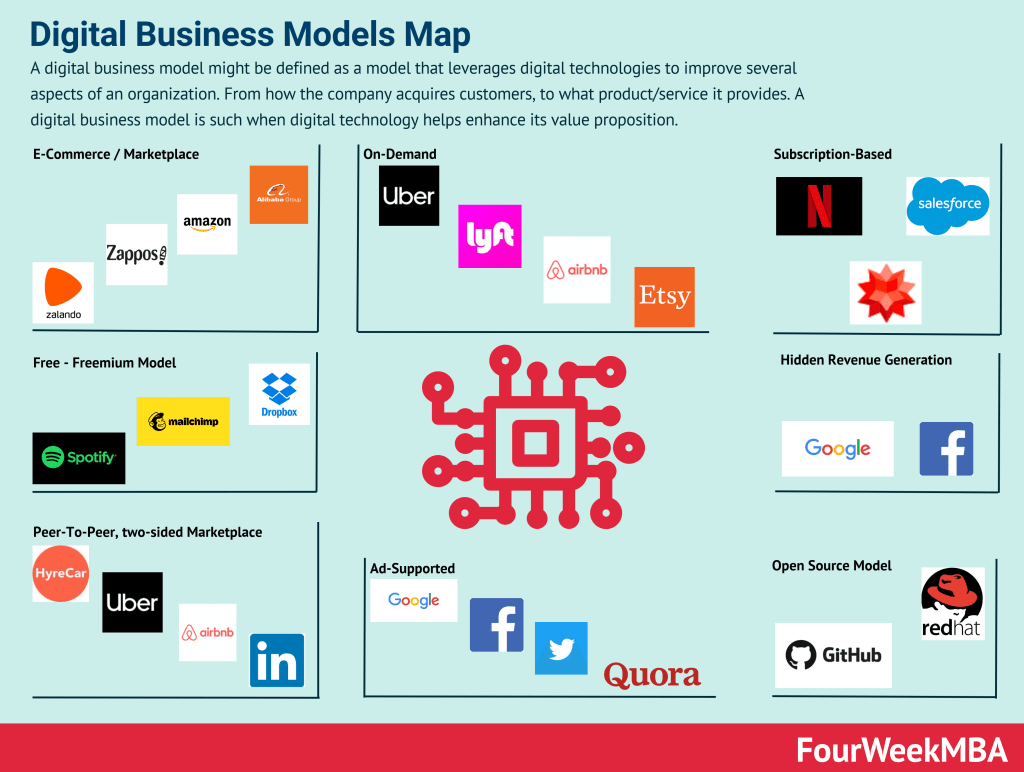


Attention Merchant Business Model


Main Free Guides:
The key components of Distribution Channels: Types, And Examples – Updated 2026 include Company, Amazon Business Model, Apple Business Model, Facebook (Meta) Business Model, Google (Alphabet) Business Model. Company: Distribution Type Amazon Business Model: Hybrid (direct to consumers + digital marketing growth strategy)
Distribution Types Database Why a distribution channel strategy matters Types of distribution channels Case study: Apple’s direct and indirect distribution mix Distribution channel vs. supply chain Case study: Tesla and Google, from physical to digital integration Supply chain vs. demand chain Internal vs. external Process-centric vs.
Distribution needs to be created, at times with sheer force combined with strategic planning and a deep understanding of customers’ needs or desire generation.
A traditional distribution strategy looks at the classic 4 Ps (product, promotion, price, and placement).
此内容由惯性聚合(RSS阅读器)自动聚合整理,仅供阅读参考。 原文来自 — 版权归原作者所有。